


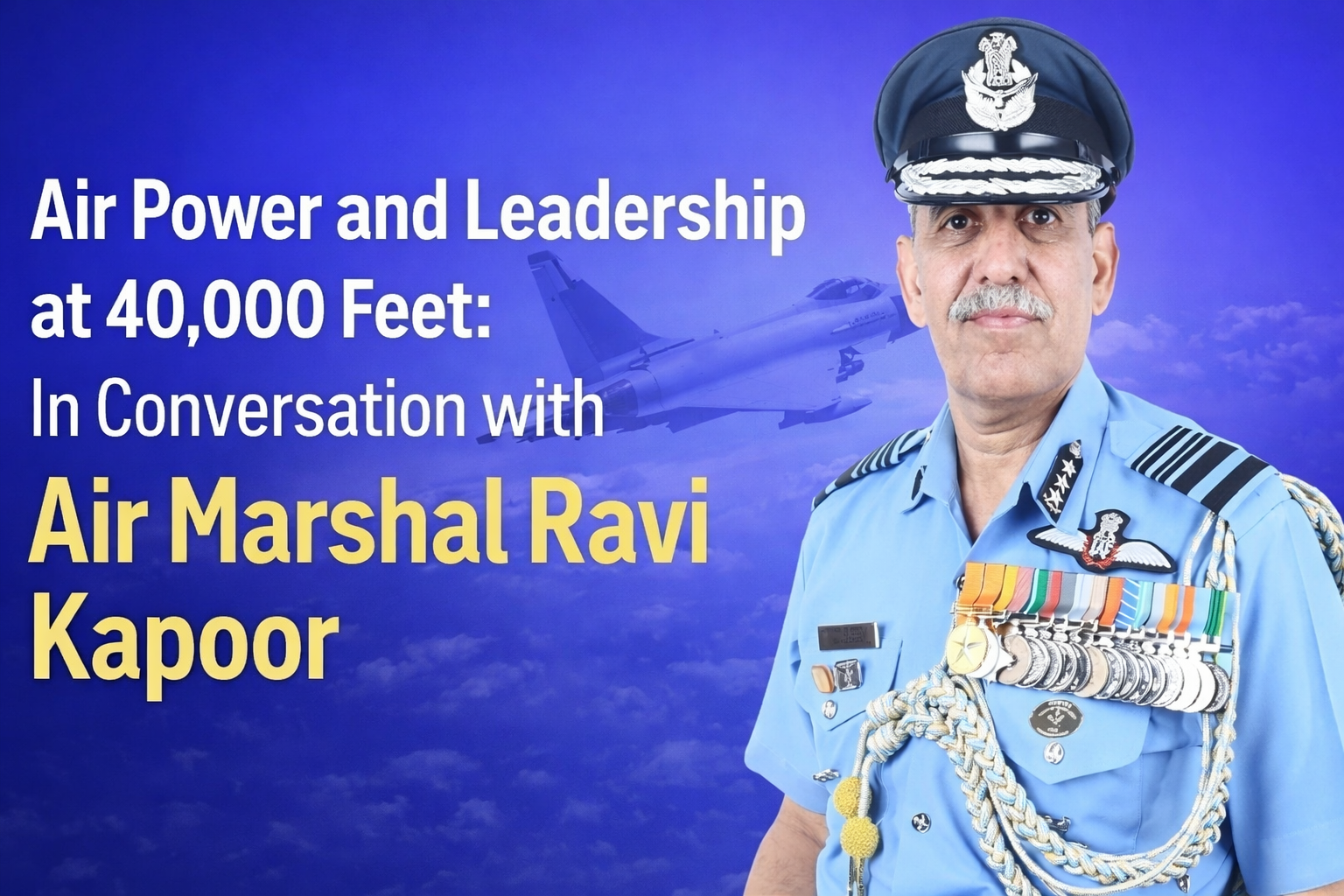
In today’s shifting security landscape, air power is no longer just a tactical asset — it is a strategic lever shaping deterrence, regional balance and military doctrine. From high-performance fighter jets to unarmed surveillance and transport aircraft operating in contested airspace, the modern pilot’s role extends far beyond technical proficiency. It demands split-second judgment, ethical discipline and a deep awareness of global power dynamics.
Few have witnessed this evolution as closely as Air Marshal Ravi Kapoor, Former Air Officer Commanding-in-Chief of Central Air Command, Indian Air Force. Over a distinguished career spanning decades, he has observed first-hand the transformation of air warfare — from conventional dominance to network-centric operations, advanced systems integration and increasingly complex non-combat missions.
In conversation with Danish Shaikh, Editor at The International Wire, Air Marshal Kapoor reflects on leadership at altitude, the psychology of fighter and transport pilots alike, the often-overlooked courage of those flying unarmed aircraft, and the future of manned aviation in an AI-driven era. At 40,000 feet, he argues, technology matters — but leadership remains decisive.
Leadership & Strategic Thought
Looking back on your decades of service, how would you define strategic leadership in the air domain today?
Strategic leadership in air domain is no longer awareness about air, one has to be familiar with technology and all domains of warfare with special emphasis on Cyber and Space since they are major enablers for aerospace operations. The technology landscape is changing rapidly this demands faster decision making not only in operations but more so in technologies shaping warfare so procurement and perspective planning for force modernisation gain tremendous importance. Another issue is of the reach of air power, air power with all force multipliers and other domains can be projected well beyond our borders both in kinetic and non-kinetic operations, this requires deep understanding of Geo-politics and Geo-Strategy. Warfare is now a whole of nation and whole of government approach demanding inter agency networks and understanding of air power by other agencies, the leadership needs to invest in this area too.
Changing character of war demands that we prepare for future wars and not train for the last one. Middle East and Ukraine wars have brought out the importance of disruptive technologies and innovation in air domain. There is a constant debate on manned and unmanned platforms, both have their relevance and importance the issue is how both can be effectively used to create desired effects through the medium of air, this needs to be clearly understood and articulated.
The world is moving from Multi Domain Operations to Joint All Domain Operations. Major focus area is on creation and integration of networks, platforms, weapons systems and though process at all levels from tactical to strategic among the war fighters from all services. Decision making and Command and control are two other areas which need training, exposure and understanding among the strategic leadership. For this grooming, selecting and training prospective leadership is imperative with special emphasis on understanding technology and capability for the manpower to absorb this rapidly evolving technology.
Lastly, force transformation and long term vision will determine the force readiness for a future fight in the domain. It is therefore important to develop the ability to foresee opportunities and impediments to identify ensure progressive capability building.
How has air power evolved from being a tactical instrument to a strategic determinant in modern conflicts?
Air domain has evolved the fastest among the three contemporary domains, this is primarily due to the fact that air power is most technologically intensive and is effected by technological change the most. While its tenets and characteristics have remained unchanged, its ability to create impact has rapidly expanded thanks to technological evolution. From observation and directing fires in WW I as tactical roles with effects in immediate battle field through strategic bombing campaign and nuclear bombing in WW II to coercing a request for cessation of operations in Op Sindoor as a strategic effect the use of air power has evolved as an instrument of choice for the national leaderships across the world.
Air power evolved from being a supporting arm to the Army to an independent instrument in national security matrix because of its characteristics. From forcing surrender in East Pakistan after the rocket attack on Governor house in Dhaka in 1971 India-Pakistan war, to devastation of Iraqi forces in Gulf war, hastening Pakistani withdrawal in Op Safed Sagar/Vijay in Kargil in 1999, Ukraine drone strikes against Russian strategic bomber bases in the ongoing Ukraine-Russia war, Operation Absolute Resolve leading to capture of Venezuelan President, air power has progressively altered the course of conflict through strategic effects.
Long range precision strikes, Multi layered Air Defence, Electronic warfare, unmanned systems, force multipliers and stealth combine to provide deep penetration, air denial and air dominance which act as strategic determinants in modern conflicts, with network centric operations providing decision superiority and space and cyber supporting complex kill webs.
In an era of hybrid warfare and cyber capabilities, where does air superiority stand?
Air superiority is defined as degree of control of air where one side holds sufficient control of the air to conduct operations without significant, prohibitive interference from enemy air forces. While air superiority is difficult to achieve in a near peer conflict however, it remains a goal for any air force to achieve for undertaking own air operations.
Hybrid warfare is a combination of sub-conventional, non-kinetic, irregular, cyber and information warfare undertaken under the direct control of conventional forces. Air superiority in such environment provides a strong deterrent against any escalation, it creates favourable conditions for real time ISR and consequent dynamic targeting without collateral damage as was witnessed during Operation Sindoor and Operation Midnight Hammer. Good Electronic Warfare capabilities and enabling technologies would ensure air operations continue without interference form the adversary. Air superiority creates favourable environment against any disinformation campaign since the effects created by own air power can be unequivocally communicated to the world.
Many argue that future wars will be fought in space and cyberspace — how central will traditional air power remain?
Space and Cyber space are enablers, while they will be extensively used in the future conflicts the primacy of air power in creating desired effects at all levels would continue. Air power with its inherent characteristics of reach, offensive action, flexibility, responsiveness and lethality will remain relevant since destruction of enemy capability would remain the most important objective. Also, use of offensive air power in form of long range precision strikes and offensive air defence would be an integral part of a high intensity multi domain operations which can address s=adversary’s command and control to reduce their ability to use space and cyber since both space and cyber are the enablers for decision making and C2. All traditional air power roles hence would remain relevant in conventional wars.
What is the single biggest misconception civilians have about air warfare?
Most uninitiated civilians have numerous misconceptions about air warfare. They consider air warfare to be destructive and escalatory with high chances of civilian casualties, which is farthest from the truth in the age of long range precision weapons which minimise collateral damage, a case in point is Op Sindoor in which the terror infrastructure was destroyed without any civilian casualty or damage to nearby installations. In fact it is missile campaigns which cause larger collateral damage due to associated accuracy issues.
Civilians also feel that air power alone cannot be a deciding factor in a conflict. This is true when the fight is for territory as is the case in Russia-Ukraine war or Israeli operations in Gaza where ground forces have been involved. Air power can cause collateral damage especially when used in urban terrain against sub conventional threat.
Civilians visualise air warfare as Top Gun close combat, being expansively showcased in movies, which is farthest from the truth. Modern technology has enabled non-contact warfare using long range precision weapons where the aircraft delivering weapons is not seen. Also the air engagements have shifted to Beyond Visual Range air to air missile engagements and stealth which rarely end up in dogfights.
Lastly, many civilians are increasingly of the view that unmanned systems will replace manned fighters. While unmanned systems are becoming increasingly useful for many roles and tasks, however, the autonomy and capability has not reached a stage where they can replace manned fighters since human intelligence is still better than artificial intelligence in unstructured air threat environment.
The Pilot’s Mindset
A soldier often says his weapon must become an extension of his body. For a pilot, what becomes that extension — the aircraft, the system, the training, or the mindset?
The pilot is trained to become an extension of aircraft capability and his innovativeness in how he uses the capability of his machine against the adversary. So it is combination of his training, knowledge, skills and in today’s world how well can he / she utilise the aircraft systems and weapons to achieve victory over the adversary.
What distinguishes a fighter pilot psychologically from other military professionals?
Fighter pilots are distinct from other military professionals. Qualities like controlled aggression, thinking on their feet, split second decision making, risk taking and remaining calm under stressful situations and high emotional stability sets them apart from other military professionals.
How do pilots balance aggression with restraint, especially in high-stakes situations?
High stakes situations demand highest level of emotional stability and quick thinking rather than recklessness, this comes from years of intense training and progressive development of knowledge and skills. Controlled restraint creates opportunities and allows wholesome decision making since high stakes situations are winning or losing.
In combat aviation, how important is instinct versus procedure?
Instinct is something innate which comes from subconscious whereas procedure is learned through training and self-learning. Knowledge of procedures produces consistent results while instincts can lead to a favourable or unfavourable outcome. Combat aviation involves clear thinking and quick assessment of situation before reacting hence instincts could be useful sometime but adherence to procedures would produce consistent outcomes.
What does situational awareness truly mean inside a cockpit at Mach speed?
In today’s air situation it is not speed but assessment and analysis of large data and complex air situation is important to retain situational awareness. Ability to assess threats and opportunities and grasp a rapidly evolving air situation are extremely important for situational awareness to take timely and correct decision.
Unarmed Aircraft and Their Pilots
Fighter pilots are often seen as the face of air power. Yet unarmed aircraft — transport, surveillance, reconnaissance — carry immense strategic weight. How do you view their role?
Air power is sum total of all resources and therefore every platform and system have an important role in the overall scheme of things or campaign plan. Targeting is the primary function of air power for which ISR is imperative so all aerial platforms whether manned or unmanned are important for ISR and electronic warfare roles. Combat support functions including rapid troop movement and resupply are undertaken by transport and helicopter fleets. India is a large country and faces two adversaries, troops were redeployed rapidly during eastern Ladakh crisis using strategic transport aircraft and resupplied using helicopters in difficult Himalayan terrain both in the north and eastern part of the country. Therefore, while fighter pilots are seen as face of air power, the numerous air power roles are performed by others without which long term effects cannot be sustained.
Do pilots of transport or humanitarian missions experience a different form of operational stress compared to combat aviators?
Transport and helicopter pilots undertaking humanitarian and disaster relief missions do experience stress arising primarily from uncertainty and rapidly changing situation. It is not a set piece one is used to and often the pilots could deal with situation like rescuing people from rooftops in a flooded river late in the evening. Evacuating our personnel from conflict torn countries like Lebanon, Ukraine, Iraq and Afghanistan proves the competence of our pilots and stringent training, rules and procedures to ensure safety of the aircraft and its occupants. There is hardly any time for preparation under such circumstances so decisions have to be delegated to the crew on the scene. All these factors creates different form of operational stress and demand high level of professionalism, discipline, ability to be innovative, understand limits of human capability and that of the machine and finally decision making under very challenging conditions.
Global Security & Air Power
With growing tensions in multiple regions — from Eastern Europe to the Indo-Pacific — how is air doctrine adapting globally?
Air power doctrine and technological evolution interact closely as has been the experience since WW II. The technological advancement has accelerated in recent years with evolution of unmanned systems, Artificial Intelligence, Robotics, Immersive technologies, Additive manufacturing and so on. This process is likely to accelerate with quantum computing, quantum sensing, Quantum Key Distribution and Post Quantum Cryptography. Technological advancements have been largely responsible for net centric operations leading to multi domain operations. Development of space and cyber domain provide non kinetic effects which were earlier difficult to achieve.
Air power being technologically intensive is shaped by technological changes. So the most profound impact has been adapting net centric operations under a multi domain construct integrating effects of air, land, sea, space and cyber. Op Sindoor was an example of doctrinal adaptation using unmanned systems alongside manned systems to create multi-dimensional effects.
The air forces must therefore, alter their force structure, operational concepts and training with emerging technologies only once they are proven for operational use.
How do you assess the changing balance between manned aircraft and drones worldwide?
Enhancements in Beyond Visual Range missile technology and quality of sensors has led to an increased zone of ambiguity where it has become difficult for manned fighters to operate without risk. This zone currently extends to around 200 kms which is the range of BVR missiles like PL-15, Meteor, Astra 2, R-37, AAM-4B and AIM-260. Additionally, the Air Defence is getting more lethal and Long range systems like the S-400 act as instruments of air denial. Operating a manned fighter in such environment is getting more and more difficult. The way to use this zone of ambiguity is through innovative use of technology like better stealth and resilient unmanned systems.
The debate whether the unmanned systems can replace manned systems has been going on for some time now and is likely to accelerate as the pace of autonomy increases and fully autonomous systems become a reality. However, that is some distance off since fully autonomous systems require human level intelligence.
Currently AI/ ML excels at processing large datasets for immediate decisions, human intelligence provides context, ethics, and nuanced judgment that machines currently lack. As the technology matures the percentage of unmanned autonomous systems is likely to increase to take on more operational lethal roles. So the process is likely to be a progression from semi-autonomous systems which are directed by humans like the manned unmanned teaming or loyal wingmen to fully autonomous systems which will combine with reducing manned intervention in the future. Manned fighters would therefore remain relevant in the foreseeable future which is the reason for all sixth generation fighters to be developed as manned systems with an unmanned option in the future.
Are we moving toward a future where artificial intelligence plays a decisive role in air combat decision-making?
Net centric operations involve diverse systems, platforms and organisations talking to each other in real time. This means huge information flow which is likely to reach limits of human cognition. The decision making under such circumstances can only be supported by machines which have the capability of processing this information in milli or micro seconds. A fighter pilot in the cockpit of a commander in the operations room analyse the available information to take a decision using the OODA loop. AI/ ML will therefore play a decisive role in every aspect of air combat decision making from ISR to targeting and decision making at operational and strategic levels.
How important is multinational air cooperation in maintaining regional stability?
Multi-national cooperation is extremely important as most nations operate contemporary aircraft and weapon systems which allow a better understanding of strengths and weakness of participants which enhances transparency of capability of the Air Force in a multi-national setting. A well trained and outcome oriented Air Force is recognised for its professionalism and readiness which enhances regional stability.
What lessons should emerging air forces learn from global conflicts over the past two decades
We are in an era of Multi Domain Operations and non-contact warfare. Importance of long range precision strike and multi layered Air Defence have been reemphasised in a net centric environment. Integrated operations and use of space, cyber and EW needs to be factored into training and exercises with an evolving force structure that meets the capability and capacity requirements of the future. Air Forces need to be prepared for both short and intense wars or long drawn conflicts depending on the adversary and support they receive.
Changing character of war impacted by rapid technological changes demands that the leadership must be technologically savvy and must be able to project technological requirements into the future with a keen eye for innovation and application of technologies available in civil domain for military applications.
Ethics, Technology & Responsibility
How should air forces prepare for the increasing public scrutiny that comes with modern warfare?
In the age of social media and information transparency it is important for the Air Forces to be agile in information warfare and strategic communication. Increased reliability and accuracy of weapons would reduce chances of collateral damage and enhance the image of the Air Force. Op Sindoor was an example where the IAF provided proof of successful strikes on terror infrastructure and other targets which proved credibility of the IAF’s ability to strike accurately.
In a world of real-time media, does the psychological pressure on pilots differ from previous generations?
The aircrew are trained to perform their mission in a professional manner which involves intense preparation and planning. Once the pilot is on a mission, the only objective is to achieve mission objectives. The leadership is trained to assume the responsibility of the overall campaign. This ensures that the pilots do not have any psychological pressure since the objectives and rules of engagement are clearly laid down.
What responsibility does military leadership bear in shaping not just capability, but character?
It is the job of leadership to provide capability to its men in blue and institute a robust mechanism of training to build character for its airmen to be able to absorb and employ this capability in any operations anywhere in the world. This is done through regular reviews and iterations to ensure the capability remains relevant for future conflicts anywhere.
After retirement, how do you reflect on the evolution of air power — with pride, caution, or both?
Air power has undergone extraordinary evolution. In fact the technological and operational evolution has been the fastest in air domain and recent conflicts provide an insight into the growing importance of air power as an instrument of choice in any future conflict. The rapid changes in technological landscape gives me confidence that the primacy of air power would be maintained in foreseeable future. I reflect on this journey with pride and great deal of satisfaction and with the confidence for a bright future.
Rapid Fire
Air power in one word?
Offensive
Instinct or training?
Training
Most underestimated role in the Air Force?
Logistics and supply chain management
Drone or fighter jet?
Both
Discipline or innovation?
Innovation with Discipline
Mach speed or silent surveillance?
See first and Shoot first
Leadership: authority or influence?
Leadership
The cockpit teaches you what about life?
Humility
One quality every pilot must have?
Ability to think on your feet
The future of global air warfare, controlled or chaotic?
Controlled chaos

Air Marshal RGK Kapoor PVSM, AVSM, VM (Retd) has over 5000 hours of flying experience on various fighter aircraft of the Indian Air Force. He has handled myriad tasks like operations, training, personnel, intelligence, cyber and media and public relations. He has commanded a fighter squadron, a UN mission in Congo and a fighter base. He was the Air and Defence Attaché at embassy of India in USA.
He has been the Deputy Commander-in-Chief of Strategic Forces Command and was Air Officer Commanding-in-Chief of Central Air Command prior to superannuating from the IAF. He was the IAF spokesperson during the Balakot strike and handled Intelligence at Air HQ during Eastern Ladakh standoff. He has been writing articles on air power, military aviation and Geo-strategy. He also participates in podcasts on military issues. In his spare time, he mentors’ people who are keen to delve into defence industry.
Read Also: Sanctions, Security and the Future of Counterterrorism


