


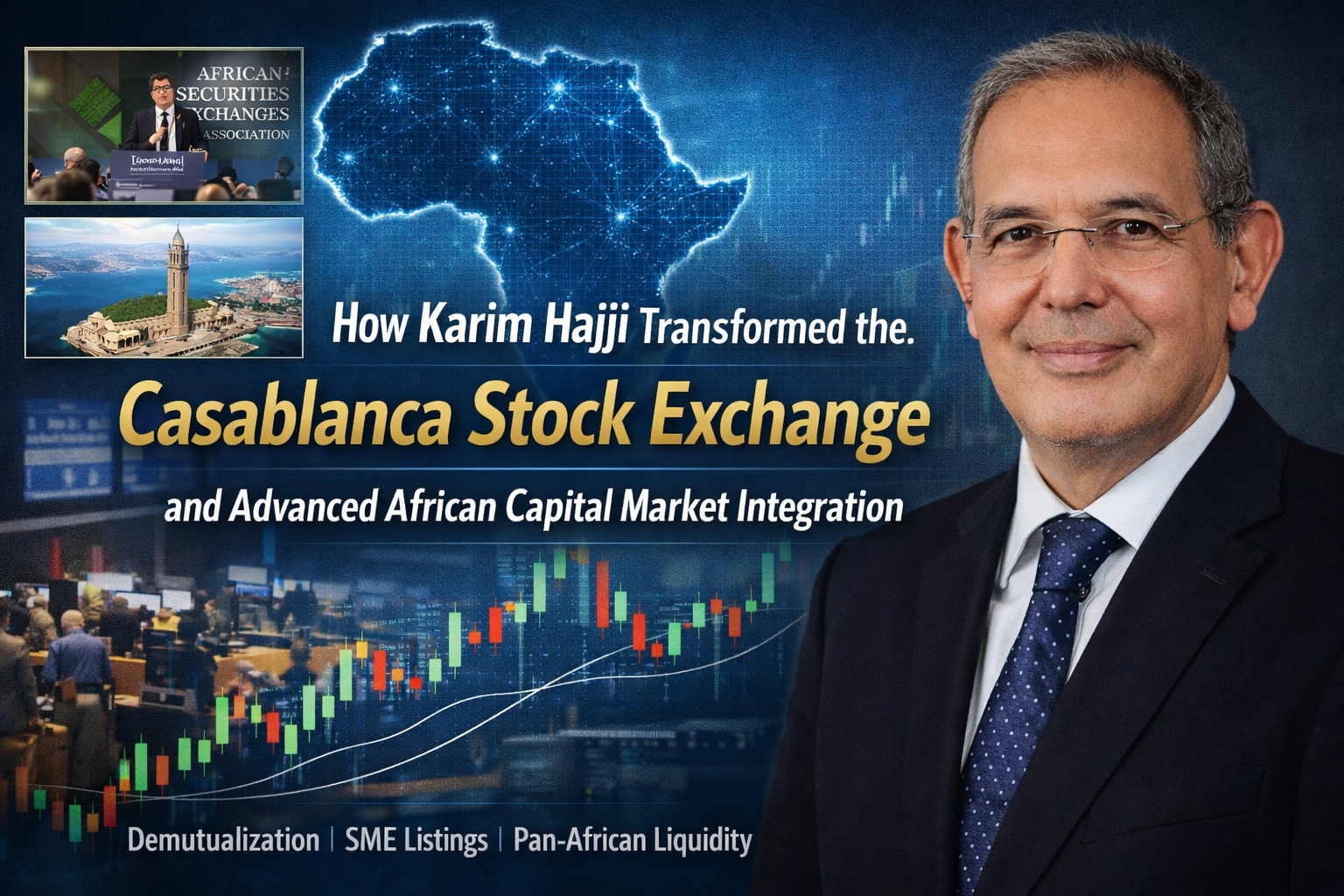
Over four decades, Karim Hajji, former CEO of the Casablanca Stock Exchange and former President of the African Securities Exchanges Association, has helped shape the architecture of Morocco’s and Africa’s capital markets.
During his 11-year tenure, Hajji led the demutualization of the Casablanca Stock Exchange, strengthened market infrastructure, advanced SME access to public markets, and positioned the exchange as one of Africa’s leading financial institutions. He also championed the African Exchanges Linkage Project to address the continent’s most persistent challenge: liquidity fragmentation.
In this wide-ranging conversation with Danish Shaikh, Editor, The International Wire, Hajji discusses emerging market liquidity constraints, the structural role of state-owned enterprise listings, the institutional barriers to cross-border integration, and why transparency, not scale defines a resilient capital market today.
At a time when African economies seek deeper capital formation and greater regional integration, his insights offer a blueprint for sustainable market development grounded in stability, credibility, and long-term vision.
Career Trajectory and Leadership Formation
Your career spans industry, corporate finance, asset management, and market infrastructure. Was this breadth intentional, or did each role expose limitations in the previous one?
I acknowledge that mine was not a typical trajectory, having spanned four different industries in a four decade career. While my graduate studies at NYU Stern prepared me for a career in the capital market world, circumstances have decided otherwise and I joined instead an industrial company. I don’t regret that choice which has helped me acquire corporate finance and management skills in one of the most innovating pharmaceutical companies, Eli Lilly and Company. I later joined a Moroccan industrial and financial group where I assumed different management roles before being appointed Group CFO. After 4 years in that role, I set up my own investment firm, Atlas Capital Group, which I sold just before the 2008 financial crisis. The Casablanca Stock Exchange was looking for a CEO. I thought this was a good opportunity to contribute to the development of Moroccan capital markets so I applied for the job and was happy to be chosen by the board.
After 11 years as CEO of the Casablanca Stock Exchange, what aspects of leadership did that role sharpen most profoundly?
During my tenure at Casablanca Stock Exchange, I spearheaded the demutualization of the exchange, set up a program to attract SMEs to the stock market, put in place a robust market infrastructure and helped position CSE as the second exchange in Africa. These were achieved mostly through my ability to bring public and private leaders together to ensure market transparency and stability and regulatory credibility. At the exchange level, I have also favoured a more participative approach, which has helped keep morale high. On occasion, though, I have made some key decisions despite the opposition of a majority of managers. During the 11 years as the CEO of CSE, there was no turnover among the top managers and very little turnover (below 5%) among employees.
What distinguishes leadership in a market institution from leadership in a private financial enterprise?
The main differences in the leadership aspects required in a market institution vs a private financial enterprise can be summarized as follows :
- The market infrastructure is part of a larger, more complex ecosystem, and is designed by construction to be neutral like a public utility even if it is privately run. A financial institution, in comparison, is competing against other financial institutions and is seeking to maximize profits. To run a market infrastructure thus requires consensus building to balance the sometimes competing interests of the market stakeholders and the regulators.
- The market infrastructure tends to prioritize stability and system resilience over short term profits. As an example, CSE under my leadership had to invest in a clearing platform 5 years ahead of the implementation of a derivatives market.
- As an institution at the core of capital markets, the market infrastructure needs to put a strong emphasis on preserving its reputation. A system failure, critical information which leaks to market participants could irremediably damage its reputation. A particular attention to risk management is required, thus a prudent, measured leadership style.
Exchange Leadership and Market Architecture
During your tenure, the Casablanca Stock Exchange underwent demutualization. What problem was demutualization fundamentally designed to solve?
The demutualization of the exchange was mainly designed to address potential conflicts of interest, our board members being at the same time our shareholders and our clients. We had no independent board members before demutualization, which made it difficult to defend the interests of the exchange vs the brokers. While our board members strived to put the exchange’s interests before their own, they were sometimes pressured by peers to defend their particular interests.
Another key issue with a mutualized exchange was the relation with regulators. Before demutualization, it was difficult for the capital market regulator and the Treasury Department to dissociate the interests of the market infrastructure from those of the market participants.
What is most misunderstood about running a stock exchange in an emerging market context ?
Liquidity is the most commonly misunderstood aspect of running a stock exchange in an emerging market context. Due to their ownership structure, most listed companies have a small free float which does not help build liquidity in an emerging market where new listings are typically scarce. This is a real challenge for most emerging markets. Many investors misunderstand the role of the market infrastructure in building liquidity in this context.
SME Access to Capital and Market Inclusion
You spearheaded a program enabling over 100 SMEs across Morocco and West Africa to access capital markets. What was the hardest barrier to overcome—regulatory, cultural, or financial?
The hardest barrier to overcome was actually cultural. We had the full support of regulators and political authorities to improve access of SMEs to capital markets.
In Morocco and West Africa, the vast majority of SMEs are family businesses. We found the owners were reluctant to list as long as they had sufficient shareholders funds or had access to finance. We conducted a survey which showed that the fear to lose control –
even if they listed a minority of the capital – was a major concern. The second was fear of sharing market and financial information with non listed competitors.
African Capital Markets and Regional Integration
As President of the African Securities Exchanges Association, you advanced the African Exchanges Linkage Project. What problem was this initiative responding to most urgently—liquidity, visibility, or fragmentation ?
The African Exchanges Linkage Project (AELP) was primarily designed to help improve liquidity which was identified as the main enabler for market development. Market fragmentation, while also of concern, appeared to be much more challenging to address due to strong political and regulatory constraints. In order to facilitate cross border trading among participating exchanges, it was decided to go through the local central depository and/or clearing house in the country where the transaction occurred.
Very few regional markets have emerged in Africa : BRVM in West Africa and BVMAC in Central Africa are the ones that come to mind. Apart from these two, who were built around regional market integration, there has been no successful experience despite efforts in Eastern and Southern Africa.
What have been the main institutional obstacles to deeper cross-border market integration in Africa ?
The main institutional obstacles to cross border trading were as follows :
- Foreign exchange controls in some countries which limit the amount a qualified investor is authorized to engage in cross border trading;
- Trust between brokers which needed to be established before they could risk their capital to initiate transactions for their counterparties;
- Trust between local depositories and custodian banks to ensure seamless settlement.
How realistic is continent-wide liquidity integration given differing regulatory regimes and market maturities ?
Within today’s environment, a full continent-wide liquidity integration is challenging due to differing regulations, multiple currencies and the ambition of every country to keep or establish its own securities exchange, much like flagship airlines. Many African countries which do not yet have an exchange have announced plans to establish one despite the unfavourable economics.
What role should large exchanges play in supporting smaller or frontier markets without dominating them?
Large exchanges could help smaller, frontier markets in many ways without actually dominating them. They could help them build capacity to run an exchange efficiently, provide hosting services – matching engine, clearing/settlement – help them with
advocacy to their local authorities to list state-owned enterprises or introduce new asset classes.
How important is the listing of state-owned enterprises in deepening African capital markets?
The listing of state-owned enterprises (SOEs) is critical to any starting exchange in Africa and can certainly help deepen African capital markets. I am thankful to IFC who gracefully agreed to commission an African-wide study when I was at the helm of the African Securities Exchanges Association to support the listing of SOEs as a way to deepen the continent’s capital markets. The study did make a strong case to support such listings which not only deepen African capital markets but also free up resources for African governments that they can direct to improving infrastructure, health and education and, finally, help improve governance of SOEs. Most African SOEs are still not listed even though many of them are fit for listing.
Advisory Work, Governance, and Board Leadership
Through GEM Finance, you now advise on restructuring, M&A, and strategic transformation. What patterns do you see most often in companies seeking such advice?
The most frequent patterns observed in companies seeking advice have to do with family governance, a reluctance to seek growth in new markets, inadequate reporting and a lack of ESG awareness.
In Morocco, many companies have come to realize that they have reached a plateau with their current governance model, and they need to open to institutional investors to reach a new level of growth. We have witnessed an unprecedented level of investment by private equity firms in recent years which has greatly benefited family businesses through appropriate governance, ESG reporting, strategic realignment, and helped deepen Moroccan capital markets.
Rapid Fire
Market depth or market breadth?
Definitely market depth
Regulation as constraint or enabler?
Regulation would work best as an enabler
Liquidity or transparency, what comes first?
Liquidity comes first.
Exchange as utility or enterprise?
As an infrastructure which is enabling price discovery, ensuring transparency and neutrality to market participants, the exchange should be considered first as a utility.
Integration or national resilience?
Integration serves better liquidity and price discovery
Private capital or public markets?
Each one plays an important role. Private capital, as a growth enabler and a source of future IPOs. Public markets for market stability, investment opportunities for retail investors.
Governance before growth or growth before governance?
Growth before governance. What’s the use of a good governance in a company with no growth?
Consensus-building or crisis decisive leadership?
Consensus building in a market infrastructure, decisive leadership in start-ups and companies facing a crisis.
One word that defines a well-functioning capital market today?
Transparency.

Karim Hajji has retired in April 2020 from his role as CEO of
Casablanca Stock Exchange, after an 11 year tenure. In this
capacity, he spearheaded the transformation of the Exchange from a mutualized to a demutualized company, moving from the 4th ranking in 2008 to the 2nd position in 2016 in Africa. He was instrumental in developing a partnership with the London Stock Exchange Group in 2014 which led to the successful implementation of a last generation trading platform and the first exchange driven SME capacity building initiative in North and West Africa, the “Elite” programme.
In 2018, he was elected Chairman of the African Securities
Exchanges Association (ASEA), which represents 28 exchanges on
the continent. In that position, Karim pushed forward the African
Exchanges Linkage Project (AELP) which aims to connect Africa’s
seven leading exchanges.
In 2011, he was invited by John Hope Bryant, founder and Chairman
of the Hope Foundation, a leading US financial literacy NGO, to join
the HOPE Global Board of Advisors.
Prior to joining CSE in April 2009, Mr Hajji was Chairman and CEO
of Atlas Capital Group, an independent investment bank, active in
both corporate finance and asset management, which he had
founded in 1999 and sold just before the 2008 financial crisis.
After an 8 year international career at Eli Lilly and Co in various
finance management roles in the US then in Italy and Switzerland, he had joined the ONA Group, Morocco’s largest conglomerate, in 1990 as advisor to the Chairman, then General Manager of an affiliate in Monaco and finally Group CFO in 1994.
Karim Hajji holds an MBA from New York University’s Stern School,
a diploma from “Institut d’Etudes Politiques de Paris” and a Master’s in capital markets from the University of Paris-IX Dauphine.
Read Also: Beyond the Hype: How Leaders Can Use AI to Drive Revenue, Efficiency and Scalable Growth


