


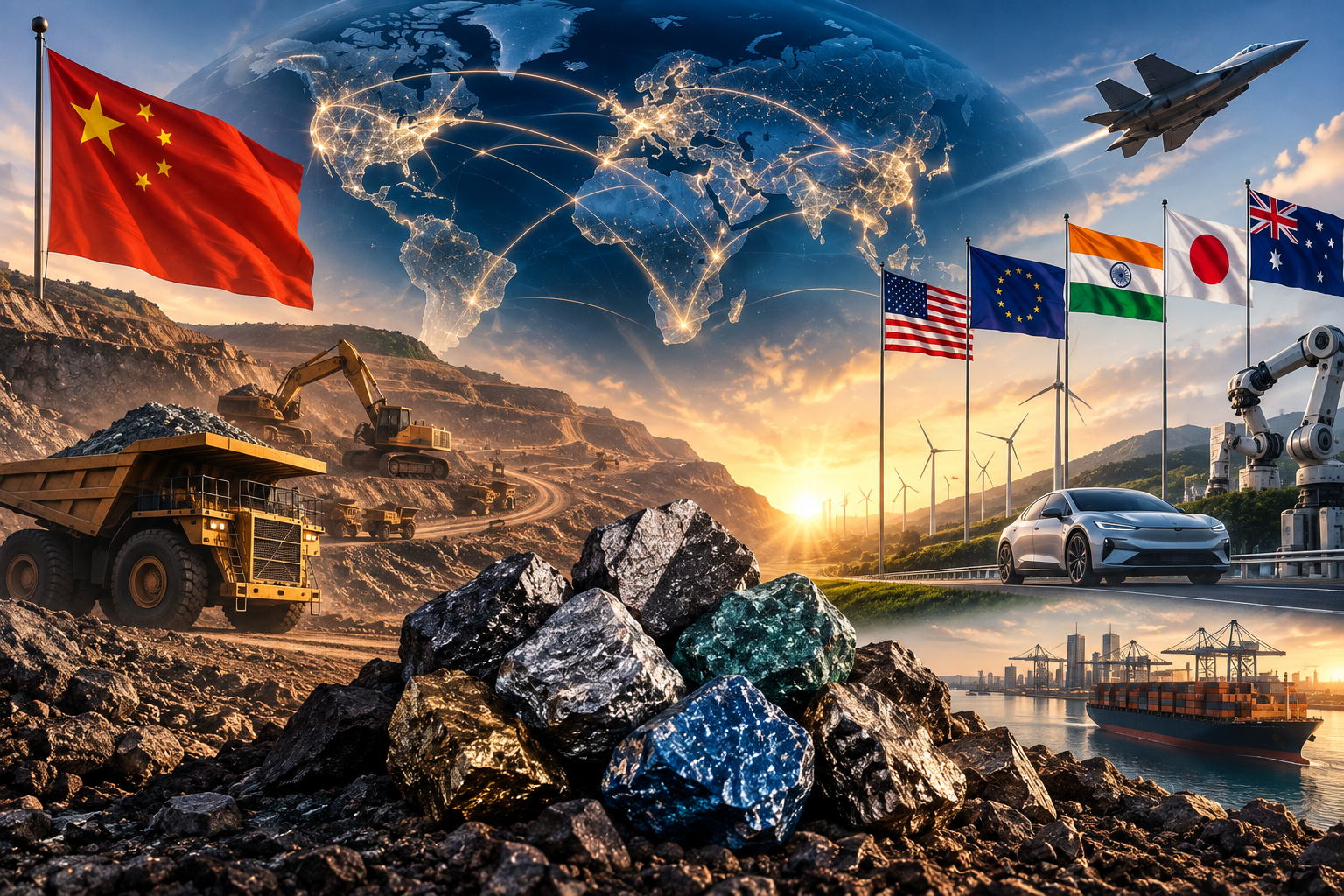
The New Geopolitical Battle Beneath the Ground
For much of the industrial era, global power was closely tied to oil.
Countries competed for access to petroleum because oil powered transportation, manufacturing, militaries and economies.
The next great resource competition may be different.
It is increasingly about the minerals buried beneath the ground.
Rare earth elements are not necessarily rare in geological terms. What makes them strategically valuable is that they are difficult and expensive to mine, separate, refine and convert into high-performance materials.
They are essential to electric vehicles, wind turbines, advanced electronics, aerospace systems, precision-guided weapons, robotics and increasingly sophisticated digital infrastructure.
And one country dominates much of the supply chain.
China.
The International Energy Agency estimates that China accounted for around 60% of global mined production of magnet rare earths in 2024, more than 90% of refining and about 94% of permanent magnet production. (IEA)
That concentration has transformed rare earths from an industrial commodity into a geopolitical weapon.
The global race is now underway to answer a critical question:
Who will control the materials powering the next generation of technology?
Why Rare Earths Matter
There are 17 elements classified as rare earth elements.
But not all have equal strategic importance.
For the emerging technology economy, four are particularly important:
- Neodymium
- Praseodymium
- Dysprosium
- Terbium
These materials are crucial for powerful permanent magnets.
Those magnets are used in electric vehicle motors, wind turbines, industrial robots, drones, aerospace systems, precision equipment and other high-performance technologies.
As the world electrifies transportation and expands automation, demand for these materials is expected to rise.
The IEA projects demand for rare earths to grow by roughly 50% to 90% by 2040, depending on the mineral and scenario. (IEA)
The strategic importance of rare earths therefore goes far beyond mining.
They sit at the intersection of:
Energy + Technology + Manufacturing + Defense + Geopolitics.
China Built the Supply Chain the World Now Needs
China’s advantage did not happen overnight.
Over several decades, the country built capabilities across the entire rare-earth value chain.
Mining.
Processing.
Separation.
Refining.
Metal production.
Alloy manufacturing.
Permanent magnet production.
That last part is particularly important.
Mining rare earths is only the beginning.
The minerals have to be separated and refined before they can become useful industrial materials.
They then have to be converted into metals, alloys and ultimately high-performance magnets.
China built capabilities across almost every stage.
That gives Beijing something more powerful than ownership of mineral deposits.
It gives it control over industrial processing capacity.
And that is why simply discovering rare earth deposits elsewhere does not immediately solve the world’s supply problem.
The Real Bottleneck Is Not Mining
This is one of the biggest misconceptions surrounding the rare-earth race.
If a country discovers a large deposit, it does not suddenly become independent.
The difficult part is building the infrastructure to process it.
The IEA describes separation as the technical core of the rare-earth value chain, followed by refining, alloying and magnet manufacturing. (IEA)
The global diversification pipeline illustrates the problem.
The IEA estimates that announced projects outside China could potentially add more than 50 kilotonnes of mining capacity by 2035.
But announced refining and separation capacity is below 40 kilotonnes.
And planned downstream production of metals, alloys and finished magnets is only around 18 kilotonnes.
The gap is enormous. (IEA)
The world may therefore succeed in finding more rare earths while remaining dependent on China to process them.
The 2025 Shock Changed the Calculation
The vulnerability became impossible to ignore in 2025.
China introduced export controls on seven heavy rare earth elements and related products.
The consequences were immediate.
Export volumes fell sharply.
Automakers in the United States, Europe and elsewhere struggled to secure permanent magnets.
Some manufacturers were forced to reduce production or temporarily halt operations. (IEA)
The lesson was stark.
A relatively small disruption in the supply of specific minerals could affect industries worth trillions of dollars.
The rare-earth problem was no longer theoretical.
It had become an industrial security issue.
The United States Is Trying to Break the Dependence
Washington increasingly views critical minerals as a national-security priority.
The objective is not simply to mine more rare earths inside the United States.
It is to build an alternative supply chain.
That means developing:
Mining.
Processing.
Refining.
Magnet production.
Recycling.
Strategic stockpiles.
International partnerships.
The United States is also attempting to attract private capital into the sector.
But there is a fundamental challenge.
Building a mine can take years.
Building a refinery requires specialized technology.
Building a competitive magnet industry requires expertise, equipment and customers.
China has spent decades developing this ecosystem.
The United States and its partners are trying to compress that process into a much shorter timeframe.
Australia Is Becoming a Strategic Player
Australia is one of the most important potential alternatives to China.
The country has significant rare-earth resources and an established mining industry.
It also has a strategic advantage that many emerging producers lack:
Mining expertise and access to Western capital markets.
Australia’s Lynas is already the largest rare-earth producer outside China, making the company strategically important to efforts to diversify global supply. Reuters reported in September 2026 that Lynas continues to pursue international expansion despite recent uncertainty around its leadership transition. (Reuters)
Australia’s challenge is moving further downstream.
Mining alone will not create supply-chain independence.
Processing and magnet manufacturing are where much of the strategic value lies.
Brazil Wants to Become the Next Major Supplier
Brazil is emerging as another critical player.
The country possesses some of the world’s largest rare-earth resources.
In September 2026, Brazil’s Senate approved legislation designed to encourage exploration and domestic processing of critical and strategic minerals, including rare earths. The legislation includes financial incentives and a fund intended to support the sector. (AP News)
That could significantly change the global supply landscape.
Brazil has an opportunity to become more than a raw-material exporter.
Its ambition is increasingly to build a domestic mineral-processing industry.
That distinction will determine how much economic value remains inside Brazil.
India Is Entering the Race
India has also recognized the strategic importance of rare earths.
The country possesses substantial geological resources, but historically has not developed a supply chain matching China’s scale.
That is now changing.
India’s 2026 strategy includes dedicated Rare Earth Corridors across Odisha, Kerala, Andhra Pradesh and Tamil Nadu, designed to connect mining, processing, research and manufacturing.
The government has also approved a ₹7,280 crore Rare Earth Permanent Magnet manufacturing scheme, targeting 6,000 tonnes per year of integrated capacity. (Press Information Bureau)
This is strategically important.
India’s objective is not merely to extract minerals.
It wants to manufacture the magnets needed by electric vehicles, renewable energy, electronics, aerospace and defense industries.
If successful, rare earths could become another component of India’s broader strategy to build domestic manufacturing capabilities.
Europe Has a Different Problem
Europe has strong manufacturing capabilities.
Automobiles.
Wind turbines.
Industrial machinery.
Aerospace.
Defense.
Electronics.
But it remains heavily dependent on imported critical materials.
The European Union’s own assessments highlight its dependence on China for rare-earth processing and permanent magnets. (Eur-Lex)
This creates a strategic contradiction.
Europe wants to accelerate the energy transition.
It wants more electric vehicles.
More wind power.
More advanced manufacturing.
More defense capabilities.
But many of those industries depend on materials whose supply chains are concentrated outside Europe.
The EU is therefore attempting to develop domestic capacity while creating partnerships with resource-rich countries.
The challenge is speed.
Building competitive European mineral-processing capacity is expensive.
And environmental permitting can take years.
Japan Learned the Lesson Earlier
Japan has a particularly important role in the rare-earth story.
The country experienced a major supply shock during its 2010 dispute with China.
That episode demonstrated how quickly mineral supply could become a geopolitical instrument.
Japan subsequently pursued diversification, recycling, stockpiling and alternative suppliers.
Its experience offers an important lesson:
Supply-chain resilience is built before a crisis, not during one.
Japan has also remained deeply involved in developing alternative supply relationships with countries such as Australia.
The Hidden Power of Permanent Magnets
Rare earths matter because they enable technologies that need extremely powerful, compact and efficient magnets.
Electric vehicles are a major example.
A high-performance electric motor can use permanent magnets containing rare earth elements.
Wind turbines use them to generate electricity efficiently.
Robots require precision motors.
Drones need lightweight and powerful motors.
Aerospace systems use advanced magnets in a variety of applications.
Defense systems use rare-earth-enabled components across multiple technologies.
This creates a powerful multiplier.
A relatively small quantity of rare earth material can sit inside a product worth thousands or millions of dollars.
That means the economic value of the downstream industry can be vastly larger than the value of the raw mineral itself.
The Defense Industry Is Particularly Vulnerable
Rare earths have become a national-security issue because they are embedded in advanced military systems.
Sensors.
Aircraft.
Missile guidance.
Radar.
Drones.
Communications equipment.
Electric motors.
Targeting systems.
Electronic warfare.
A country may possess advanced military technology but still depend on foreign suppliers for critical materials inside that technology.
That creates a strategic vulnerability.
The same mineral that powers a civilian electric vehicle can also support a military system.
This dual-use characteristic makes rare earths particularly sensitive.
The AI Connection
There is another reason the rare-earth race is accelerating.
Artificial intelligence.
AI is often described as a software revolution.
But AI ultimately depends on enormous physical infrastructure.
Data centers.
Power systems.
Cooling equipment.
Robotics.
Advanced electronics.
Semiconductor manufacturing.
Rare earths do not necessarily sit at the center of AI computing itself, but they are increasingly important to the wider industrial ecosystem supporting advanced technology.
The IEA specifically identifies rare earths as important to digital technologies, automation and robotics. (IEA)
As the world builds more automated factories, data centers and advanced machines, demand for high-performance materials will rise.
The New Geopolitical Map of Minerals
The global mineral race is creating an unusual geopolitical landscape.
China has processing dominance.
The United States has capital, technology and a huge industrial market.
Australia has mining expertise and resources.
Brazil has enormous geological potential.
India has resources, manufacturing ambitions and a massive domestic market.
Japan has technological expertise and decades of supply-chain diversification experience.
Europe has advanced manufacturing but resource constraints.
African countries possess significant mineral resources but require more investment in infrastructure and processing.
The future will therefore depend increasingly on partnerships.
No single country is likely to control the entire alternative supply chain.
Africa Could Become the Next Battleground
Africa has significant deposits of critical minerals.
Countries across the continent are attracting growing attention from China, the United States, Europe, India and other powers.
But there is a crucial question:
Will African countries simply export raw minerals?
Or will they develop processing and manufacturing industries?
The answer could determine whether the mineral boom produces long-term economic transformation or simply another cycle of commodity dependence.
The most valuable position in the supply chain is increasingly not the mine.
It is the refinery.
The processing plant.
The magnet factory.
The battery factory.
The technology company.
Recycling Could Become a Strategic Weapon
Mining is not the only answer.
Recycling could become increasingly important as today’s electric vehicles, wind turbines, electronics and industrial equipment reach the end of their useful lives.
The IEA expects secondary supply from recycling to increase significantly over the coming decades. (IEA)
Rare-earth recycling is technically difficult and remains relatively immature compared with recycling of metals such as copper.
But the potential is enormous.
The rare earths already embedded in millions of machines could eventually become a secondary resource.
That would reduce pressure on new mines and create another route toward supply security.
The Environmental Challenge
There is an uncomfortable contradiction at the heart of the rare-earth race.
The world needs these minerals to accelerate clean-energy technologies.
But mining and processing them can have significant environmental consequences.
Extraction can generate waste.
Chemical separation can require large amounts of water and reagents.
Poorly managed operations can damage ecosystems and communities.
This creates a difficult policy question.
How does the world accelerate the clean-energy transition without simply exporting the environmental costs to mining regions?
A sustainable mineral strategy therefore requires more than diversification.
It requires higher environmental standards and better processing technologies.
The Price Problem
There is another obstacle.
Alternative supply is often more expensive.
The IEA estimates that refining projects outside dominant suppliers can face capital costs 20% to more than 150% higher, while operating costs are on average around 50% higher. (IEA)
This creates a difficult economic equation.
Consumers want cheap electric vehicles.
Manufacturers want low-cost components.
Investors want attractive returns.
Governments want secure supply.
But diversification can cost more.
For the global economy, the question becomes:
How much are governments and companies willing to pay for resilience?
The World Is Moving From “Just in Time” to “Just in Case”
For decades, globalization optimized supply chains around efficiency.
Buy from the cheapest producer.
Keep inventories low.
Minimize redundancy.
Move components across borders.
The rare-earth crisis is challenging that philosophy.
Governments increasingly want:
Multiple suppliers.
Strategic stockpiles.
Domestic processing.
Recycling.
Long-term contracts.
Allied supply chains.
The result could be a more expensive but more resilient global industrial system.
The age of maximum efficiency may be giving way to the age of strategic redundancy.
Who Will Win the Rare-Earth Race?
The answer may not be the country with the largest reserves.
It will likely be the country—or coalition—that controls the greatest portion of the complete value chain.
Mining → Processing → Refining → Metals → Magnets → Manufacturing → Recycling
China currently dominates much of this chain.
The United States and its allies are trying to build alternatives.
India is attempting to create a domestic ecosystem.
Brazil and Australia could become major resource suppliers.
Japan and Europe can contribute advanced technology.
Africa could become an important source of future supply.
The next decade will determine how much of China’s dominance can realistically be diversified.
Frequently Asked Questions
Why are rare earth minerals so important?
Rare earths are essential inputs for powerful permanent magnets and other advanced technologies used in electric vehicles, wind turbines, electronics, robotics, aerospace and defense.
Does China control all rare earth deposits?
No. Rare earth resources exist in many countries. China’s major advantage is its dominance across mining, refining and especially permanent-magnet manufacturing.
Can the United States replace China?
Not quickly. Building mines is only one part of the challenge. Processing, refining and magnet manufacturing require specialized infrastructure and expertise that take years to develop.
Why is India investing in rare earths?
India wants to reduce dependence on external supply chains and build domestic manufacturing capabilities for permanent magnets used in EVs, renewable energy, electronics and defense. (Press Information Bureau)
Could Brazil become a major rare-earth power?
Yes. Brazil has substantial resources and is now developing policies designed to encourage exploration and domestic processing. (AP News)
Can recycling solve the rare-earth problem?
Recycling can reduce pressure on primary supply, but it is unlikely to eliminate the need for new mining and processing. It will increasingly become one component of a diversified supply strategy. (IEA)
The New Oil of the Technology Age?
Rare earths are sometimes described as the “new oil.”
The comparison is imperfect.
Oil is consumed as energy.
Rare earths are materials that enable products and technologies.
But geopolitically, the comparison is useful.
Both can become strategic dependencies.
Both can influence industrial power.
Both can create enormous geopolitical leverage.
And both demonstrate a fundamental reality of the global economy:
Control over critical resources creates power far beyond the value of the resource itself.
The race for rare earths is therefore not simply a mining story.
It is a story about who will manufacture the world’s electric vehicles.
Who will build its robots.
Who will dominate advanced defense technology.
Who will control critical supply chains.
Who will lead the clean-energy transition.
And ultimately, who will possess the industrial capabilities required to compete in the next technological era.
China built its advantage over decades.
The rest of the world is now trying to catch up.
The winners will not necessarily be those who discover the most minerals.
They will be those who build the most resilient mine-to-magnet ecosystems.
And beneath the surface of the earth, a new geopolitical contest is already underway.


