


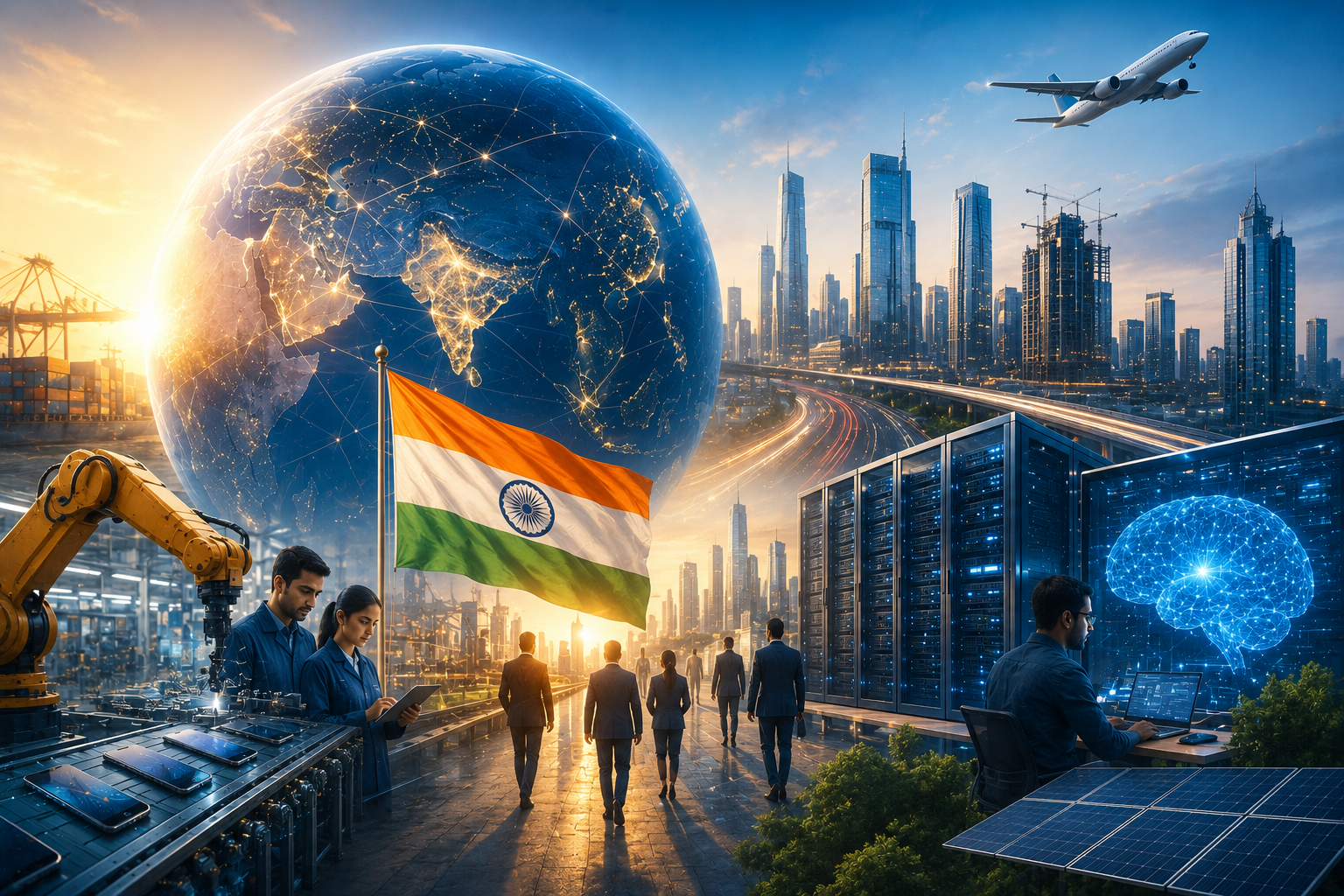
India Is Becoming More Than a Market
For decades, multinational companies looked at India primarily as a market.
A huge population.
A growing middle class.
A young workforce.
An increasingly connected consumer base.
Today, that calculation is changing.
India is increasingly becoming a place where global companies build, manufacture, engineer, innovate and export.
The shift is visible across sectors.
Apple is expanding its manufacturing footprint.
Global technology companies are building cloud and AI infrastructure.
Financial institutions are expanding global capability centres.
Semiconductor companies are entering the ecosystem.
Manufacturers are looking at India as part of their global supply chains.
And foreign investment into manufacturing is rising.
India received $81.04 billion in gross FDI in FY2024–25, while manufacturing FDI rose 18% to $19.04 billion.
This is not simply another investment cycle.
It reflects a structural change in how global companies think about India.
The question is no longer:
“How big is the Indian market?”
It is increasingly:
“How much of our global business should we build from India?”
The China Plus One Strategy Is Accelerating
One of the biggest reasons companies are expanding in India is geopolitical diversification.
For years, China became the central manufacturing hub for global companies.
But the pandemic, U.S.–China tensions, export controls, rising operating costs and supply-chain disruptions have encouraged businesses to reduce excessive dependence on a single country.
The objective is not necessarily to leave China.
It is to build alternatives.
This is the China Plus One strategy.
India is increasingly one of the most important beneficiaries.
Apple’s manufacturing expansion provides perhaps the clearest example.
India’s iPhone exports reportedly reached approximately $23 billion in 2025, almost 85% higher than the previous year.
The significance goes beyond iPhones.
Once a country develops manufacturing capabilities for sophisticated products, suppliers, logistics providers, component manufacturers and skilled workers begin developing around that ecosystem.
That creates a multiplier effect.
Apple Is Becoming a Manufacturing Story
Apple’s relationship with India illustrates how quickly the country’s role can change.
India was once primarily a consumer market for Apple.
It is increasingly becoming a production and export base.
Foxconn and Tata Electronics have emerged as major manufacturing partners, while India’s production-linked incentives have helped accelerate the expansion.
Government data shows India’s electronics production increased from approximately ₹1.9 lakh crore in 2014–15 to ₹11.3 lakh crore in 2024–25.
Electronics exports rose more than eightfold during the same period.
That creates an important signal for other multinational companies.
India is demonstrating that complex global manufacturing can be scaled domestically.
The Next Opportunity: Beyond Assembly
The biggest test for India is whether it can move beyond assembly.
Manufacturing an end product is only one part of a global supply chain.
The deeper economic value lies in:
Components.
Semiconductors.
Materials.
Design.
Engineering.
Research.
Tooling.
Logistics.
After-sales services.
If India can develop these capabilities alongside final manufacturing, the economic impact could be substantially larger.
This is why semiconductor policy has become strategically important.
India’s government says 10 semiconductor projects have been approved under the Semicon India programme, representing approximately ₹1.6 lakh crore in investment commitments, including fabrication and packaging facilities.
The objective is not simply to manufacture chips.
It is to create an ecosystem.
India Is Becoming an AI Infrastructure Destination
Manufacturing is only one part of the story.
The other is digital infrastructure.
Global technology companies are investing heavily in India’s cloud and AI ecosystem.
Microsoft recently opened its largest India data-center hub in Hyderabad and now operates four cloud regions in the country. The company has also committed approximately $20.5 billion to expanding its Indian operations.
Amazon, Microsoft and Google have collectively announced major investments in India’s AI and data-center infrastructure, with reported commitments approaching $57 billion.
This creates a remarkable convergence.
India is simultaneously becoming:
A market for AI.
A producer of AI services.
A source of technology talent.
And increasingly, a location for the physical infrastructure powering AI.
That could become one of India’s most important economic advantages of the next decade.
The Global Capability Centre Revolution
Another transformation is happening quietly.
Multinational companies are increasingly building large technology and engineering organizations in India.
These are no longer simply traditional back offices.
Global capability centres are increasingly involved in:
Artificial intelligence.
Cybersecurity.
Product development.
Cloud engineering.
Finance.
Research.
Data science.
Global operations.
A recent report citing industry data put India’s GCC ecosystem at more than 2,100 centres employing around 2.36 million people and generating nearly $100 billion in revenue.
Charles Schwab, for example, is expanding its India technology presence and plans to scale its workforce there to approximately 2,000 by the end of 2027.
This represents a significant evolution.
India is moving from being an outsourcing destination to becoming part of the core operating architecture of global companies.
Talent Is One of India’s Biggest Advantages
India’s most obvious competitive advantage remains its people.
The country produces a huge number of engineers, technology professionals, finance specialists and business graduates.
But the advantage is becoming more sophisticated.
Indian professionals are increasingly moving into global leadership roles.
They are running product organizations.
Engineering teams.
Research centres.
Financial operations.
AI divisions.
Global business units.
This creates a self-reinforcing cycle.
More global companies create more opportunities.
More opportunities attract more talent.
More talent attracts more companies.
And more companies deepen the ecosystem.
India’s Domestic Market Is Still a Superpower
There is another reason companies want to build in India.
Even when the primary objective is exports, India itself remains one of the world’s largest potential markets.
A company can build in India and sell to:
India.
The Middle East.
Africa.
Europe.
Southeast Asia.
The United States.
That makes India unusual.
It can serve simultaneously as a market, manufacturing base, technology centre and export platform.
This combination is one of India’s strongest structural advantages.
Government Policy Is Helping Change the Equation
India’s manufacturing transformation has not happened entirely through market forces.
Government policy has played an important role.
The Production Linked Incentive programme has become one of the central tools.
According to the Indian government, PLI schemes had attracted more than ₹2.16 lakh crore in investment, generated approximately ₹20.41 lakh crore in production, and created around 14.39 lakh jobs through December 2025.
The strategy extends across electronics, pharmaceuticals, automobiles, telecommunications, solar manufacturing, batteries and other sectors.
The broader objective is straightforward:
Make India competitive enough that global companies want to build here—not merely sell here.
Infrastructure Is Changing the Investment Equation
India’s infrastructure has historically been one of the biggest concerns for multinational companies.
That is changing, although significant challenges remain.
Highways are expanding.
Dedicated freight corridors are developing.
Ports are being modernized.
Industrial corridors are being built.
Air connectivity is improving.
Digital infrastructure has expanded dramatically.
The next challenge is integrating these systems.
A multinational manufacturer does not evaluate a country based on one highway or one port.
It evaluates the entire supply chain.
Can components arrive on time?
Can finished products reach ports efficiently?
Is power reliable?
Can factories scale?
Can workers be hired?
Can regulations be navigated efficiently?
India’s competitiveness will increasingly depend on answering those questions consistently.
The Energy Question Could Become Critical
There is one area where India’s opportunity comes with a major challenge.
Energy.
Manufacturing requires electricity.
Semiconductor fabs require enormous amounts of reliable power.
AI data centers require even more.
India’s future investment strategy will therefore depend partly on whether it can expand electricity generation and transmission quickly enough.
This is especially important because the global AI boom is creating a race for data-center capacity.
India’s data-center capacity has expanded rapidly, and the country is now one of Asia-Pacific’s largest markets outside China.
But power, water and transmission infrastructure could become constraints.
The next phase of India’s investment story will therefore be as much about energy infrastructure as factories.
Why Global Companies Are Choosing India Now
The decision is ultimately driven by several factors coming together.
1. Market Scale
India provides access to one of the world’s largest consumer markets.
2. Talent
Its workforce provides significant engineering, technology and business capabilities.
3. Supply Chain Diversification
Global companies want alternatives to excessive dependence on China.
4. Government Incentives
Manufacturing incentives can improve the economics of establishing operations.
5. Digital Infrastructure
India has developed a sophisticated digital ecosystem supporting payments, identity, commerce and financial services.
6. Geopolitical Position
India maintains relationships across the United States, Europe, Russia, the Gulf and Asia.
7. Long-Term Growth
Multinationals are not investing only for today’s India.
They are investing for the India they expect to exist ten years from now.
But India Cannot Take the Investment for Granted
The opportunity is enormous.
So are the challenges.
India still needs to improve:
- Logistics efficiency
- Regulatory predictability
- Land availability
- Skill development
- Power infrastructure
- Component ecosystems
- R&D capabilities
- Ease of doing business
- Export competitiveness
The next phase is therefore harder than attracting factories.
India must make those factories globally competitive.
The Real Prize Is Not Foreign Investment
This is perhaps the most important point.
India should not measure success simply by how much foreign capital enters the country.
The bigger prize is what that capital creates.
Does it develop Indian suppliers?
Does it transfer technology?
Does it train workers?
Does it create intellectual property?
Does it generate exports?
Does it create globally competitive Indian companies?
Does it integrate India into global value chains?
If the answer is yes, foreign investment becomes more than capital.
It becomes an accelerator of industrial transformation.
India Could Become the “Build Here, Sell Everywhere” Economy
The most ambitious version of India’s strategy is not:
Build for India.
It is:
Build in India. Sell to the world.
That distinction changes everything.
It means India becomes part of the global production system.
A phone assembled in India can be sold in America.
A software platform developed in Bengaluru can serve Europe.
An AI system built in Hyderabad can support companies globally.
A pharmaceutical manufactured in Gujarat can reach Africa.
A semiconductor packaged in India can enter global electronics supply chains.
The country’s domestic scale becomes the foundation for international scale.
The Next Decade Could Be Decisive
The global economy is undergoing a structural transformation.
China is moving up the value chain.
The United States is investing heavily in advanced technology.
Europe is seeking greater strategic autonomy.
The Gulf is diversifying beyond oil.
Southeast Asia is attracting manufacturing investment.
And India is attempting to become one of the world’s major production and technology hubs.
The competition will be intense.
India will not automatically win.
But it now has an opportunity that would have seemed improbable two decades ago.
Global companies are no longer asking whether they should have a presence in India.
Increasingly, they are asking:
How much of our future should we build there?
That may be the most important change of all.
Frequently Asked Questions
Why are global companies investing in India?
Companies are attracted by India’s large domestic market, technology talent, manufacturing potential, supply-chain diversification opportunities, government incentives and expanding infrastructure.
Is India replacing China as a manufacturing hub?
India is becoming an important alternative manufacturing location, particularly in electronics and other strategic sectors. It is more accurate to describe this as diversification rather than an immediate replacement of China.
Why is Apple manufacturing in India?
Apple has expanded production in India as part of its broader manufacturing and supply-chain strategy. India’s production incentives and growing electronics ecosystem have supported that expansion.
Why are technology companies building data centers in India?
India has a rapidly growing digital and AI market, a large technology workforce and increasing demand for cloud computing. Major technology companies are investing in data-center infrastructure to serve that growth.
What could stop India from becoming a major global investment hub?
Infrastructure bottlenecks, regulatory complexity, skills shortages, energy constraints and insufficient domestic component ecosystems could limit India’s ability to convert investment announcements into sustained industrial competitiveness.
India’s Moment Is Getting Bigger
Global companies once came to India because it was a large market.
Then they came because India offered cost advantages.
Then they came for technology talent.
Now something much bigger is happening.
They are building factories, engineering centres, data centers, semiconductor facilities, AI infrastructure and global capability centres.
That changes India’s role in the world economy.
India is no longer simply participating in globalization.
It is increasingly becoming one of the places where globalization is being built.
The next decade will determine whether India can turn this wave of investment into something more durable:
A deeper manufacturing ecosystem.
A world-class technology industry.
A stronger export economy.
More high-value jobs.
And globally competitive Indian companies.
The ultimate opportunity is not to become another China.
It is to build a distinctly Indian economic model that combines scale, talent, technology, manufacturing and global connectivity.
If India can do that, the companies building there today may not simply be investing in India.
They may be helping build the next center of the global economy.


