


The Waterway That Keeps the World Moving
For decades, the Red Sea has been one of the world’s most important commercial arteries.
Every day, hundreds of cargo ships carrying oil, liquefied natural gas, automobiles, electronics, food, and manufactured goods pass through the narrow corridor connecting the Indian Ocean to the Mediterranean via the Suez Canal.
Although it accounts for only a small fraction of the world’s oceans, the Red Sea supports a significant share of global maritime trade.
When shipping through the region slows or becomes unsafe, the effects are felt far beyond the Middle East.
Factories experience delays.
Energy prices fluctuate.
Retailers face higher costs.
Consumers pay more.
The Red Sea crisis has demonstrated a simple reality of globalization:
The world’s economy depends on a handful of strategic chokepoints.
When one of them is disrupted, the consequences ripple across continents.
Why the Red Sea Matters
The Red Sea is more than a regional waterway.
It is one of the shortest maritime routes connecting Asia with Europe.
Ships traveling between China, India, Southeast Asia, and Europe typically pass through the Bab el-Mandeb Strait before entering the Red Sea and continuing through the Suez Canal.
This route dramatically reduces travel time compared with sailing around southern Africa.
Every additional day at sea increases fuel costs, insurance expenses, labor costs, and delivery times.
For modern supply chains built around speed and efficiency, the Red Sea is indispensable.
It has become one of the foundations of global trade.
The Cost of Rerouting
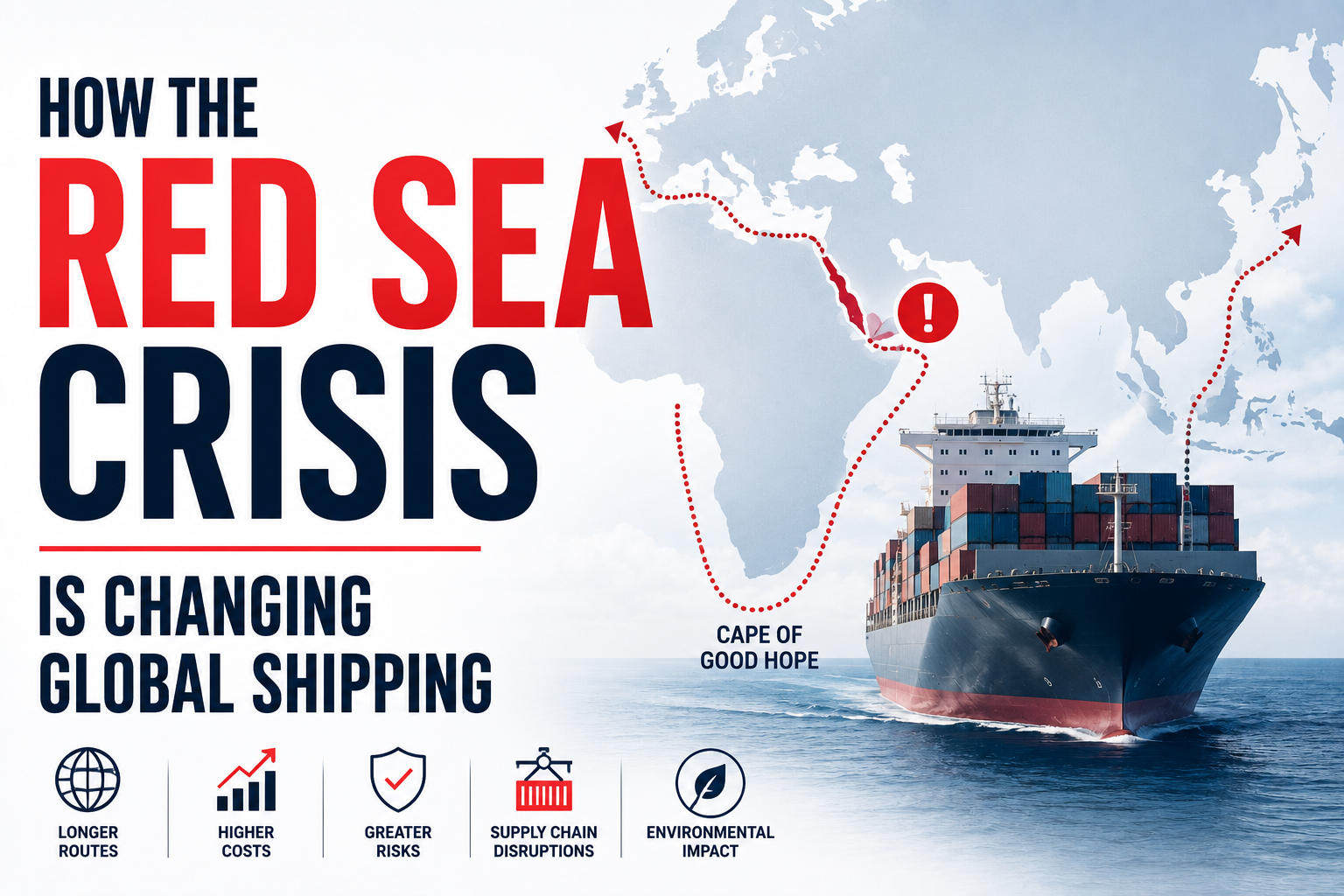
As security risks increased, many shipping companies began diverting vessels around the Cape of Good Hope at the southern tip of Africa.
The alternative route is significantly longer.
Ships may spend an additional one to two weeks at sea depending on their destination.
The consequences are immediate.
Higher fuel consumption.
Longer delivery schedules.
Reduced availability of shipping capacity.
Higher freight rates.
Increased emissions.
Delays across international supply chains.
The longer journey also ties up ships for extended periods, reducing the number of voyages each vessel can complete annually.
This effectively reduces global shipping capacity without removing a single ship from service.
Rising Costs for Global Trade
Shipping is the backbone of international commerce.
More than four-fifths of global merchandise trade by volume moves by sea.
When freight costs rise, those increases eventually filter through the economy.
Importers pay more.
Manufacturers pay more.
Retailers pay more.
Consumers ultimately bear much of the additional cost.
Products ranging from furniture and electronics to clothing and industrial machinery become more expensive to transport.
Even businesses that never ship through the Red Sea may experience higher costs because global shipping markets are interconnected.
A disruption in one major trade route affects pricing across many others.
The Energy Security Challenge
The Red Sea is also critical for global energy markets.
Large volumes of crude oil, refined petroleum products, and liquefied natural gas pass through the region.
Any disruption creates uncertainty.
Markets respond quickly to perceived supply risks.
Even if physical shortages do not occur, uncertainty alone can influence energy prices.
Higher energy prices affect transportation.
Manufacturing.
Agriculture.
Electricity generation.
Inflation.
Because energy remains central to every modern economy, shipping disruptions quickly become macroeconomic concerns.
Insurance Has Become a Strategic Cost
One of the least visible consequences of the Red Sea crisis has been the sharp increase in maritime insurance.
Ships operating in higher-risk regions often require additional war-risk coverage.
Insurance premiums can rise substantially during periods of heightened instability.
Shipping companies must decide whether the shorter route justifies the increased risk and insurance costs.
Many conclude that rerouting is the safer economic choice despite the longer journey.
Risk management has become as important as navigation.
Supply Chains Are Becoming More Resilient
The crisis has reinforced lessons first learned during the pandemic.
Efficiency alone is no longer sufficient.
Businesses increasingly prioritize resilience.
Manufacturers are diversifying suppliers.
Companies are increasing inventory levels.
Supply chains are becoming geographically broader.
Alternative shipping routes are receiving greater attention.
Ports outside traditional trade corridors are attracting increased investment.
The era of single-route dependence is gradually giving way to multi-route resilience.
The Red Sea crisis is accelerating this transformation.
Winners and Losers
Every disruption creates both challenges and opportunities.
Some ports experience declining traffic.
Others gain new business as shipping patterns change.
Countries positioned along alternative trade corridors may attract additional investment.
Rail freight linking Asia and Europe becomes more attractive for certain goods.
Regional manufacturing hubs benefit as companies seek to shorten supply chains.
Shipping companies with larger fleets may gain pricing power during periods of constrained capacity.
The geography of global logistics is becoming more dynamic.
Trade routes are increasingly shaped by geopolitical realities rather than economics alone.
The Environmental Cost
Longer shipping routes carry environmental consequences.
Additional fuel consumption increases greenhouse gas emissions.
More time at sea means higher operating costs and greater environmental impact.
Ironically, a crisis driven by geopolitics may also slow progress toward reducing emissions from international shipping.
The shipping industry therefore faces a difficult balancing act.
Maintaining security.
Managing costs.
Meeting sustainability goals.
These objectives do not always align.
The Return of Maritime Geopolitics
For much of the globalization era, shipping was viewed primarily as a commercial activity.
That perception has changed.
Sea lanes are increasingly recognized as strategic infrastructure.
Governments are investing more heavily in naval capabilities.
International cooperation to protect maritime trade has become increasingly important.
Control over chokepoints such as the Bab el-Mandeb Strait, the Suez Canal, the Strait of Hormuz, and the Strait of Malacca carries enormous geopolitical significance.
The Red Sea crisis illustrates that maritime security and economic security are inseparable.
Global commerce ultimately depends on secure oceans.
Could the Crisis Permanently Change Shipping?
The immediate disruption may eventually ease.
The longer-term effects could endure.
Companies are unlikely to forget the vulnerabilities exposed by repeated disruptions.
Future supply chains will probably incorporate greater redundancy.
Shipping companies may permanently diversify routes.
Governments may invest more heavily in port infrastructure and logistics resilience.
Businesses may place greater emphasis on regional manufacturing.
The crisis is unlikely to end globalization.
It is more likely to reshape how globalization operates.
Trade will continue.
But it will increasingly prioritize resilience alongside efficiency.
Frequently Asked Questions
Why is the Red Sea important for global shipping?
The Red Sea connects the Indian Ocean to the Mediterranean through the Suez Canal, providing one of the shortest and most efficient trade routes between Asia and Europe.
Why are ships avoiding the Red Sea?
Security concerns have led many shipping companies to reroute vessels around the Cape of Good Hope to reduce operational risks.
How does the crisis affect consumers?
Longer shipping routes increase transportation costs, which can eventually raise the prices of imported goods and contribute to inflation.
Which industries are most affected?
Energy, retail, manufacturing, automotive, electronics, logistics, and global trade sectors are among the industries most exposed to shipping disruptions.
Could global supply chains permanently change?
Yes. Many businesses are already diversifying suppliers, increasing inventories, and redesigning logistics networks to improve resilience against future disruptions.
A Crisis That Is Redefining Global Trade
The Red Sea crisis is more than a regional security challenge.
It is a reminder of how interconnected the modern economy has become.
A disruption affecting a relatively narrow stretch of water can influence inflation in Europe, manufacturing in Asia, energy markets in the Middle East, and consumer prices across the world.
It has exposed the vulnerabilities of supply chains optimized almost exclusively for efficiency.
The future of global shipping will likely be shaped by a different philosophy.
Not the fastest route.
Not always the cheapest route.
But the most resilient route.
As geopolitical competition intensifies and maritime security becomes increasingly uncertain, global trade is entering a new era—one where shipping lanes are no longer just commercial highways but strategic assets at the center of international politics.
The Red Sea has become a powerful reminder that in a globalized economy, geography still matters.


