


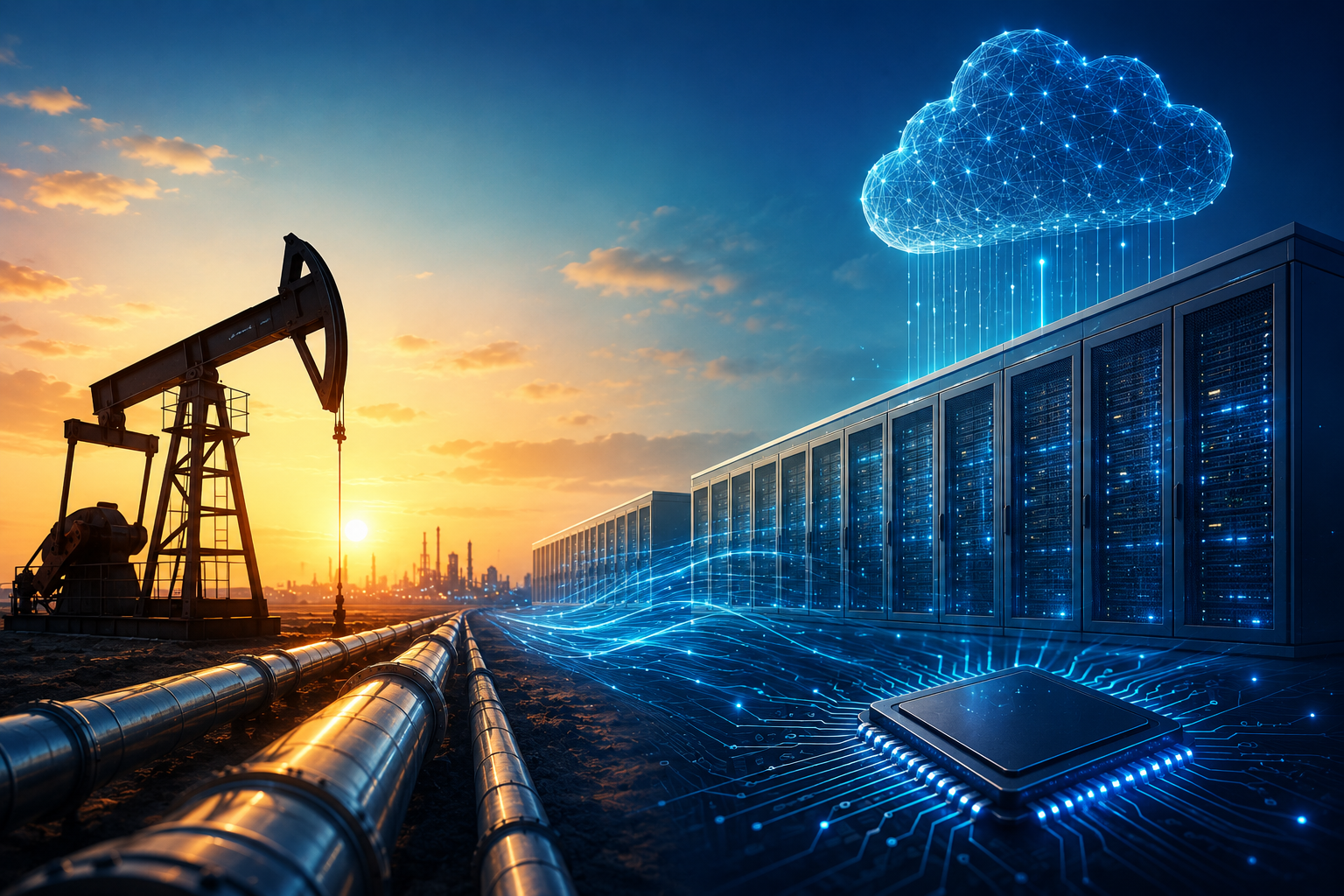
The New Infrastructure of Power
For more than a century, oil fields were among the world’s most valuable strategic assets.
Countries with abundant energy resources gained economic influence. Nations that controlled production and transportation networks could shape industries, trade and geopolitics.
Oil powered factories, cars, aircraft and military machines.
The AI era is creating a different kind of strategic resource.
Compute.
And compute requires infrastructure.
At the center of that infrastructure are data centers.
What once looked like warehouses filled with servers are rapidly becoming some of the most strategically important pieces of economic infrastructure on the planet.
Artificial intelligence cannot operate without enormous amounts of computing power and electricity. The International Energy Agency estimates that data centers consumed about 415 TWh of electricity in 2024, equivalent to roughly 1.5% of global electricity consumption. Its base case projects that data-center electricity use will more than double to around 945 TWh by 2030, with AI as the most important driver of growth.
The comparison with oil fields is therefore not simply about money.
It is about strategic dependence.
The countries and companies that control access to compute, power, land, cooling, connectivity and advanced chips could hold enormous influence over the AI economy.
From Oil Fields to Compute Fields
Oil fields extract hydrocarbons from the ground.
Data centers convert electricity and computing hardware into something increasingly valuable:
intelligence.
Inside a modern AI data center, enormous clusters of specialized processors train models, run inference and execute increasingly complex digital tasks.
The basic economic chain looks something like this:
Energy → Data Center → Compute → AI → Digital Products → Economic Value
That makes data centers fundamentally different from traditional office buildings.
They are industrial infrastructure.
They require electricity.
They require cooling.
They require high-speed networks.
They require land.
They require advanced chips.
And they increasingly require direct relationships with energy producers and utilities.
The more powerful AI becomes, the more important this infrastructure becomes.
The Electricity Race Has Already Begun
The AI boom is creating a new competition for electricity.
The IEA says electricity demand from data centers surged 17% in 2025, while demand from AI-focused data centers grew even faster. Capital expenditure by five major technology companies exceeded $400 billion in 2025 and is expected to rise another 75% in 2026.
This is transforming the relationship between technology companies and energy markets.
For decades, technology companies primarily purchased electricity.
Increasingly, they are helping shape where electricity is generated and how infrastructure is built.
Renewable energy projects.
Natural gas plants.
Nuclear power.
Battery storage.
Transmission networks.
Long-term power contracts.
The AI industry is becoming a major force in energy planning.
The New Geography of Power
Oil fields are concentrated in particular regions.
Data centers can theoretically be built almost anywhere.
In reality, geography still matters enormously.
A data center needs access to:
- Cheap and reliable electricity
- Available land
- High-capacity transmission
- Fiber-optic connectivity
- Cooling resources
- Regulatory approval
- Skilled workers
- Political stability
This is creating a new global competition for suitable locations.
Europe is already seeing developers move away from major cities toward areas where land and electricity are cheaper and grid connections can be obtained faster.
The geography of AI is therefore increasingly becoming the geography of power availability.
The next major technology hub may not be determined by proximity to venture capital.
It may be determined by access to megawatts.
Why Energy May Become the Limiting Factor for AI
For decades, technology advanced faster than physical infrastructure.
A new software application could be launched in weeks.
A new data center takes years.
A new power plant can take even longer.
That creates a fundamental mismatch.
AI companies can develop new models rapidly.
But electricity grids cannot expand at the same speed.
The IEA identifies grid connections, transformers, gas turbines, advanced chips and other physical infrastructure as potential bottlenecks for data-center expansion.
This could fundamentally change the economics of the technology industry.
The question may increasingly be:
Who has the best AI model?
But:
Who can secure the power and infrastructure to run it at scale?
The Rise of the Hyperscale Economy
The world’s largest technology companies are already committing enormous resources to data-center infrastructure.
Microsoft.
Google.
Amazon.
Meta.
Oracle.
And a growing ecosystem of specialized AI infrastructure companies.
The scale of investment is unprecedented.
JLL reported that North American data-center absorption reached 25 GW in the first half of 2026, roughly double the level of the previous year, while vacancy remained around 1%.
This is no longer simply a technology real-estate boom.
It is an infrastructure race.
Companies are competing to secure capacity before their competitors do.
The Data Center Becomes a Strategic Asset
Consider what happens when a company controls a large amount of AI compute.
It can train larger models.
Serve more customers.
Run more AI agents.
Process more data.
Offer faster services.
Develop new products.
And potentially gain advantages in scientific research, defense, finance, manufacturing and healthcare.
That makes compute capacity strategically valuable.
Governments are beginning to recognize this.
AI infrastructure is increasingly being discussed alongside semiconductors, energy and telecommunications as part of national economic competitiveness.
In the future, countries may compete not only over who designs the best AI models but over who has access to enough computing power to develop and deploy them.
The Middle East Is Entering the Race
The oil-producing countries of the Middle East may have an unexpected advantage in the AI era.
They already possess something data centers desperately need:
energy.
Countries such as Saudi Arabia, the United Arab Emirates and Qatar are investing heavily in artificial intelligence, cloud infrastructure and digital transformation.
Their challenge is to convert energy wealth into computing infrastructure and technological capability.
This could create an extraordinary geopolitical transition.
The region that became wealthy by supplying energy to the industrial world could attempt to become wealthy by supplying compute capacity to the AI world.
Oil may not disappear.
But its strategic importance could increasingly coexist with another resource: computing power.
Data Centers Could Change the Meaning of Energy Security
Traditional energy security asks:
Can a country obtain enough oil and gas?
The AI economy adds another question:
Can a country obtain enough electricity to power its digital infrastructure?
That question will become increasingly important.
Countries with unreliable grids may struggle to compete in AI-intensive industries.
Countries with abundant low-cost electricity could attract data-center investment.
Countries that combine cheap power with strong connectivity could become major AI hubs.
Electricity could therefore become a competitive advantage in the global digital economy.
The Nuclear Revival
The AI boom is also changing the conversation around nuclear energy.
Nuclear power provides large quantities of reliable electricity with low operational carbon emissions.
That makes it attractive for data-center operators seeking predictable long-term power.
The IEA expects renewables and natural gas to provide much of the additional electricity needed for data centers, while nuclear and geothermal technologies are also expected to contribute. Its analysis sees the first small modular reactors coming online around 2030.
The result could be an unexpected alliance:
Nuclear power + data centers + artificial intelligence.
Energy companies and technology companies may increasingly become partners rather than separate industries.
Water Will Become Another Strategic Constraint
Electricity is not the only resource data centers need.
Cooling is critical.
High-performance AI processors generate enormous amounts of heat.
Some facilities therefore require significant quantities of water or sophisticated cooling systems.
This is creating difficult questions for communities.
Should scarce water resources be allocated to industrial AI infrastructure?
How much electricity should a data center consume?
Who pays for new transmission infrastructure?
How much economic benefit does a local community receive?
These questions are already generating political opposition in some regions.
JLL has reported growing community resistance to data-center development in North America, particularly around electricity, water and noise impacts.
The future of AI infrastructure will therefore depend not only on technology.
It will depend on social acceptance.
The New Resource Curse?
Oil created enormous wealth.
But it also created political dependence, environmental damage and geopolitical competition.
Could data centers create a similar phenomenon?
Possibly.
Regions with abundant cheap electricity could become magnets for AI investment.
Land values could rise.
Infrastructure could expand.
Tax revenues could increase.
Jobs could be created.
But local communities could also face:
Higher electricity demand.
Water stress.
Grid congestion.
Environmental concerns.
Noise.
Rising property costs.
The AI infrastructure boom therefore needs to avoid creating a digital version of the resource curse.
Data Is Not the New Oil
The phrase “data is the new oil” became popular during the previous technology revolution.
But the analogy has always been incomplete.
Oil is a finite physical resource.
Data can be copied.
Processed.
Combined.
Reused.
The more important analogy for the AI era may therefore be:
Data centers are the oil fields.
They are physical assets that make another valuable resource—compute—available at industrial scale.
Without them, AI remains a laboratory technology.
With them, AI becomes infrastructure.
The Companies That Control Compute May Gain Enormous Power
The AI economy is creating a new hierarchy.
At the top are advanced semiconductor manufacturers.
Then come cloud platforms and hyperscalers.
Then specialized AI infrastructure providers.
Then applications built on top of these systems.
The companies controlling the infrastructure layer may capture a disproportionate share of the economic value.
This is similar to previous industrial eras.
Railways benefited from the expansion of manufacturing.
Oil producers benefited from automobile growth.
Telecommunications networks benefited from the internet.
The infrastructure provider often becomes more powerful than any single application built on top of it.
But There Is a Major Difference From Oil
There is an important reason not to take the analogy too far.
Data centers can be built.
Oil fields cannot be manufactured.
As technology improves, compute becomes more efficient.
New chip architectures can reduce energy consumption.
Cooling systems can improve.
AI models can become more efficient.
Renewable energy capacity can expand.
Nuclear power can grow.
This means the scarcity of compute infrastructure could change faster than the scarcity of oil.
The AI economy may therefore experience cycles of infrastructure shortage and oversupply.
Today’s shortage could become tomorrow’s excess capacity.
The Race Will Be About More Than Data Centers
The real strategic asset is the entire AI infrastructure stack.
Energy
↓
Power Generation
↓
Transmission
↓
Data Centers
↓
Semiconductors
↓
Networking
↓
Cloud & Compute
↓
AI Models
↓
Applications
↓
Economic Value
Control over one layer creates advantages.
Control over multiple layers creates extraordinary strategic power.
That is why the AI infrastructure race increasingly involves governments, utilities, semiconductor companies, cloud providers, investors and energy producers.
What This Means for India
India has an opportunity to become an important part of the global AI infrastructure network.
Its enormous digital economy, growing technology sector and expanding energy capacity provide a foundation.
But India faces the same challenge as every other country:
AI needs reliable, affordable and scalable electricity.
Data-center growth could create opportunities for Indian cities and regions with strong power availability and connectivity.
It could also encourage investment in renewable energy, nuclear power, transmission infrastructure and digital networks.
India’s advantage may ultimately come from combining:
Energy + Data + Talent + Market Scale.
If those four elements converge, India could become much more than a consumer of AI.
It could become one of its infrastructure hubs.
The New Oil Barons May Look Different
The oil era created powerful energy companies and resource-rich states.
The AI era could create a different class of economic giants.
Data-center operators.
Cloud platforms.
Chip manufacturers.
Power producers.
AI infrastructure companies.
Companies controlling these assets could become some of the most valuable enterprises in the world.
The new “oil barons” may not own oil fields.
They may own gigawatts of computing capacity.
Frequently Asked Questions
Why are data centers being compared with oil fields?
Oil fields supplied the energy that powered industrial economies. Data centers provide the computing infrastructure that powers AI, making them strategically important physical assets in the digital economy.
Why does AI require so much electricity?
Training and running advanced AI models requires large amounts of computing power. The processors performing these calculations consume electricity, while cooling systems and other infrastructure add to the energy requirement.
Could electricity become more important than data for AI?
Electricity is increasingly becoming a critical physical constraint. As AI adoption grows, access to affordable and reliable power could determine where new computing capacity can be built.
Will data centers become as geopolitically important as oil?
They may become strategically important, but the comparison has limits. Data centers are infrastructure that can be built and expanded, while oil reserves are finite geographic resources.
Which countries could become major AI infrastructure hubs?
The United States and China are currently dominant in data-center electricity consumption, while regions across Europe, Asia and the Middle East are expanding rapidly. Countries with abundant electricity, land, connectivity and stable regulatory environments could attract significant future investment.
The New Geography of Artificial Intelligence
The industrial age was shaped by access to resources.
Coal.
Oil.
Steel.
Electricity.
The digital age initially appeared to be different.
Software seemed weightless.
The internet seemed borderless.
But artificial intelligence is bringing the physical world back into technology.
AI needs chips.
Chips need factories.
Factories need electricity.
Data centers need power and cooling.
Networks need infrastructure.
And all of it requires enormous amounts of capital.
That means the future of AI will not be determined solely inside laboratories.
It will also be determined by power plants, transmission lines, semiconductor factories and enormous data-center campuses.
The companies and countries that secure these resources early could gain a major advantage.
The world’s most valuable infrastructure may no longer be buried beneath the ground.
It may sit inside giant buildings filled with processors.
Oil powered the industrial age.
Compute could power the AI age.
And the data centers that produce that compute may become the strategic assets around which the next global economy is built.


