


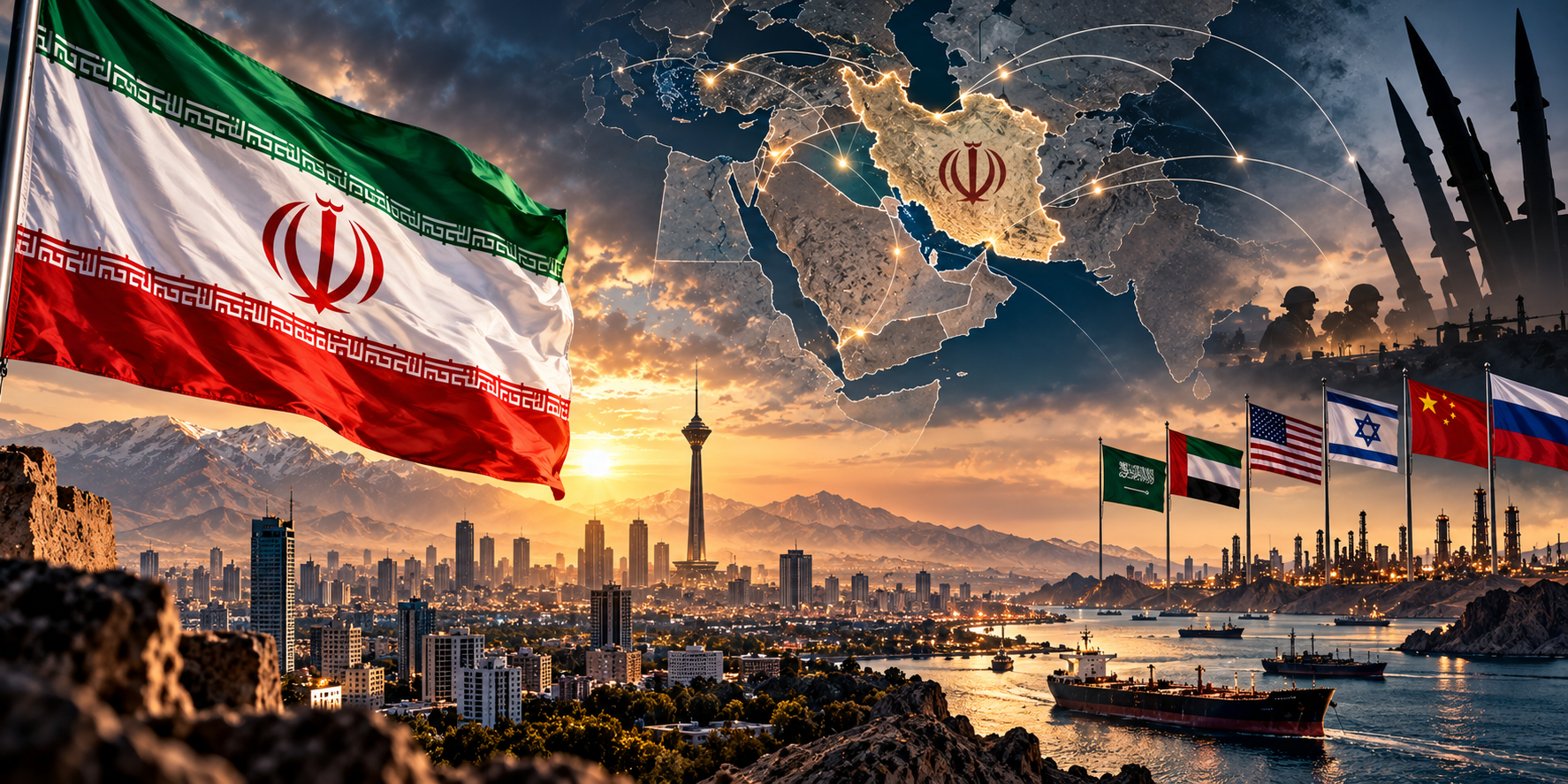
Iran remains too strategically important to be excluded from the Middle East’s future, yet the regional environment in which it once exercised influence has changed dramatically. As military confrontation, economic pressure and shifting alliances reshape the region, Tehran faces a defining question: can it turn strategic resilience into lasting political and economic security?
Introduction: Iran at a Strategic Crossroads
The Middle East is entering a period of profound realignment, and few countries have more at stake in its outcome than Iran.
For decades, Tehran built its regional strategy around a combination of military deterrence, partnerships with non-state armed groups, missile capabilities, ideological influence and resistance to American and Israeli power. This approach allowed Iran to project influence beyond its borders despite economic sanctions and a conventional military that faced significant disadvantages against better-equipped adversaries.
But the strategic environment has changed.
The weakening of several Iranian-aligned groups, the fall of Bashar al-Assad’s government in Syria, the expansion of direct confrontation with Israel and the United States, and the severe disruption caused by the 2026 war have challenged important elements of Iran’s regional strategy. The conflict has also exposed the economic and diplomatic costs of prolonged confrontation.
By late October 2026, Iran’s future remains uncertain. The conflict has not produced a settled regional order, and the relationship between Tehran and Washington remains deeply adversarial. Iran continues to possess important sources of leverage, but its ability to convert those assets into a stable regional position is an open question.
Iran is therefore approaching a strategic crossroads. It can prioritise deterrence and resistance, pursue a combination of military strength and pragmatic diplomacy, or eventually seek a broader regional accommodation that places economic recovery ahead of permanent confrontation.
These paths are not mutually exclusive in every respect. Tehran may combine elements of all three, adjusting its approach as circumstances change.
The central question is no longer simply whether Iran will remain a regional power. It is what kind of power it will become—and whether its strategy can deliver security, economic recovery and political stability at the same time.
1. The End of the Old Regional Equation
Iran’s regional position was built on a network of relationships extending across the Middle East. Its partnerships with Hezbollah in Lebanon, armed groups in Iraq, the Houthis in Yemen and Palestinian organisations formed part of a broader strategy intended to create strategic depth and complicate the calculations of Iran’s adversaries.
This network was often described as the Axis of Resistance. It gave Tehran multiple channels through which to exert pressure, respond to threats and increase the potential costs of military action against Iran itself.
The system had important limitations, but it helped Iran compensate for conventional military disadvantages.
Over time, however, the assumptions underpinning this approach came under pressure. The war following the October 2023 Hamas attacks on Israel devastated Gaza, weakened Hezbollah through the subsequent conflict in Lebanon and intensified the confrontation between Israel and Iran. The fall of Assad’s government in Syria further disrupted Tehran’s regional position by removing a longstanding state partner and complicating its strategic access to the Levant.
The 2026 war with the United States and Israel added another dimension. Direct confrontation placed Iran’s own military infrastructure, energy facilities and national economy under greater pressure.
These developments do not mean that Iran’s regional relationships have disappeared. Nor does the weakening of allied organisations necessarily eliminate their capacity to influence local conflicts. But the strategic value of those relationships can no longer be assumed to remain what it was before the regional upheavals.
A recent analysis by the Barcelona-based research institute CIDOB argues that Iran retains considerable capacity to disrupt regional calculations, while its ability to shape a positive regional order through its traditional network has become more constrained.
That distinction matters.
A country can retain the ability to impose costs on its opponents without possessing the economic strength, diplomatic relationships or institutional credibility required to build a stable regional settlement.
Iran’s next strategic phase will be shaped by whether it can bridge that gap.
2. The Military Question: Deterrence Without Permanent War
Iran’s security strategy has long been influenced by its experience of isolation, foreign intervention and the Iran-Iraq War of the 1980s. Its leadership has sought to make any attack on the country costly, using missiles, drones, asymmetric capabilities and relationships with regional partners.
The underlying logic is deterrence: convince adversaries that military action against Iran would produce consequences extending beyond the immediate battlefield.
The 2026 conflict has tested this approach.
Iran has demonstrated that it retains capabilities capable of affecting regional security and international commerce. Its ability to threaten shipping through the Strait of Hormuz has also reinforced the importance of geography in its strategic calculations.
Yet deterrence has a second dimension. It must protect the country without making repeated confrontation so costly that the economy, infrastructure and domestic political stability become increasingly difficult to sustain.
Iran now faces this dilemma more sharply.
If Tehran concludes that the war demonstrated the inadequacy of restraint, it may prioritise the rebuilding of missile forces, drones, air defences and other capabilities. It could also seek to strengthen its remaining regional partnerships and develop additional methods of imposing costs on its adversaries.
Such an approach might preserve elements of Iran’s deterrent capacity. However, it could also encourage further sanctions, increase the likelihood of renewed military confrontation and deepen the security concerns of neighbouring Gulf states.
An alternative would be to combine credible defensive capabilities with more predictable regional diplomacy. Under this approach, Iran would not necessarily abandon deterrence. Instead, it would attempt to reduce the circumstances in which military confrontation becomes the default instrument of policy.
The distinction is between possessing military leverage and relying on its repeated use.
For Iran, sustainable security will require more than demonstrating an ability to retaliate. It will also require arrangements that reduce the likelihood of another devastating conflict.
3. The Gulf States: From Rivalry Towards Managed Coexistence?
Iran’s relationship with the Arab Gulf states will be one of the most consequential elements of its future.
For years, Tehran and several Gulf governments have competed over regional influence, maritime security, political movements and the role of external powers. Saudi Arabia and Iran restored diplomatic relations in 2023 through an agreement brokered by China, creating an opportunity to reduce tensions without resolving their underlying differences.
The subsequent regional conflict has complicated that process.
The Gulf states have strong reasons to avoid another prolonged war. Their economic strategies depend on secure energy infrastructure, predictable shipping routes, foreign investment and international confidence. Military escalation threatens all four.
At the same time, attacks, maritime disruption and the possibility of renewed confrontation reinforce concerns about Iran’s regional conduct and the reliability of any diplomatic understanding.
The resulting environment is not one of straightforward reconciliation. It is one in which governments must balance competing priorities: deterrence, economic security, strategic autonomy and the need to preserve diplomatic channels.
Analysis by Chatham House has highlighted the emergence of a different Persian Gulf security equation following the 2026 conflict, with Iran’s economic vulnerability coexisting alongside its ability to threaten regional shipping and neighbouring states.
For Tehran, improved relations with Saudi Arabia, the United Arab Emirates, Qatar and Oman could reduce its diplomatic isolation and create opportunities for economic cooperation. But progress will depend on whether regional governments believe that dialogue can produce reliable commitments in practice.
For Gulf governments, engagement with Iran need not mean accepting its regional policies. Diplomacy can coexist with defensive cooperation, economic diversification and efforts to protect critical infrastructure.
A durable regional arrangement would need to address several issues:
- Respect for national sovereignty and territorial integrity.
- Protection of commercial shipping and freedom of navigation.
- Restraint in the use of force and support for destabilising cross-border activity.
- Communication mechanisms to reduce the risk of miscalculation.
- Greater transparency around military activity and regional security concerns.
Such arrangements would not eliminate rivalry. Their purpose would be to prevent rivalry from repeatedly escalating into war.
Iran’s future influence in the Gulf may depend less on its ability to dominate regional relationships than on whether it can become a participant in arrangements that neighbouring states consider credible and beneficial.
4. The United States and Israel: The Limits of a Military Solution
Iran’s relationship with the United States and Israel remains the central external constraint on its strategic choices.
Washington has sought to limit Iran’s military capabilities, constrain its nuclear programme and reduce the risks posed by its regional partnerships. Israel has viewed Iran’s military and nuclear activities as major security threats and has pursued efforts to weaken them.
Iran, in turn, has regarded American military deployments and Israeli operations as threats to its national security and the survival of its political system.
The 2026 war intensified this confrontation without producing a stable resolution.
By late August, a briefing from the UK House of Commons Library reported that efforts to establish a durable settlement had stalled, that sanctions had intensified and that the conflict had aggravated Iran’s economic difficulties. A separate Congressional Research Service report described a cycle of renewed strikes and a sanctions campaign following the collapse of earlier arrangements.
This leaves both sides facing difficult choices.
Continued military pressure may degrade particular capabilities, but it cannot by itself establish a lasting political settlement. Conversely, Iran’s ability to retaliate or disrupt regional commerce does not guarantee that it can compel its adversaries to accept its wider strategic objectives.
The central problem is that each side may regard continued pressure as necessary to improve its bargaining position, while the cumulative cost of confrontation increases for the entire region.
Any future negotiations would therefore need to address more than an immediate halt to military operations. The difficult questions include nuclear monitoring, sanctions relief, maritime security, missile capabilities, regional armed groups and mechanisms for verifying commitments.
These issues are interconnected, but attempting to resolve every disagreement in a single agreement could make negotiations harder to sustain.
A narrower arrangement focused on preventing renewed war, protecting shipping and establishing credible communication channels might offer a starting point. Whether either side would accept such a framework remains uncertain.
The long-term challenge is to create a relationship in which neither country believes that permanent confrontation offers greater security than a negotiated arrangement.
5. Iran’s Economy: The Domestic Constraint on Regional Ambition
Iran’s strategic future will ultimately be constrained by its economic condition.
Even before the 2026 war, the country faced longstanding problems involving sanctions, inflation, underinvestment, currency weakness, energy shortages and water stress. The conflict has compounded these pressures by damaging infrastructure, disrupting trade and increasing uncertainty over the country’s economic future.
A UK House of Commons Library assessment published in October 2026 reported that Iran’s currency had reached a record low against the US dollar in August and that year-on-year inflation had reached 84%. It also described continuing sanctions, disruption to maritime trade, energy shortages and rising unemployment. These figures reflect the period covered by that assessment and should not be treated as a permanent measure of Iran’s economic condition.
The consequences extend beyond household finances.
A weakened economy limits the government’s capacity to rebuild infrastructure, maintain public services, attract investment and provide opportunities for younger generations. It can also intensify competition over public resources and reduce the state’s ability to respond to environmental and social pressures.
Iran’s economic challenge is therefore not simply to restore oil exports or recover from war damage. It must address the interaction between external restrictions and domestic structural weaknesses.
A sustainable recovery would require several mutually reinforcing changes.
First, more predictable external relations. Reduced military risk and a credible path towards sanctions relief could improve trade, investment and access to international financial channels.
Second, domestic economic reform. Greater transparency, improved investment conditions, stronger financial institutions and more predictable regulation would help reduce barriers to private-sector activity.
Third, infrastructure renewal. Electricity, water, transport and industrial systems require investment that becomes more difficult when public finances are strained.
Fourth, human-capital retention. Iran has a substantial pool of educated professionals, but economic uncertainty and restricted opportunities can encourage skilled workers to seek employment abroad.
Fifth, a more balanced relationship between security spending and development. National defence remains a legitimate state responsibility, but prolonged confrontation can consume resources needed for economic renewal.
The political difficulty is that economic reform may require changes to established institutions and interests. Sanctions relief alone would not automatically resolve domestic inefficiencies, just as internal reform alone would not remove the effects of external restrictions.
Iran’s future prosperity will depend on how effectively it addresses both.
6. Domestic Politics: Security, Legitimacy and the Question of Governance
Iran’s regional strategy cannot be separated from its internal political structure.
The Islamic Republic combines elected institutions with powerful unelected bodies and religious and security institutions. The Islamic Revolutionary Guard Corps (IRGC) occupies an especially important position in the country’s military, security and economic systems.
The 2026 war has raised further questions about how power is distributed within the Iranian state.
An analysis published by the Stimson Center in August 2026 argued that the conflict strengthened the position of IRGC-linked commanders and security networks, while further narrowing the political space available to reformist and moderate currents. This is an assessment of evolving power structures, rather than proof that all internal political competition has disappeared.
If security institutions gain greater influence over strategic decision-making, Iran may adopt a more cautious approach towards perceived threats but a more restrictive approach towards domestic political opposition.
That possibility creates a fundamental tension.
The state may view centralised control as necessary to preserve national security. Yet long-term stability also depends on public confidence, economic opportunity and the ability of institutions to respond to social grievances.
Economic hardship, inflation, unemployment and restrictions on political expression can deepen dissatisfaction. External conflict may temporarily strengthen nationalist sentiment, but it can also intensify public frustration when the costs of confrontation fall on households and businesses.
Iran’s future political trajectory will depend partly on how its leadership interprets these pressures.
One possibility is greater centralisation, with national security prioritised over political opening. Another is a more pragmatic approach that attempts to restore public confidence through economic improvement and selective policy adjustments. A broader political transformation is also conceivable, but its timing, form and likelihood cannot be established with confidence.
The important point is that Iran’s regional posture and domestic legitimacy are connected. A foreign policy that repeatedly imposes high economic costs may become harder to sustain without corresponding improvements in the lives of ordinary citizens.
7. China, Russia and India: Partnerships With Limits
As relations with the United States remain hostile, Iran has incentives to strengthen its relationships with China, Russia, India and other countries outside the Western alliance system.
These relationships can provide diplomatic support, commercial opportunities, energy partnerships and alternative channels for trade. They may also reduce some of the pressure created by Iran’s international isolation.
However, these partnerships should not be mistaken for a unified strategic alliance capable of solving Iran’s problems.
China: Economic opportunity and strategic calculation
China is important to Iran as a potential buyer of energy, a major economic power and a diplomatic actor with influence in the Gulf. Beijing also has an interest in protecting regional trade and avoiding disruptions to energy markets.
But China’s relationship with Iran exists alongside extensive economic and diplomatic interests in Saudi Arabia, the UAE and other Gulf states. Beijing has incentives to preserve flexibility rather than automatically support every Iranian strategic objective.
For Tehran, the challenge is to turn its relationship with China into predictable economic benefits without assuming that Beijing will absorb the costs of Iran’s confrontation with Washington.
Russia: Strategic cooperation without unlimited guarantees
Russia and Iran have developed cooperation in security, military affairs and diplomacy. Their shared opposition to some aspects of Western policy creates areas of common interest.
Nevertheless, the relationship has limits. Russia has its own military and economic priorities, and its willingness or capacity to provide assistance in a particular crisis cannot be assumed. Cooperation does not necessarily amount to a binding guarantee of Iran’s security.
Tehran must therefore evaluate the relationship in terms of concrete capabilities, economic value and political commitments rather than broad declarations of partnership.
India: Connectivity, trade and strategic autonomy
India has historically sought to maintain relationships with Iran while expanding its economic and strategic partnerships with the Gulf states, Israel and the United States.
Connectivity projects, including the International North-South Transport Corridor and India’s interest in Chabahar Port, have offered potential routes linking South Asia with Iran, Central Asia and markets beyond. Their practical development, however, is affected by sanctions, financing, security conditions and wider geopolitical developments.
For Iran, India represents an important potential partner in trade and connectivity. But the scope of that relationship depends on the external constraints faced by Indian businesses and the viability of individual projects.
For all three countries, the broader lesson is the same: Iran’s partners may help reduce its isolation, but they cannot substitute for a more stable regional environment and a functioning domestic economy.
8. The Nuclear Question: A Central Test of Regional Security
Iran’s nuclear programme will remain one of the most consequential issues shaping its international relationships.
The dispute involves several connected concerns: the nature and scale of Iran’s nuclear activities, international monitoring, the risk of proliferation, sanctions and the security calculations of Israel, the United States and regional governments.
The 2026 conflict has made the issue more difficult. Military action and damage to nuclear-related infrastructure can complicate verification, increase mistrust and create uncertainty about the condition of facilities and the status of nuclear materials.
A lasting settlement would require credible monitoring and a framework capable of addressing the security concerns of the parties involved. It would also need to establish what sanctions relief or other benefits Iran might receive in return for verifiable commitments.
For Iran, the choice involves competing priorities. Maintaining nuclear-related capabilities may be viewed by some decision-makers as a source of leverage and deterrence. But continued uncertainty could deepen sanctions, discourage investment and reinforce the belief among adversaries that further military action may be necessary.
For the United States and Israel, attempts to prevent Iran from acquiring nuclear weapons must be considered alongside the consequences of military escalation and the limits of force in producing a verifiable, durable outcome.
The future of the nuclear issue is therefore not merely a technical question. It is part of the wider contest over whether Iran and its adversaries can establish rules that reduce the incentives for renewed conflict.
9. Three Possible Futures for Iran
Iran’s future is not predetermined. Several broad paths remain possible, and developments could combine elements of more than one.
Scenario One: Fortress Iran
In this scenario, Tehran concludes that the 2026 war confirms the need for greater military self-reliance and tighter domestic control.
The government prioritises the reconstruction of military capabilities, strengthens security institutions and deepens cooperation with Russia, China and other non-Western partners. Diplomatic engagement continues, but mainly as a way to manage immediate pressures or secure limited concessions.
This path could preserve the state’s ability to resist external pressure. However, it would risk extending economic isolation, increasing tensions with Gulf neighbours and making future military crises more likely.
It would also leave unresolved the domestic economic and governance problems that could undermine long-term resilience.
Scenario Two: Active Deterrence With Regional Engagement
Under this scenario, Iran retains significant military capabilities but combines them with a more pragmatic regional policy.
Tehran seeks to restore diplomatic channels with Saudi Arabia and other Gulf states, improve maritime communication and explore arrangements that reduce the risk of direct confrontation. It continues to resist American and Israeli pressure but recognises that economic recovery requires a more predictable regional environment.
This approach would not necessarily involve a fundamental ideological transformation. Diplomacy could remain an instrument of national security rather than a rejection of the existing political system.
Its success would depend on whether Iran’s neighbours consider its commitments credible and whether the United States and Israel are willing to negotiate arrangements that address their own security concerns.
Scenario Three: Gradual Strategic Normalisation
A more ambitious possibility would involve a gradual shift towards economic recovery, regional integration and more stable relations with external powers.
Such a transition could require changes in domestic priorities, more predictable economic rules, verifiable nuclear commitments and a sustained reduction in regional tensions. It would also require neighbouring governments to recognise that a stable Iran is preferable to a permanent cycle of military confrontation.
This scenario would be difficult. Decades of mistrust, competing security objectives and the political interests invested in the current confrontation would remain significant obstacles.
Nevertheless, normalisation need not happen all at once. Limited agreements on shipping, diplomatic communication, trade and nuclear monitoring could create opportunities for further progress if implemented consistently.
These three broad scenarios reflect possibilities rather than predictions. Iran’s actual trajectory will depend on internal leadership decisions, economic conditions, regional responses and the willingness of external powers to test diplomatic alternatives. Similar scenario frameworks have been explored by the Middle East Institute in its assessment of Iran’s strategic choices after the war.
10. What Regional Realignment Means for the Middle East
Iran’s future will influence the wider regional order, but it will not determine that order by itself.
Saudi Arabia and the UAE are pursuing economic diversification and seeking to protect investment, infrastructure and international trade. Israel remains focused on security threats and the regional balance of power. Turkey has its own strategic interests, while Iraq, Qatar, Oman and other regional actors must manage relationships that do not always align.
The United States, China, Russia and European powers also have interests in energy security, maritime access, nuclear non-proliferation and the future of regional partnerships.
This makes the Middle East increasingly difficult to describe through a simple division between opposing blocs. States may cooperate on one issue while competing on another. Diplomatic engagement can coexist with military deterrence, and economic partnerships can persist despite political disagreements.
For Iran, this creates both constraints and opportunities.
A more flexible regional order could provide room for selective agreements and economic engagement. But it could also leave Tehran facing a combination of security partnerships and diplomatic arrangements designed to limit its influence.
The decisive issue is whether Iran can participate in regional arrangements without treating every compromise as a strategic defeat—and whether its neighbours can pursue security without assuming that permanent exclusion or confrontation will produce stability.
The Gulf’s economic future, the security of maritime routes and the wider regional balance all depend partly on how this relationship evolves.
Conclusion: Iran Must Decide What Its Power Is For
Iran will remain a consequential Middle Eastern state because of its geography, population, energy resources, military capabilities and central position in regional security.
But being consequential is not the same as being secure, prosperous or influential in a way that produces lasting benefits.
The regional realignment has exposed the limits of an approach that relies heavily on military deterrence, strategic networks and resistance to external powers. These instruments can impose costs on adversaries and preserve bargaining leverage, but they cannot by themselves rebuild infrastructure, stabilise the currency, generate employment or establish trust with neighbouring countries.
Iran’s future will depend on whether it can connect national security with economic recovery and a more sustainable regional policy.
That does not mean it must abandon every element of its existing strategy. It means that military capabilities and diplomatic relationships must serve a wider national purpose: protecting the country while creating the conditions for its people and economy to recover.
The same challenge confronts Iran’s adversaries. A regional settlement that leaves every side expecting another war is unlikely to deliver lasting security. Military pressure may change capabilities, but a durable order requires credible rules, verifiable commitments and channels through which disputes can be managed.
Iran’s defining choice is whether it seeks influence primarily through the capacity to disrupt the regional order, or through a combination of deterrence, diplomacy and economic strength that allows it to help shape that order.
The outcome remains uncertain. But one conclusion is clear: the next phase of Iran’s history will be shaped not only by the military balance, but also by the decisions Tehran makes about its economy, governance and relationship with the wider Middle East.
The future of Iran and the future of regional stability are now closely connected. Neither can be secured through confrontation alone.


