


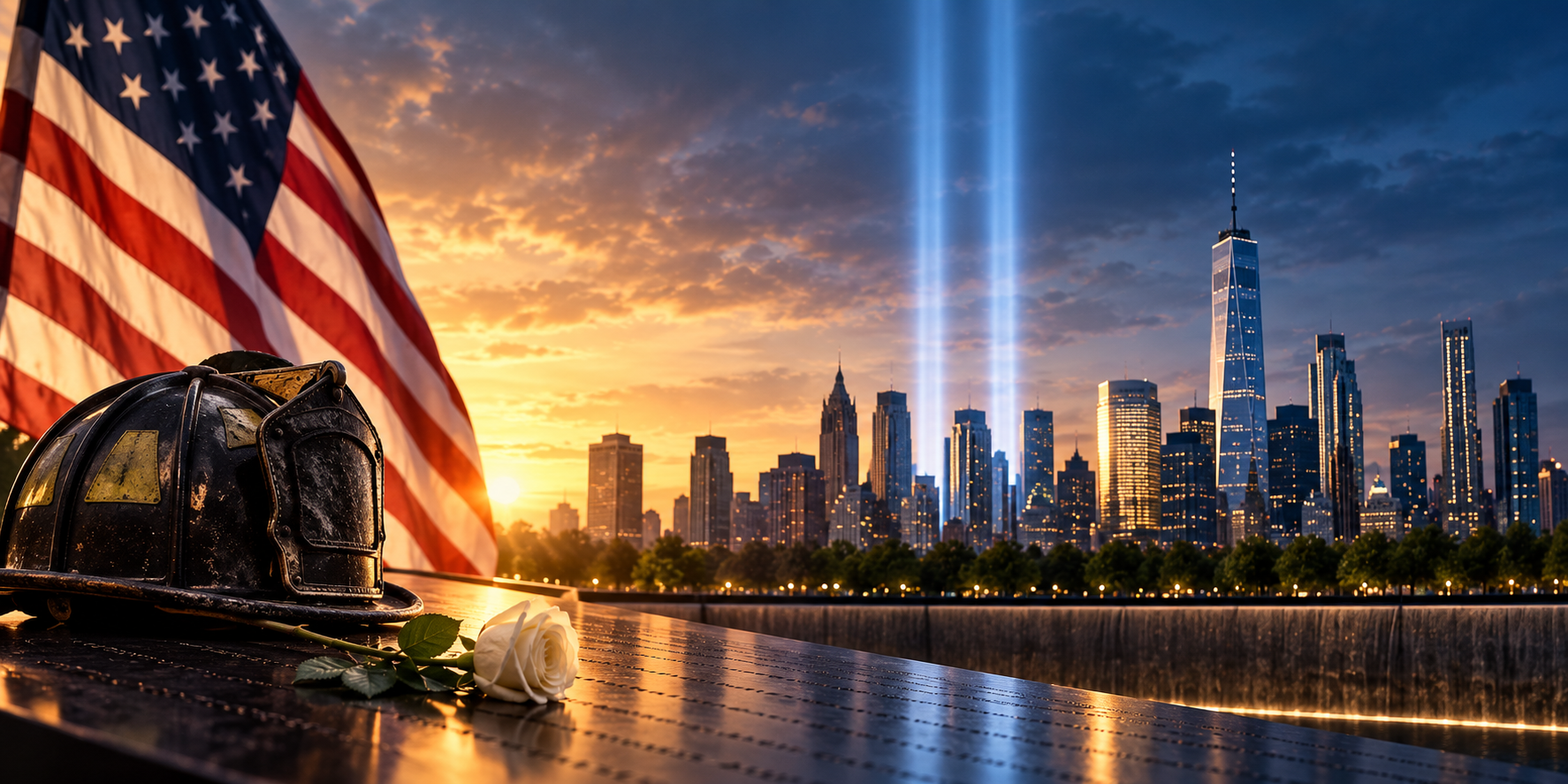
Twenty-five years later, the towers are gone, the wars have ended or changed form, a generation has grown up without remembering the morning itself — but the consequences of September 11, 2001 are still embedded in the world we live in.
At 8:46 in the morning on September 11, 2001, American Airlines Flight 11 struck the North Tower of the World Trade Center.
Seventeen minutes later, United Airlines Flight 175 hit the South Tower.
The Pentagon was attacked.
United Airlines Flight 93 crashed into a field near Shanksville, Pennsylvania after passengers and crew fought back against the hijackers.
By the end of the day, 2,977 people had been killed.
They came from more than 90 countries.
They were office workers, firefighters, police officers, airline employees, visitors, military personnel and children. They were Americans and foreigners, Christians, Jews, Muslims and people of many other faiths and backgrounds. The 9/11 Memorial describes the victims as a cross-section of humanity, ranging in age from two and a half to 85.
But the death toll did not end that day.
For thousands of survivors and first responders, September 11 became a lifelong medical and psychological battle.
And for the world, it became a geopolitical dividing line.
There is the world before 9/11.
And there is the world after it.
The Morning That Changed History
The attacks were unprecedented in their scale and method.
The United States had experienced terrorism before. It had faced attacks overseas and the 1993 bombing of the World Trade Center.
But September 11 was different.
Commercial aircraft had been transformed into weapons.
The targets were not only buildings.
They were symbols.
The World Trade Center represented American economic power.
The Pentagon represented American military power.
Washington itself represented political power.
The attackers were seeking not simply casualties, but psychological shock.
They succeeded.
The 9/11 Commission later described September 11 as a moment when the United States became a transformed nation and concluded that the country had been unprepared for the nature of the attack.
But amid the catastrophe came something that has endured longer than many of the political arguments that followed.
People ran toward the danger.
The First Responders Who Ran Into the Fire
Firefighters entered burning towers while thousands of people were trying to escape.
Police officers moved upward through stairwells.
Paramedics established emergency treatment areas in conditions that were almost impossible to comprehend.
Port Authority officers, emergency medical workers, transit workers and ordinary civilians helped strangers reach safety.
And then the buildings collapsed.
Hundreds of first responders were killed at the World Trade Center.
Their deaths became one of the defining symbols of September 11: the instinct to save another human being even when personal survival was no longer certain.
The heroism of that morning is easy to turn into mythology.
But for the families left behind, it was painfully real.
A spouse lost a partner.
A child lost a parent.
Parents lost sons and daughters.
Friends lost friends.
And thousands of families suddenly had to build a future around an absence.
That absence never disappeared.
The Passengers of Flight 93
The story of Flight 93 became another symbol of resistance.
After learning through telephone calls that other hijacked aircraft had already been used in attacks, passengers and crew understood that their aircraft was part of a larger operation.
They fought back.
The plane crashed in Pennsylvania before reaching its intended target.
Everyone aboard died.
But their actions prevented the aircraft from reaching whatever target the hijackers had selected.
Twenty-five years later, the Flight 93 story remains one of the most powerful examples of ordinary people making an extraordinary decision under unimaginable circumstances.
They were not soldiers.
They were passengers.
And on that morning, they became something else.
They became the line between the hijackers and another possible catastrophe.
The World Stood With America
The immediate international reaction to 9/11 was remarkable.
Flags were lowered.
Candles were lit.
Vigils appeared in cities around the world.
The victims were from more than 90 countries, making the tragedy international even before governments responded.
NATO invoked Article 5 — its collective-defense clause — for the first and, so far, only time in its history.
An attack on the United States was treated as an attack on the Alliance.
NATO subsequently deployed forces and capabilities in support of the U.S.-led response and eventually assumed command of the International Security Assistance Force in Afghanistan.
The United Nations also responded.
On September 28, 2001, the Security Council unanimously adopted Resolution 1373, establishing a broad international counterterrorism framework and creating the Counter-Terrorism Committee to monitor implementation.
For a brief moment, the international system appeared remarkably united.
The United States had been attacked.
The world wanted the perpetrators held accountable.
But that unity would not last forever.
From Counterterrorism to the War on Terror
The United States invaded Afghanistan in October 2001, targeting al-Qaeda and the Taliban government that had provided the organization sanctuary.
The mission initially had a clear objective:
prevent Afghanistan from being a safe haven for international terrorism.
But the war became much longer and more complicated.
The United States and its allies remained in Afghanistan for two decades.
The Taliban eventually returned to power.
The war became one of the defining strategic failures — and enduring debates — of the post-9/11 era.
Then came Iraq.
The 2003 invasion of Iraq was not a direct response to the September 11 attacks, and the 9/11 Commission’s account distinguishes the Iraq question from the campaign against al-Qaeda. Congress had enacted a separate 2002 authorization for the use of military force against Iraq.
But politically, Iraq became inseparable from the broader post-9/11 era.
That decision transformed the Middle East.
It destabilized Iraq, contributed to the emergence of new extremist movements and consumed enormous American and allied resources.
The lesson of the post-9/11 period became increasingly complicated:
A terrorist attack can be defeated militarily without the political consequences of the response necessarily being controllable.
The Security State Was Rebuilt
9/11 also transformed the United States from within.
Airport security changed.
Intelligence agencies changed.
Borders changed.
Financial systems were redesigned to track terrorist financing.
Information-sharing between government agencies became a national priority.
The Department of Homeland Security was created in 2002.
The USA PATRIOT Act expanded investigative powers.
The 9/11 Commission itself warned that the expansion of government power needed to be balanced against privacy and civil liberties.
That tension remains one of the most important legacies of September 11.
How much freedom should a democracy surrender in order to become safer?
And who decides when extraordinary security powers have gone too far?
Those questions did not disappear when al-Qaeda’s operational capabilities declined.
They became part of the permanent political debate.
The Muslim World Was Changed Too
One of the most complicated consequences of 9/11 was the relationship between the West and the Muslim world.
The attacks were carried out by an extremist organization claiming an Islamist justification.
But the overwhelming majority of Muslims did not support the attacks.
That distinction was often blurred in the years that followed.
Muslim communities in the United States and Europe experienced suspicion, discrimination and, at times, violence.
The politics of immigration and integration changed.
The meaning of national security changed.
And the relationship between Islam, terrorism and Western politics became one of the defining political questions of the early 21st century.
This was one of 9/11’s most damaging unintended consequences.
An extremist organization sought to divide societies.
In some cases, the aftermath helped deepen those divisions.
The challenge after 9/11 was therefore not simply defeating terrorism.
It was doing so without allowing terrorists to define relationships between entire religions, civilizations or communities.
Saudi Arabia: From Suspicion to Strategic Partnership
Few relationships demonstrate the complexity of the post-9/11 world better than the relationship between the United States and Saudi Arabia.
Fifteen of the 19 hijackers were Saudi nationals.
That fact generated intense scrutiny of Saudi Arabia.
Twenty-five years later, questions surrounding alleged assistance to two hijackers remain part of ongoing litigation by victims’ families. Newly surfaced records have renewed calls for additional declassification, while Saudi Arabia continues to deny that its government knowingly supported al-Qaeda or the attacks. A federal judge has allowed the families’ case to proceed, but allegations and evidence remain contested.
Yet the broader U.S.-Saudi relationship evolved rather than collapsed.
Saudi Arabia itself became a target of al-Qaeda terrorism.
The Kingdom expanded counterterrorism cooperation with Washington and developed extensive security cooperation with the United States.
Today, Washington describes Saudi Arabia as a significant partner in security and counterterrorism, while the two countries maintain extensive military, economic and diplomatic ties.
This is one of the great geopolitical ironies of the post-9/11 world:
a relationship placed under extraordinary suspicion by the attacks ultimately became an important part of the campaign against the extremist movement that carried them out.
Yet for many 9/11 families, unanswered questions about Saudi-linked individuals remain deeply personal.
Twenty-five years have not erased them.
India and the Post-9/11 World
For India, September 11 was also significant.
India had experienced terrorism for decades and immediately understood the dangers of transnational extremist networks.
Over time, counterterrorism became an important component of the growing India-U.S. relationship.
Today, India and the United States cooperate on intelligence, counterterrorism, homeland security, cybersecurity and law enforcement. The bilateral counterterrorism relationship includes information exchange, capacity building, operational cooperation and regular dialogue.
The relationship between Washington and New Delhi today is vastly broader than it was in 2001.
That evolution was shaped by many factors — China’s rise, Indo-Pacific strategy, defense cooperation and economic ties among them — but the post-9/11 security environment helped accelerate the recognition that the two democracies faced increasingly interconnected security challenges.
Russia, China and the End of the Unipolar Moment
Immediately after 9/11, the geopolitical environment briefly looked different.
Russia expressed solidarity with the United States.
China condemned the attacks.
NATO stood behind Washington.
There was an extraordinary degree of international recognition that terrorism represented a common threat.
But the strategic relationship between the great powers evolved dramatically afterward.
The United States became deeply engaged in Afghanistan and Iraq.
Russia’s relationship with Washington deteriorated over the following years.
China’s economic power expanded.
The global financial crisis weakened confidence in the Western economic model.
And by the 2020s, great-power competition had returned.
The world of 2026 is no longer the overwhelmingly unipolar environment that existed immediately after 9/11.
The United States remains the world’s most powerful military and one of its largest economic and technological powers.
But China is a global competitor.
Russia remains a major military power.
India has become a more consequential strategic actor.
Middle powers have gained greater room to maneuver.
And the international system is increasingly multipolar.
In that sense, 9/11 sits at the beginning of a geopolitical era that ultimately produced a very different world from the one many expected in 2001.
The Families Never Got to Leave September 11 Behind
For the rest of the world, September 11 became history.
For the families, it became biography.
Every birthday.
Every anniversary.
Every graduation.
Every wedding.
Every child who grew older without a parent.
Every photograph that became more valuable with time.
The grief evolved.
It did not disappear.
Some families became activists.
Some fought for compensation.
Some demanded greater transparency.
Some became advocates for peace.
Some simply continued living.
Organizations such as Voices Center for Resilience were created by people who lost loved ones and sought to help other families navigate grief, trauma and the long aftermath of mass tragedy.
The 9/11 Memorial itself became a place where the enormous scale of the event could be reduced to individual lives.
Names.
Faces.
Stories.
A father.
A mother.
A son.
A daughter.
A colleague.
A friend.
That is important because numbers eventually become abstract.
Names do not.
The First Responders Paid a Price Long After the Cameras Left
Perhaps the most overlooked part of the 9/11 story is what happened after the dust settled.
The people who survived Ground Zero did not simply walk away from the disaster.
They carried exposure to dust, smoke and toxic substances.
They developed respiratory illnesses, cancers, mental-health conditions and other chronic diseases.
The World Trade Center Health Program now serves nearly 150,000 members across all 50 states and U.S. territories. It provides medical monitoring and treatment for certified 9/11-related conditions among responders and survivors.
The program covers conditions including respiratory and digestive disorders, cancers and mental-health conditions such as PTSD, depression and anxiety.
The implication is profound.
The emergency did not end when the buildings stopped burning.
For many people, it became a medical condition that could surface years or even decades later.
That is why the 25th anniversary is not only about remembering the people who died on September 11.
It is also about remembering those who are still living with what happened there.
Twenty-Five Years Later, the Death Toll Has Not Stopped
The 9/11 Memorial’s 2026 commemoration includes a new seventh moment of silence specifically honoring people who have died from 9/11-related health effects.
That is a significant change.
For decades, the annual ceremony focused on the victims killed on the day itself.
Now remembrance is being expanded to acknowledge the second wave of loss.
The Memorial will continue its annual reading of the names of the 2,983 people memorialized for the 2001 attacks and the 1993 World Trade Center bombing, while the additional moment of silence recognizes those lost to the health consequences of 9/11.
The symbolism is powerful.
September 11 is no longer a single-day tragedy.
It is a continuing story.
A Generation Has Grown Up Without 9/11
Perhaps the clearest sign of how much time has passed is this:
Millions of Americans have no personal memory of September 11.
The 9/11 Memorial estimates that approximately 100 million Americans are too young to remember the day themselves.
For them, 9/11 is history.
It exists in photographs.
Documentaries.
School textbooks.
Museum exhibits.
Family stories.
Names carved into stone.
That creates a new responsibility.
The challenge is no longer simply to remember.
It is to teach what happened without turning history into mythology or politics.
The next generation needs to understand both the horror of the attacks and the complexity of what followed.
What Does 9/11 Mean in 2026?
Twenty-five years later, the world is asking a different question.
Not:
“Where were you when it happened?”
But:
“What did we become afterward?”
The United States became more security-conscious.
Air travel became more controlled.
Intelligence agencies became more integrated.
NATO changed its strategic focus.
Counterterrorism became a permanent feature of international diplomacy.
Wars were launched.
Wars were prolonged.
Wars ended.
New terrorist organizations emerged.
Al-Qaeda was weakened.
ISIS later emerged from the instability of the post-Iraq environment.
The Taliban returned to power.
The Middle East experienced enormous political upheaval.
The United States’ relationship with the Muslim world became more complicated.
China rose.
India rose.
Russia returned as a major challenger to the West.
And the international system became more fragmented.
The world that exists today cannot be understood without September 11.
But neither can it be understood only through September 11.
History is not a straight line.
9/11 was a catalyst.
The choices made afterward shaped the consequences.
The Greatest Lesson May Be About Power
The central lesson of September 11 may not be that terrorism is powerful.
It is that small groups can trigger decisions by great powers that reshape the world.
Nineteen hijackers changed American foreign policy.
They triggered wars.
They transformed intelligence agencies.
They changed airports.
They altered immigration politics.
They reshaped alliances.
They influenced generations of soldiers.
They changed how Muslims were perceived in many Western societies.
They altered the strategic balance of the Middle East.
That is an extraordinary demonstration of asymmetric power.
But there is another lesson.
The response to terrorism is itself a choice.
Military force is a choice.
Surveillance is a choice.
Diplomacy is a choice.
Coalition-building is a choice.
Nation-building is a choice.
Restraint is a choice.
The history of the last 25 years demonstrates that the consequences of those choices can last much longer than the crisis that produced them.
The World Today Is Not the World of September 12, 2001
On September 12, 2001, the dominant emotion was shock.
Then came solidarity.
Then war.
Then exhaustion.
Then debate.
Then revision.
And eventually, memory.
Today, the geopolitical threats facing the world are different.
Terrorism remains a threat, but states are again competing directly with one another.
Cyberwarfare has become central.
Artificial intelligence is changing security.
Drones have transformed warfare.
Great-power rivalry has returned.
Economic coercion has become a weapon.
And geopolitical competition increasingly stretches across technology, finance, energy, supply chains and information.
The security architecture created after 9/11 has not disappeared.
But it now sits inside a much more complicated world.
What Should We Remember?
The easiest way to remember 9/11 is through the images.
The towers burning.
The smoke over Manhattan.
The Pentagon.
The field in Pennsylvania.
The photographs of missing people.
The American flags.
The faces of firefighters.
The empty spaces where buildings once stood.
But remembrance must go beyond images.
Remember the 2,977 people who never went home.
Remember the firefighters and police officers who climbed upward while others ran down.
Remember the passengers and crew of Flight 93.
Remember the emergency workers who spent days, weeks and months at Ground Zero.
Remember the families who had to raise children without mothers and fathers.
Remember the survivors who still carry physical and psychological scars.
Remember the Muslim Americans who faced hatred for crimes they did not commit.
Remember the soldiers who went to Afghanistan and Iraq.
Remember the civilians caught in those wars.
Remember the political decisions made in the aftermath — including those that succeeded and those that failed.
And remember the extraordinary solidarity that appeared around the world in the first hours and days.
Because remembering only the destruction tells half the story.
The other half is about what human beings did in response.
Twenty-Five Years Later: Never Forget, But Also Never Stop Learning
On September 11, 2026, families will gather again at the Memorial.
The names will be read.
The moments of silence will return.
The Tribute in Light will rise over New York.
The memorial pools will continue to occupy the footprints of the towers.
And another generation will ask what happened.
The answer should not be simply:
“Terrorists attacked America.”
That is where the story begins.
It is not where the story ends.
The deeper story is about nearly 3,000 lives lost, thousands of heroes who responded, families who spent 25 years carrying grief, survivors who continue to fight illness, soldiers who went to distant wars, societies that changed their understanding of security and freedom, and a world whose political architecture was permanently altered.
Twenty-five years later, the most important act of remembrance is not anger.
It is not revenge.
It is not political division.
It is not using the memory of the dead to settle the arguments of the living.
It is remembering the human beings who were there.
The people who ran.
The people who stayed.
The people who rescued.
The people who waited.
The people who mourned.
And the people who kept going.
Because September 11 was a day of unimaginable loss.
But it was also a day that revealed something equally powerful:
when history breaks, ordinary people often become extraordinary.
Twenty-five years later, the world remembers the darkness.
But it should remember the courage that appeared inside it, too.
We remember the dead.
We honor the living.
And we carry the lessons forward.


