


The International Wire | Geopolitics
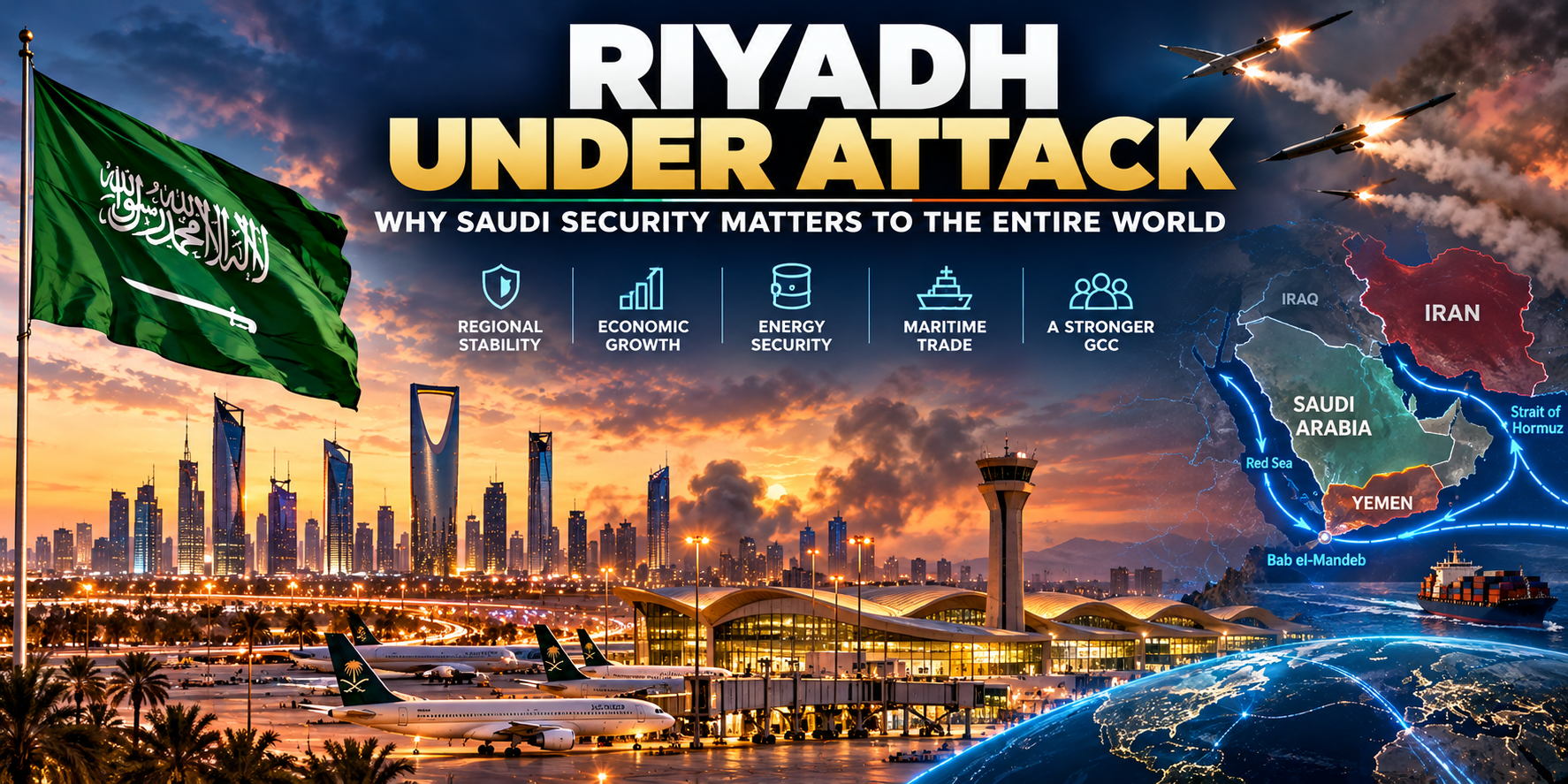
The renewed Houthi attacks on Saudi Arabia have brought the wider Iran war closer to the Gulf’s economic heart. For Riyadh and its GCC partners, the priority is to defend sovereignty, protect civilians and preserve regional stability. For the world, the stakes include energy security, maritime trade and confidence in the global economy.
Saudi Arabia’s economic transformation rests on a clear ambition: to make the kingdom a global centre for investment, tourism, logistics, technology and international business. The renewed Houthi attacks on Riyadh have put that ambition under pressure, demonstrating how a regional war can threaten not only national security but also the economic foundations of the wider Gulf.
The attacks on King Khalid International Airport in October 2026 caused significant casualties and severe disruption to air travel. Saudi authorities reported 13 deaths and more than 300 injuries in the strike on 10 October, followed by another attack the next day that killed one person and injured nearly a dozen. The Houthis claimed responsibility for the attacks, which Saudi Arabia and regional partners condemned as a dangerous escalation.
These were not merely attacks on transport infrastructure. An international airport connects families, businesses, diplomats, investors and global supply chains. Targeting it threatens civilians and disrupts the movement of people and goods far beyond the immediate area.
The wider context is the war involving Iran, the United States and Israel, which has increased risks to energy supplies and maritime routes across the Middle East. The renewed Houthi campaign has brought those risks directly to Saudi Arabia, a central pillar of the Gulf’s economic and security architecture.
The central issue is larger than the battlefield: Saudi Arabia’s security is inseparable from GCC stability, and Gulf stability is a strategic interest for the global economy.
Saudi Arabia’s Sovereignty and the Principle of Civilian Protection
Saudi Arabia has a legitimate responsibility to defend its territory and protect its citizens and residents. That responsibility is especially urgent when attacks threaten civilian airports and critical infrastructure.
The Gulf Cooperation Council has expressed solidarity with the kingdom. Its leadership has condemned Houthi attacks on Saudi airports and other locations, emphasising that the security of Saudi Arabia is integral to the security of all GCC member states.
On 12 October, Saudi Arabia, Turkey, Pakistan and Egypt jointly condemned the attacks and called for an immediate halt to hostilities. Their statement supported legitimate measures by Riyadh to counter the threats and prevent further attacks.
This regional solidarity reflects a shared interest in protecting civilian populations, maintaining the safety of international aviation and preventing further escalation. It also reinforces a fundamental principle: civilian infrastructure must not become an accepted instrument of political or military pressure.
Saudi Arabia’s response must protect its population while remaining consistent with international law, including the obligation to distinguish civilians from military targets. The broader objective should be to restore deterrence without allowing retaliation to become an open-ended conflict.
The Yemen Front and the Wider Iran War
The renewed confrontation with the Houthis cannot be separated from the broader regional crisis. The movement, which is aligned with Iran and has received Iranian support, possesses missile and drone capabilities that can threaten targets well beyond Yemen. Its leadership also has domestic political objectives, meaning that the conflict cannot be understood solely as a direct extension of Tehran’s policy.
Saudi Arabia’s challenge is both immediate and strategic: defend its territory, protect critical infrastructure and prevent Yemen from becoming a prolonged additional front in the wider war.
The geography matters. The Bab el-Mandeb Strait connects the Red Sea with the Gulf of Aden and forms part of a major shipping corridor linking Asia and Europe through the Suez Canal. A deterioration in security around Yemen can increase risks to commercial shipping, raise insurance costs and force vessels onto longer routes.
The renewed fighting in Yemen threatens Saudi security and maritime access through the Red Sea, including routes that can offer alternatives when traffic through the Strait of Hormuz is disrupted.
This creates a serious strategic dilemma. A stronger military response may be necessary to deter attacks, but an expanding campaign could provoke further retaliation and deepen the humanitarian crisis in Yemen. The sustainable objective is to protect Saudi Arabia while preserving a path towards a political settlement.
The GCC’s Shared Security Interest
The Gulf’s prosperity depends on the reliability of its infrastructure: airports, seaports, energy facilities, telecommunications networks and commercial corridors. Threats to one country can quickly affect its neighbours through disrupted travel, higher insurance premiums, energy-market volatility and reduced business confidence.
For the GCC, collective security is a practical economic necessity, not simply a diplomatic statement.
Three priorities stand out.
- Defensive cooperation: Strengthen intelligence sharing, early-warning systems, air defence and protection of critical infrastructure.
- Maritime security: Work with regional and international partners to safeguard commercial shipping and freedom of navigation.
- Diplomatic engagement: Maintain channels to reduce miscalculation and prevent a cycle of attacks and retaliation from widening the war.
The GCC’s members have different diplomatic relationships and national priorities. Unity does not require identical positions on every regional issue. It requires a shared commitment to protecting sovereignty, civilians and the economic foundations of the Gulf.
Vision 2030: Protecting Confidence in Saudi Arabia
Saudi Arabia’s Vision 2030 programme aims to broaden the economy beyond hydrocarbons by expanding tourism, entertainment, technology, logistics, manufacturing and international services. These ambitions depend on long-term investment and reliable operating conditions.
The attacks have created a reputational challenge. Aviation disruption has led to flight cancellations and suspensions, while uncertainty has also affected major events in Riyadh and the participation of senior international energy executives.
The consequences may reach tourism, hospitality, international conferences, aviation, logistics and large development projects. Businesses may reassess travel arrangements, insurance exposure and continuity plans. Investors may delay decisions while seeking greater clarity about the security environment.
These are real risks, but they do not mean Saudi Arabia’s economic transformation has failed. The kingdom retains substantial economic capacity and significant opportunities across its domestic market and international partnerships.
The test is whether the country can protect essential services, restore reliable transport, communicate clearly with investors and sustain economic activity during a period of regional instability. Confidence is built not by dismissing security concerns, but by demonstrating the ability to manage them.
Saudi Arabia’s future should not be defined by the attacks it faces. It will depend on how effectively it protects its people, strengthens resilience and continues to pursue its economic ambitions.
The Global Economic Consequences
The conflict’s effects extend well beyond the Gulf. Energy prices, shipping costs and supply-chain uncertainty can transmit regional instability into the global economy.
Oil markets respond both to actual supply losses and to the risk of future disruption. Threats to energy infrastructure or maritime routes can raise price volatility, increasing costs for importing countries and energy-intensive industries. Higher fuel prices can also feed into transport, manufacturing and consumer prices.
Shipping faces similar pressures. When vessels encounter greater security risks, operators may change routes and insurers may increase premiums. Longer journeys can raise fuel consumption, delay deliveries and tie up shipping capacity. These effects can spread from oil and gas to manufactured goods, industrial inputs, chemicals and agricultural products.
Food and fertiliser supply chains are also exposed to higher energy and freight costs. The consequences are particularly difficult for lower-income countries, where households spend a greater share of their income on essential goods.
The impact is uneven. Energy exporters whose production and shipments remain secure may benefit from higher prices, while import-dependent economies can face larger bills and inflationary pressure. Businesses may have to absorb higher costs or pass them on to consumers.
The central point is that the security of Saudi Arabia and the wider GCC is not a regional concern alone. It is closely connected to the stability of global energy markets and international trade.
Diplomacy Must Prevent a Wider War
Military preparedness is necessary to defend Saudi territory, but it cannot by itself resolve Yemen’s political divisions or eliminate the incentives driving regional escalation.
A durable approach must address the immediate threat to Saudi Arabia while preserving a route towards political de-escalation. It must also recognise that the wider confrontation involving Iran, the United States and Israel makes regional diplomacy more difficult.
If every attack triggers retaliation and every retaliation produces another round of attacks, Yemen risks becoming a prolonged extension of the broader war. The result would be greater civilian suffering, continuing pressure on shipping and higher economic costs across the region.
Diplomatic channels should therefore remain open alongside defensive measures. Any credible process would need to address attacks on Saudi territory, threats to commercial shipping, humanitarian access and Yemen’s political future.
The objective is not to reward aggression. It is to create conditions in which Saudi Arabia can protect its people without facing recurrent attacks, Yemen can move towards a political settlement, and the Gulf can return its attention to development and prosperity.
Conclusion: A Secure Saudi Arabia Is in the World’s Interest
The renewed Houthi attacks on Riyadh are a direct threat to Saudi sovereignty and civilian safety. They also reveal how the wider Iran war is placing pressure on Yemen, Gulf security and the maritime routes on which global commerce depends.
Saudi Arabia has a legitimate responsibility to defend its territory. The GCC’s solidarity reflects the reality that the kingdom’s security is closely connected to the stability and prosperity of the entire Gulf.
The attacks also test Saudi Arabia’s economic transformation. Vision 2030 depends on connectivity, investor confidence and reliable infrastructure. Preserving those foundations requires strong defensive capabilities, effective contingency planning, clear communication and continued economic execution.
The wider world has a stake in the outcome. Disruption to Gulf energy supplies and Red Sea shipping can increase costs for businesses, governments and households across continents. Protecting regional stability is therefore a shared international interest.
The way forward must combine firmness on sovereignty with a clear commitment to de-escalation. Saudi Arabia should not be expected to tolerate attacks on its cities or civilian infrastructure. At the same time, the region cannot afford an indefinite cycle of retaliation that deepens Yemen’s suffering and threatens global trade.
For Saudi Arabia, the task is to protect its people and preserve its economic future. For the GCC, it is to turn solidarity into practical security cooperation. For the international community, it is to recognise that a secure Gulf is essential to global economic stability.


