


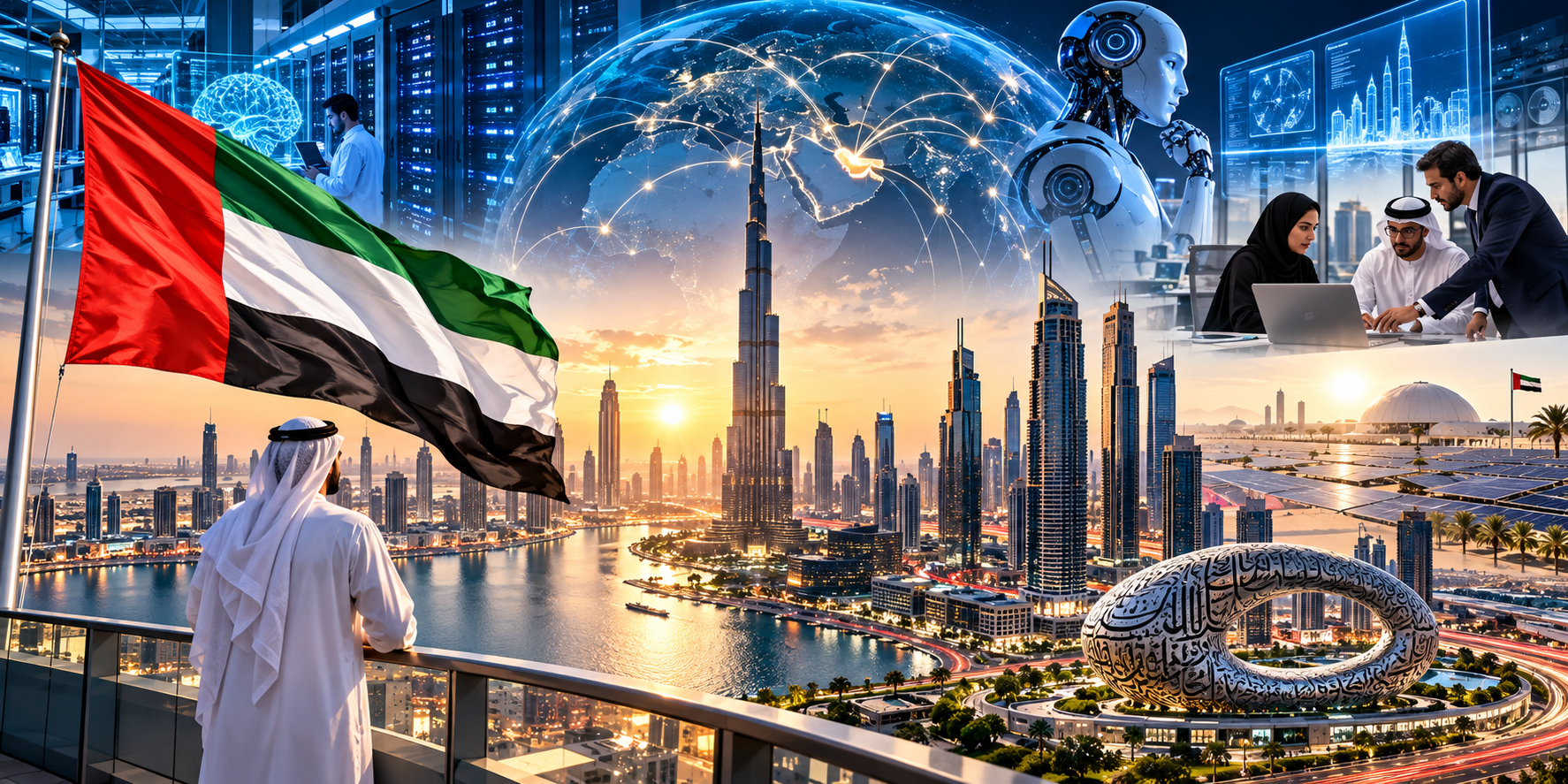
From sovereign wealth and advanced data centres to global technology partnerships and AI-powered government, the United Arab Emirates is positioning itself at the centre of the next technological revolution. Its ambition extends beyond adopting artificial intelligence: it wants to help build, finance and govern the infrastructure on which the AI economy will depend.
Introduction: The UAE’s Next Economic Transformation
For decades, the United Arab Emirates built its international influence through energy, aviation, logistics, finance, tourism and global trade. Today, it is pursuing another strategic ambition: becoming a major global centre for artificial intelligence.
The shift reflects a broader transformation in the world economy. Artificial intelligence is no longer simply a software industry. It is becoming a strategic resource that depends on advanced semiconductors, enormous computing capacity, reliable electricity, data infrastructure, research talent and access to capital. Countries able to bring these elements together will have an advantage in developing AI systems and deploying them across their economies.
The UAE has recognised this early.
Through long-term national strategies, sovereign investment vehicles, partnerships with global technology companies and efforts to integrate AI into government services, the country is attempting to establish itself across multiple layers of the AI value chain. Its ambitions extend from building computing infrastructure and attracting international companies to developing Arabic-language AI capabilities and applying intelligent systems in finance, healthcare, energy, transport and public administration.
The strategy is visible in both Abu Dhabi and Dubai. Abu Dhabi is leveraging state-backed capital, technology companies and large-scale infrastructure projects. Dubai is using its international business ecosystem, digital-government initiatives and efforts to attract technology entrepreneurs and skilled professionals.
The UAE’s National Strategy for Artificial Intelligence 2031 established the policy direction in 2017. Subsequent initiatives have expanded the ambition from adopting AI to building an integrated ecosystem for investment, innovation, governance and deployment. In April 2026, the UAE announced a framework intended to move 50% of government sectors and operations towards agentic AI within two years. The government also approved the establishment of an Artificial Intelligence and Data Authority in June 2026 to coordinate public data, AI and digital-government capabilities.
These initiatives reveal the scale of the ambition. The UAE wants AI to become not merely another technology sector, but an important foundation of its economic diversification and international competitiveness.
1. Beyond Oil: AI as a New Pillar of Economic Power
Economic diversification has been a central objective of the UAE’s development strategy. Although oil and gas remain important, the country has spent decades expanding into sectors that generate income, employment and international influence beyond hydrocarbons.
Artificial intelligence offers an opportunity to accelerate that transition.
Unlike traditional industries, AI can influence productivity across multiple sectors simultaneously. It can help financial institutions assess risk, logistics companies optimise routes, energy providers manage infrastructure, hospitals support clinical workflows and governments improve service delivery.
The UAE’s attraction to AI is therefore not limited to the revenue generated by technology companies. It also lies in the potential to make the wider economy more productive and internationally competitive.
International economic assessments have identified the UAE’s AI investments, global partnerships, education initiatives and government adoption as important elements of its emerging position in the global AI economy. They have also highlighted challenges associated with labour-market disruption, energy consumption, security and systemic risk.
For the UAE, AI could support several strategic objectives:
- Economic diversification: Build technology-related industries alongside established sectors such as energy, finance, tourism and logistics.
- Productivity: Automate repetitive work and improve decision-making in both government and business.
- Foreign investment: Attract technology companies, infrastructure providers, entrepreneurs and research partnerships.
- Skills development: Expand demand for engineers, data specialists, AI researchers and technology managers.
- International influence: Become a partner of choice for countries and companies seeking computing capacity, investment and AI expertise.
The underlying strategy is to use the UAE’s existing economic strengths to enter an industry that could shape the next generation of global growth.
2. Sovereign Wealth: The Capital Behind the AI Ambition
One of the UAE’s most significant advantages is its ability to mobilise large pools of capital for long-term strategic investments.
AI infrastructure is expensive. Building data centres, acquiring advanced chips, developing models and recruiting specialist talent can require substantial investment before a business generates consistent returns. In many cases, infrastructure must be developed years ahead of the demand it is expected to serve.
The UAE’s state-linked investment ecosystem gives it the capacity to participate in projects that require long investment horizons. Abu Dhabi’s financial institutions and technology companies can invest domestically while also building relationships with global AI developers, semiconductor suppliers and infrastructure providers.
An important example is MGX, an Abu Dhabi-based investment company established to focus on artificial intelligence and advanced technologies. Its mandate reflects the UAE’s intention to participate in the financing of the global AI ecosystem, rather than limiting its investments to domestic applications.
G42, the Abu Dhabi-based technology group, is another important part of the strategy. It operates across AI, cloud computing, data infrastructure and related technologies, helping connect local investment ambitions with international technology partnerships.
The distinction is important. A country can attract foreign technology companies without owning or financing a significant part of the ecosystem. The UAE is attempting to occupy both positions: a market for international AI companies and a source of capital for the infrastructure and businesses that underpin the industry.
However, investment capacity alone does not guarantee technological leadership. Returns will depend on the quality of investments, access to advanced hardware, the development of local capabilities and the ability to turn infrastructure into commercially valuable services.
The strategic objective is not simply to spend more. It is to ensure that capital creates enduring economic capabilities.
3. Stargate UAE: Building the Infrastructure of the AI Economy
The competition for AI leadership is increasingly a competition for computing infrastructure.
Training and operating advanced AI models requires specialised processors, high-speed networking, substantial electricity and sophisticated cooling systems. As demand for AI services grows, access to this infrastructure becomes a strategic consideration for companies and governments alike.
The UAE has responded with plans for large-scale AI data-centre capacity.
In May 2025, the UAE and the United States announced the Stargate UAE project in Abu Dhabi. The initiative is led by G42 in collaboration with major international technology companies, including OpenAI, Oracle, NVIDIA, Cisco and SoftBank. The broader campus was announced with an eventual planned capacity of five gigawatts, while the initial Stargate UAE phase was designed around one gigawatt of capacity. The first 200 megawatts were scheduled to come online in 2026. These are project plans and targets; actual delivery and operational capacity must be assessed separately.
The project illustrates why the UAE is attracting attention in the global AI race.
First, it combines domestic capital with international technology expertise. Second, it positions the UAE as a potential location from which AI services can be developed and delivered to regional and international markets. Third, it gives the country a stake in the physical infrastructure that increasingly determines how much AI computing capacity can be supplied.
Data centres can also attract supporting industries, including cloud services, network operators, engineering companies, cybersecurity providers and specialist maintenance businesses.
But scale creates its own challenges. AI infrastructure requires secure supply chains, reliable electricity, sophisticated cooling, water management and access to advanced chips. Construction targets do not automatically translate into productive computing capacity, and the economics of large data centres depend on utilisation, operating costs and sustained demand.
The UAE’s infrastructure ambitions will therefore be measured not only by announced gigawatts, but also by how efficiently those facilities operate and how much economic value they generate.
4. G42 and the Global Technology Partnerships Strategy
The UAE’s AI strategy is not based entirely on developing every technology independently. It relies significantly on partnerships with established international companies.
G42 has become a central institution in this approach. Its activities connect AI development, cloud computing, data infrastructure and international technology cooperation. Through partnerships with major US technology firms, the group is helping bring global computing expertise and AI capabilities into the UAE.
Microsoft announced a $1.5 billion investment in G42 in April 2024, alongside plans for collaboration in AI infrastructure and services. The partnership was accompanied by commitments concerning security, responsible AI and cooperation between the two companies. It represented a significant example of how the UAE’s technology ecosystem is attracting participation from global firms.
Such relationships provide several advantages.
They can help local companies access computing platforms, enterprise software, research expertise and international distribution networks. They can also make the UAE a more attractive location for companies seeking to serve the Middle East, Africa and parts of South Asia.
Yet partnerships involve strategic trade-offs. Access to advanced chips and technologies can be influenced by export controls, national-security requirements and the foreign policies of supplier countries. International firms must also consider data protection, cybersecurity and the risks associated with operating critical infrastructure across jurisdictions.
The UAE’s challenge is to convert these partnerships into durable domestic capabilities while maintaining the trust of international technology suppliers and customers.
5. Sovereign AI: Why the UAE Wants More Than Access to Foreign Models
A central issue in the global AI race is technological sovereignty.
Sovereign AI generally refers to a country’s ability to develop, control or securely operate important parts of its AI ecosystem, including computing infrastructure, data, models, talent and governance. It does not necessarily mean producing every component domestically. Rather, it involves reducing critical dependencies and ensuring that AI capabilities serve national priorities.
For the UAE, sovereign AI has both economic and strategic dimensions.
Government agencies, financial institutions, healthcare providers and energy companies may handle sensitive data that cannot always be transferred freely to foreign platforms. Organisations also need assurances about security, service continuity, regulatory compliance and control over how their information is processed.
Developing local infrastructure and AI capabilities can give the UAE greater flexibility in these areas. It may also enable the development of systems better suited to Arabic-language users, regional business practices and the legal requirements of the markets it serves.
But sovereignty is not absolute independence. Advanced AI systems depend on international semiconductor supply chains, specialised equipment, research communities and software ecosystems. Even countries with substantial data-centre capacity may remain dependent on foreign suppliers for critical components.
The UAE’s practical objective is therefore to strengthen its position within the global AI ecosystem while preserving the ability to make independent decisions about how AI is deployed.
This is also why partnerships with the United States and other technology-producing countries matter. Access to advanced hardware and systems is essential, but it must be balanced against the risks of excessive reliance on a narrow group of suppliers.
6. Dubai and Abu Dhabi: Two Complementary AI Ecosystems
The UAE’s AI ambitions are supported by the distinct economic strengths of its two principal business centres.
Abu Dhabi: Capital, infrastructure and strategic technology
Abu Dhabi’s strengths include sovereign investment, large-scale infrastructure, energy resources and technology groups such as G42. Its AI ambitions are closely linked to strategic investment, computing capacity and the development of sovereign digital capabilities.
Dubai: Business adoption, entrepreneurship and global connectivity
Dubai’s international business environment, financial services, logistics networks and technology ecosystem support the commercial adoption of AI. Its Universal Blueprint for Artificial Intelligence seeks to expand AI use across strategic sectors, attract talent and companies, and strengthen its role in AI governance and regulation.
The two centres are complementary rather than interchangeable. Abu Dhabi can support capital-intensive infrastructure and strategic investment, while Dubai can provide access to international businesses, customers, entrepreneurs and professional services.
Together, they can help the UAE connect the supply side of AI—capital, computing and technology—with the demand side: businesses and public institutions seeking to use AI in everyday operations.
The wider test is whether these advantages generate a deep ecosystem of local suppliers, researchers, start-ups and skilled professionals, rather than concentrating the sector around a limited number of large institutions.
7. AI-Powered Government: Turning Strategy into Daily Operations
The UAE’s AI ambitions extend beyond data centres and investment funds. The government is also positioning itself as a major user of AI.
The national strategy launched in 2017 identified government services and public-sector performance as important areas for AI adoption. Dubai’s AI blueprint subsequently emphasised AI across strategic sectors, commercial opportunities and the transformation of public services.
In April 2026, the UAE announced an initiative aimed at moving 50% of government sectors and operations towards agentic AI within two years. Agentic AI systems are designed to carry out multi-step tasks with varying degrees of autonomy, rather than merely responding to individual prompts. In June, the approval of an Artificial Intelligence and Data Authority added a central institutional mechanism for coordinating AI, public data and digital-government capabilities.
Potential applications include:
- Processing routine government requests and administrative workflows.
- Helping public agencies analyse data and identify operational bottlenecks.
- Supporting document review and information retrieval.
- Improving transport planning and public infrastructure management.
- Providing more responsive digital services to residents and businesses.
The potential economic benefits are significant. If AI reduces processing times, lowers administrative costs and improves service quality, it can enhance the operating environment for businesses and residents.
However, autonomous government systems also require safeguards. Decisions affecting public benefits, immigration, licensing, legal rights or access to essential services must be subject to appropriate oversight, clear accountability and mechanisms for correcting errors.
The UAE’s ability to deploy AI at scale will therefore depend not only on technical capability but also on public trust, data quality, security and responsible governance.
8. Energy: The UAE’s Structural Advantage—and a Critical Test
AI is often described as a digital technology, but its expansion depends on physical resources.
Large AI data centres consume substantial amounts of electricity. They also require cooling systems, networking equipment, reliable power connections and resilient infrastructure. As computing demand increases, energy availability can become a major constraint on expansion.
The UAE has several potential advantages. It is an established energy producer, has experience developing large infrastructure projects and has invested in solar power and nuclear generation. These capabilities could support the expansion of energy-intensive digital infrastructure, provided that electricity generation, transmission and cooling capacity develop alongside computing demand.
But energy production alone does not resolve the challenge.
Data centres need reliable power at the right location and time. Their economics depend on electricity prices, grid capacity, cooling efficiency and the availability of suitable land. In a hot, arid climate, thermal management and water use also require careful planning.
In February 2026, the Ministry of Energy and Infrastructure, Khazna Data Centers and Agility announced a pilot to apply Phaidra’s AI technology to energy efficiency in data centres and district cooling operations. The initiative illustrates how AI can be used not only as a consumer of energy, but also as a tool for managing energy-intensive systems.
The next stage of the UAE’s infrastructure strategy will require coordination among technology companies, utilities, energy producers and regulators.
The country must demonstrate that it can expand computing capacity while maintaining reliability, controlling costs and managing environmental impacts. If it can do so, energy infrastructure could become a competitive advantage. If power, cooling or water constraints emerge, those same requirements could limit the pace of growth.
9. Talent, Research and the Arabic-Language Opportunity
Capital and infrastructure can be built relatively quickly compared with the development of a deep research ecosystem. AI leadership also depends on people: researchers who advance models, engineers who build systems, entrepreneurs who develop products and professionals who understand how to apply the technology in specific industries.
The UAE has sought to attract international talent while expanding AI education, research partnerships and workforce development. Its official AI strategy identifies talent attraction and training, research capability and an innovation ecosystem among its objectives.
Its international business environment can help bring together specialists from different countries. Universities, research institutions, technology companies and public agencies can also create pathways for experimentation and commercial deployment.
One particularly important opportunity is Arabic-language AI.
Arabic is spoken across a large and diverse region, but language technology must account for different dialects, writing conventions, cultural contexts and domain-specific terminology. Systems designed primarily around English-language data may perform unevenly when applied to Arabic-language public services, education, healthcare and business operations.
Developing stronger Arabic capabilities could allow UAE-based organisations to serve regional users and create products with international commercial potential.
Yet this opportunity requires more than adapting existing models. High-quality language datasets, local research, evaluation standards and ongoing collaboration with Arabic-speaking communities are essential. Systems must also be tested for accuracy, bias and their ability to handle regional linguistic variation.
The UAE’s long-term competitiveness will depend on whether it can develop and retain expertise, not simply import it.
10. The Geopolitical Dimension: AI as a New Instrument of Influence
AI is becoming an area of strategic competition among the United States, China, Europe and other technology-producing powers. Governments increasingly view advanced computing, semiconductors, data and AI models as matters of economic security and national resilience.
The UAE’s strategy places it at the intersection of these competing interests.
Its relationships with US technology companies provide access to important elements of the Western AI ecosystem. Its role as a global business and investment centre creates opportunities to connect capital, companies and customers across multiple regions.
This position can increase the UAE’s relevance to international technology partnerships. It can also give the country a role in discussions about AI governance, digital infrastructure and the rules governing the cross-border movement of data and computing services.
However, geopolitical opportunity comes with constraints.
Advanced AI chips and computing systems can be subject to export controls. Technology partnerships may depend on security commitments, compliance arrangements and confidence that sensitive systems will be protected. Changes in the policies of major supplier countries could affect the availability of equipment or the conditions under which it can be used.
The UAE must therefore balance openness to global investment with regulatory credibility and strategic resilience.
Its objective is not necessarily to become independent of every major technology power. Rather, it is to remain an indispensable partner while diversifying its relationships and strengthening its domestic capabilities.
11. The Risks: Investment Is Not the Same as Leadership
The UAE’s AI ambitions are substantial, but several challenges will determine whether they translate into durable economic power.
Dependence on foreign technology: Advanced processors, manufacturing equipment and many leading AI models are developed outside the UAE. Partnerships reduce some barriers but do not eliminate external dependencies.
Concentration of investment: Large infrastructure projects and state-backed companies can accelerate development, but an ecosystem dominated by a small number of institutions may leave less room for independent start-ups, research teams and smaller suppliers.
Commercial returns: Data centres and AI infrastructure require enormous upfront investment. Announced capacity does not guarantee strong utilisation, sustainable revenues or competitive operating costs.
Talent development: Attracting international specialists is valuable, but long-term success also requires local education, research institutions, technical training and pathways for people to build careers in the sector.
Governance and privacy: Greater use of AI in government and business raises questions about data protection, accountability, transparency, cybersecurity and the handling of errors.
Energy and water: Computing capacity must expand in a way that respects power-system constraints, cooling requirements and the environmental conditions of an arid region.
Geopolitical exposure: Export controls, supply-chain disruptions and changes in international technology policy could affect access to the most advanced hardware and systems.
These risks do not negate the UAE’s progress. They define the conditions under which its strategy must operate.
The central question is whether the country can turn financial capacity and ambitious projects into a self-reinforcing ecosystem that produces innovation, skilled employment, competitive services and long-term productivity gains.
12. What the UAE’s AI Strategy Means for the Middle East
The UAE’s emergence as an AI hub has implications beyond its own economy.
For Gulf countries pursuing economic diversification, AI offers a potential route to new industries, improved public services and greater productivity. It also creates opportunities for cooperation in energy infrastructure, research, digital trade and technology investment.
For companies across the Middle East, the UAE could become a location from which to access computing services, regional technology partnerships and specialised expertise. For governments, it offers a model of combining state investment, international partnerships and public-sector adoption, although each country will need to adapt such an approach to its own institutions, resources and priorities.
The region’s wider opportunity lies in applying AI to its economic and social needs. Potential areas include Arabic-language services, financial technology, logistics, energy management, healthcare and education.
At the same time, a successful regional AI economy will require more than a few large data-centre projects. It will depend on competition, research collaboration, digital skills, secure data systems and the ability of local businesses to build commercially viable products.
If the UAE can develop those capabilities, its AI ecosystem could generate benefits that extend well beyond its borders.
Conclusion: From Oil Wealth to Computing Power
The UAE’s rise as an AI hub reflects a deliberate effort to convert existing economic strengths into influence in a new strategic industry.
Its investment capacity can support long-term projects. Its international business networks can attract technology partners. Its energy and infrastructure capabilities can help accommodate the physical demands of AI. Its government initiatives can create opportunities for large-scale deployment, while its ambition to attract talent and develop Arabic-language capabilities offers routes towards more specialised innovation.
Projects such as Stargate UAE, the expansion of G42, Dubai’s AI blueprint and the federal government’s plans for AI-enabled operations illustrate the breadth of the strategy. They also show that the UAE is seeking a role in several parts of the AI economy at once: financing, infrastructure, deployment and governance.
But global AI leadership cannot be secured through investment announcements alone. It requires operational infrastructure, reliable access to advanced technology, skilled people, commercially successful businesses, responsible governance and measurable productivity gains.
The UAE’s most important test is therefore not how much AI infrastructure it announces, but how effectively that infrastructure is used to generate lasting economic value.
The country is positioning itself for a world in which computing capacity, AI expertise and access to intelligent systems are increasingly important sources of economic and strategic influence. Its success will depend on whether it can transform capital and infrastructure into enduring technological capability.
If that transition succeeds, AI could become a significant new pillar of the UAE’s economic diversification—and a defining element of its international role in the decades ahead.


