


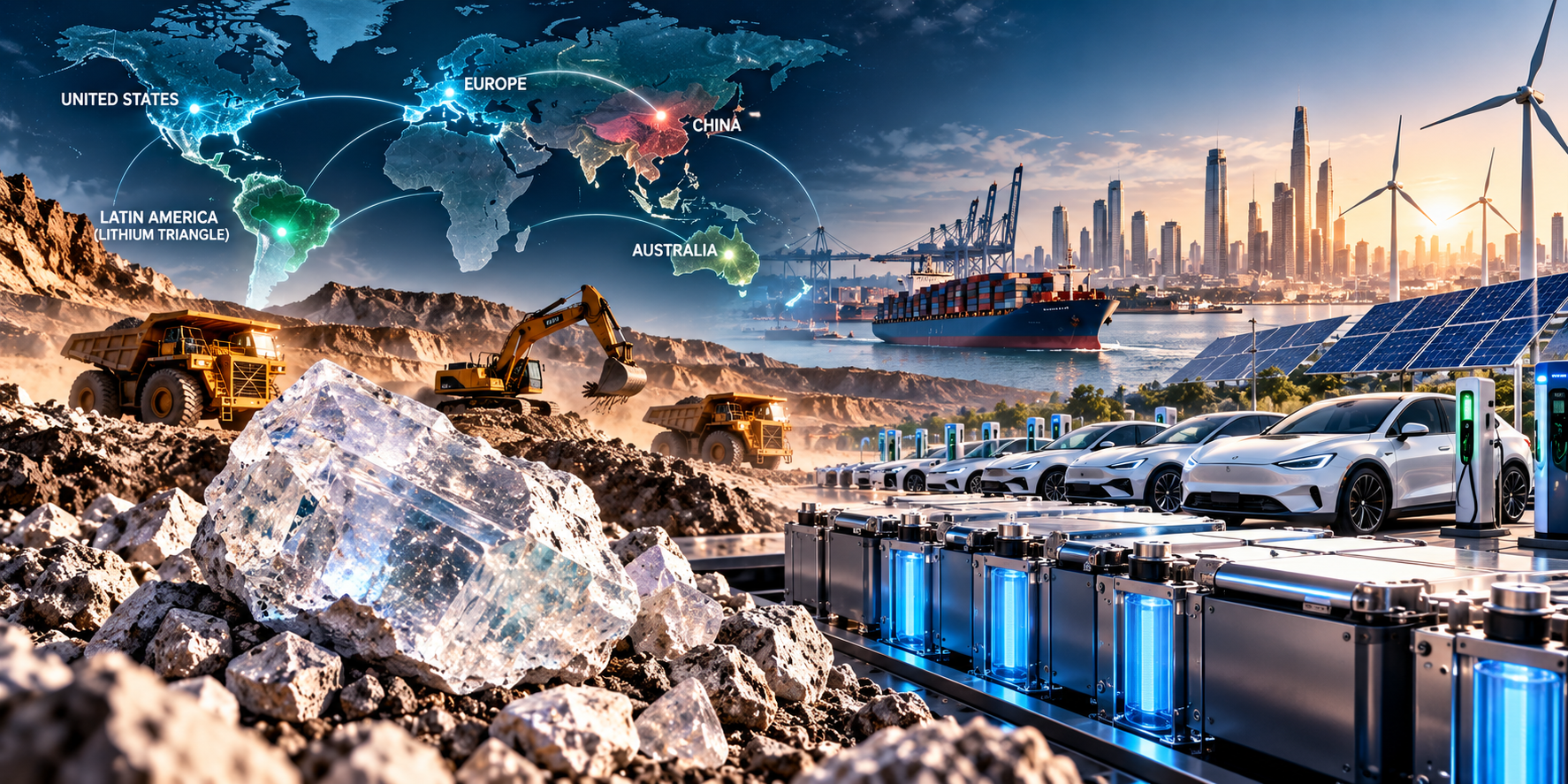
From electric vehicles and renewable energy storage to industrial policy and geopolitical competition, lithium is becoming one of the defining strategic resources of the twenty-first century. But, as with oil, the real power lies not simply in possessing the resource—it lies in controlling the supply chain.
Introduction: The World’s New Strategic Commodity
For much of the twentieth century, oil shaped the global balance of power. Nations with abundant petroleum reserves acquired enormous economic influence, while countries dependent on imported energy built foreign policies around securing reliable supplies. Oil influenced wars, alliances, trade routes, industrial development and the rise of global superpowers.
The twenty-first century is introducing a different strategic equation.
As transportation becomes increasingly electrified, renewable energy expands and electricity storage becomes more important, lithium has emerged as a critical resource for the global economy. The lightweight metal is a central ingredient in the rechargeable batteries used in electric vehicles, consumer electronics and stationary energy storage systems.
The International Energy Agency (IEA) reports that global lithium demand increased by approximately 25% annually on average over 2024 and 2025. Demand is being driven by the expansion of electric vehicles and battery storage, alongside other applications. Battery deployment across electric vehicles and energy storage systems has also increased dramatically over the past several years. <Cite refs={[“turn248553search1″,”turn248553search5”]}/>
This transformation has elevated lithium from a relatively specialised industrial material into a strategic economic asset.
Governments are competing to secure mineral resources, companies are investing in mines and processing facilities, and manufacturers are attempting to reduce their dependence on concentrated supply chains. Countries that once prioritised access to oil and natural gas are increasingly concerned about access to the minerals and technologies underpinning electrification.
Yet the comparison between lithium and oil requires an important distinction. Oil remains indispensable across transportation, petrochemicals, aviation, shipping and numerous industrial processes. Lithium does not provide energy in the same way. It enables batteries to store and deliver electricity generated from other sources.
Lithium is the new oil not because it performs the same function, but because control over its supply chain is becoming a source of economic competitiveness, technological advantage and geopolitical leverage.
The emerging contest is therefore about much more than mining a metal. It is about who will manufacture batteries, control processing technologies, build industrial ecosystems and capture the economic value of the energy transition.
1. Why Lithium Matters to the Modern Economy
Lithium’s strategic importance comes from its role in rechargeable battery technology.
Lithium-ion batteries are widely used because they offer a combination of energy density, rechargeability and performance suited to applications ranging from smartphones to electric cars and large-scale electricity storage. Different battery chemistries use different combinations of materials, but lithium remains fundamental to the principal lithium-ion battery families.
Three major developments are expanding its importance.
The electric vehicle revolution
The transition from internal combustion engines to electric vehicles is changing the structure of the automotive industry.
Traditional vehicles depend on engines, transmissions and fuel systems. Electric vehicles place greater emphasis on battery packs, electric motors, power electronics and software. Battery manufacturing has consequently become a major arena of industrial competition.
Automakers now compete not only on vehicle design and brand recognition, but also on battery costs, charging performance, production scale and access to materials.
The IEA’s Global EV Outlook 2026 identifies electric vehicles and battery energy storage as the principal drivers of lithium-ion battery deployment. Together, these applications account for around 90% of the current lithium-ion battery market. <Cite refs={[“turn248553search5″,”turn248553search6”]}/>
For manufacturers, reliable access to lithium and other battery materials can influence production costs, supply-chain resilience and long-term competitiveness.
A shortage of a relatively small quantity of a critical material can disrupt a much larger industrial system.
Renewable energy and electricity storage
Solar and wind power are transforming electricity generation, but they also create a challenge: output fluctuates with weather conditions and the time of day.
Battery storage helps address this problem by storing electricity when supply exceeds immediate demand and releasing it when needed.
This capability is important for electricity grids, renewable energy projects, commercial facilities and data centres seeking greater control over their power requirements.
As electricity systems become more dependent on variable renewable generation, storage is becoming an increasingly important component of energy infrastructure.
Lithium is therefore connected not only to the future of transport, but also to the reliability and flexibility of modern electricity networks.
Digital infrastructure and strategic technology
Lithium-ion batteries are also used in mobile devices, laptops, telecommunications equipment, backup power systems and other electronic products.
Their significance is expanding alongside digital infrastructure. Artificial intelligence, cloud computing and data centres are increasing the need for reliable electricity, although lithium batteries are only one part of the broader energy infrastructure supporting these systems.
The connection is strategic: the digital economy depends on electricity, and battery storage can help improve the flexibility and resilience of the systems supplying it.
Lithium consequently sits at the intersection of transportation, energy, manufacturing and digital technology.
2. The Geography of Lithium: Where the Resources Are Located
Lithium is not distributed evenly across the world. Its commercially important resources are concentrated in a limited number of countries, creating both opportunities and vulnerabilities.
Australia is a major producer of hard-rock lithium, while Chile and Argentina possess substantial lithium resources in salt-flat brines. Bolivia is also associated with significant lithium resources, although resources in the ground should not be confused with economically recoverable reserves or actual production.
These distinctions matter. A country may possess substantial geological resources without having the infrastructure, technology, financing, water access, permitting framework or industrial capacity required to develop them commercially.
Lithium production also depends on the characteristics of the deposit.
Hard-rock mining, especially from spodumene deposits, requires extraction and processing techniques different from those used to recover lithium from underground brines. Brine operations can involve lengthy evaporation processes, while newer direct lithium extraction technologies aim to recover lithium more quickly under suitable conditions. Their commercial performance varies by deposit and technology.
The result is a complicated geographical landscape in which resource ownership does not automatically translate into industrial power.
UN Trade and Development has highlighted the asymmetry between lithium resource distribution and the concentration of downstream processing, with China holding a particularly strong position in refining and processing. <Cite refs={[“turn248553search3″,”turn248553search7”]}/>
The most important question is therefore not simply which country has lithium underground.
It is which countries can transform that lithium into battery-grade chemicals, battery components and finished products at competitive costs.
3. China’s Advantage: The Power of Processing
One of the most important lessons from the lithium industry is that mining alone does not determine geopolitical influence.
China has built a formidable position across the battery value chain, including mineral processing, cathode and anode materials, battery manufacturing and electric vehicles.
This position reflects years of investment, industrial coordination, manufacturing scale, technical expertise and the development of integrated supply chains.
The advantage is cumulative.
A country that operates large-scale processing facilities can develop specialised workforces, establish relationships with battery manufacturers, improve production efficiency and attract suppliers of related equipment and materials. These capabilities reinforce one another.
Once an industrial ecosystem reaches sufficient scale, competing with it becomes more difficult than simply opening a new mine.
The IEA’s 2026 critical minerals assessment highlights the continuing concentration of mineral refining and the challenges involved in establishing competitive processing capacity outside dominant suppliers. It also identifies gaps between planned mining capacity and downstream battery-material production in several supply chains. <Cite refs={[“turn248553search0″,”turn248553search1”]}/>
This concentration creates a strategic vulnerability for countries that possess mineral resources but depend on foreign processing.
It also explains why governments increasingly view battery materials as an industrial policy issue rather than merely a mining-sector concern.
The competition is shifting from securing access to raw materials towards securing access to the complete industrial ecosystem.
China’s position should not be interpreted as absolute control over every stage of lithium production. Australia, Chile, Argentina and other producers remain important, while battery manufacturing and processing capabilities are developing elsewhere.
Nevertheless, China’s integrated industrial base gives it considerable influence over costs, technological development and the speed at which supply chains can expand.
The strategic lesson is clear: owning the resource is valuable, but controlling the transformation of that resource into a finished industrial product can be even more valuable.
4. The Lithium Triangle: Can Latin America Turn Resources Into Power?
The region commonly known as the Lithium Triangle—centred on Argentina, Bolivia and Chile—has attracted international attention because of its substantial lithium-bearing salt-flat resources.
Its potential is considerable.
As global demand for batteries grows, these countries have an opportunity to attract investment, expand exports, generate employment and develop industrial capabilities linked to the energy transition.
But the benefits are not guaranteed.
Mining and brine extraction can create environmental pressures, including concerns over water use, local ecosystems and the distribution of economic benefits. Conditions differ significantly between deposits, so environmental impacts must be assessed at the project level rather than assumed to be identical across the region.
Governments must also decide how much of the value chain they want to develop domestically.
Exporting raw or minimally processed materials can generate revenue, but refining, chemical production, component manufacturing and technical services may offer additional economic opportunities.
Moving downstream, however, requires capital, reliable electricity, skilled workers, technology, infrastructure and access to competitive markets.
There is also a policy trade-off. Aggressive restrictions on exports or demands for domestic processing can encourage industrial development, but poorly designed policies may deter investment or make projects commercially unviable.
Latin America’s challenge is to negotiate a better position in the global battery economy without sacrificing the investment needed to develop its resources.
The countries that combine transparent regulation, responsible extraction, infrastructure development and credible industrial strategies will be best placed to convert geological advantages into lasting economic power.
5. The United States and Europe: The Search for Supply-Chain Security
The concentration of battery-material processing has prompted governments in the United States and Europe to reassess their dependence on overseas suppliers.
For these economies, lithium is not simply an input purchased by manufacturers. It is part of a wider strategic challenge involving electric vehicles, energy storage, industrial competitiveness and national security.
A disruption in mineral supplies can affect multiple industries simultaneously.
Governments are therefore pursuing a range of responses, including incentives for domestic production, investment in refining and battery manufacturing, partnerships with resource-rich countries, recycling initiatives and efforts to diversify imports.
But supply-chain diversification is expensive.
New projects may face higher construction costs, longer permitting processes, infrastructure constraints and shortages of specialised workers. Established producers often benefit from accumulated expertise, existing supplier networks and economies of scale.
The IEA’s 2026 assessment warns that alternative refining projects can face substantial cost disadvantages relative to established production centres. It also stresses that expanding mining capacity without corresponding growth in processing and manufacturing will not create fully diversified supply chains. <Cite refs={[“turn248553search0″,”turn248553search3”]}/>
This creates a difficult policy question.
Should governments accept higher short-term costs in exchange for more secure and diversified supply chains?
For many strategic industries, the answer may be yes. A supply chain that appears inexpensive under normal market conditions can become costly if a disruption stops production.
However, diversification should not mean replacing one excessive dependency with another. It requires multiple viable suppliers, competitive processing capacity, transparent standards and commercial relationships capable of surviving market volatility.
The goal is resilience, not autarky.
6. India’s Lithium Ambition: From Import Dependence to Industrial Capability
For India, lithium has direct implications for energy security, manufacturing and the long-term competitiveness of its automotive industry.
India’s transition towards electric mobility and greater renewable energy deployment creates a growing need for batteries. Yet developing a domestic battery ecosystem requires more than identifying lithium deposits.
It requires investment across the value chain: mineral extraction, refining, battery chemicals, cell manufacturing, components, engineering, recycling and the development of a skilled workforce.
India has explored domestic lithium opportunities, including resources identified in Jammu and Kashmir. But geological identification is only an initial step. Commercial viability, recoverability, environmental considerations, infrastructure and project economics must be established before a deposit can be counted on as a dependable source of supply.
India’s strategy must therefore avoid equating resource discovery with resource security.
Even if domestic production expands, imported materials and technology are likely to remain important during the development of a competitive industry.
A resilient approach would combine several priorities.
First, diversify imports. India should cultivate relationships with multiple producers and processing centres rather than depend excessively on a single source.
Second, develop domestic processing. Mining without competitive refining and chemical production would leave India exposed to bottlenecks elsewhere in the supply chain.
Third, build battery manufacturing capabilities. Access to lithium creates greater economic value when connected to cell production, automotive manufacturing, power storage and related industries.
Fourth, invest in recycling. Recovering valuable materials from end-of-life batteries can gradually reduce the need for primary extraction and create a domestic secondary supply stream.
Fifth, strengthen research and development. Improvements in battery chemistry, manufacturing efficiency, recycling and alternative storage technologies can reduce vulnerability to supply disruptions.
India also has an opportunity to use its large domestic market to support industrial learning and scale. But this will depend on consistent policy, cost competitiveness, technical expertise and commercially sustainable investment.
The objective should not be to achieve complete self-sufficiency at any cost. It should be to ensure that India’s transition to electric mobility and cleaner electricity does not create a new form of strategic dependence.
7. The Price Problem: Why Lithium Is a Volatile Strategic Asset
Lithium’s strategic importance does not guarantee stable profits for producers.
The market has experienced sharp price swings as mining investment, processing capacity, electric vehicle demand, battery chemistry preferences and government policies have changed.
During periods of high prices, producers have incentives to expand capacity. But new mines and processing facilities take time to develop. If many projects enter production as demand growth slows, the market can move into oversupply.
Prices then fall, squeezing producers and potentially delaying investment in future projects.
The reverse can also occur. When demand rises faster than available supply, or when production is disrupted, prices can increase sharply.
The IEA’s 2026 assessment reported that lithium prices more than doubled amid strong energy-storage demand and constrained supply after a period of weaker prices. Australia’s June 2026 resources outlook also projected continued demand growth while warning that global supply could remain ahead of demand in the early part of its outlook period before moving towards balance later in the decade. These projections are not guarantees; they depend on market conditions and the timing of new capacity. <Cite refs={[“turn248553search0″,”turn248553search4”]}/>
This volatility creates a paradox.
Lithium is becoming more strategically important, but individual lithium investments can remain commercially risky.
Governments may view secure supplies as essential, while investors must still evaluate production costs, future prices, permitting risks and technological changes.
The distinction between strategic importance and investment attractiveness is critical. A mineral can be indispensable to an economy without every mine or processing company being a profitable investment.
For policymakers, the challenge is to avoid both extremes: neglecting supply security during periods of low prices and encouraging excessive investment based on assumptions of permanently high prices.
8. The Technology Challenge: Will Lithium Remain Dominant?
The lithium industry faces another uncertainty: technological change.
Lithium-ion batteries are not a single technology. They encompass several chemistries with different costs, performance characteristics and material requirements.
Lithium iron phosphate (LFP) batteries, for example, avoid nickel and cobalt in their cathodes and have gained importance because of their cost and performance characteristics. Other lithium-ion chemistries make different trade-offs among energy density, durability, safety and cost.
Research is also advancing in sodium-ion batteries, solid-state batteries and alternative energy-storage technologies.
These developments could change demand for particular materials, but their effects should not be overstated.
Sodium-ion batteries, for instance, may be suitable for some applications where cost, availability and performance requirements favour them. They do not automatically displace lithium-ion batteries across every market.
Similarly, solid-state batteries may offer important performance advantages if technical and commercial hurdles are overcome, but their eventual impact depends on manufacturing scale, cost, reliability and adoption.
The IEA has highlighted the importance of changing battery chemistry preferences and the development of alternative technologies in shaping battery-material markets. <Cite refs={[“turn248553search5″,”turn248553search6”]}/>
The implication is that lithium demand will be shaped not only by how many electric vehicles and storage systems are produced, but also by which battery technologies manufacturers adopt.
Countries and companies that invest in research, manufacturing flexibility and technological adaptation may be better positioned than those that rely on a single forecast.
Lithium’s strategic importance is likely to persist, but the distribution of value across the battery supply chain may evolve considerably.
9. Recycling: The Next Source of Lithium Security
The lithium economy will not depend indefinitely on newly mined material alone.
As electric vehicles, stationary storage systems and consumer electronics reach the end of their useful lives, recycling can recover lithium and other valuable battery materials.
A mature recycling industry could reduce waste, create new industrial opportunities and provide an additional source of supply.
It could also improve resilience by recovering materials already present within domestic economies, rather than relying exclusively on imports.
But recycling is not an immediate substitute for mining.
Battery lifetimes create a time lag between the rapid expansion of battery deployment and the arrival of large volumes of used batteries for recycling. Many batteries installed during the recent growth phase will remain in service for years.
Collection systems, transport networks, recycling technologies, safety standards and commercially viable recovery processes must also be developed.
The IEA’s 2026 battery analysis notes that the availability of end-of-life batteries has not kept pace with deployment and that recycling capacity remains highly concentrated geographically. <Cite refs={[“turn248553search5″,”turn248553search6”]}/>
This means recycling should be treated as a long-term supply-security strategy rather than a quick solution to current shortages.
Countries that develop efficient collection and recovery systems today may gain an advantage as larger volumes of used batteries become available.
In the longer term, a circular battery economy could reduce pressure on primary resources and strengthen the connection between domestic manufacturing, consumption and material recovery.
10. The Environmental Cost of the Lithium Economy
The transition to electric mobility and cleaner electricity is often presented as a technological solution to environmental problems. But the materials required to support it also have environmental costs.
Lithium extraction can affect water resources, landscapes and local communities. Hard-rock mining involves land disturbance and energy use, while brine extraction can affect local hydrological systems. The scale and nature of these impacts vary by location, extraction method and project design.
Processing and battery manufacturing also consume energy and require effective management of chemicals, waste and emissions.
The environmental question is not whether lithium extraction is impact-free. It is whether the benefits of electrification can be achieved while reducing the environmental and social costs of the materials supply chain.
That requires credible environmental assessments, water monitoring, transparent reporting, responsible waste management, meaningful consultation with affected communities and enforcement of standards.
It also requires governments to resist the temptation to treat strategic importance as a reason to weaken oversight.
Poorly managed extraction can damage ecosystems, undermine public trust and delay projects. Responsible development, by contrast, can improve the legitimacy and durability of the supply chains on which the energy transition depends.
The new mineral economy will be judged not only by how much material it produces, but also by how it treats workers, communities and the environment.
11. Lithium and the New Geopolitics of Energy
Oil geopolitics historically revolved around producing regions, shipping routes, refining capacity and access to global markets. Lithium introduces a different configuration of strategic relationships.
The key actors include resource-rich countries, mineral processors, battery manufacturers, automakers, technology companies and governments seeking to secure industrial supply chains.
This creates several potential sources of leverage.
Resource-rich countries can negotiate investment terms and seek a greater share of the economic benefits from extraction. Processing centres can influence the cost and availability of battery-grade materials. Manufacturers with large production bases can shape technology standards and supply-chain relationships.
Governments can also use industrial policy, export restrictions, trade measures and investment screening to influence the flow of strategic materials and technologies.
The IEA’s 2026 critical minerals assessment describes a more complicated geopolitical environment in which supply concentration and trade restrictions have become practical economic security concerns. It also highlights the difficulty of diversifying supply when refining, processing technologies and manufacturing equipment are concentrated. <Cite refs={[“turn248553search0″,”turn248553search3”]}/>
Yet lithium geopolitics is not simply a replay of the oil era.
Oil is consumed as fuel and its supply is closely tied to continuous extraction and transportation. Lithium is incorporated into products that can remain in use for years and, in some cases, be recycled. Its strategic importance depends heavily on industrial processing, battery technology and the economics of electrification.
Moreover, the transition is not eliminating oil. Global energy systems continue to rely on a mixture of fossil fuels, nuclear power, renewables and other sources. Petroleum remains crucial to aviation, shipping, petrochemicals and many industrial applications.
The emerging world is therefore not moving from an oil economy to a lithium economy overnight. It is adding a new layer of strategic competition to an energy system that remains diverse and interconnected.
For governments, the challenge is to prepare for a future in which energy security increasingly depends on both traditional fuels and the materials required for electrification.
12. Who Will Win the Lithium Race?
There will be no single winner.
Countries with large resources may benefit from exports and investment. Countries with processing expertise may capture greater value from refining. Economies with advanced manufacturing capabilities may lead in batteries, vehicles and energy-storage systems.
Others may gain advantages through recycling, engineering, research or the development of alternative technologies.
The most successful countries will probably be those that connect these capabilities rather than relying on one part of the value chain.
For resource-rich economies, this means moving beyond extraction where commercially feasible.
For manufacturing economies, it means securing reliable supplies while building competitive industrial capacity.
For technology leaders, it means improving battery performance, reducing costs and developing more efficient production and recovery systems.
For import-dependent economies such as India, it means combining diversified trade relationships with domestic capabilities and technological investment.
The race will also be influenced by the ability of companies to survive price cycles. A supply chain that depends on continuous government support or uneconomic production may struggle to remain competitive.
Strategic autonomy must therefore be built on commercially viable industries, not merely political declarations.
Conclusion: The New Oil Is About More Than Lithium
Lithium has become one of the defining strategic resources of the energy transition. Its importance extends beyond electric vehicles to electricity storage, industrial manufacturing and the broader competition to control the technologies of a more electrified world.
But the central lesson is not that every country must race to extract as much lithium as possible.
It is that access to resources, processing capacity, technological expertise and manufacturing ecosystems increasingly determines who captures the value of economic transformation.
The oil era demonstrated how concentrated energy supplies could influence national security and international relations. The lithium era is revealing a different vulnerability: modern economies can become dependent on complex supply chains in which a small number of countries control crucial processing and manufacturing capabilities.
For India, the United States, Europe and other economies seeking greater resilience, the answer lies in diversification, innovation, responsible resource development and investment across the battery value chain.
For Australia, Chile, Argentina and other resource-rich countries, the opportunity is to convert geological advantages into durable economic development.
For China, the challenge is to sustain its industrial advantages in a world increasingly determined to diversify critical supply chains.
And for the global economy, the long-term task is to ensure that the transition towards electrification does not reproduce the vulnerabilities of the fossil-fuel era in a new form.
Oil helped determine the strategic balance of the twentieth century. Lithium will help shape the industrial and technological balance of the twenty-first. But the decisive advantage will belong not simply to those who possess the mineral—it will belong to those who know how to turn it into economic power.


