


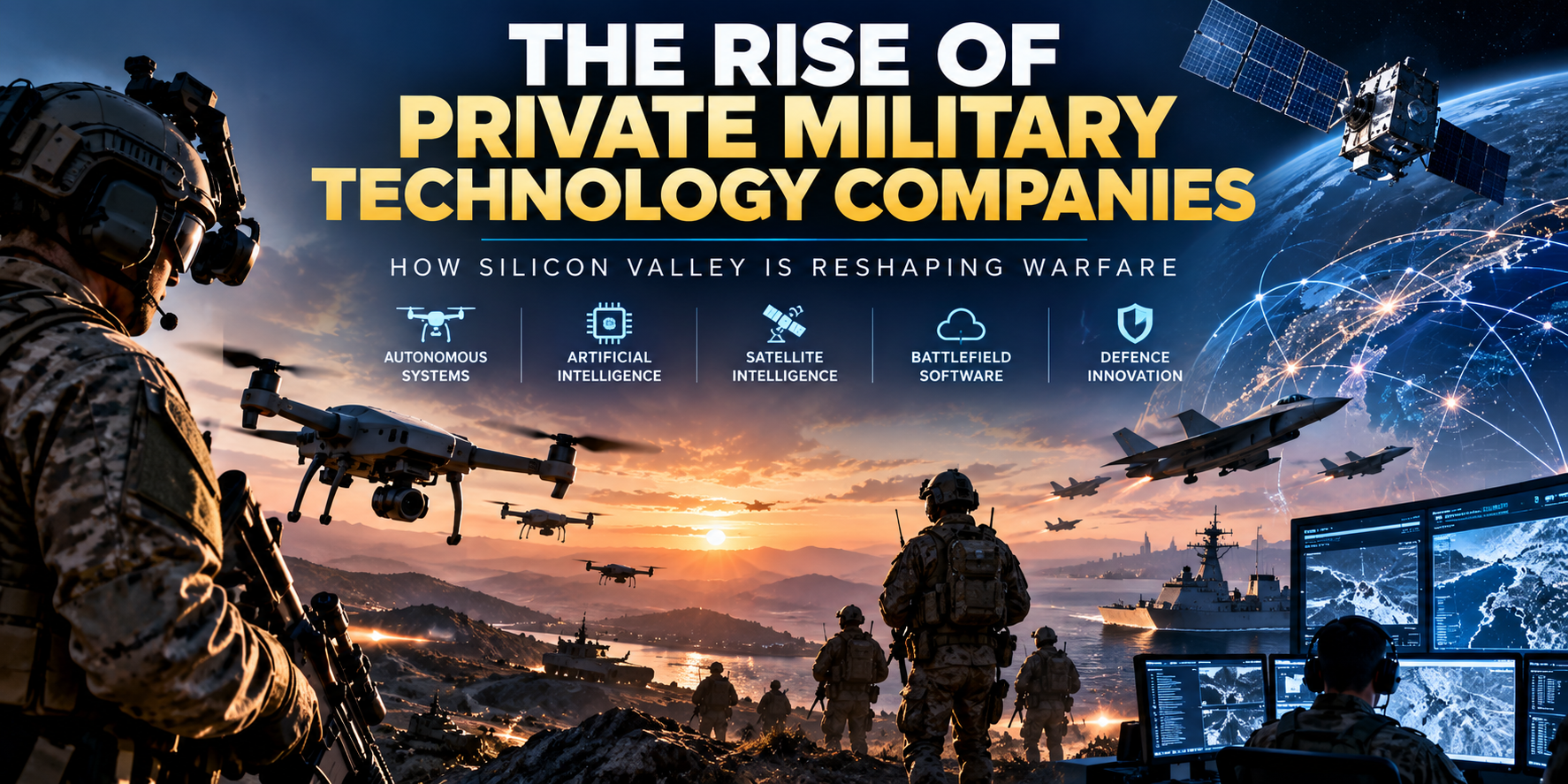
From AI-powered intelligence and autonomous drones to battlefield software and satellite surveillance, private technology firms are changing how militaries fight—and who holds power over the technologies of war.
The next transformation in warfare may not be led exclusively by the traditional arms industry. It may be driven by companies that build artificial intelligence, autonomous drones, battlefield software and the digital infrastructure connecting modern military forces.
A new generation of defence technology firms is challenging the way governments develop, purchase and deploy military capabilities. Companies such as Anduril Industries, Palantir Technologies, Shield AI and Germany’s Helsing are bringing a software-first approach to a sector historically dominated by large defence contractors and lengthy procurement programmes.
Their proposition is straightforward: military advantage increasingly depends not only on weapons, but on the ability to process intelligence, connect sensors, coordinate systems and adapt technology quickly.
The implications extend beyond business competition. As private firms become embedded in military operations, they gain influence over critical national security infrastructure. Governments must therefore confront a fundamental question: who controls the technology on which modern warfare increasingly depends?
From the Military-Industrial Complex to the Defence-Tech Economy
The private sector has always played a central role in military innovation. Aircraft, missiles, ships and communications systems have long been developed by commercial manufacturers working with governments.
What is changing is the nature of the technology—and the companies entering the market.
Traditional defence contractors remain indispensable for complex platforms and large-scale manufacturing. But newer firms are concentrating on AI, data integration, autonomy, robotics and modular systems that can be updated more frequently.
Rather than developing a single weapon in isolation, these companies often aim to connect multiple capabilities through software. Sensors collect information; algorithms help analyse it; command systems present it to operators; and connected platforms act on decisions made by military personnel.
This creates a different kind of defence supplier. Its value may lie less in the individual machine it manufactures than in the software and information systems linking an entire operation.
The boundary between old and new defence industries is also blurring. Traditional contractors are investing in AI and autonomous systems, while technology startups are moving into manufacturing. Anduril’s recently announced plan for a major US Navy submarine-components facility illustrates how a software-oriented defence company can expand into conventional industrial production. <Cite refs={[“turn341817news31″,”turn341817news26”]}/>
The result is not the disappearance of the military-industrial complex. It is its evolution into a broader ecosystem combining defence manufacturers, software firms, AI developers, investors and commercial technology providers.
Why Military Technology Is Changing Now
Three forces are accelerating this transformation.
1. Warfare is becoming a contest of information
Modern militaries collect enormous volumes of data from satellites, drones, radar, communications networks and other sensors. Turning that information into a reliable operational picture is a major challenge.
AI-enabled systems can help analyse imagery, identify patterns and prioritise information for human review. Data-integration platforms can connect systems that would otherwise operate separately.
These capabilities can improve situational awareness, but they are not infallible. Poor-quality data, misleading outputs, cyber interference and incompatible systems can undermine their value.
The strategic advantage therefore lies not simply in possessing more data, but in converting it into timely, reliable information that commanders can use.
2. Drones have changed the economics of combat
The war in Ukraine has demonstrated how uncrewed systems, electronic warfare and rapid technological adaptation can reshape military operations.
Relatively inexpensive drones can threaten valuable equipment, complicate air defence and expose weaknesses in logistics. Their effectiveness has pushed governments to seek systems that can be modified and produced faster than many conventional weapons programmes.
Private firms are developing drones, counter-drone systems, autonomous navigation, sensors and software to coordinate these capabilities.
Yet low cost alone does not guarantee effectiveness. Systems must survive electronic interference, operate reliably and integrate with wider military capabilities. Industrial capacity and the ability to replace equipment also matter.
3. Governments are seeking faster innovation
Traditional defence procurement often involves long development cycles, extensive testing and complex contracting. These processes reflect the high stakes of military equipment, but they can make it difficult to respond quickly to emerging threats.
Technology firms advocate shorter development cycles, frequent updates and closer collaboration with military users.
The US military has increasingly tested commercial defence technologies, including drones and counter-drone systems. But recent Army testing has also exposed the difficulties of integrating new technologies under realistic conditions, with some systems struggling with heat, communications, autonomy and training requirements. <Cite refs={[“turn341817news24″,”turn341817news30”]}/>
The lesson is important: speed matters, but speed without reliability is not military advantage.
The Companies Reshaping the Defence Landscape
The sector is diverse. Some companies specialise in intelligence software; others build autonomous aircraft, sensors or integrated defence systems. Their business models and operational roles should not be treated as interchangeable.
<AsyncImage query=”Anduril Industries defence technology autonomous drones Lattice command control systems” aspectRatio=”16:9″ width=”100%” alt=”Autonomous defence systems and military technology associated with Anduril Industries”/>
Anduril Industries: Building Software-Defined Defence
Founded in 2017, Anduril has become a prominent example of the new defence-tech model. It develops autonomous systems, sensors, command-and-control software and military hardware.
Its Lattice platform is designed to integrate information from different sensors and systems into a shared operational picture. The broader ambition is to make military capabilities function as a connected network rather than as isolated pieces of equipment.
Anduril is also pursuing manufacturing at scale, challenging the idea that technology startups should remain focused on software or prototypes.
Its expansion into larger industrial programmes illustrates the sector’s direction: companies that began with a software-first philosophy are increasingly competing for roles across the defence supply chain. <Cite refs={[“turn341817news31″,”turn341817news32”]}/>
Palantir Technologies: The Power of Military Data
Palantir specialises in software that integrates and analyses information from multiple sources. In defence and intelligence, such platforms can support operational planning, intelligence analysis and decision-making.
Its involvement in Project Maven, a US Department of Defense initiative using AI to assist with intelligence analysis, highlights the growing importance of data-processing systems in military operations.
Unlike a company that supplies a particular aircraft or drone, a software provider can become embedded across multiple functions and platforms. That can make its technology strategically important—and difficult to replace.
The resulting risks include vendor dependence, limited interoperability and uncertainty over who controls data, software updates and the technical knowledge needed to maintain critical systems.
Shield AI: Developing Autonomous Capabilities
Shield AI focuses on AI-enabled autonomy for aircraft and other uncrewed systems.
Its technology reflects a wider effort to enable platforms to perform selected tasks in environments where communications are unreliable or human control is constrained.
Autonomy can reduce the burden on operators and support operations in difficult conditions. But its military value depends on predictable performance, rigorous testing and clear limits on what a system can decide independently.
The distinction between a drone that navigates autonomously and a weapon authorised to select and engage targets without human approval is fundamental. These are not equivalent capabilities.
Helsing: Europe’s Defence-Tech Ambition
Germany-based Helsing represents Europe’s effort to build advanced defence capabilities within its own industrial and technological ecosystem.
Its work includes AI-enabled defence software and autonomous systems. The company has attracted attention as European governments reassess their defence-industrial capacity and dependence on external suppliers.
The issue is not simply commercial competition with American firms. It is also about strategic autonomy: whether European governments can develop, maintain and control critical capabilities when geopolitical circumstances change.
Germany’s decision in 2026 to establish a mechanism for direct government investment in defence startups further illustrates the growing policy importance of the sector. <Cite refs={[“turn341817news34”]}/>
Together, these companies demonstrate that private military technology is not one market. It is a collection of overlapping capabilities—from data analysis and autonomous navigation to sensors, communications and industrial manufacturing.
Ukraine and the New Pace of Military Innovation
Ukraine has become an important proving ground for military technology because the conflict demands continuous adaptation.
Drones, electronic warfare, intelligence-sharing systems and communications technologies are being modified in response to changing battlefield conditions. The experience has strengthened the case for shorter development cycles and closer cooperation between military users and private developers.
It has also exposed the limits of technological optimism.
A system that performs well in a demonstration may fail under electronic interference, extreme weather or sustained operational pressure. A promising prototype may be difficult to manufacture in large numbers. An effective individual technology may offer limited value if it cannot integrate with other systems.
Ukraine’s experience therefore points to a broader conclusion: innovation is most valuable when supported by trained personnel, resilient logistics, effective command structures and the capacity to repair and replace equipment.
Private companies can accelerate adaptation. They cannot independently supply every element of a functioning defence system.
The United States and China: Competing Models of Military Innovation
The United States and China both rely on private-sector innovation, but their institutional arrangements differ.
The American system combines commercial technology firms, venture capital, research universities, established defence contractors and government procurement. This ecosystem can encourage competition and rapid experimentation, but it can also create fragmented systems, complex contracting and dependence on individual vendors.
China’s approach is shaped by its civil-military fusion strategy, which encourages the transfer of civilian technological capabilities into national defence. Its industrial scale and emphasis on technological self-reliance support efforts to integrate advances in AI, robotics, communications and manufacturing into military modernisation.
Neither model guarantees success.
American companies may develop advanced systems but struggle with production or integration. Chinese firms may benefit from industrial coordination but face their own technical, organisational and strategic constraints.
The competition will depend on more than algorithms or corporate valuations. It will be shaped by manufacturing capacity, access to advanced semiconductors, research quality, reliable supply chains and the ability to deploy technology effectively.
The Commercial Giants Behind Military Technology
Defence-tech startups do not operate independently. Their capabilities often rely on commercial cloud infrastructure, advanced chips, satellite communications, data storage and foundational AI systems.
This creates a layered technology ecosystem.
A defence company may develop the software or platform used by a military customer, while relying on other firms for processors, cloud services or communications infrastructure. Those dependencies can affect security, cost, resilience and operational control.
Governments must therefore evaluate more than the visible product. They must understand the wider technology stack, including who owns the data, who can modify the software, how systems can be maintained and what happens if a supplier becomes unavailable.
This is where private military technology intersects with the broader geopolitical competition over semiconductors, AI infrastructure and digital sovereignty.
The company supplying the weapon may not be the only company exercising strategic influence. The provider controlling the software, data or computing infrastructure may be just as consequential.
The Risks: Accountability, Dependency and Autonomous Warfare
The expansion of private military technology creates opportunities, but it also raises difficult questions.
Who is accountable when AI contributes to a military decision?
AI can support intelligence analysis and operational planning, but it does not remove the legal responsibilities of states, commanders and operators.
Systems need appropriate testing, oversight and mechanisms for investigating failures. Responsibility must remain clear even when decisions are supported by complex software.
Can governments become dependent on private suppliers?
If critical military functions depend on a small number of companies, replacing a supplier may become difficult and expensive.
Contracts should address interoperability, data access, cybersecurity, technical documentation and continuity of service. Governments also need the expertise to assess whether a system is performing as claimed.
Can autonomous systems increase escalation risks?
Autonomous and semi-autonomous technologies can shorten the time between detecting a threat and responding to it. In a crisis, that may reduce the opportunity for human verification and judgment.
The consequences depend on the system, its operating limits and the rules governing its use. A navigation system, an AI-enabled surveillance platform and a weapon that independently selects targets raise very different questions.
International humanitarian law continues to apply to military operations regardless of the technologies involved. The challenge is ensuring that new capabilities can be used consistently with legal obligations and meaningful human responsibility.
Can innovation outpace oversight?
Private firms may develop and deploy capabilities faster than procurement rules, regulatory frameworks or oversight mechanisms can adapt.
That creates a governance challenge for governments: how to encourage useful innovation without surrendering control over decisions that carry serious security and humanitarian consequences.
Europe and India: The Search for Defence-Technology Independence
The rise of private military technology is reshaping defence policy beyond the United States and China.
European governments are seeking to expand domestic production, strengthen industrial cooperation and reduce dependence on external suppliers for critical capabilities. Firms such as Helsing are part of this effort, alongside established defence manufacturers and broader European innovation programmes.
India faces a related opportunity.
Its technology workforce, engineering capabilities and expanding startup ecosystem could support the development of domestic expertise in drones, AI, robotics, cybersecurity, sensors and secure communications.
But a large technology workforce does not automatically produce advanced defence capabilities. Progress depends on sustained research investment, effective procurement, testing infrastructure, manufacturing capacity and the ability to move from prototypes to reliable production.
Technological independence also does not require manufacturing every component domestically. The more practical objective is to understand critical dependencies, develop alternatives where necessary and maintain access to trusted international supply chains.
For India, the strategic question is whether its technology sector can move beyond providing services and components to developing defence products that are reliable, scalable and globally competitive.
What Comes Next?
The defence-tech sector is likely to be shaped by four developments.
- AI integration: Software will become more deeply embedded in intelligence, logistics, surveillance, planning and selected autonomous functions.
- Industrial scale: The ability to manufacture and maintain systems reliably will become as important as the ability to invent them.
- Technological sovereignty: Governments will scrutinise dependencies on foreign suppliers for critical chips, software, cloud infrastructure and communications.
- Stronger accountability requirements: Security, reliability, human oversight and legal compliance will become increasingly important as systems assume more consequential roles.
The companies best positioned to succeed will not necessarily be those with the most dramatic demonstrations or the highest valuations. They will be those capable of converting promising technology into reliable capabilities that military organisations can operate, maintain and trust.
Conclusion: Who Controls the Future of Warfare?
Private military technology companies are changing the relationship between governments, industry and war.
Their influence increasingly extends beyond equipment. They help shape the software, intelligence systems, autonomous platforms and digital infrastructure through which militaries understand threats and coordinate operations.
That creates genuine opportunities for faster innovation. It also raises questions about corporate power, national sovereignty, cybersecurity and accountability.
Traditional defence contractors will remain essential. But the industry is evolving into a hybrid system in which established manufacturers, technology startups, AI developers and commercial infrastructure providers increasingly depend on one another.
The decisive advantage will not come from technology alone. It will depend on whether governments can integrate new capabilities into effective military institutions while retaining control over critical systems and ensuring that their use remains accountable.
In modern warfare, power belongs not only to those who build the weapons, but also to those who control the software, data and infrastructure that make them work.
That is what makes the rise of private military technology companies more than a business story. It is a question of who will shape the future of global security.


