


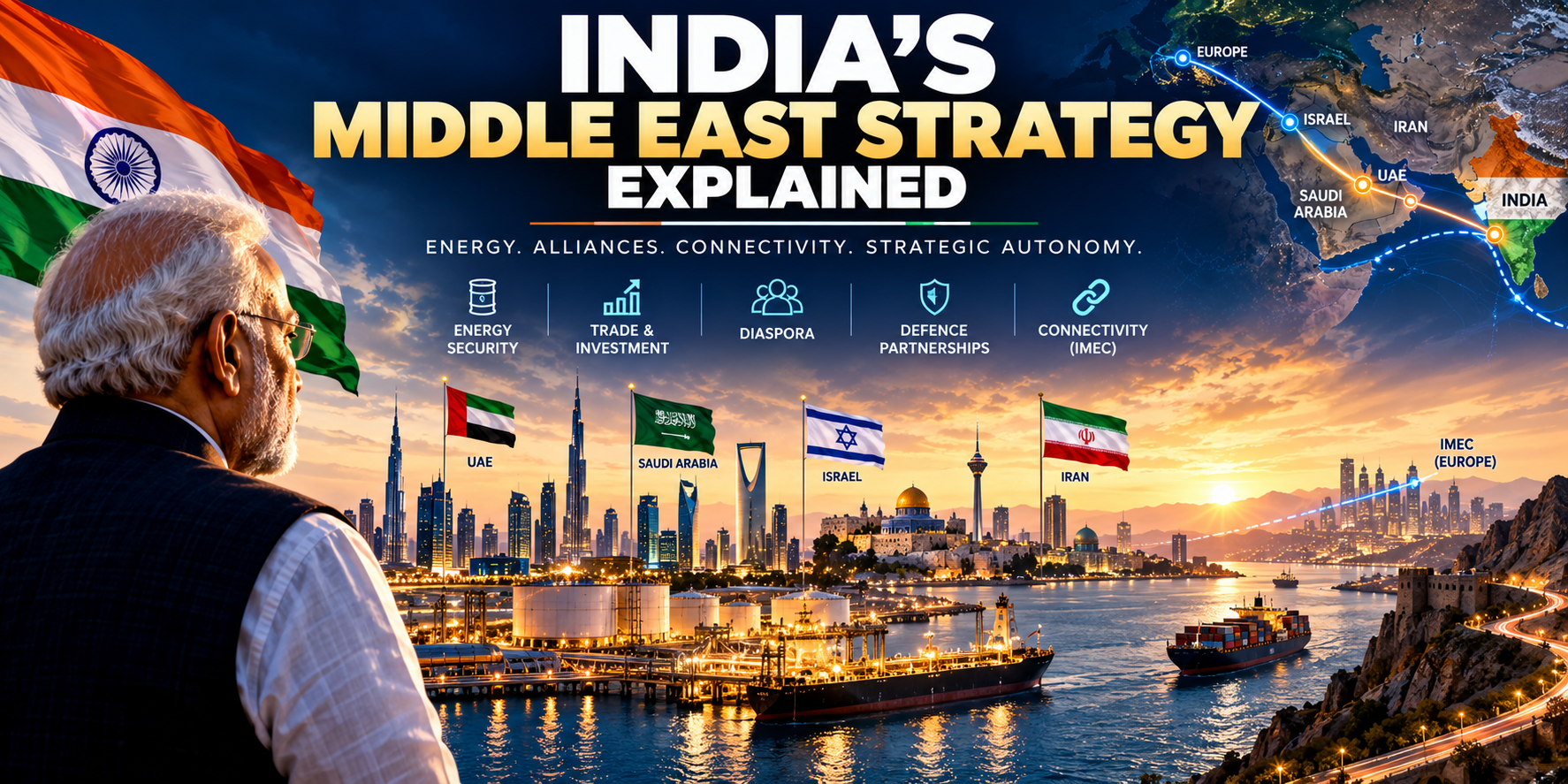
India is deepening ties with Israel, Saudi Arabia, the UAE and Iran while protecting its energy supplies, trade routes and diaspora. But as regional conflicts intensify, New Delhi’s policy of strategic balance is facing one of its toughest tests.
India’s Middle East strategy is built around a fundamental contradiction: New Delhi needs strong relationships with countries that do not always share the same interests.
It needs Gulf oil and gas, Israeli defence technology, Iranian connectivity, Arab investment and secure maritime routes. It also needs to protect millions of Indian citizens living across the region, maintain relations with the United States and avoid being drawn into conflicts that could damage its economic growth.
For decades, India’s approach to West Asia was shaped by energy dependence, support for the Palestinian cause and caution about regional rivalries. Today, its ambitions are considerably broader. The region is a source of investment, advanced technology, defence cooperation, infrastructure partnerships and strategic connectivity to Europe.
Yet the regional conflicts of 2026 have exposed the vulnerabilities of this strategy. Disruption around the Strait of Hormuz, attacks on regional infrastructure and tensions involving Iran, Israel and the Gulf states have demonstrated how quickly distant geopolitical events can affect India’s economy and national security. <Cite refs={[“turn958257search1″,”turn888899search4″,”turn958257search5”]}/>
Understanding India’s Middle East policy therefore requires looking beyond individual diplomatic visits or bilateral agreements. It requires understanding how New Delhi is trying to protect its interests across a region where economic interdependence and geopolitical rivalry increasingly overlap.
1. Why the Middle East Is Strategically Essential to India
India’s relationship with the Middle East rests on five interconnected interests: energy, trade, citizens abroad, security and connectivity.
Energy security
India is one of the world’s largest energy consumers and relies substantially on imported crude oil and natural gas. The Gulf remains an important source of these supplies.
The strategic risk is not limited to whether oil-producing countries continue exporting. It also concerns the routes through which energy reaches global markets.
The Strait of Hormuz, connecting the Persian Gulf with the Gulf of Oman and the Arabian Sea, is particularly important. Disruptions can affect crude oil, liquefied natural gas, shipping costs, insurance premiums and the prices of essential commodities.
The 2026 regional conflict has reinforced this vulnerability. The Indian government has responded by pursuing diplomatic engagement, securing alternative supplies and strengthening the resilience of its energy imports. <Cite refs={[“turn888899search3″,”turn888899search4″,”turn958257search2”]}/>
For New Delhi, the lesson is clear: energy security requires both reliable relationships with Gulf producers and greater flexibility in sourcing supplies from elsewhere.
Trade and investment
The Gulf has evolved from a primarily energy-focused relationship into a broader economic partnership.
India’s trade with the six members of the Gulf Cooperation Council (GCC)—Saudi Arabia, the UAE, Qatar, Kuwait, Oman and Bahrain—reached approximately $178.6 billion in financial year 2025–26, according to India’s Embassy in Riyadh. Cumulative GCC investment in India stood at about $31.6 billion as of March 2026. <Cite refs={[“turn888899search0”]}/>
The relationship increasingly encompasses infrastructure, logistics, finance, renewable energy, food security, technology and industrial development.
The UAE is particularly important. Bilateral merchandise trade reached approximately $101.25 billion in FY2025–26, making it one of India’s most significant economic partners. Both governments have committed to doubling trade to $200 billion by 2032. <Cite refs={[“turn888899search7″,”turn888899search8”]}/>
These figures explain why India’s Middle East policy is no longer simply an extension of its energy diplomacy. The region has become an important component of its wider economic transformation.
The Indian diaspora
Nearly 10 million Indians live and work across GCC countries. They contribute to Gulf economies and send substantial remittances back to India.
According to India’s Embassy in Riyadh, remittances from Indians in the GCC amounted to approximately $52.44 billion in FY2024–25—nearly 38% of India’s total remittance receipts that year. <Cite refs={[“turn888899search0”]}/>
This creates both an economic asset and a major responsibility.
Regional instability can disrupt employment, flights, businesses and the movement of Indian workers. In a serious conflict, the government may have to coordinate evacuations, provide consular assistance and protect citizens across several countries simultaneously.
The diaspora is therefore not merely a social connection. It is a central consideration in India’s foreign and security policy.
2. India’s Core Strategy: Multi-Alignment, Not Exclusive Alliances
India’s Middle East policy is often described as multi-alignment: maintaining relationships with competing powers while preserving freedom of decision-making.
The approach is pragmatic. India works closely with Israel on defence and technology, deepens economic and strategic cooperation with Saudi Arabia and the UAE, and maintains relations with Iran despite significant external pressures.
This does not mean that India is equally close to every country, or that every relationship carries the same strategic weight.
Rather, New Delhi tries to prevent cooperation with one partner from unnecessarily closing the door to another.
The logic is particularly important because the region’s rivalries do not fit neatly into a single political divide. Gulf states have their own competing interests. Israel’s relationships with Arab governments remain affected by the Palestinian question and regional security. Iran’s relationships with its neighbours are shaped by longstanding strategic tensions.
India has little interest in importing these rivalries into its own foreign policy.
The approach also reflects a broader ambition: India wants to become a major power with the ability to pursue its interests independently, rather than functioning as a permanent participant in another country’s regional strategy.
But multi-alignment has limits. When partners enter direct conflict, India may be forced to make choices about public statements, defence cooperation, trade, energy supplies and diplomatic engagement.
Strategic autonomy gives India flexibility; it does not eliminate the cost of difficult choices.
3. Saudi Arabia: Energy, Investment and Economic Transformation
Saudi Arabia has become one of India’s most consequential partners in the Gulf.
The relationship rests on energy imports and trade, but it is increasingly shaped by investment, industrial cooperation and Saudi Arabia’s Vision 2030 economic transformation programme.
For Riyadh, India offers a large market, a growing economy, technology capabilities and opportunities for long-term investment. For New Delhi, Saudi Arabia provides access to capital, energy resources and a regional partner with substantial diplomatic influence.
Bilateral trade reached approximately $41.88 billion in FY2024–25, according to the Indian Embassy in Riyadh. Cooperation has also expanded into investment forums, health, space, startups and other sectors. <Cite refs={[“turn888899search6”]}/>
The relationship matters beyond its commercial value. Saudi Arabia’s position gives it influence in the Arab and Islamic worlds, while its economic transformation creates opportunities for Indian companies in technology, infrastructure, services and industrial development.
However, India must navigate Saudi Arabia’s regional interests rather than assume that economic alignment guarantees political agreement.
Riyadh’s calculations regarding Iran, Israel, regional security and Palestinian statehood may differ from those of New Delhi or Washington.
India’s objective is to deepen cooperation without becoming dependent on any single regional alignment.
4. The UAE: India’s Gateway to Gulf Capital and Commerce
If Saudi Arabia is a central strategic and energy partner, the UAE is one of India’s most important commercial gateways.
Dubai and Abu Dhabi connect Indian businesses to international finance, logistics, aviation, technology and investment networks. The UAE also hosts a large Indian community and has developed extensive economic ties with India.
The relationship now extends beyond conventional trade. Both countries are cooperating in energy, infrastructure, artificial intelligence, investment and maritime affairs.
The bilateral economic partnership is also linked to India’s ambitions for better regional connectivity, including the India–Middle East–Europe Economic Corridor (IMEC).
For India, the UAE offers a combination of capital, commercial networks and geographical access. For the UAE, India represents a major consumer market, a technology partner and an important destination for investment.
Yet the Gulf should not be treated as a unified geopolitical bloc. Saudi Arabia and the UAE have overlapping interests but also differences in regional priorities and economic competition.
India’s challenge is to maintain strong relations with both countries while adapting to shifts in their strategic calculations.
5. Israel: Defence Technology and Strategic Cooperation
India’s relationship with Israel has expanded significantly since the establishment of full diplomatic relations in 1992.
Defence cooperation has been an important component, including military equipment, surveillance, sensors and other advanced technologies. The relationship also encompasses agriculture, water management, cybersecurity, research and innovation.
For India, Israel is a valuable technology and security partner. Cooperation can support domestic defence modernisation and provide access to specialised capabilities.
However, the relationship exists within a wider regional and diplomatic context.
India also maintains substantial economic and political ties with Arab countries and has long supported a negotiated two-state solution to the Israeli-Palestinian conflict. Its official position recognises the importance of Israeli security alongside Palestinian aspirations for statehood.
This creates a delicate balancing act.
Closer defence cooperation with Israel does not remove India’s interest in Palestinian rights, humanitarian assistance or regional stability. Equally, its support for a Palestinian political settlement does not require abandoning cooperation with Israel.
The challenge is to maintain a credible, consistent position while recognising the human and strategic consequences of the conflict.
For India, the relationship with Israel is important—but it cannot be the organising principle of its entire Middle East policy.
6. Iran: Strategic Geography, Connectivity and Diplomatic Risk
Iran occupies a distinct place in India’s regional calculations.
Its location offers potential access to Afghanistan, Central Asia and wider Eurasian trade routes. India’s involvement in developing Iran’s Chabahar Port reflects this geographical interest.
Chabahar provides an alternative route towards Afghanistan and Central Asia, reducing reliance on routes through Pakistan. It also supports India’s ambition to diversify its regional connectivity options. <Cite refs={[“turn888899search11″,”turn888899search2”]}/>
But the relationship carries serious constraints.
US sanctions on Iran complicate trade, investment, banking and infrastructure cooperation. Regional conflict creates further uncertainty, while India must also preserve its relations with the United States and Gulf partners.
These pressures illustrate the limits of strategic autonomy. India may see clear long-term value in a project or relationship while facing immediate financial, diplomatic or security obstacles to pursuing it.
Chabahar is therefore more than a port project. It represents India’s attempt to maintain strategic options in a region where access and connectivity can be influenced by the policies of other powers.
India’s engagement with Iran must balance this long-term geographical logic against the practical constraints of sanctions, conflict and commercial risk.
7. IMEC: India’s Ambition to Connect the Middle East and Europe
Announced at the G20 summit in New Delhi in 2023, the India–Middle East–Europe Economic Corridor is among the most ambitious expressions of India’s regional strategy.
The proposed corridor envisages a network of shipping connections, rail links and associated infrastructure linking India with the Gulf and Europe. Its wider ambitions include improving logistics, strengthening trade and potentially supporting energy and digital connectivity.
For India, IMEC could help diversify trade routes, deepen economic ties with the Gulf and Europe, and strengthen its position in global supply chains.
It is also viewed in the context of China’s Belt and Road Initiative, although the two projects differ in structure, geography and implementation.
India and the UAE have established a framework for cooperation on IMEC, including potential collaboration and investment in ports, maritime infrastructure and logistics. <Cite refs={[“turn888899search1”]}/>
However, the corridor faces major obstacles.
Its success depends on infrastructure investment, coordination among multiple governments, financing, security and political conditions across the region. The unresolved Israeli-Palestinian conflict and wider regional tensions complicate the political environment needed for implementation.
The project should therefore be understood as a strategic ambition, not a completed trade route.
IMEC could strengthen India’s economic position—but only if diplomatic alignment, infrastructure and commercial viability develop together.
8. The United States: An Important Partner, Not India’s Regional Manager
The United States plays a major role in India’s wider strategic environment.
Washington is an important partner in defence, advanced technology, trade and the Indo-Pacific. Its relationships with Israel and the Gulf states also influence the regional security environment in which India operates.
India and the United States share interests in maritime security, resilient supply chains and preventing regional instability from disrupting international commerce. But their approaches to individual Middle East conflicts do not always coincide.
India seeks to maintain its partnership with Washington without automatically adopting every American position towards Iran, Israel or the Gulf.
This distinction is central to New Delhi’s foreign policy.
India wants cooperation with the United States to strengthen its options—not narrow them.
At the same time, US sanctions, export controls and security decisions can directly affect India’s ability to pursue projects involving Iran or access certain technologies.
The relationship consequently requires constant negotiation between shared interests and independent priorities.
9. The 2026 Conflict: A Stress Test for India’s Strategy
The regional conflict that escalated in February 2026 has demonstrated the vulnerability of India’s economic and diplomatic interests.
The consequences extend well beyond the countries directly involved. Energy supplies, commercial shipping, air travel, fertiliser availability and the safety of Indian citizens can all be affected by the same crisis.
The Indian government has called for restraint, dialogue and diplomacy, while emphasising civilian protection and the safety of commercial shipping. It has also engaged with regional governments and international partners to address the crisis. <Cite refs={[“turn958257search1″,”turn888899search4”]}/>
The situation exposes three major challenges.
First, energy diversification is essential but cannot eliminate exposure overnight. Alternative suppliers can reduce dependence on individual routes or producers, but replacing established supply chains during a crisis can be expensive and difficult.
Second, diaspora protection requires diplomatic access. India needs working relationships across the region to assist citizens, organise travel and coordinate emergency measures.
Third, neutrality is not the same as influence. Calling for de-escalation is consistent with India’s interests, but it does not guarantee that the parties involved will follow its preferred course.
The crisis therefore tests not only India’s diplomatic language but also its practical capacity to protect citizens, maintain supplies and keep commercial activity functioning.
10. India’s Biggest Strategic Challenges
India has considerable advantages in the Middle East: a large market, established partnerships, economic weight and a reputation for maintaining relationships across political divides.
But four structural challenges remain.
Dependence on regional energy and shipping
India can diversify suppliers, build reserves and expand alternative energy sources. Yet its exposure to global energy prices and maritime disruption will remain substantial for the foreseeable future.
Competing relationships
Maintaining relations with Israel, Iran and rival Gulf powers becomes harder when their interests collide. India must decide which interests are essential, which compromises are acceptable and where its diplomatic position must remain consistent.
The gap between ambition and implementation
Projects such as IMEC and Chabahar offer strategic potential, but they require financing, infrastructure, political coordination and sustained commercial engagement. Announcements alone do not deliver connectivity.
Limited control over regional outcomes
India is an influential economy and diplomatic actor, but it does not possess the leverage of the United States across regional security or the same direct influence as local powers over their immediate neighbourhoods.
Its most effective strategy is likely to combine diplomatic engagement with economic resilience and selective security cooperation rather than attempting to shape every regional dispute.
11. What India’s Middle East Strategy Could Look Like by 2030
India’s next phase of engagement will likely depend on its ability to convert established relationships into durable economic and strategic capacity.
Five priorities stand out.
Diversify energy supplies. Expand sourcing options, strategic reserves and domestic alternatives while maintaining strong relationships with Gulf producers.
Deepen economic integration. Move beyond commodity trade into technology, manufacturing, logistics, renewable energy and long-term investment.
Protect citizens abroad. Strengthen consular coordination, emergency planning and cooperation with host governments.
Build connectivity that can withstand geopolitical shocks. Advance projects such as IMEC while retaining alternative routes and avoiding dependence on a single corridor.
Maintain diplomatic flexibility with clear principles. Continue engaging Israel, Iran, Arab governments and external powers while defending civilian protection, sovereignty, maritime security and diplomatic resolution of disputes.
These priorities would not eliminate the contradictions in India’s regional policy. They would, however, reduce the cost of managing them.
Conclusion: India Wants Access, Influence and Independence
India’s Middle East strategy is neither a simple alliance system nor an attempt to remain detached from regional affairs.
It is an effort to secure energy, attract investment, protect its citizens, expand trade routes and maintain relationships with competing powers without surrendering independent decision-making.
The UAE offers commercial access and investment. Saudi Arabia provides energy, capital and strategic influence. Israel contributes important defence and technology cooperation. Iran offers geographical options and connectivity, despite substantial political and sanctions-related constraints. The United States remains a major external partner whose regional policies can shape India’s choices.
The challenge is making these relationships work together when regional conflict pushes them apart.
India cannot control the Middle East’s political future. It can, however, reduce its vulnerabilities, diversify its options and use its economic weight to sustain diplomatic engagement.
The ultimate measure of India’s strategy will not be how many partnerships it maintains, but how effectively those partnerships protect its national interests when the region is in crisis.
That is the real test of strategic autonomy—and it will shape India’s role in the Middle East for years to come.
Frequently Asked Questions
What is India’s Middle East strategy?
India’s strategy focuses on energy security, trade, investment, diaspora protection, regional connectivity and strategic autonomy. It maintains relationships with Israel, Iran, Saudi Arabia, the UAE and the United States while seeking to avoid unnecessary involvement in regional conflicts.
Why is the Middle East important to India?
The region is important because of energy imports, trade, investment, remittances, shipping routes and the large Indian community living across the Gulf. Instability can directly affect India’s economy and citizens abroad.
Why does India maintain relations with both Israel and Iran?
The two relationships serve different interests. Israel is an important defence and technology partner, while Iran offers geographical access to Afghanistan and Central Asia through routes such as Chabahar. India seeks to preserve both relationships despite competing geopolitical pressures.
What is India’s relationship with Saudi Arabia and the UAE?
Both countries are major economic and strategic partners. Their relationships with India include energy, trade, investment, technology and infrastructure. The UAE is particularly important as a commercial and financial gateway, while Saudi Arabia is a major energy and investment partner.
What is IMEC, and why does it matter to India?
The India–Middle East–Europe Economic Corridor is a proposed network of shipping, rail and associated infrastructure connecting India with the Gulf and Europe. It could improve connectivity and trade, but its implementation depends on financing, infrastructure and regional political stability.
How does the Iran conflict affect India?
Conflict involving Iran and the wider Gulf can disrupt energy supplies, shipping, air travel and trade. It can also put Indian citizens at risk and complicate India’s relations with Iran, Israel, Gulf governments and the United States.
What does strategic autonomy mean in Indian foreign policy?
Strategic autonomy means preserving the ability to make foreign-policy decisions according to India’s national interests rather than automatically following another power’s position. In the Middle East, it means maintaining partnerships across competing political and strategic divides.
What is India’s biggest challenge in the Middle East?
The central challenge is protecting its economic and security interests while maintaining relationships with countries whose rivalries can intensify rapidly. Energy dependence, diaspora safety, sanctions and regional conflict make that balancing act difficult.
Editorial note: Figures cited above use different reporting periods and definitions. Trade values, investment stocks and remittance totals should not be compared as equivalent measures. IMEC remains a proposed corridor, and its implementation depends on political and commercial conditions.


