


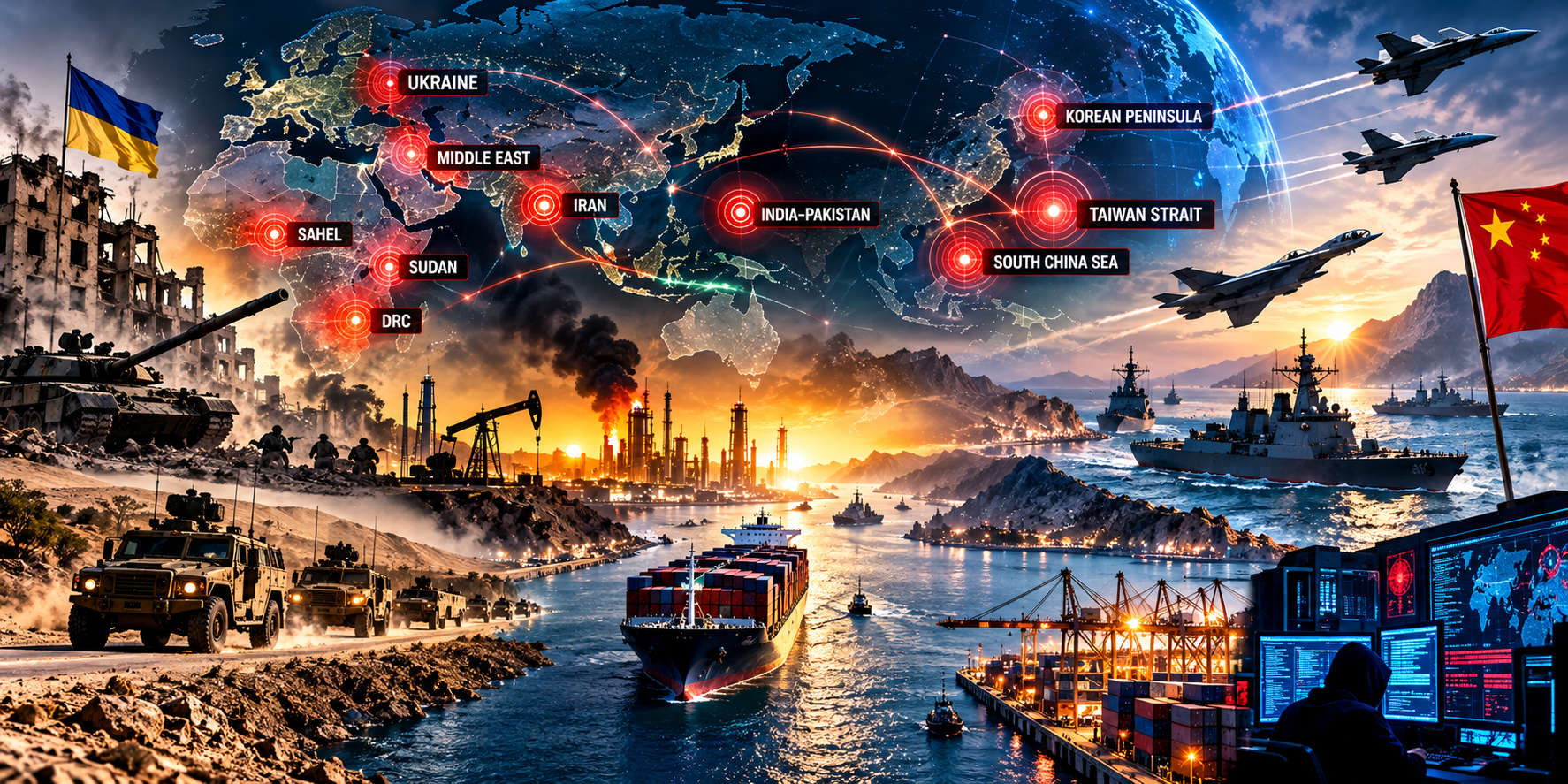
From the Taiwan Strait and the South China Sea to the Middle East, Eastern Europe and the Horn of Africa, the world’s most dangerous geopolitical fault lines are increasingly interconnected. The next major crisis may not begin with a declaration of war. It could emerge from a maritime confrontation, a miscalculation between military powers, an attack on critical infrastructure or the collapse of an already fragile ceasefire.
Introduction: A World of Interconnected Risks
The international order is entering a period of sustained strategic uncertainty.
Great-power competition is intensifying, regional conflicts are becoming more complex, and the economic consequences of geopolitical instability are spreading far beyond national borders. Military confrontations affect energy markets. Trade restrictions influence industrial policy. Competition over technology and critical minerals is reshaping alliances, while cyber operations and attacks on infrastructure are creating new vulnerabilities.
The danger is not that every regional crisis will develop into a global war. Most will remain geographically contained, and diplomacy, deterrence and economic interdependence can prevent escalation. The greater concern is that several crises could occur simultaneously, placing pressure on the military, economic and diplomatic resources of major powers.
The Council on Foreign Relations’ Conflicts to Watch in 2026 identifies a broad range of conflict risks with potential consequences for international stability. Meanwhile, the European Union’s 2026 strategic outlook highlights flashpoints ranging from the Taiwan Strait and Ukraine to Iran, Sudan and the Korean Peninsula.
These risks should not be treated as predictions of inevitable conflict. They are warning points where political decisions, military activity and unresolved disputes could produce serious consequences.
For governments, businesses and investors, understanding these flashpoints is essential to anticipating changes in security policy, energy prices, trade routes, defence spending and global economic confidence.
The central question is not simply where the next conflict might occur. It is which regional crises have the potential to draw in major powers, disrupt the global economy or fundamentally change the international balance of power.
1. The Taiwan Strait: The Most Consequential US–China Flashpoint
The Taiwan Strait remains one of the most consequential potential flashpoints in international politics because it sits at the intersection of territorial claims, military deterrence, advanced technology and the strategic competition between China and the United States.
Beijing regards Taiwan as part of China and has not renounced the use of force to achieve unification. Taiwan maintains its own democratic political system and governing institutions. The United States maintains unofficial relations with Taiwan and provides support for its defensive capabilities, while opposing unilateral changes to the status quo.
The danger arises from the interaction between these positions.
Chinese military activity, maritime pressure, exercises and operations designed to influence Taiwan’s behaviour can increase the risk of miscalculation. Taiwanese efforts to strengthen deterrence and international partnerships can, in turn, be interpreted by Beijing as challenges to its objectives.
Recent developments demonstrate that pressure is not limited to large-scale military exercises. The Council on Foreign Relations’ conflict tracker reported confrontations involving Chinese maritime vessels and Taiwan’s coast guard around the Pratas Islands in October 2026, alongside earlier incidents involving coordinated maritime activity.
Why the Taiwan Strait matters globally
A serious crisis could have consequences well beyond East Asia.
Taiwan is central to advanced semiconductor manufacturing, making the island important to industries ranging from artificial intelligence and consumer electronics to telecommunications and automotive production.
The surrounding waters also form part of a wider maritime system connecting major Asian economies with global markets. Any sustained disruption could affect shipping, insurance, manufacturing schedules and investor confidence.
A military confrontation involving China and the United States would also create difficult choices for regional allies, including Japan, South Korea, the Philippines and Australia.
The greatest danger may not begin with an invasion. It could emerge from a blockade-like operation, an accident involving military aircraft or ships, a coercive exercise that becomes difficult to end, or a political crisis that narrows the room for compromise.
What to watch: Chinese military and coast guard activity, Taiwanese defence preparations, US and allied deployments, crisis communications and any change in the operational status of shipping and air routes.
The Taiwan Strait deserves particular attention because a crisis there could combine military escalation with severe consequences for global technology and trade.
2. The South China Sea: Maritime Rivalry and the Risk of Miscalculation
The South China Sea is another major fault line in the strategic competition between China and the United States.
China asserts extensive maritime claims, while the Philippines, Vietnam, Malaysia, Brunei and Taiwan have overlapping claims or interests in parts of the sea. The United States conducts operations supporting freedom of navigation and maintains security commitments to the Philippines.
The dispute is not simply about islands and reefs. It concerns access to fishing grounds, energy resources, commercial shipping routes and the rules governing maritime activity.
The most dangerous incidents may involve coast guard vessels, fishing fleets, military aircraft or resupply missions rather than direct exchanges between national militaries.
In October 2026, the Council on Foreign Relations’ conflict tracker reported renewed friction involving Chinese and US naval activity near Sabina Shoal and a diplomatic dispute between China and the Philippines following remarks by China’s ambassador. Earlier incidents included allegations of dangerous manoeuvres and obstruction of Philippine resupply operations.
These encounters illustrate how a dispute that appears limited in scale can become politically difficult to manage.
The alliance dimension
The Philippines’ defence relationship with the United States adds a wider strategic dimension. A serious armed attack on Philippine forces, public vessels or aircraft could raise questions about alliance commitments and the credibility of American deterrence.
China, meanwhile, seeks to protect its territorial claims and prevent external powers from constraining its maritime operations.
Both sides have incentives to demonstrate resolve. Both also have reasons to avoid a conflict that would damage regional trade and economic stability.
The risk lies in the gap between these objectives.
A collision, injury or loss of life could trigger domestic pressure for retaliation. If political leaders believe that backing down would undermine national credibility, a manageable maritime incident could become a larger confrontation.
What to watch: Encounters near contested features, coast guard tactics, joint military exercises, resupply missions, changes in alliance posture and the effectiveness of communication channels during incidents.
The South China Sea is a reminder that global conflicts do not always begin with a deliberate decision to wage war. Sometimes, they begin with an incident that political leaders struggle to contain.
3. The Russia–Ukraine War and the Security of Europe
Russia’s war against Ukraine remains central to European security.
The conflict has reshaped defence planning, accelerated military investment, altered energy relationships and strengthened NATO’s focus on deterrence along its eastern flank.
For Ukraine, the core issue is national survival and territorial integrity. For Russia, the war is connected to its regional ambitions and its opposition to Ukraine’s integration with Western institutions. For European governments and the United States, the conflict raises questions about the future of the European security order and the credibility of commitments to allied countries.
The danger extends beyond the front line.
Drone and missile attacks, strikes on energy infrastructure, maritime incidents and the use of cyber capabilities create risks that can affect neighbouring states. The closer such incidents occur to NATO territory, the more important attribution, communication and crisis management become.
In October 2026, the Council on Foreign Relations highlighted continuing confrontation over Ukraine, while recent reporting described a Russian drone attack that sank a commercial vessel near Romanian waters in the Black Sea. The incident illustrates the risks created when the war’s effects approach the territory and maritime space of NATO members.
The escalation risk
A direct war between Russia and NATO is not inevitable, but it would represent a far more dangerous conflict than the current confrontation.
The principal risks include an attack causing substantial casualties on allied territory, a misinterpreted military movement, an escalation involving long-range strikes, or an incident in the Baltic or Black Sea that produces pressure for a direct response.
The presence of nuclear weapons raises the stakes further. Nuclear deterrence may discourage direct conflict, but it does not eliminate the possibility of miscalculation or escalation.
Europe is also confronting a long-term strategic question: how to sustain Ukraine’s defence, maintain credible deterrence and prepare for a security environment in which Russia remains a major military challenge.
What to watch: The intensity of attacks, the status of diplomatic initiatives, incidents near NATO borders, European defence production, military deployments and signals concerning escalation thresholds.
The future of this conflict will influence not only Ukraine but also Europe’s defence spending, political cohesion, energy security and relationship with the United States.
4. Iran, Israel and the Persian Gulf: The Strategic Importance of Hormuz
The Middle East remains one of the most consequential centres of geopolitical risk, particularly where the confrontation involving Iran, Israel and the United States intersects with the security of Gulf shipping.
The region’s strategic importance rests on several overlapping issues: military deterrence, nuclear proliferation concerns, regional alliances, energy exports and the vulnerability of maritime infrastructure.
The Strait of Hormuz is particularly important. It connects the Persian Gulf with the Gulf of Oman and the wider Indian Ocean, providing a major route for international oil and gas shipments.
A sustained disruption would affect energy markets, shipping insurance, transport costs and the economic outlook of countries dependent on imported energy.
Recent developments have demonstrated the fragility of this maritime environment. The Council on Foreign Relations’ Iran conflict tracker reported that unidentified projectiles struck tankers transiting the Strait of Hormuz in late September and early October 2026, while regional military deployments and nuclear-related tensions remained prominent concerns.
The attribution of individual incidents is critical. An attack on a commercial vessel should not automatically be assigned to a particular state without credible evidence.
Why escalation could spread
A confrontation could intensify through several pathways: attacks on shipping, strikes against military facilities, retaliatory action by regional partners, or a breakdown in arrangements intended to limit hostilities.
The consequences would not be confined to the countries directly involved.
Asian economies, including India, depend on stable energy markets and reliable maritime routes. European and other importing economies would also face higher costs if oil and gas shipments were disrupted.
Higher energy prices could feed inflation, complicate monetary policy and increase transport and manufacturing costs.
For Gulf states, the dilemma is particularly difficult. They must protect their infrastructure and trade routes while avoiding a wider conflict that threatens economic diversification and long-term investment.
What to watch: Maritime incidents, military deployments, nuclear diplomacy, sanctions, attacks on energy infrastructure and the security of commercial shipping.
The Persian Gulf illustrates how a regional security crisis can become a global economic shock.
5. The Korean Peninsula: Nuclear Deterrence and Military Miscalculation
The Korean Peninsula remains a persistent flashpoint because of North Korea’s nuclear and missile capabilities, the military posture of South Korea and the United States, and the wider strategic competition involving China, Russia and Japan.
North Korea regards its nuclear arsenal as central to regime security and deterrence. The United States and South Korea maintain a security alliance designed to deter aggression, while Japan has strengthened its attention to regional missile and security threats.
The resulting environment is highly militarised and politically sensitive.
Missile launches, military exercises, artillery incidents or changes in nuclear doctrine can rapidly increase tensions. Even when each side views its actions as defensive, the other may interpret them as preparation for an attack.
Why the flashpoint matters
A renewed armed conflict would have immediate consequences for the Korean Peninsula and wider East Asia.
South Korea is a major industrial economy with important roles in semiconductors, electronics, shipbuilding and advanced manufacturing. Japan is deeply connected to regional supply chains. A serious crisis could disrupt production, trade, financial markets and maritime activity.
The presence of nuclear weapons adds a further layer of danger. Although deterrence is intended to prevent war, it also means that misinterpretation of signals or a breakdown in command-and-control assumptions could have catastrophic consequences.
China also has a significant interest in preventing instability near its borders, while the United States must balance deterrence with the risk of escalation.
What to watch: North Korean missile and nuclear activity, military exercises, changes in official doctrine, cross-border incidents and the state of communication between the parties.
The Korean Peninsula is a reminder that a conflict can remain unresolved for decades without becoming safe. Persistent militarisation can preserve an uneasy balance while leaving substantial risks intact.
6. Sudan and the Horn of Africa: A Regional Crisis With Global Consequences
Sudan’s civil war has become a major humanitarian and regional security crisis.
The conflict between the Sudanese Armed Forces and the Rapid Support Forces has devastated communities, displaced large numbers of people and weakened the institutions needed to provide security and essential services.
Its strategic significance is amplified by Sudan’s geography.
The country sits near the Red Sea, a vital corridor for international maritime trade, and borders several states already facing political, economic or security pressures. Instability can affect migration, border security, arms flows and regional diplomatic relationships.
Recent analysis from the Italian Institute for International Political Studies has examined Sudan’s conflict within a changing Middle Eastern security environment, highlighting how external interests and regional competition can complicate efforts to end the war.
Why Sudan matters beyond its borders
The crisis risks becoming more difficult to resolve if external actors continue to provide political, financial or material support to competing sides.
Fragmentation of state authority can create opportunities for armed groups, trafficking networks and illicit resource economies. It can also make humanitarian access more difficult and undermine neighbouring countries’ stability.
The Red Sea dimension is especially important. Sudan’s location places its internal conflict within a wider corridor connecting Europe, the Middle East, Africa and Asia.
However, the conflict should not be reduced to a maritime-security issue. Its most immediate consequences fall on Sudanese civilians, whose needs include protection, food, healthcare, shelter and access to humanitarian assistance.
What to watch: Changes in territorial control, humanitarian access, external support for the warring parties, cross-border displacement and diplomatic efforts to establish a credible ceasefire.
Sudan illustrates a broader pattern in contemporary conflict: a domestic war can acquire regional dimensions while generating consequences for trade, migration and international security.
7. The Red Sea and the Bab el-Mandeb: The Vulnerability of Global Trade
The Red Sea corridor connects the Indian Ocean with the Mediterranean through the Bab el-Mandeb Strait, the Red Sea and the Suez Canal.
For global shipping, this route is strategically important because it provides a direct connection between Asian manufacturing centres and European markets.
Disruption can force vessels to reroute around the Cape of Good Hope, increasing journey times, fuel consumption and shipping costs.
The strategic significance of the corridor extends beyond commercial efficiency. It affects energy shipments, container trade, insurance markets and the reliability of global supply chains.
Sudan’s instability adds to the region’s complexity, while the wider security environment around Yemen and the Red Sea has demonstrated how threats to commercial shipping can become international concerns. The European Union’s 2026 strategic outlook identifies Yemen and the wider Red Sea environment among the areas where conflict dynamics could produce further instability.
Why shipping disruptions matter
Modern supply chains depend on predictable transport schedules. Delays can affect factories that rely on imported components, retailers that operate with limited inventories and energy markets that depend on regular deliveries.
The impact is not limited to the cost of moving goods. Shipping disruptions can increase working-capital requirements, delay production and complicate inventory planning.
For governments and businesses, the challenge is to balance security measures with the need to keep commercial routes open.
What to watch: Attacks on commercial vessels, maritime security operations, insurance costs, changes in shipping routes and developments in Yemen and surrounding coastal states.
The Red Sea is a strategic reminder that a relatively narrow maritime passage can have consequences for the entire global economy.
8. India–Pakistan and Kashmir: A Nuclear-Armed Rivalry
India and Pakistan remain a major regional flashpoint because of their unresolved disputes, competing security perceptions and nuclear capabilities.
Kashmir is central to the rivalry, while militant attacks, border incidents and military responses can rapidly increase tensions.
The danger lies in the speed with which a crisis can develop. An attack that a government attributes to an organisation operating from across the border may create intense domestic pressure to retaliate. The other side may then interpret the response as a wider military threat.
Both countries have substantial conventional military capabilities, and the presence of nuclear weapons creates a serious escalation risk.
Yet nuclear deterrence does not remove the possibility of conflict. It can constrain the choices available to leaders without preventing limited military exchanges, miscalculation or an unintended escalation.
Why the rivalry matters internationally
India is a major economy with expanding global trade, technology and diplomatic relationships. Pakistan occupies an important geographic position near Afghanistan, Iran, China and the Arabian Sea.
A major crisis could disrupt regional trade, weaken investor confidence and divert resources towards military readiness. It could also place pressure on international diplomatic efforts and complicate broader regional security.
The European Union’s 2026 strategic outlook identifies the Kashmir region as a potential flashpoint for renewed conflict.
What to watch: Major militant attacks, official attribution, cross-border military activity, diplomatic communication, ceasefire arrangements and public statements that narrow the room for de-escalation.
For both countries, crisis management is not merely a diplomatic preference. It is an essential part of nuclear risk reduction.
9. The Sahel: Expanding Insurgencies and Fragile State Authority
Across parts of the Sahel, armed insurgencies, political instability, weak state capacity and competition over resources have created a persistent security challenge.
The region’s difficulties are not uniform. Countries face different combinations of militant violence, military-led governments, economic pressures, local grievances and competition over territory.
However, a recurring pattern is the difficulty of establishing durable security when military operations are not accompanied by effective governance, economic opportunity and trusted local institutions.
The conflict environment can also cross borders. Armed groups exploit porous frontiers, while displaced communities, illicit trade networks and disrupted economic activity place pressure on neighbouring states.
Recent analysis has highlighted the role of informal gold trading networks in sustaining conflict economies across parts of the Sahel and the Horn of Africa.
Why the Sahel deserves attention
Persistent instability can weaken state authority and create space for armed organisations to operate. It can also disrupt agriculture, trade and infrastructure investment, deepening economic hardship.
For international partners, the region presents a difficult policy problem: security assistance may help governments confront armed groups, but it cannot substitute for legitimate institutions, functioning public services and political settlements.
External involvement can also become counterproductive if local populations view it as disconnected from their needs or national sovereignty.
What to watch: The geographic spread of insurgencies, cooperation between neighbouring governments, access to humanitarian assistance, changes in foreign security partnerships and the resilience of local economies.
The Sahel may not dominate global headlines every day, but its instability can have enduring consequences for African security and international efforts to address conflict and displacement.
10. The Democratic Republic of the Congo and the Great Lakes Region
Eastern Democratic Republic of the Congo remains an important flashpoint because armed conflict intersects with weak state authority, displacement, regional rivalries and valuable mineral resources.
The region’s significance extends beyond its immediate security environment. The DRC is an important source of minerals used in global industrial supply chains, including cobalt, which is used in certain battery chemistries.
However, the conflict cannot be explained solely through competition over minerals. Local political disputes, armed group activity, security concerns and historical grievances are also central to the crisis.
The involvement or alleged support of neighbouring actors can complicate diplomatic efforts and increase the risk that violence will spread across borders.
The resource-security connection
The global demand for critical minerals creates economic opportunities, but it can also increase the strategic importance of resource-producing regions.
Where governance is weak, mineral revenues and trading networks may become entangled with armed groups and illicit economic activity. Conflict can then damage local communities while undermining the transparency and reliability of supply chains.
This does not mean that critical mineral production inevitably creates conflict. Rather, responsible governance, traceability and effective institutions influence whether resource wealth supports development or intensifies existing tensions.
What to watch: Changes in territorial control, regional diplomacy, cross-border military activity, humanitarian access and measures to prevent conflict-linked mineral trading.
The DRC highlights an important feature of modern geopolitics: local conflicts can intersect with global competition over the materials required for advanced manufacturing and the energy transition.
11. Afghanistan–Pakistan: Border Security and Regional Instability
Relations between Afghanistan and Pakistan remain another potential source of instability.
The two countries share a long and difficult-to-manage border, and security concerns involving militant organisations have repeatedly strained their relationship.
Pakistan has accused militants operating from Afghan territory of carrying out attacks inside Pakistan. Afghan authorities have disputed aspects of Pakistan’s claims and resisted external pressure over their internal security policies.
The resulting tensions can lead to border clashes, restrictions on movement and trade, diplomatic disputes and displacement.
The situation is complicated by Afghanistan’s economic difficulties, the humanitarian consequences of prolonged instability and the limited mechanisms available for resolving security disagreements.
Why the issue matters
Escalation could disrupt regional trade and transit routes, increase humanitarian pressures and complicate the security calculations of China, Iran and other neighbouring countries.
Pakistan’s internal security and economic stability are also important to the wider region. Sustained confrontation along the border could divert resources from development and increase uncertainty for businesses and investors.
What to watch: Cross-border attacks, military operations, border closures, diplomatic engagement and developments affecting trade and humanitarian access.
The central challenge is to prevent security disputes from becoming a self-reinforcing cycle in which violence produces retaliation, retaliation deepens mistrust, and mistrust makes cooperation more difficult.
12. Cybersecurity and Critical Infrastructure: The Invisible Flashpoint
Not every major geopolitical crisis begins with troops crossing a border.
Cyber operations targeting electricity networks, telecommunications systems, financial institutions, transport infrastructure or government services can disrupt societies without conventional military action.
The challenge is attribution. A cyber incident may be difficult to trace conclusively, and governments may disagree over whether it constitutes espionage, criminal activity, coercion or an act of aggression.
That ambiguity can create opportunities for hostile actors while complicating a targeted country’s response.
Critical infrastructure is especially vulnerable because modern economies depend on interconnected digital and physical systems. A cyberattack can affect the operation of industrial equipment, interrupt essential services or undermine public confidence.
The strategic danger
Cyber operations may be used to gather intelligence, disrupt an adversary during a crisis, impose economic costs or test the resilience of critical systems.
The risk is not necessarily that a single cyberattack will trigger a major war. It is that an attack occurring alongside a military or diplomatic confrontation could be misinterpreted as part of a wider campaign.
The European Union’s 2026 strategic outlook also highlights hybrid attacks and threats to submarine cables and other critical infrastructure as areas of concern.
What to watch: Disruptions to critical services, credible attribution assessments, threats to undersea cables, coordinated cyber incidents and changes in national cyber-defence policies.
For governments and businesses, resilience increasingly requires preparation for attacks that fall below the traditional threshold of armed conflict but can still impose significant economic and strategic costs.
13. The Arctic: A New Frontier of Strategic Competition
The Arctic is becoming more important to global strategy as climate change alters the physical environment and increases attention to shipping routes, resources and military access.
The region has long been strategically significant because of its proximity to North America, Europe and Russia. It is also home to important military infrastructure and sensitive communication systems.
As Arctic conditions change, governments are paying closer attention to maritime access, resource development, surveillance and the security of critical infrastructure.
The region’s future will be shaped by a combination of environmental change, commercial calculations and strategic rivalry.
Why the Arctic matters
The Arctic is not simply an emerging shipping shortcut. Its commercial potential depends on difficult operating conditions, seasonal variability, infrastructure availability, insurance costs and environmental risks.
At the same time, increased military activity or a confrontation involving regional states could raise tensions between Russia and NATO members.
The danger is that strategic competition intensifies faster than the institutions and communication mechanisms needed to manage it.
What to watch: Military deployments, maritime incidents, disputes over access and resources, infrastructure security and the relationship between Arctic states and NATO.
The Arctic may not experience the same level of conflict as more active flashpoints, but it is increasingly relevant to the long-term distribution of military and economic power.
14. How These Flashpoints Could Affect the Global Economy
The consequences of geopolitical instability are often underestimated because the immediate fighting takes place far from major financial centres.
In reality, modern economies are connected through energy, transport, finance, manufacturing and technology.
A disruption in one region can create effects elsewhere through several channels.
Energy prices: Conflict near major production centres or shipping routes can increase uncertainty over oil and gas supplies.
Trade and logistics: Maritime insecurity can raise insurance costs, delay deliveries and force vessels to take longer routes.
Inflation: Higher energy and transport costs can raise the prices of goods and services, complicating monetary policy.
Industrial production: Disruptions to critical minerals, semiconductors or other strategic materials can affect manufacturing and infrastructure projects.
Defence spending: Prolonged insecurity can redirect public resources towards military capabilities, reducing fiscal space for other priorities.
Investment and financial markets: Political uncertainty can delay projects, increase risk premiums and alter investment flows.
These consequences are not automatic. Markets may absorb short-lived disruptions, and governments and businesses can adapt through alternative suppliers, strategic inventories and changes in transport routes.
However, the cost of adjustment rises when several flashpoints intensify at the same time.
This is why geopolitical risk should be understood as a system of interconnected vulnerabilities rather than a list of isolated conflicts.
15. What Should Governments and Businesses Watch?
A useful approach to geopolitical risk distinguishes between the existence of a dispute and evidence that the dispute is becoming more dangerous.
Not every military exercise signals an imminent conflict. Not every diplomatic disagreement leads to escalation. The key is to look for combinations of indicators that suggest political leaders are losing room to manoeuvre.
Five warning signals deserve particular attention.
1. Changes in military posture
Unusual deployments, mobilisation, sustained logistical preparation and changes in force readiness can indicate a shift beyond routine signalling. Such movements must be interpreted in context rather than treated as definitive evidence of planned conflict.
2. Attacks on commercial infrastructure
Repeated attacks on shipping, energy facilities, communications networks or transport corridors may indicate that a conflict is expanding beyond its original theatre.
3. Diplomatic breakdown
The suspension of crisis communication, withdrawal from negotiations or the collapse of arrangements designed to limit hostilities can make incidents harder to contain.
4. Economic coercion
Export restrictions, sanctions, financial pressure and controls on strategic technologies can signal a broader contest in which economic measures and military strategy increasingly interact.
5. Domestic political pressure
Leaders facing intense nationalist sentiment, public anger or challenges to their authority may have less flexibility to compromise. Domestic politics can therefore influence how governments respond to external incidents.
For companies, these indicators should feed into practical contingency planning: alternative suppliers, transport routes, insurance arrangements, inventory policies and crisis-response procedures.
For governments, the priority is to strengthen deterrence without making escalation inevitable, preserve diplomatic channels and ensure that economic security policies do not unnecessarily deepen confrontation.
Conclusion: The Next Crisis May Begin at the Margins
The world’s most dangerous geopolitical flashpoints are not necessarily the places where the largest armies are currently fighting.
They are the places where unresolved disputes, military capabilities, strategic rivalries and economic vulnerabilities overlap.
The Taiwan Strait could become the focal point of a major-power crisis. The South China Sea presents persistent risks of maritime miscalculation. The Russia–Ukraine war continues to shape European security. Iran and the Persian Gulf demonstrate how regional confrontation can threaten global energy markets. Sudan, the Sahel and eastern Democratic Republic of the Congo show how local conflicts can become intertwined with regional competition and global economic interests.
The Korean Peninsula, Kashmir, Afghanistan–Pakistan tensions, cyber threats and the Arctic add further layers of uncertainty.
None of these flashpoints guarantees a wider war. Their significance lies in the possibility that a local event could produce consequences beyond the control of the actors involved.
The challenge for international leaders is to recognise that deterrence alone cannot resolve every underlying dispute. Diplomatic channels, credible communication, economic resilience and practical crisis-management mechanisms remain essential to preventing local confrontations from escalating.
For businesses and investors, the lesson is equally clear: geopolitical risk is no longer an occasional external shock. It is a factor that must be integrated into decisions about supply chains, energy security, investment and long-term planning.
The defining geopolitical challenge of the coming years may not be a single world-shaking event. It may be the cumulative pressure of several regional crises unfolding in an increasingly interconnected world.
The countries best prepared for that future will be those that can anticipate risks, preserve strategic flexibility and prevent a local flashpoint from becoming a global crisis.


