


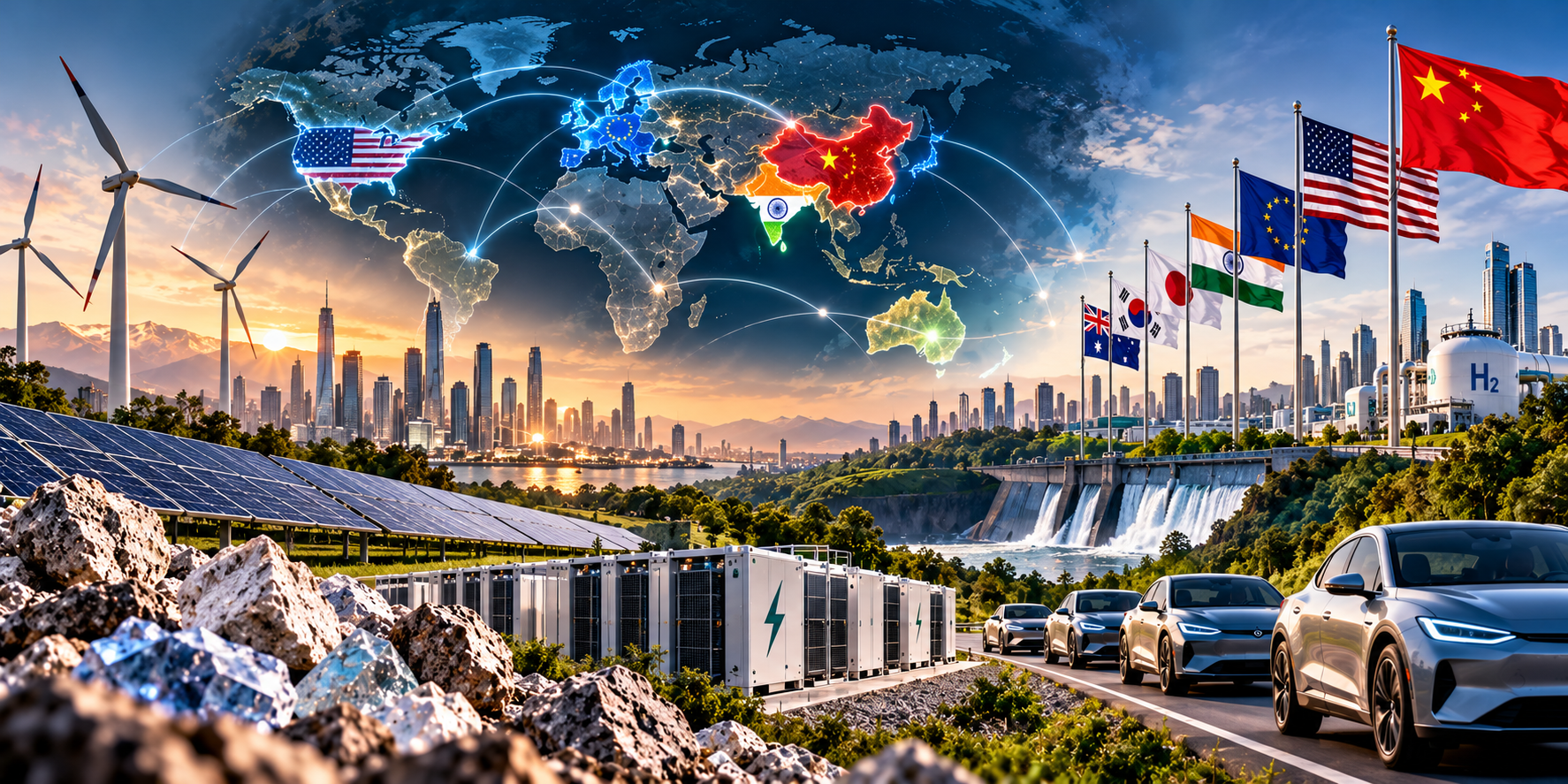
The green economy is becoming one of the defining arenas of geopolitical competition. China has established a formidable lead in clean technology manufacturing, the United States retains enormous financial and technological capabilities, Europe brings regulatory influence and advanced industrial expertise, while India and resource-rich emerging economies are seeking to capture a larger share of the next industrial revolution. The ultimate winners will be those that turn the energy transition into lasting economic power.
Introduction: The Next Great Economic Contest
The industrial revolutions of the past transformed the global balance of power. Coal helped propel Britain to the forefront of nineteenth-century industry. Oil became a pillar of twentieth-century economic growth and geopolitical influence. Semiconductor technology, advanced manufacturing and digital infrastructure subsequently became essential sources of strategic advantage.
The next major contest is taking shape around the green economy.
Solar panels, wind turbines, electric vehicles, battery storage, hydrogen technologies, modern electricity grids and low-carbon industrial processes are reshaping how economies produce energy, manufacture goods and compete for investment.
What makes this transformation particularly significant is that it is not simply an environmental project. It is an industrial, technological and geopolitical competition.
Countries that develop competitive clean technologies can create export industries, attract investment, build skilled workforces and reduce exposure to imported fuels. Those that secure access to critical minerals and establish domestic manufacturing capabilities may gain greater control over their economic futures.
The scale of the opportunity is substantial. The International Energy Agency’s World Energy Investment 2026 report estimates that global energy investment will reach approximately $3.4 trillion in 2026, with around $2.2 trillion directed towards clean energy technologies and infrastructure. China, the United States and the European Union remain among the largest centres of energy investment. <Cite refs={[“turn157865search1”]}/>
Yet the green economy will not have a single winner.
Some countries will dominate manufacturing. Others will lead in research, finance, electricity infrastructure, critical minerals or renewable energy deployment. Resource-rich economies may benefit from supplying the materials required for the transition, while countries with large domestic markets could attract factories and build new industrial ecosystems.
The central question is therefore not simply which country will become the greenest.
It is which countries will control the technologies, supply chains, capital and industrial capabilities that make the green economy possible.
1. China: The Manufacturing Superpower of the Green Economy
<text>China is currently the strongest contender for overall industrial leadership in the green economy.</text>
Its advantage is not confined to a single technology. China has developed extensive manufacturing ecosystems across solar photovoltaics, batteries, electric vehicles, critical mineral processing and other clean energy technologies.
This breadth matters because industrial dominance often emerges from the interaction between different sectors.
Solar panel manufacturers benefit from specialised equipment suppliers. Battery producers benefit from access to processed materials and component manufacturers. Electric vehicle companies benefit from a large domestic market, established supply chains and the availability of battery technology.
When these industries develop together, they create a competitive ecosystem that is difficult for other countries to reproduce quickly.
The IEA’s Energy Technology Perspectives 2026 highlights China’s exceptional concentration in clean technology manufacturing. It estimates that China accounts for roughly 80% of global solar module production capacity, around 95% of wafer capacity, approximately 85% of battery cell assembly capacity and as much as 97% of anode active material capacity. China also processes more than 70% of global supplies of lithium, cobalt, graphite and rare earths. <Cite refs={[“turn157865search21”]}/>
These figures reveal the depth of China’s advantage.
The country does not simply produce finished products. It occupies crucial positions across the supply chains that make those products possible.
Why China’s position is difficult to challenge
China’s strength rests on several mutually reinforcing advantages:
- Manufacturing scale: Large production volumes help reduce costs and improve operational efficiency.
- Integrated supply chains: Producers can access materials, components, equipment and industrial services within established networks.
- Domestic demand: A large market for electric vehicles, batteries and renewable energy supports manufacturing growth.
- Infrastructure: Industrial clusters, ports, electricity networks and logistics systems facilitate production and exports.
- Industrial policy: Sustained investment and policy support have helped develop manufacturing capabilities over many years.
- Technical expertise: Specialised workforces, suppliers and manufacturing knowledge strengthen competitiveness.
This combination creates a powerful feedback loop. Manufacturing scale attracts suppliers; suppliers reduce costs; lower costs expand demand; and expanding demand supports further investment.
China’s position also gives it geopolitical leverage. If a country depends heavily on Chinese suppliers for critical materials or manufacturing components, a trade disruption or export restriction can have consequences far beyond the immediate commodity market.
The International Energy Agency’s 2026 critical minerals assessment highlights the economic vulnerabilities created by concentrated processing capacity and restrictions affecting strategic materials and technologies. <Cite refs={[“turn157865search3”]}/>
However, China’s dominance is not invulnerable. Trade barriers, geopolitical tensions, domestic overcapacity, profitability pressures and efforts to diversify supply chains could reshape its position.
China is also not necessarily the leader in every dimension of the energy transition. Manufacturing scale, energy-system performance, research leadership and emissions reduction are different measures of success.
Nevertheless, if the question is which country is best positioned to capture the manufacturing value of the green economy, China remains the leading candidate.
2. The United States: Technology, Capital and Strategic Reinvention
The United States approaches the green economy from a different position.
Its principal strengths include advanced research, deep capital markets, major technology companies, energy resources, entrepreneurial capacity and a large consumer market.
The country has considerable capabilities in battery innovation, software, power electronics, advanced materials, nuclear energy, carbon management and emerging energy technologies. It also possesses significant natural resources that could support domestic supply chains.
But the American model faces a central challenge: converting technological and financial advantages into competitive manufacturing at scale.
China’s industrial ecosystems have developed over many years. Reproducing them requires more than funding individual factories. It requires reliable access to materials, competitive electricity, specialised equipment, skilled labour, transport infrastructure and a predictable policy environment.
The United States has used industrial incentives, investment support and trade policy to encourage domestic clean technology manufacturing. Yet the durability and structure of these policies can change with political priorities.
This creates uncertainty for companies considering investments that may take years to become commercially viable.
America’s strategic advantage
The United States does not need to manufacture every component domestically to remain influential.
It can retain a strong position through research and development, software, advanced engineering, intellectual property, project finance and the design of next-generation energy systems.
Its capital markets can fund new technologies and large infrastructure projects. Its universities and laboratories can develop innovations that later become commercial industries.
At the same time, rising electricity demand from data centres, industrial facilities and electrification is increasing the importance of grid investment, storage and dependable power generation.
The IEA’s 2026 investment outlook identifies battery storage, geothermal energy, nuclear power and grid resilience among important areas of American energy investment. It also highlights the continuing importance of natural gas in the country’s broader energy strategy. <Cite refs={[“turn157865search1”]}/>
That last point illustrates an important distinction: the United States’ energy future is likely to involve a mixture of technologies rather than a uniform transition away from fossil fuels.
America’s eventual position will depend on whether it can combine its research strengths and financial resources with a more competitive industrial base.
The American opportunity is to become a technology and capital superpower of the green economy—even if it does not dominate every manufacturing segment.
3. Europe: Regulation, Engineering and the Green Industrial Challenge
Europe has played a major role in shaping climate policy, industrial standards and the development of clean energy technologies.
The European Union possesses significant strengths in engineering, industrial equipment, wind technology, electricity infrastructure, research, environmental regulation and specialised manufacturing.
Its policy frameworks have also influenced how businesses around the world approach emissions, energy efficiency and environmental reporting.
However, Europe faces a difficult industrial challenge.
Developing ambitious climate targets is not the same as producing clean technologies competitively. Manufacturers must operate within a commercial environment shaped by electricity prices, financing costs, labour expenses, permitting procedures, market demand and international competition.
European companies may possess sophisticated technology yet struggle to compete with lower-cost imports if domestic production becomes substantially more expensive.
This tension is especially important in sectors where Chinese manufacturers benefit from highly integrated supply chains and enormous production capacity.
Europe’s path to leadership
Europe’s strongest opportunity lies in combining advanced engineering with technological specialisation and a more resilient industrial base.
Potential areas of strength include:
- Offshore wind and related industrial equipment.
- Advanced electricity grids and power-management systems.
- Industrial energy efficiency and electrification.
- Low-emissions manufacturing technologies.
- Energy storage and specialised battery applications.
- Carbon management and industrial decarbonisation.
- Environmental standards and the regulation of sustainable supply chains.
Europe also needs to strengthen its access to critical minerals and processing capacity.
The IEA’s 2026 critical minerals outlook identifies major cost disadvantages facing some processing projects outside dominant manufacturing centres. Higher construction costs, expensive feedstock, infrastructure gaps and shortages of specialised expertise can make supply-chain diversification difficult. <Cite refs={[“turn157865search3”]}/>
For Europe, this means industrial policy must address the economics of production rather than relying exclusively on targets or regulations.
If European governments can make clean manufacturing commercially sustainable while maintaining innovation and engineering excellence, the continent can remain an important green economy power.
If not, it risks becoming increasingly dependent on foreign manufacturers for technologies that its own policies are designed to promote.
4. India: The Emerging Contender With the Greatest Long-Term Potential?
India occupies a distinctive position in the global green economy.
It has a large domestic market, rising electricity demand, a substantial industrial workforce, growing engineering capabilities and considerable potential for renewable energy deployment.
Its development challenge is also different from that of advanced economies. India must expand energy access, support economic growth, improve urban infrastructure and create employment while managing the environmental consequences of industrialisation.
This creates both an opportunity and a constraint.
A rapidly expanding economy can provide substantial demand for solar power, batteries, electric vehicles, transmission infrastructure and energy-efficient industrial equipment. Domestic demand can help manufacturers achieve scale before competing more aggressively in international markets.
However, India remains exposed to imported equipment and materials across important segments of the clean energy supply chain. Developing domestic manufacturing will require sustained investment, technological capabilities, competitive production costs and reliable access to critical minerals.
Where India can compete
Solar manufacturing and deployment
India has the potential to expand its solar industry by combining domestic demand, manufacturing incentives, engineering capabilities and investment in electricity infrastructure. Sustained competitiveness will depend on the cost and quality of domestic production, including access to upstream components.
Electric vehicles and batteries
India’s automotive industry and large domestic market create opportunities in electric two-wheelers, three-wheelers, passenger vehicles, commercial fleets and battery storage. The challenge is to build competitive battery supply chains rather than rely predominantly on imported cells and components.
Green hydrogen and industrial decarbonisation
India could develop green hydrogen applications where they are commercially and technically suitable, including selected industrial processes and future low-emissions fuels. But costs, infrastructure, reliable clean electricity and the availability of customers will determine the scale of deployment.
Power grids and electricity storage
As renewable energy capacity expands, transmission infrastructure, grid flexibility and energy storage become increasingly important. Investment in these systems will be essential to integrate new generation capacity and maintain reliability.
Critical minerals and recycling
India’s long-term energy security will depend partly on diversifying mineral imports, developing commercially viable domestic resources where possible and building battery recycling capabilities.
The obstacle: manufacturing depth
India’s challenge is not simply to install more renewable energy capacity. It is to capture more of the value generated by the technologies it deploys.
A country can become a major market for solar panels or electric vehicles without becoming a leading producer of their most valuable components.
That distinction determines whether the green transition creates a broad industrial ecosystem or primarily expands demand for imported equipment.
The World Economic Forum’s Energy Transition Index 2026 ranked India 70th among 120 countries, while noting improvements in transition readiness. The index measures broader energy-system performance and readiness rather than manufacturing capability alone, so it should not be interpreted as a direct ranking of future industrial potential. <Cite refs={[“turn157865search0″,”turn157865search4”]}/>
India’s opportunity lies in combining domestic deployment with manufacturing, research, workforce development and infrastructure investment.
It is unlikely to replace China across the entire green technology supply chain in the near term. But it could become one of the most important markets and manufacturing centres in a more diversified global green economy.
Its ultimate success will depend on execution: stable policies, affordable finance, competitive industry, reliable electricity and the development of technical expertise.
5. Japan and South Korea: Technology Specialists in the Green Economy
Japan and South Korea may not possess the same scale of domestic resources or markets as China, the United States or India. Their strengths lie in advanced manufacturing, industrial research and specialised technologies.
Both countries have sophisticated industrial bases, established global companies and substantial experience in electronics, materials science, engineering and automotive production.
Their opportunities include batteries, advanced materials, power electronics, hydrogen technologies, industrial efficiency and next-generation energy systems.
South Korea is particularly important in battery manufacturing, while Japan has significant capabilities in automotive engineering, industrial equipment, materials and energy technologies.
Their strategic challenge is to retain technological advantages while reducing dependence on concentrated overseas supply chains.
Battery production, for example, depends on more than the availability of lithium. It also requires cathode and anode materials, chemical processing, specialised machinery, cell engineering and large-scale quality control.
Countries that master these industrial processes can capture significant value even when they do not produce all the raw materials themselves.
Japan and South Korea are therefore likely to remain important green economy powers, particularly in high-value technologies and specialised manufacturing.
Their future influence will depend on their ability to innovate, maintain competitive production and establish partnerships with a broader range of mineral suppliers and industrial markets.
6. Australia, Chile and Argentina: Will Resource-Rich Countries Capture the Value?
The green economy requires enormous quantities of materials, including lithium, copper, nickel, graphite and rare earth elements.
This creates significant opportunities for countries with commercially viable mineral deposits.
Australia is a major lithium producer and an important mining economy. Chile is a major copper producer and possesses substantial lithium resources. Argentina has attracted growing interest in lithium development, while several other countries possess important deposits of minerals needed for batteries, electricity networks and clean energy equipment.
These countries could benefit from export revenue, investment, infrastructure development and employment.
But resource ownership does not guarantee industrial dominance.
A country that exports unprocessed minerals may capture only part of the value generated by the final product. Processing, refining, component manufacturing and battery production can create additional economic opportunities, although they require different capabilities and may not be commercially viable in every location.
The IEA’s Global Critical Minerals Outlook 2026 highlights Latin America’s potential to expand its role in diversified critical mineral supply chains. It also identifies financing constraints, infrastructure gaps, technical capabilities and local stakeholder engagement as important factors shaping the region’s ability to capture more value. <Cite refs={[“turn157865search2″,”turn157865search3”]}/>
The opportunity is to move from being a source of raw materials to becoming a more integrated participant in the green economy.
That does not mean every mining country should attempt to manufacture batteries or solar panels. Industrial strategy must reflect local advantages, market access, skills, energy costs and investment requirements.
For some countries, efficient extraction and responsible mining may remain the most competitive route. Others may have the potential to develop processing, refining and specialised manufacturing.
The strongest long-term outcomes will come from matching industrial ambition to commercial reality.
7. Indonesia and the New Geography of Mineral Processing
Indonesia illustrates how resource policy can reshape the green economy.
The country is an important nickel producer and has sought to expand domestic processing and downstream industrial activity.
Nickel is used in several industrial applications, including some battery chemistries. Indonesia’s strategy demonstrates how a resource-rich country can attempt to move beyond exporting raw materials by attracting investment in processing and manufacturing.
However, the economic benefits of downstream development depend on costs, technology, environmental management, market conditions and the durability of investment.
Nickel is not equally important to every battery chemistry, and demand can change as manufacturers adjust the composition of batteries to improve performance and reduce costs.
Indonesia must therefore manage the risk of investing heavily in industrial capacity whose profitability may be affected by changing technologies or periods of oversupply.
The broader lesson is relevant to mineral-rich economies worldwide: resources can create bargaining power, but lasting industrial success requires technological competence, responsible production and access to commercially sustainable markets.
8. The Nordics: Small Countries With Outsized Influence
Sweden, Finland, Denmark and Norway demonstrate that green economy leadership is not determined by population or market size alone.
The Nordic countries have built strong capabilities in areas such as renewable electricity, electrification, industrial technology, energy efficiency and sustainable infrastructure. Their performance also reflects institutional capacity, infrastructure quality and the ability to implement long-term policies.
The World Economic Forum’s Energy Transition Index 2026 placed Sweden, Finland and Denmark in the top three positions, highlighting the continuing strength of Nordic energy systems and their enabling conditions. <Cite refs={[“turn157865search0″,”turn157865search8”]}/>
The Nordic model offers several lessons.
First, reliable infrastructure matters as much as ambitious targets. Second, technological innovation is most effective when supported by practical implementation. Third, stable institutions and predictable rules can encourage investment over long periods.
These countries may not dominate the green economy by total market size, but they can exert influence through specialised technologies, industrial expertise and models of energy-system management.
Their example also shows that leadership has multiple dimensions. A country can perform exceptionally well in energy-system sustainability and readiness without being the world’s largest clean technology manufacturer.
9. The Middle East: From Hydrocarbons to Clean Energy Investment
The Middle East faces a distinctive strategic question: how can economies built around oil and gas prepare for a world in which electrification and low-emissions technologies become more important?
The region is not abandoning hydrocarbons overnight. Oil and gas remain important to public finances, exports, petrochemicals, industry and global energy security.
But several Middle Eastern economies are investing in renewable power, hydrogen-related projects, new industrial sectors, energy infrastructure and technology.
Saudi Arabia and the United Arab Emirates are particularly prominent in efforts to diversify their economies and expand their role in international investment.
The region has several potential advantages: abundant solar resources, significant pools of capital, established energy expertise and access to international trade networks.
Its future role could include renewable electricity generation, industrial decarbonisation, selected hydrogen applications, energy-intensive manufacturing and investment in clean technology projects overseas.
However, capital availability alone does not guarantee leadership.
Projects must remain commercially viable, infrastructure must be developed, and new industries must create technical capabilities and productive employment.
The region will also need to manage the tension between continued hydrocarbon revenues and investments intended to reduce emissions over time.
The most successful economies may be those that use existing energy wealth to build competitive new industries rather than treating diversification as a collection of isolated projects.
10. Africa and Latin America: The Green Economy’s Resource Frontier
Africa and Latin America could play increasingly important roles in the green economy, but their opportunities are not identical.
Africa possesses significant mineral resources, renewable energy potential and opportunities to expand electricity access. Several countries could benefit from investment in solar power, transmission infrastructure, mineral processing and industrial development.
The Democratic Republic of the Congo is particularly important in cobalt mining, while other African countries have resources relevant to batteries, electricity networks and renewable energy equipment.
The central challenge is ensuring that mineral extraction produces broader economic development rather than leaving countries dependent on low-value exports.
That requires reliable electricity, transport infrastructure, skilled workers, financing, stable institutions and investment in processing where commercially justified.
Latin America has a different combination of advantages, including lithium resources, copper production, hydropower and significant renewable energy potential.
Chile and Argentina are important to the lithium supply chain, while Chile and Peru are major copper producers. Brazil has substantial potential across renewable electricity, bioenergy, minerals and industrial development.
Both regions could capture more value by strengthening domestic processing, industrial capabilities and regional cooperation.
But they must avoid assuming that every stage of the supply chain can be replicated domestically at competitive cost.
The IEA’s 2026 critical minerals outlook stresses that financing, infrastructure, technical expertise and engagement with local communities are central to expanding mineral supply chains outside established centres. <Cite refs={[“turn157865search2″,”turn157865search3”]}/>
For resource-rich countries, the green economy represents a development opportunity—but only if mineral wealth is translated into durable economic capabilities.
11. The Critical Minerals Contest: Who Controls the Supply Chains?
The green economy is often described in terms of renewable energy capacity and electric vehicle sales. But beneath these visible technologies lies a less visible contest over critical minerals and industrial processing.
Lithium, cobalt, graphite, nickel, copper and rare earth elements serve different functions across batteries, electricity networks, electric motors, wind turbines and other technologies.
Their supply chains vary substantially. Some minerals are mined in one country and processed in another; others are recovered as by-products of different mining operations. Refining capacity, technical expertise and manufacturing equipment can be more geographically concentrated than the underlying mineral resources.
This creates a strategic vulnerability.
A country may possess the resources needed for the energy transition but still depend on foreign processing facilities to turn them into usable industrial materials.
The IEA’s 2026 critical minerals outlook identifies continued concentration in refining and highlights the challenges of developing alternative supply chains, including the higher costs of new facilities and shortages of specialised equipment and expertise. <Cite refs={[“turn157865search3”]}/>
This is why the green economy will increasingly be shaped by industrial strategy.
Governments are seeking to diversify suppliers, encourage domestic processing, build recycling systems and secure long-term access to materials.
However, diversification will take time. New facilities require capital, trained workers, infrastructure, reliable energy and commercial customers. They must also compete against established producers that benefit from scale.
The most resilient countries will not necessarily produce every critical mineral domestically. They will build portfolios of trusted suppliers, maintain strategic capabilities and reduce excessive dependence on individual supply-chain bottlenecks.
12. The Next Frontier: Grids, Storage and Reliable Electricity
One of the biggest misconceptions about the green economy is that installing renewable energy capacity is sufficient to complete the transition.
Solar panels and wind turbines generate electricity, but power systems also need transmission networks, distribution infrastructure, storage, flexible generation and mechanisms for balancing supply and demand.
As electricity consumption rises, these supporting systems become increasingly important.
Electric vehicles, industrial electrification and data centres are adding new demands to electricity networks. Renewable generation must be connected to consumers, and power systems must remain reliable as the mix of energy sources changes.
The World Economic Forum’s Energy Transition Index 2026 identifies grid modernisation, infrastructure bottlenecks, financing and policy uncertainty among the central challenges facing the next phase of the energy transition. <Cite refs={[“turn157865search0″,”turn157865search4”]}/>
This creates opportunities for countries that can manufacture transformers, power electronics, cables, storage systems and grid-management technologies.
It also increases the importance of engineering, project development and electricity-market design.
The next stage of green economy leadership may therefore depend less on announcing new renewable energy targets and more on delivering reliable, affordable electricity at scale.
Countries that solve the infrastructure problem could gain a substantial competitive advantage in manufacturing, artificial intelligence, transport and other electricity-intensive industries.
13. The Green Economy Is Not a Single Race
Comparing countries through a single ranking can obscure the different forms of leadership emerging across the green economy.
A country with a highly sustainable electricity system may not be a major exporter of solar panels. A country with extensive mineral resources may lack the processing capacity needed to capture more value. A manufacturing superpower may still face significant environmental and energy-security challenges.
The World Economic Forum’s Energy Transition Index 2026 reflects these differences by assessing both energy-system performance and the conditions required for future progress. Its findings show that leadership remains concentrated among advanced economies, while major emerging markets continue to shape global investment, manufacturing and energy demand. <Cite refs={[“turn157865search0″,”turn157865search8”]}/>
It is therefore useful to distinguish five dimensions of green economy power:
- Manufacturing leadership: The ability to produce clean technologies at scale and competitive cost.
- Technology leadership: The ability to develop new materials, engineering systems and commercially valuable innovations.
- Resource security: Reliable access to critical minerals, processing facilities and industrial inputs.
- Capital and infrastructure: The ability to finance and deliver large-scale projects, modernise electricity networks and attract private investment.
- System performance: The ability to provide reliable, affordable and increasingly sustainable energy.
China is particularly strong in manufacturing and processing. The United States has considerable advantages in research, capital and technology. Europe and the Nordic countries have strengths in engineering, energy-system performance and industrial specialisation. India has a major opportunity in deployment and industrial development. Resource-rich economies can gain influence through mining, processing and carefully chosen downstream industries.
These positions are not mutually exclusive, and they can change as technologies, policies and markets evolve.
14. Three Scenarios for the Future of the Green Economy
The next decade could produce several different patterns of global leadership.
Scenario One: China Extends Its Manufacturing Lead
In this scenario, China retains its advantages in scale, processing, technology and industrial integration.
Its manufacturers continue to compete internationally on cost and performance, while other countries struggle to reproduce the complete supply chains needed to challenge them.
China remains the central manufacturing power of the green economy, even as other economies develop selective alternatives.
Scenario Two: A More Diversified Green Economy Emerges
In this scenario, the United States, Europe, India, Japan, South Korea and resource-rich economies expand their manufacturing and processing capabilities.
The global system becomes more expensive in some areas but less dependent on individual suppliers.
Countries specialise in different parts of the value chain, creating a more distributed industrial network.
This outcome would require sustained investment, stronger international partnerships and commercially viable projects outside existing manufacturing centres.
Scenario Three: Regional Blocs Reshape the Transition
In this scenario, geopolitical tensions increasingly determine trade and investment.
Governments prioritise trusted suppliers, domestic capacity and strategic partnerships. Export restrictions, industrial subsidies and trade barriers influence where factories are built and which technologies become dominant.
The green economy continues to expand, but the pace and cost of deployment differ across regions.
This could improve resilience in some countries while increasing costs and slowing progress elsewhere.
The most likely outcome may combine elements of all three scenarios: continued Chinese manufacturing strength, selective diversification and greater regional competition over strategic technologies and materials.
These are analytical possibilities rather than predictions. Their relative likelihood will depend on policy decisions, technological developments, investment and the ability of countries to deliver competitive industries.
Conclusion: The Winners Will Be Those Who Build the Entire System
The global green economy is becoming a defining contest of industrial and geopolitical power.
China currently holds the strongest overall position in clean technology manufacturing and several critical mineral supply chains. The United States remains a major contender through research, capital, energy resources and advanced technology. Europe has important strengths in engineering, regulation and energy systems. India has substantial long-term potential because of its market size, industrial ambitions and rising energy demand.
Japan, South Korea and the Nordic countries will continue to matter through specialised technologies and industrial expertise. Australia, Chile, Argentina, Indonesia and other resource-rich economies can gain influence by supplying essential materials and, where commercially viable, moving into higher-value activities.
Africa and Latin America have opportunities to use their resources and renewable energy potential to support wider economic development.
But the balance of power is not settled.
The decisive advantage will belong to countries that connect resources, technology, finance, manufacturing and infrastructure into a competitive system. Announcing ambitious targets is not enough. Installing renewable capacity is not enough. Possessing critical minerals is not enough.
The real challenge is to turn these assets into productive industries that can compete internationally, withstand supply disruptions and create lasting economic value.
The green economy will reward countries that can innovate, manufacture, finance and deliver at scale.
The next great industrial powers will not simply be the countries that generate the cleanest energy. They will be the countries that build the technologies, control the supply chains and capture the economic value of the transition.


