


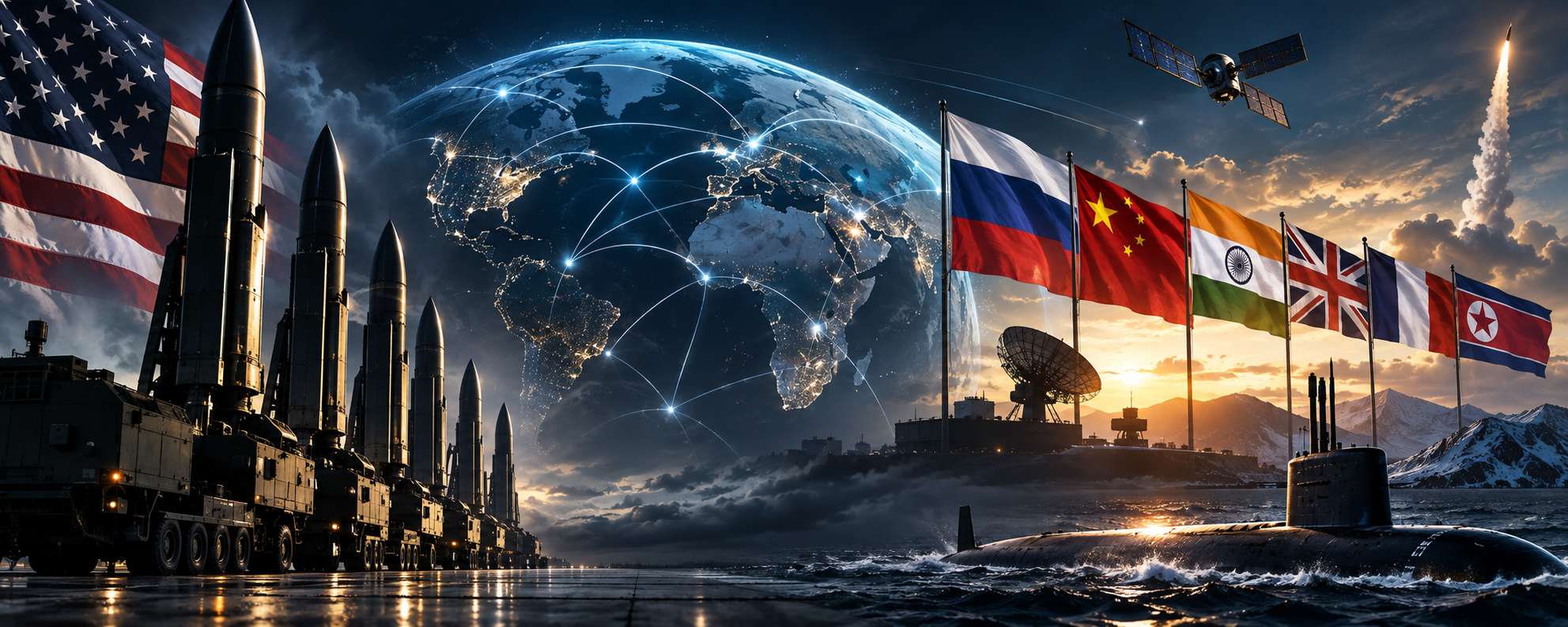
For almost eight decades, nuclear deterrence has rested on a grim proposition: the certainty of unacceptable retaliation can make the deliberate use of nuclear weapons irrational. That proposition helped prevent direct war between the United States and Soviet Union during the Cold War. But the strategic environment that produced classical nuclear deterrence is disappearing. The world is moving from a predominantly bipolar nuclear order toward a more complex system involving multiple nuclear powers, emerging technologies, regional rivalries, cyber operations, space systems and increasingly compressed decision times.
The nuclear age began in 1945.
The United States demonstrated the destructive power of the atomic bomb at Hiroshima and Nagasaki.
Within a few years, the Soviet Union had acquired its own nuclear capability.
The strategic competition that followed produced an unprecedented arms race.
Thermonuclear weapons replaced the first-generation atomic bomb.
Intercontinental ballistic missiles made continents vulnerable.
Ballistic-missile submarines created survivable second-strike capabilities.
Strategic bombers provided another layer of nuclear forces.
Early-warning satellites and radars attempted to ensure that a nuclear attack could be detected before it was too late.
And gradually, an extraordinary strategic doctrine emerged.
Nuclear weapons were increasingly valued not because they could win a conventional war, but because they could make the consequences of starting one unacceptable.
That is the essence of deterrence.
It is based on several interconnected assumptions:
The adversary must believe that retaliation is possible.
The adversary must believe that retaliation would be devastating.
The adversary must believe that the state possessing nuclear weapons has the political will and command capability to respond.
And both sides must retain enough confidence in their warning and command systems to avoid acting on false information.
The first three conditions establish deterrence.
The fourth establishes strategic stability.
The future nuclear problem is that all four are becoming harder to manage.
SIPRI’s 2026 assessment found that all nine nuclear-armed states—the United States, Russia, China, France, the United Kingdom, India, Pakistan, North Korea and Israel—continued to modernize their nuclear forces during 2025. SIPRI estimates that the world possessed approximately 12,187 nuclear warheads in January 2026, including about 9,745 in military stockpiles potentially available for use.
The global nuclear arsenal is therefore not disappearing.
The architecture around it is changing.
And the future of deterrence will depend on whether strategic stability can survive that transformation.
The Nuclear Order Is No Longer Bipolar
The Cold War nuclear system was dominated by two powers.
The United States.
The Soviet Union.
Other nuclear states existed, but the central strategic balance was overwhelmingly bipolar.
That made deterrence difficult, but comparatively intelligible.
Washington had to understand Moscow.
Moscow had to understand Washington.
Today, that structure has changed.
There are nine nuclear-armed states.
They possess different arsenals.
Different doctrines.
Different warning systems.
Different political structures.
Different perceptions of acceptable risk.
And different regional security environments.
SIPRI identifies the nine nuclear-armed states as the United States, Russia, the United Kingdom, France, China, India, Pakistan, North Korea and Israel.
The future nuclear order is therefore likely to be multipolar rather than bipolar.
That distinction is fundamental.
In a two-player system, a state’s nuclear posture can be calibrated largely against one principal adversary.
In a multipolar system, a state may need to deter several potential adversaries simultaneously while also accounting for the reactions of other nuclear powers.
The result is a far more complicated strategic environment.
1. The United States and Russia Still Dominate the Nuclear Balance
Despite the emergence of additional nuclear powers, the United States and Russia remain at the center of the global nuclear balance.
Together, they possess the overwhelming majority of the world’s nuclear warheads.
SIPRI estimates that Russia and the United States together account for roughly 83 percent of global military stockpiles.
Their arsenals include:
- Intercontinental ballistic missiles
- Submarine-launched ballistic missiles
- Nuclear-capable aircraft
- Strategic submarines
- Non-strategic nuclear weapons
- Extensive command-and-control systems
Both countries are also engaged in large-scale modernization.
The critical issue is no longer simply the number of weapons.
It is the survivability, accuracy, readiness, diversity and integration of their nuclear forces.
A smaller arsenal with highly survivable second-strike forces may provide substantial deterrent value.
A larger but vulnerable arsenal may create pressure to use weapons before they are destroyed.
That is why survivability remains one of the central concepts in nuclear strategy.
2. The Expiration of New START Changes the Strategic Environment
The expiration of the 2010 New Strategic Arms Reduction Treaty in February 2026 removed the last bilateral US-Russian treaty framework limiting deployed strategic nuclear forces.
SIPRI identifies the expiration of New START as a major development in the deterioration of the nuclear arms-control environment.
This does not mean that the United States and Russia immediately abandon all restraint.
Nor does the expiration automatically produce a new arms race.
But it removes an important layer of predictability.
Arms-control treaties do more than establish numerical limits.
They can provide:
Transparency.
Verification.
Notification mechanisms.
Communication channels.
Predictability about force structures.
Without those mechanisms, each side has greater uncertainty about the other’s future capabilities.
And uncertainty can itself become destabilizing.
3. China Is the Most Important Structural Change
The most consequential development in the global nuclear balance may be China’s rapid nuclear expansion.
For decades, China’s nuclear arsenal was considerably smaller than those of the United States and Soviet Union/Russia.
That distinction is narrowing.
SIPRI estimates that China had approximately 620 nuclear warheads in January 2026 and says China is expanding its arsenal faster than any other nuclear-armed state. It also assesses that China could potentially possess at least as many ICBMs as Russia or the United States by the end of the decade, depending on how its forces develop.
This fundamentally changes strategic calculations.
The United States can no longer think about strategic stability only in terms of Moscow.
Russia cannot think only about Washington.
And China cannot build its deterrent without considering both.
The resulting system is increasingly triangular.
Washington – Moscow – Beijing.
That is strategically more complicated than the Cold War.
4. Three-Way Deterrence Is Harder Than Two-Way Deterrence
In a two-player system, stability can theoretically emerge from mutual vulnerability.
In a three-player system, the calculation becomes more complicated.
Suppose the United States increases its nuclear capabilities because of China’s expansion.
Russia may interpret that increase as directed partly against itself.
China may interpret it as evidence that the United States seeks strategic superiority.
Russia could respond.
China could respond.
And the original US decision could trigger two separate reactions.
This creates what strategists sometimes describe as action-reaction dynamics.
The danger is that each country may believe it is responding defensively while its actions appear offensive to another.
The result can be an arms competition without any participant consciously choosing an arms race.
5. Strategic Stability Is More Than Mutual Destruction
The phrase mutually assured destruction is often used as shorthand for nuclear deterrence.
But strategic stability is broader.
A stable deterrence relationship requires that neither side believes it can gain substantially by launching a first strike.
It also requires that neither side believes it must strike first because waiting would make its position dramatically worse.
This produces two different forms of stability:
Crisis Stability
The belief that neither side has an incentive to use nuclear weapons first during a crisis.
Arms-Race Stability
The belief that neither side has a compelling incentive to continuously expand its arsenal because of the other’s capabilities.
A nuclear system can possess deterrence while lacking either form of stability.
That distinction will become increasingly important in the multipolar era.
6. Second-Strike Capability Remains the Foundation
The core principle of modern strategic deterrence remains the ability to retaliate after absorbing an attack.
This is the logic of second-strike capability.
If a state knows that an adversary’s nuclear forces cannot eliminate its retaliatory forces, launching a first strike becomes strategically irrational because retaliation remains possible.
This is why nuclear submarines are so important.
They are difficult to locate and can provide survivable retaliatory forces.
It is also why hardened command systems, dispersed forces and secure communications matter.
The deterrent is not simply the warhead.
The deterrent is the entire system that guarantees the ability to respond.
7. Nuclear Deterrence Is Becoming Multidomain
During the early nuclear age, strategic deterrence focused primarily on nuclear delivery systems.
Today, nuclear deterrence increasingly interacts with:
Cyber.
Space.
Artificial intelligence.
Missile defense.
Hypersonic weapons.
Conventional precision strike.
Electronic warfare.
NATO explicitly describes its deterrence posture as an integrated combination of nuclear, conventional and missile-defense capabilities, complemented by space and cyber capabilities.
This creates a fundamental problem.
A conflict does not have to begin with a nuclear weapon.
It could begin with a cyberattack.
An attack on satellites.
A conventional strike.
An electronic-warfare operation.
Or an incident involving an unmanned system.
The nuclear question then becomes:
Can escalation across conventional, cyber, space and nuclear domains be controlled?
8. Artificial Intelligence Is Changing the Strategic Equation
Artificial intelligence is perhaps the most consequential emerging technology for future nuclear stability.
AI can process information faster than humans.
It can analyze satellite imagery.
Detect unusual activity.
Identify patterns.
Fuse intelligence.
Track objects.
And generate assessments.
These capabilities may improve early warning.
But they can also introduce new risks.
A machine-learning system does not understand political context in the way a human decision-maker does.
It identifies patterns based on available information.
If the underlying data is incomplete, manipulated or misleading, the resulting assessment may also be wrong.
In a nuclear crisis, an incorrect assessment can have consequences that cannot be reversed.
SIPRI’s 2026 Yearbook treats artificial intelligence and international security as a major emerging strategic issue alongside nuclear forces and space security.
The central question is therefore not whether AI should be used.
It is:
Where should the boundary between machine analysis and human decision-making be placed?
9. The Most Important AI Principle May Be Human Control
Nuclear decisions involve consequences that exceed ordinary military calculations.
An AI system can recommend.
It can classify.
It can warn.
It can simulate.
But the decision to employ nuclear weapons carries political and strategic consequences that cannot be delegated to an algorithm without introducing profound risks.
The safest architecture is therefore likely to preserve meaningful human control over nuclear employment decisions.
That does not mean rejecting AI.
It means using AI primarily to strengthen:
Analysis.
Verification.
Warning.
Scenario modelling.
Decision support.
rather than replacing political authority.
The faster technology becomes, the more important deliberate human judgment may become.
10. Cyberwarfare Creates a New Nuclear Vulnerability
Nuclear weapons may be physical.
Nuclear deterrence is increasingly digital.
Command systems.
Communications.
Early-warning networks.
Satellites.
Data processing.
Authentication.
These systems must function under extreme conditions.
A cyberattack does not necessarily need to seize control of a nuclear weapon.
It could attempt to manipulate the information around it.
Imagine a situation in which a nuclear command authority cannot determine whether an incoming warning is genuine.
The danger is obvious.
A false warning could create pressure to act.
A communications failure could create uncertainty about leadership instructions.
A compromised information system could produce false confidence.
This makes cybersecurity part of nuclear stability.
11. Space Is Becoming a Nuclear Domain
Modern nuclear deterrence depends heavily on space-based capabilities.
Satellites support:
- Early warning
- Communications
- Navigation
- Intelligence
- Missile tracking
- Strategic surveillance
The vulnerability of those systems is therefore strategically important.
If a state believes its space-based warning systems are under attack, it may interpret the action as preparation for a larger military operation.
That can create escalation pressure.
The challenge is particularly serious because attacks against space systems may be difficult to attribute immediately.
A satellite malfunction could result from:
Technical failure.
Cyberattack.
Electronic interference.
Physical attack.
An accident.
In a crisis, uncertainty about the cause can itself become dangerous.
12. Hypersonic Weapons Compress Decision Time
Hypersonic weapons and other advanced delivery systems introduce another problem:
time.
Traditional strategic warning systems were designed around particular assumptions about missile flight times and trajectories.
Highly maneuverable high-speed systems can complicate those assumptions.
The issue is not merely that they travel quickly.
It is that their trajectories can be more difficult to predict.
That can reduce the time available to determine:
What is being attacked?
What is the weapon’s payload?
Is the attack conventional or nuclear?
Is this a limited strike?
Is a larger attack underway?
The shorter the decision window, the greater the pressure on political leaders.
13. Speed Can Become a Strategic Liability
Military technology traditionally treats speed as an advantage.
In nuclear command systems, speed can become more complicated.
A faster warning is valuable if it is accurate.
A faster false warning can be dangerous.
A faster weapon provides less time for diplomacy.
A faster decision cycle can reduce opportunities for verification.
The future of nuclear stability may therefore require something counterintuitive:
Preserving decision time.
Strategic stability is not necessarily maximized by making every system faster.
Sometimes it is strengthened by creating enough time to verify information.
14. Missile Defense Can Affect Offensive Planning
Missile defense creates another strategic dilemma.
If one state believes that an adversary’s missile-defense system could eventually intercept enough incoming warheads to undermine retaliation, it may seek to strengthen its offensive capabilities.
That could involve:
More warheads.
More delivery systems.
Greater survivability.
Decoys.
Multiple independently targetable re-entry vehicles.
Maneuverable warheads.
Alternative delivery systems.
The objective would be to preserve the credibility of retaliation.
This illustrates an important principle:
A defensive capability can produce offensive responses if an adversary believes it threatens strategic stability.
15. Nuclear Signalling Has Become More Difficult
Deterrence is partly about communication.
States must communicate capability and resolve without accidentally communicating an intention to initiate war.
That is difficult under normal circumstances.
It becomes harder during crises.
A military exercise may be intended as deterrence.
An adversary may interpret it as preparation for attack.
A nuclear statement intended for domestic political consumption may be interpreted abroad as strategic signaling.
This is why nuclear strategy cannot be separated from diplomacy.
16. Strategic Ambiguity Has Both Benefits and Risks
Nuclear powers sometimes deliberately avoid revealing precise information about their capabilities or intended responses.
Ambiguity can complicate an adversary’s calculations.
But excessive ambiguity can produce uncertainty.
If an adversary cannot determine where the red lines are, it may either become cautious or miscalculate.
The strategic challenge is therefore to maintain enough uncertainty to preserve deterrence while maintaining enough clarity to prevent catastrophic misunderstanding.
There is no universal formula.
Different states manage this balance differently.
17. India-Pakistan Demonstrates the Importance of Regional Deterrence
The future of nuclear deterrence cannot be understood only through Washington, Moscow and Beijing.
South Asia remains one of the world’s most consequential nuclear regions.
India and Pakistan possess nuclear weapons and maintain competing strategic doctrines.
India’s stated nuclear doctrine has historically emphasized credible minimum deterrence and a no-first-use posture, while Pakistan’s strategy has developed partly around compensating for India’s conventional military advantages.
This creates a different deterrence problem from the US-Russia relationship.
The geographic distances are smaller.
Decision times can be shorter.
Conventional military conflict remains possible.
And political crises can escalate rapidly.
SIPRI reported continued nuclear modernization by both India and Pakistan in 2025.
The lesson is significant:
Nuclear weapons may deter total war without preventing limited conventional conflict.
Managing the space between those two realities is one of the hardest problems in regional deterrence.
18. China-India-Pakistan Creates a More Complex Asian Balance
South Asia is not a two-player nuclear system.
India’s strategic calculations increasingly include China.
Pakistan’s calculations include India.
China’s calculations increasingly include the United States as well as India.
This creates overlapping strategic triangles.
United States – China – India
and
China – India – Pakistan
These relationships interact.
An improvement or deterioration in one can influence another.
That is characteristic of a multipolar nuclear environment.
19. North Korea Represents a Different Deterrence Model
North Korea’s nuclear strategy is fundamentally connected to regime security and deterrence against the United States and South Korea.
SIPRI estimates that North Korea had assembled approximately 60 warheads by January 2026 and possessed enough fissile material for additional weapons.
Its nuclear and missile programs therefore have implications far beyond the Korean Peninsula.
They affect:
South Korea.
Japan.
The United States.
China.
Russia.
The challenge is particularly difficult because conventional military confrontation on the Korean Peninsula could rapidly create nuclear escalation risks.
20. Extended Deterrence Is Under Pressure
The nuclear order also includes states that do not possess nuclear weapons but rely on nuclear-armed allies.
The United States extends nuclear deterrence to allies in Europe and Asia.
NATO continues to describe its nuclear forces as a central component of collective defense and extended deterrence.
This creates a difficult strategic question:
How much risk is a nuclear-armed state willing to accept on behalf of an ally?
Extended deterrence has always depended on the credibility of that commitment.
But in a multipolar environment, allies may increasingly question whether their security can depend indefinitely on another country’s nuclear posture.
That can influence debates about:
- Nuclear sharing
- Conventional defense
- Missile defense
- Strategic autonomy
- Indigenous deterrence capabilities
21. Europe Is Reinforcing Its Nuclear Architecture
NATO’s nuclear posture remains central to European security.
In June 2026, NATO’s Nuclear Planning Group agreed to continue strengthening the Alliance’s nuclear deterrence mission through modernization, stronger nuclear planning and adaptation to the changing security environment.
The Alliance emphasizes that political control over nuclear deterrence remains with its member governments through NATO’s established structures.
This is significant because the European strategic environment has changed dramatically.
The future European deterrence architecture will involve:
US strategic forces.
British nuclear forces.
French nuclear forces.
NATO conventional forces.
Missile defense.
Space capabilities.
Cyber capabilities.
The result is increasingly multidimensional.
22. The Middle East Remains a Nuclear Proliferation Concern
The Middle East presents another strategic challenge.
Israel maintains a policy of nuclear ambiguity.
Iran’s nuclear program has generated decades of international concern.
Other regional states monitor these developments closely.
The broader issue is proliferation.
If governments conclude that conventional military capabilities and international guarantees cannot provide sufficient security, the incentive to pursue nuclear options can increase.
This is why non-proliferation is not merely a legal issue.
It is also a security issue.
The credibility of the global non-proliferation regime depends partly on whether states believe they can remain secure without acquiring nuclear weapons.
23. The NPT Is Under Severe Pressure
The Treaty on the Non-Proliferation of Nuclear Weapons remains the central global framework for limiting nuclear proliferation.
But its political foundation is under strain.
The 2026 NPT Review Conference, held from 27 April to 22 May, ended without consensus on a substantive final outcome. The United Nations described the failure as particularly concerning in the context of rising nuclear risks.
The disagreement reflects a longstanding problem.
Non-nuclear states argue that nuclear-armed states have not made sufficient progress toward disarmament.
Nuclear-armed states argue that the deteriorating security environment makes deterrence necessary.
Both positions exist within the same treaty framework.
The challenge is reconciling them.
24. Arms Control Has to Evolve
Traditional arms control focused heavily on numbers.
How many warheads?
How many launchers?
How many missiles?
The future will require a broader approach.
It may need to address:
AI-enabled early warning.
Cyber interference with nuclear command systems.
Space-based strategic systems.
Hypersonic weapons.
Missile defense.
Non-strategic nuclear weapons.
Emerging delivery technologies.
Transparency and crisis communication.
This will make future arms-control negotiations considerably more complicated.
But the complexity is also the reason they are increasingly necessary.
25. Risk Reduction May Be More Realistic Than Immediate Disarmament
Complete nuclear disarmament remains the long-term objective of the NPT framework.
But the immediate strategic environment makes rapid elimination difficult.
Risk reduction therefore becomes important.
Measures could include:
- Crisis communication mechanisms
- Greater transparency
- Advance notification of major exercises
- Protection of nuclear command systems
- Agreements against interference with early-warning systems
- Clearer AI governance
- Strategic dialogue
- Confidence-building measures
These steps would not eliminate nuclear weapons.
They could, however, reduce the probability that a crisis becomes uncontrollable.
26. The Most Dangerous Nuclear Scenario May Be Miscalculation
A deliberate nuclear war requires a political decision.
A catastrophic nuclear crisis could begin differently.
A false warning.
A cyberattack.
A satellite malfunction.
A conventional strike on a dual-use facility.
A misinterpreted military exercise.
An AI-generated assessment.
A communication failure.
The strategic danger lies in the possibility that leaders make rational decisions based on incorrect information.
This is one of the defining challenges of the future nuclear environment.
27. Nuclear Deterrence Depends on Reliable Command and Control
A nuclear force is only credible if political leaders can control it.
That requires secure:
Communications.
Authentication.
Warning systems.
Command networks.
Decision procedures.
Physical infrastructure.
The command-and-control system therefore deserves as much attention as the weapons themselves.
A nuclear arsenal with compromised command systems is not necessarily more secure because it possesses more warheads.
In fact, the opposite may be true.
28. The Nuclear Balance Is Becoming a Competition Over Information
During the Cold War, strategic competition was measured through missiles and warheads.
Today, information has become equally important.
Who sees the adversary first?
Who can distinguish conventional from nuclear activity?
Who can verify an incoming attack?
Who controls the satellites?
Who protects the data?
Who can detect deception?
Who can maintain communications under cyberattack?
These questions increasingly determine strategic stability.
The future nuclear competition will therefore be partly a competition over information superiority.
29. Deterrence Is About Perception, Not Just Capability
A nuclear weapon creates deterrence only if an adversary believes it will be used under certain circumstances.
This means deterrence is partly psychological.
A state must communicate:
Capability.
Resolve.
Credibility.
Red lines.
But it must also communicate restraint.
If an adversary believes a nuclear power is willing to escalate uncontrollably, deterrence may become less stable rather than more stable.
The objective is not simply to convince an adversary that you can retaliate.
It is to convince the adversary that you can retaliate and that you understand the consequences of escalation.
30. The Nuclear Taboo Remains Strategically Important
Nuclear weapons have not been used in warfare since 1945.
That historical record has helped create a powerful norm against nuclear use.
The so-called nuclear taboo does not eliminate nuclear risk.
But it matters.
Every nuclear-armed state operates within an international environment in which nuclear use carries extraordinary political, military and humanitarian consequences.
Preserving that restraint is an important component of strategic stability.
31. The Future Nuclear Arms Race May Not Be About Warhead Numbers
The next arms competition may be measured through capabilities rather than simply stockpile size.
States may compete over:
Survivability.
Precision.
Speed.
Penetration capabilities.
Missile defense.
Space surveillance.
Cyber resilience.
Artificial intelligence.
Command-and-control systems.
This makes traditional arms-control accounting increasingly difficult.
A country could improve its strategic position without dramatically increasing its warhead inventory.
That is why future arms-control frameworks will need to consider capability, not merely quantity.
32. Strategic Stability May Require Slower Decisions
The conventional military instinct is to seek faster detection and faster response.
Nuclear strategy may require a different balance.
More time for verification.
More redundancy.
More human review.
More communication.
More confidence that an alert is genuine.
The objective should not necessarily be to make nuclear decision-making instantaneous.
It should be to make it reliable.
That distinction may become one of the defining principles of future nuclear command systems.
33. The Future of Deterrence Will Be Regional and Global at the Same Time
The nuclear order will increasingly operate on two levels.
Global
United States, Russia and China will remain central to strategic stability.
Regional
India-Pakistan, North Korea-East Asia and the Middle East will generate their own deterrence dynamics.
The systems will overlap.
A crisis involving one nuclear power can affect calculations elsewhere.
That creates a global network of strategic interdependence.
34. India Will Be an Important Actor in the Future Nuclear Order
India occupies an increasingly important position in the nuclear system.
It is:
A nuclear-armed state.
A major military power.
A major economy.
A permanent member of neither the UN Security Council nor the NPT nuclear-weapon-state category, but an influential actor in global strategic affairs.
India’s nuclear relationship with Pakistan remains central.
Its strategic relationship with China is increasingly important.
And its growing relationship with the United States adds another dimension to the Asian strategic balance.
India’s future nuclear doctrine will therefore have consequences beyond South Asia.
35. The Future May Require a New Concept of Deterrence
Classical deterrence asked:
Can I destroy you after you attack me?
The new strategic environment requires additional questions:
Can my command system survive cyberattack?
Can I distinguish an AI-generated false warning from a real attack?
Can I protect my satellites?
Can I identify the source of an attack?
Can I prevent conventional conflict from escalating?
Can I communicate with my adversary during a crisis?
Can I preserve enough decision time to verify information?
The future of deterrence is therefore becoming less about weapons alone.
It is about the resilience of an entire strategic system.
36. What Strategic Stability Will Require
A credible nuclear strategy in the coming decades will increasingly depend on six elements.
1. Survivability
Nuclear forces must remain capable of retaliation after an attack.
2. Command-and-Control Resilience
Political leaders must retain reliable control under extreme conditions.
3. Information Integrity
Early-warning and intelligence systems must be protected from manipulation.
4. Human Judgment
AI and automation should support rather than replace political responsibility for nuclear decisions.
5. Strategic Communication
Adversaries need reliable channels to prevent miscalculation.
6. Arms-Control Mechanisms
Rules, transparency and verification remain essential even when geopolitical relations are poor.
No single element is sufficient.
Together, they form the foundation of strategic stability.
37. The Central Contradiction of Nuclear Deterrence
Nuclear deterrence contains a fundamental contradiction.
The weapons are intended to prevent war.
But maintaining the ability to use them requires preparing for the possibility of war.
The credibility of deterrence therefore depends on military readiness.
Its stability depends on restraint.
Its legitimacy depends partly on arms control.
And its ultimate objective is to prevent the weapons from ever being used.
That contradiction cannot be eliminated.
It has to be managed.
38. The Nuclear Future Will Be Defined by Restraint
The future nuclear order will not be determined solely by the size of arsenals.
It will also depend on political judgment.
Leaders will have to decide when to signal strength.
When to communicate.
When to de-escalate.
When to exercise restraint.
And when not to interpret every military or technological development as preparation for an attack.
In a world of increasingly sophisticated weapons, strategic restraint may become a form of strategic capability in itself.
The New Nuclear Equation
The Cold War nuclear equation was comparatively simple:
If you attack me, I can destroy you.
The emerging equation is much more complicated:
If you attack me, can I detect the attack accurately?
Can I determine who launched it?
Can I distinguish nuclear from conventional weapons?
Can my command systems survive?
Can my satellites remain operational?
Can my communications be trusted?
Can I verify the information before responding?
Can I prevent a conventional conflict from crossing the nuclear threshold?
These questions will define the next generation of nuclear strategy.
The Future of Nuclear Deterrence
Nuclear deterrence is unlikely to disappear in the foreseeable future.
The major nuclear powers continue to regard nuclear forces as important components of national security.
NATO, for example, states that nuclear weapons remain a core component of its deterrence and defence posture and that the Alliance will remain nuclear as long as nuclear weapons exist.
At the same time, NATO formally maintains commitments to arms control, disarmament and non-proliferation.
That apparent contradiction captures the strategic reality.
States continue to rely on nuclear deterrence while simultaneously acknowledging that a safer world ultimately requires reducing nuclear dangers.
The challenge is how to move between those two positions without destabilizing security in the process.
Conclusion
The first nuclear age was defined by two superpowers.
The second is emerging as a multipolar system.
The United States and Russia remain the dominant nuclear powers.
China is expanding its arsenal.
India and Pakistan continue to modernize.
North Korea is strengthening its nuclear capabilities.
The United Kingdom and France maintain independent deterrents.
Israel retains nuclear ambiguity.
And the international arms-control architecture is under increasing pressure.
At the same time, the technologies surrounding nuclear deterrence are changing.
Artificial intelligence is transforming information processing.
Cyberwarfare threatens command networks.
Space systems underpin early warning and communications.
Hypersonic weapons can compress decision time.
Missile defense can influence offensive planning.
Conventional precision weapons increasingly interact with nuclear strategy.
The result is a strategic environment in which the distinction between nuclear and conventional competition is becoming increasingly difficult to maintain.
The greatest danger may therefore not be a leader deliberately deciding to launch a nuclear war.
It may be a chain of miscalculations.
A false warning.
A cyber intrusion.
A misunderstood military exercise.
A damaged satellite.
A conventional attack.
An AI-generated assessment.
A breakdown in communication.
One decision made under extreme uncertainty.
That is why the future of nuclear deterrence cannot be measured only by the number of warheads a country possesses.
It must also be measured by the resilience of the systems surrounding them.
Can states maintain credible deterrence without creating incentives for first use?
Can technology improve warning without eliminating human judgment?
Can nuclear powers compete without making escalation inevitable?
Can arms control adapt to a world of three major strategic powers rather than two?
Can regional nuclear crises remain below the nuclear threshold?
These are the defining questions of the next nuclear era.
The purpose of deterrence is ultimately paradoxical.
A nuclear force is considered successful when its existence prevents its use.
That means the ultimate measure of nuclear power is not destruction.
It is restraint.
The future of nuclear deterrence will therefore depend on an uncomfortable balance:
Enough capability to deter.
Enough transparency to prevent miscalculation.
Enough resilience to survive attack.
Enough communication to manage crises.
Enough human judgment to resist catastrophic error.
And enough diplomacy to ensure that strategic competition never becomes irreversible.
The Cold War taught the world that nuclear weapons can make major-power war extraordinarily dangerous.
The next era will test whether the international system can preserve that deterrent effect while managing a far more complicated strategic environment.
Because in the nuclear age, the most consequential victory is not defeating an adversary.
It is preventing the point at which deterrence fails.


