


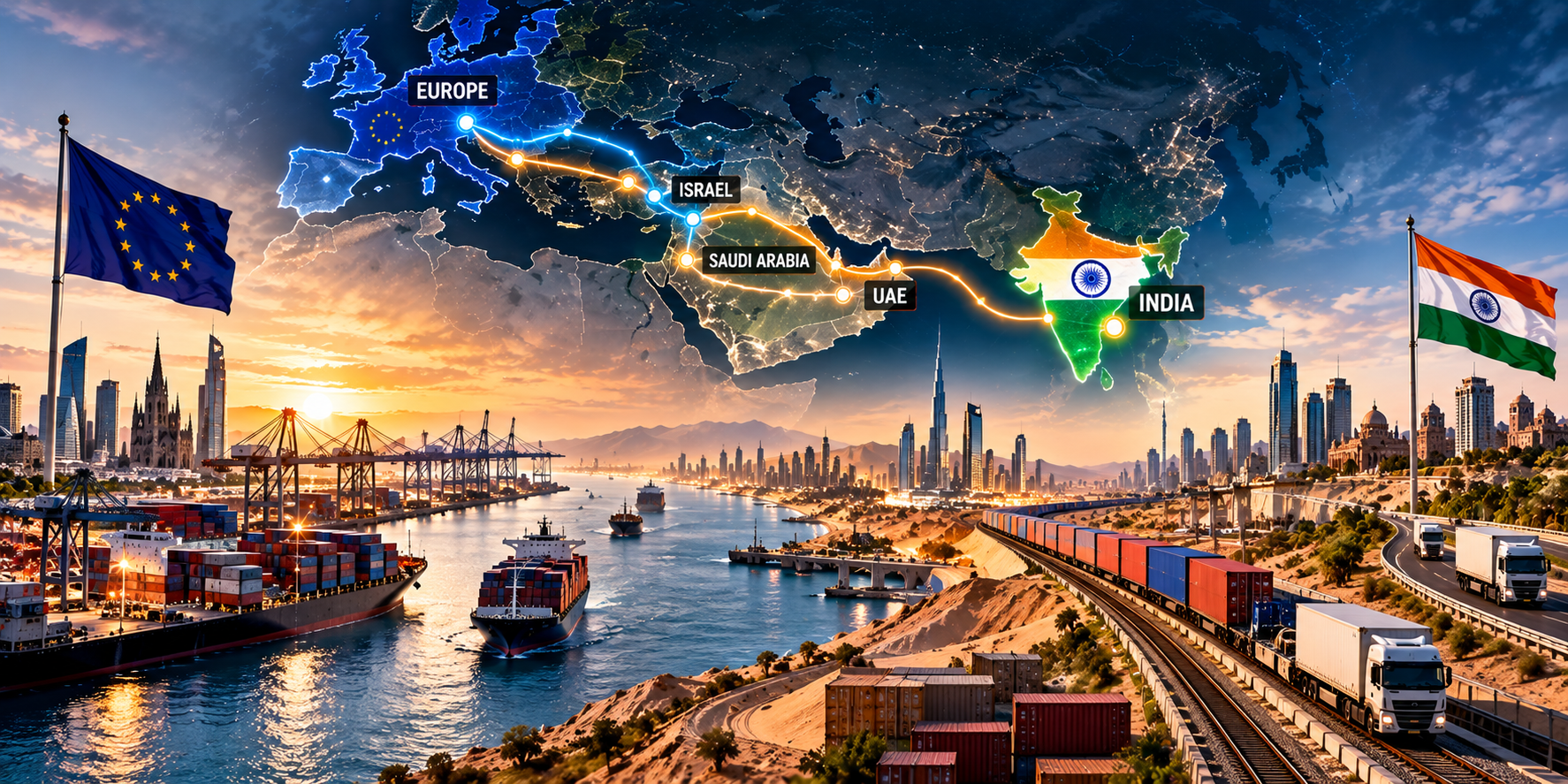
The proposed India–Middle East–Europe Economic Corridor could reshape trade between Asia and Europe, strengthen India’s strategic position and create a new network of transport, energy and digital infrastructure. But its success will depend on more than investment in ports and railways: political stability, regional cooperation and the ability to turn a strategic vision into commercially viable infrastructure will determine whether the corridor becomes a defining trade route of the twenty-first century.
Introduction: Reconnecting Three Economic Regions
For centuries, trade routes have influenced the rise and decline of economic powers. The Silk Road connected Asia with Europe through networks of merchants and cities. Maritime routes across the Indian Ocean helped link South Asia, the Arabian Peninsula, East Africa and the Mediterranean. Later, the Suez Canal transformed shipping between Europe and Asia, becoming one of the most strategically important passages in global commerce.
The twenty-first century may see another transformation in how these regions connect.
The India–Middle East–Europe Economic Corridor, widely known as IMEC, proposes a modern network linking India with the Gulf and connecting the Gulf to Europe. Announced during the G20 Summit in New Delhi in September 2023, the initiative seeks to integrate maritime transport, railways, logistics infrastructure, energy connections and digital networks.
The ambition is considerable. India would gain a new framework for connectivity with European markets, Gulf economies could strengthen their position as international logistics hubs, and Europe could diversify trade relationships with one of the world’s largest and fastest-growing major economies.
The corridor also reflects a broader shift in global economics. Countries are increasingly seeking trade routes that are not merely efficient, but resilient against geopolitical disruption, concentrated supply chains and interruptions to maritime traffic.
The European Union and India have already been expanding their economic relationship. The EU–India trade agreement concluded in January 2026 represents a major development in that relationship, while both sides continue to pursue cooperation in connectivity, technology and supply-chain resilience. <Cite refs={[“turn266686search14″,”turn471000search6”]}/>
However, IMEC should not be confused with a completed transport network. Its original vision still requires substantial infrastructure development, cross-border coordination, financing and political cooperation.
The real significance of IMEC lies in its potential to turn India, the Middle East and Europe into a more integrated economic space—and in the strategic competition that will shape whether that potential becomes reality.
1. What Is the India–Europe Corridor?
IMEC is a proposed multimodal economic corridor designed to connect India, the Arabian Peninsula and Europe through coordinated transport and infrastructure networks.
The original framework envisages two principal sections.
The eastern corridor: India to the Gulf
The eastern section would connect India to Gulf countries through maritime transport, linking Indian ports with regional logistics hubs.
From the Gulf, goods could transfer to rail and other land-based transport infrastructure, depending on the routes developed and agreements reached between participating countries.
For India, this offers a potential way to strengthen commercial links with Gulf markets while establishing another pathway towards Europe.
The northern corridor: The Gulf to Europe
The northern section is intended to connect the Gulf with the eastern Mediterranean and European markets through a combination of railway and maritime links.
The proposed network would require compatible transport infrastructure, customs arrangements, border procedures and logistics systems across several jurisdictions.
Its success would therefore depend on more than constructing rail lines. Goods would need to move efficiently between ships, ports, railways, warehouses and final destinations.
More than a transport project
The corridor’s broader vision includes energy and digital connectivity.
Proposals have included electricity connections, digital cables and infrastructure supporting potential clean-energy and hydrogen supply chains. These components could create value beyond the movement of containers, although their development would require separate technical, commercial and regulatory decisions.
The European Union has identified IMEC as part of its wider connectivity strategy, linking transport, energy, digital infrastructure and supply-chain diversification. <Cite refs={[“turn266686search12″,”turn266686search2”]}/>
The project is consequently best understood as a potential economic network rather than a single railway or shipping route.
2. Why the World Needs New Trade Routes
Global trade has expanded through increasingly integrated supply chains. Manufacturers source components from several countries, assemble products in different locations and distribute finished goods across international markets.
This model can reduce costs, increase specialisation and improve access to markets. But it also creates vulnerabilities when critical routes become congested or insecure.
Maritime chokepoints illustrate the problem.
The Suez Canal is a major connection between the Mediterranean and the Red Sea. The Strait of Hormuz is central to energy shipments from the Persian Gulf, while the Bab el-Mandeb Strait connects the Red Sea with the Gulf of Aden.
Disruption at any of these locations can affect shipping schedules, insurance costs, energy prices and industrial supply chains.
The 2021 Suez Canal blockage demonstrated how a single incident could obstruct a major international shipping route. Subsequent insecurity around the Red Sea further highlighted the vulnerability of commercial shipping to regional conflict.
IMEC’s strategic appeal is partly rooted in this experience. A diversified network could give participating countries more options when traditional routes face disruption. The Middle East Institute identifies shipping resilience, regional integration and digital connectivity as important motivations behind the corridor’s original design. <Cite refs={[“turn266686search1″,”turn266686search25”]}/>
But a crucial distinction must be made: a new corridor does not automatically eliminate existing chokepoints.
IMEC would still depend on maritime transport, ports and political stability across the regions it connects. Its effectiveness would depend on the routes available, the capacity of the infrastructure and whether cargo owners could switch between alternatives when necessary.
The objective should therefore be to complement existing routes, improve resilience and expand commercial options—not to assume that one corridor can remove every supply-chain vulnerability.
3. India’s Strategic Opportunity: From Market to Connectivity Power
India stands to gain from IMEC because its economic growth increasingly depends on reliable international connectivity.
As manufacturing expands and Indian companies seek customers abroad, transport costs, delivery times and access to foreign markets become important determinants of competitiveness.
A more integrated trade network could help Indian exporters reach customers across the Gulf and Europe while strengthening the country’s role in regional logistics.
Potential beneficiaries include manufacturers, pharmaceutical companies, engineering firms, textile exporters, electronics producers, agricultural businesses and logistics providers.
The scale of the opportunity will depend on the products being transported, the infrastructure developed and the commercial terms under which the corridor operates.
Strengthening India’s manufacturing ambitions
India’s industrial strategy seeks to expand domestic manufacturing and increase its participation in international supply chains.
But manufacturing competitiveness depends on more than wages, incentives or factory capacity. Companies also need predictable transport, reliable electricity, efficient customs procedures, access to components and dependable delivery schedules.
A well-functioning corridor could help address some of these requirements.
For example, a manufacturer exporting machinery or industrial components to Europe would benefit from a logistics system that combines predictable transit, transparent customs procedures and efficient transfers between transport modes.
The benefits would not be automatic. If the corridor adds expensive transfers, complicated border procedures or delays, the commercial advantage could disappear.
India’s challenge is therefore to integrate IMEC with domestic infrastructure development, including modern ports, freight corridors, logistics parks, customs digitisation and more efficient movement of goods between production centres and export gateways.
Strategic autonomy through connectivity
IMEC also has a geopolitical dimension.
India seeks deeper economic relations with Europe and the Gulf while maintaining a foreign policy that preserves flexibility across competing global powers.
Improved connectivity could broaden its options and strengthen its commercial relationships without requiring exclusive alignment with a single geopolitical bloc.
The corridor is often discussed in the context of competition with China’s Belt and Road Initiative. Yet India’s economic case should not depend entirely on that rivalry.
The more durable argument is that India benefits from having additional reliable trade routes, stronger commercial partnerships and greater access to international markets.
Connectivity can support strategic autonomy when it expands a country’s choices rather than creating a new dependence.
4. Europe’s Interest: Diversification, Trade and Economic Security
For Europe, IMEC offers a potential way to deepen its economic relationship with India while strengthening links with the Gulf.
India provides a large market for European machinery, industrial equipment, pharmaceuticals, chemicals, transport technology and other goods. European companies also have potential opportunities in India’s infrastructure development, energy transition and expanding manufacturing sector.
At the same time, European policymakers have increasingly emphasised economic security and the need to diversify supply chains.
The EU–India trade agreement concluded in January 2026 provides an important policy foundation for expanding commercial exchange. The European Commission says the agreement is intended to reduce trade barriers, create export opportunities and diversify economic relationships. <Cite refs={[“turn266686search14”]}/>
Trade agreements and transport corridors, however, perform different functions.
A trade agreement can reduce tariffs and establish rules for market access. A corridor can improve physical connectivity and logistics. The greatest benefits arise when these instruments work together.
For European businesses, IMEC could create opportunities to access Indian markets through more integrated transport and logistics networks. It could also encourage investment in ports, warehouses, digital systems, industrial facilities and related services.
European participation will depend on whether the route is commercially competitive with established maritime alternatives and whether its governance arrangements offer sufficient predictability.
Europe’s gateway competition
Mediterranean ports could play an important role in receiving and distributing cargo moving through the corridor.
Countries including Italy, France and Greece have expressed interest in the wider connectivity agenda. India’s engagement with Italy in May 2026 reaffirmed support for IMEC and encouraged concrete steps towards its first ministerial meeting. <Cite refs={[“turn471000search3″,”turn471000search4”]}/>
The competition between ports could become an important part of the corridor’s development.
However, selecting a port is only one decision. The chosen gateway must connect efficiently to inland transport networks, customs systems, industrial centres and final markets.
Europe’s success will depend on treating the corridor as an integrated logistics system rather than a collection of disconnected infrastructure projects.
5. The Gulf: From Energy Exporters to Global Logistics Hubs
The Gulf occupies a central position in the proposed corridor.
Saudi Arabia and the United Arab Emirates have invested in ports, logistics, transport infrastructure and economic diversification. Both have reasons to strengthen their roles as gateways linking Asia, Europe and Africa.
The corridor could reinforce these ambitions by encouraging new rail connections, logistics facilities, warehousing, industrial zones and digital infrastructure.
For Gulf economies, the opportunity extends beyond collecting transit fees.
A functioning corridor could attract distribution centres, assembly operations, processing facilities and service providers. It could also strengthen links between logistics, manufacturing, finance and technology.
Saudi Arabia’s potential role
Saudi Arabia’s geographic position and investment ambitions could make it an important participant in the Gulf-to-Mediterranean segment.
Rail infrastructure, ports, industrial zones and border connections would need to be coordinated with neighbouring countries for the corridor to operate efficiently.
The commercial case would depend on cargo volumes, infrastructure costs, operating arrangements and the ability to provide reliable connections to both Asian and European markets.
The UAE’s potential role
The UAE has developed an international logistics network supported by ports, aviation, maritime services and trade infrastructure.
Its relationship with India is particularly relevant. In February 2024, the two countries signed an intergovernmental framework agreement intended to support cooperation on IMEC’s operation and development, including ports, maritime transport and logistics. <Cite refs={[“turn266686search6″,”turn266686search11”]}/>
That agreement provides a bilateral foundation for cooperation, but it does not by itself complete the wider multinational corridor.
The Gulf’s broader challenge is to translate geographic advantage into durable commercial activity. A location on a map is valuable only when infrastructure, institutions, security and logistics services make it practical for businesses to use.
6. The Geopolitical Challenge: Can the Middle East Sustain the Corridor?
The corridor’s greatest uncertainty is not engineering. It is geopolitics.
IMEC requires sustained cooperation across countries with different political priorities, security relationships and regional ambitions.
The route’s northern section would need dependable connections through the Gulf and the Levant to Mediterranean gateways. That raises difficult questions about political relations, infrastructure access and the stability of the surrounding region.
The wars and tensions that have affected the Middle East since the corridor was announced in 2023 have slowed its original momentum.
A June 2026 assessment from the Middle East Institute described the corridor’s implementation as effectively on hold in its original form, citing regional instability and unresolved political conditions. Other official and diplomatic statements during 2026 have continued to express support for advancing the project. <Cite refs={[“turn266686search1″,”turn471000search2″,”turn471000search3”]}/>
These assessments illustrate an important distinction: diplomatic support can continue even when the physical corridor remains incomplete.
The Israel–Gulf dimension
The corridor’s original geopolitical logic was closely connected to the possibility of wider regional normalisation and cooperation.
Improved relations between Israel and Gulf states could facilitate infrastructure planning and cross-border connectivity. But conflict, distrust and unresolved political disputes can make these arrangements difficult to sustain.
A commercial corridor cannot be insulated completely from the political relationships through which it passes.
The Saudi–UAE dimension
Saudi Arabia and the UAE share important economic interests, but they also compete in areas such as logistics, investment, aviation and regional influence.
That competition does not make cooperation impossible. It does mean that the corridor’s governance must provide clear incentives for each participant and establish workable arrangements for infrastructure, customs, investment and the distribution of economic benefits.
The wider regional environment
The security of maritime routes and the stability of participating states will affect investor confidence.
If companies cannot rely on cargo moving predictably across borders, the corridor may struggle to attract the volumes needed to justify its costs.
The project’s political challenge is therefore to create a framework in which cooperation remains commercially worthwhile even when regional relations become difficult.
7. IMEC and China’s Belt and Road Initiative
The corridor is frequently compared with China’s Belt and Road Initiative (BRI), which has supported transport, energy and other infrastructure projects across multiple regions.
The comparison is understandable. Both initiatives involve international connectivity and can influence trade relationships, investment flows and geopolitical influence.
However, the two are not identical.
The BRI is a broad programme encompassing numerous projects and countries. IMEC is a proposed corridor with a more specific geographic focus connecting India, the Gulf and Europe.
Their structures, financing arrangements and implementation histories differ. It is therefore more useful to compare their commercial performance and strategic implications than to assume they are direct equivalents.
The competition for connectivity
China has developed substantial influence through infrastructure investment, manufacturing and trade relationships. IMEC could give India, Europe and participating Gulf economies another framework for connecting markets and coordinating infrastructure.
For India, the corridor may complement its broader objective of diversifying trade and strengthening international partnerships.
For Europe, it could expand economic ties with India and support the diversification of supply chains.
For Gulf states, it could create additional opportunities to act as logistics and industrial hubs.
But a corridor will not become competitive merely because it offers an alternative to China-backed routes.
It must deliver commercially attractive services, reliable transit and clear economic benefits.
The long-term contest will be decided by performance: costs, delivery times, reliability, investment returns and the ability to support real trade.
8. The Economic Case: What Could IMEC Deliver?
IMEC’s economic potential lies in reducing friction between markets.
International trade involves costs beyond the price of transporting a container. Businesses must manage inventory, insurance, customs procedures, delays, storage, financing and uncertainty over delivery times.
A well-designed corridor could reduce some of these costs by integrating infrastructure and improving coordination between transport providers and border authorities.
Lower logistics costs
Rail transport may be competitive for particular cargoes and distances, especially when combined with efficient port operations. But rail is not automatically cheaper than shipping.
The commercial result will depend on the cargo, route, transfer requirements, handling costs and reliability of the entire journey.
The corridor will need to demonstrate a clear advantage for specific trade flows rather than rely on general claims about faster transport.
More resilient supply chains
A diversified network could give businesses additional routing options during disruptions.
However, resilience depends on having usable alternatives with sufficient capacity. A route that exists only on paper cannot protect a manufacturer from a shipping crisis.
New investment and employment
Infrastructure development can generate demand for construction, engineering, logistics, maintenance, digital services and associated industries.
Long-term gains may also arise if businesses locate distribution centres, processing operations or manufacturing facilities near the corridor.
But these benefits depend on commercially viable projects, effective regulation and sufficient cargo volumes. Infrastructure expenditure alone does not guarantee sustained economic development.
Digital and energy connectivity
Digital infrastructure could improve trade documentation, cargo tracking, data exchange and customs coordination. Energy links may create opportunities for cross-border electricity cooperation and potential clean-energy supply chains.
These components could be strategically important, but they require their own technical standards, financing, security arrangements and commercial agreements.
The economic value of IMEC will therefore depend on how well its transport, digital and energy components are coordinated.
9. The Infrastructure Challenge: Building a Corridor That Works
A corridor linking several countries is only as efficient as its weakest connection.
Ports may need expansion. Railways may require new construction or upgrades. Border crossings need compatible procedures, and logistics operators must be able to transfer goods between transport modes without excessive delays.
These tasks require capital and coordination.
Financing and commercial viability
Large infrastructure projects require clear financial structures and realistic assessments of demand.
Governments may fund public infrastructure, while private investors can participate where expected returns justify the risk. Multilateral institutions may also help finance eligible projects or provide technical support.
But investors need clarity over construction costs, operating responsibilities, revenue arrangements and the allocation of political and commercial risks.
If those questions remain unresolved, projects can be delayed even when political leaders continue to endorse the corridor.
Standards and customs
Differences in documentation, customs procedures, rail standards, data systems and border regulations can create friction.
A corridor that moves goods efficiently within one country may become slow when cargo crosses several jurisdictions.
Digital documentation, compatible tracking systems and coordinated customs processes could help reduce these obstacles.
The need for transparent governance
Participants must agree on how infrastructure is operated, how costs are shared and how disruptions are managed.
Transparent procurement, environmental safeguards, dispute-resolution procedures and predictable regulation would help build confidence among governments and investors.
The corridor’s long-term success will depend as much on institutional design as on physical infrastructure.
10. The India–Europe Trade Relationship Beyond IMEC
Even if the corridor takes longer than expected to develop, the wider India–Europe economic relationship can continue to expand.
Trade agreements, industrial partnerships, investment, research cooperation and technology exchange are not dependent on the completion of a single route.
The EU–India trade agreement concluded in January 2026 offers a significant framework for deepening commercial engagement. Cooperation in clean technologies, critical minerals, digital infrastructure and industrial research could also strengthen the relationship. <Cite refs={[“turn266686search14″,”turn471000search6″,”turn471000search7”]}/>
This is important because it reduces the risk of treating IMEC as an all-or-nothing project.
The corridor can be developed progressively. Bilateral port cooperation, improved maritime connections, digital systems and selected infrastructure investments may deliver benefits even before a complete end-to-end route becomes operational.
The key is to ensure that individual projects are compatible with a wider connectivity strategy rather than becoming isolated investments with limited value.
India and Europe have complementary economic interests. India offers scale, a growing market and expanding industrial capabilities. Europe offers advanced engineering, capital, technology and access to a large integrated market.
The challenge is to convert these complementary strengths into durable commercial relationships.
11. What Must Happen for IMEC to Succeed?
The corridor’s prospects depend on several practical conditions.
First, political commitment must translate into implementation. Statements of support need to be followed by defined responsibilities, realistic schedules, financing decisions and measurable milestones.
Second, regional security must improve sufficiently to support reliable operations. Investors and logistics companies need confidence that cross-border infrastructure can function without repeated disruption.
Third, the corridor must demonstrate commercial value. It needs competitive costs, reliable transit times and sufficient demand to support investment and ongoing operations.
Fourth, participants must coordinate customs and technical standards. Efficient transport requires more than railway tracks and port capacity.
Fifth, financing must be transparent and sustainable. Projects should be assessed on realistic demand and long-term operating costs, not simply their strategic symbolism.
Sixth, the network must remain flexible. Alternative ports, routes and logistics arrangements could improve resilience if individual sections face disruption.
Finally, the corridor should deliver benefits to participating communities. Employment, skills development, environmental safeguards and local economic opportunities can help build the public legitimacy needed for long-term infrastructure investment.
These conditions are demanding, but they are not unique to IMEC. They are the requirements of any multinational infrastructure project intended to transform international trade.
Conclusion: A Strategic Vision Still Waiting to Become Infrastructure
The India–Middle East–Europe Economic Corridor represents an ambitious attempt to rethink connectivity between three important economic regions.
For India, it offers the prospect of improved access to Gulf and European markets, stronger manufacturing competitiveness and a broader network of international partnerships.
For Europe, it creates a potential framework for trade diversification and deeper engagement with India. For Gulf economies, it offers an opportunity to strengthen their roles as logistics and industrial hubs.
The corridor could also support wider cooperation in digital infrastructure, energy and supply-chain resilience.
But its strategic importance should not obscure the distance between political ambition and commercial reality. The route remains under development, and its ultimate configuration, financing, timelines and operating arrangements will depend on decisions that have yet to be fully resolved.
Regional instability is a serious obstacle. So are infrastructure costs, cross-border coordination and the need to demonstrate that the corridor can compete with established transport routes.
The project’s success will not be measured by the number of declarations signed or the scale of the vision announced. It will be measured by whether goods move reliably, businesses use the route, investment produces lasting value and participating economies become more connected.
The broader lesson is that global trade is entering a period in which connectivity has become a strategic asset. Countries want not only access to markets, but also resilient routes, diversified partnerships and greater control over the infrastructure supporting their economies.
If IMEC succeeds, it could become more than a new route between India and Europe. It could become a framework for a more interconnected economic order linking South Asia, the Gulf and the Mediterranean.
Its future, however, will be determined not by geography alone, but by political cooperation, commercial performance and the ability to turn an ambitious idea into a functioning system.


