


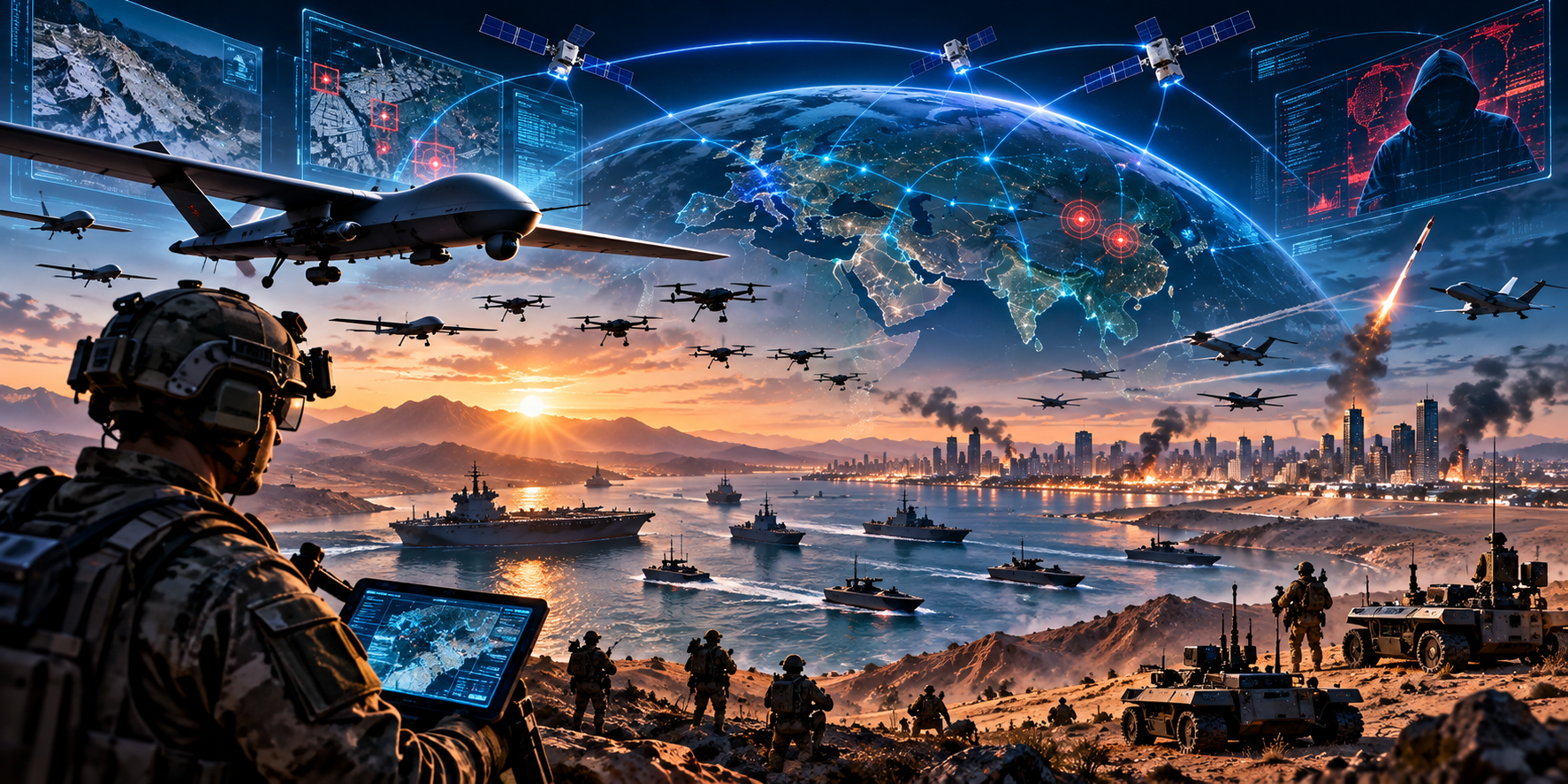
By 2040, the battlefield may be defined by autonomous systems, artificial intelligence, cyber operations and contested space. But the decisive advantage will belong not simply to the country with the most advanced weapons, but to the one capable of integrating technology, industrial capacity, human judgment and strategic resilience into a coherent system of war.
Introduction: The Next Revolution in Warfare
Imagine a military conflict in 2040.
Satellites detect unusual activity across a disputed border. Artificial intelligence processes thousands of intelligence reports, commercial satellite images and sensor feeds in seconds. Autonomous aircraft begin surveillance missions while uncrewed surface vessels monitor maritime approaches. Cyber operations disrupt selected communications networks, and electronic warfare systems interfere with navigation and battlefield connectivity.
Commanders must make decisions in an environment where information changes continuously, machines operate at extraordinary speed and the distinction between military and civilian infrastructure becomes increasingly difficult to maintain.
This scenario is not a prediction of a specific future war. It is a plausible illustration of how emerging technologies could combine to transform military operations over the next fourteen years.
The foundations are already visible. Conflicts today demonstrate the growing importance of drones, electronic warfare, intelligence networks, precision weapons and resilient logistics. The Russia–Ukraine war, in particular, has highlighted how technological adaptation and the ability to replace equipment can influence the balance between opposing forces.
Meanwhile, NATO’s emerging-technology priorities include artificial intelligence, autonomous systems, quantum technologies, biotechnology, space, hypersonic systems, advanced materials, energy and next-generation communications.
By 2040, these technologies may no longer operate as separate military capabilities. They could form interconnected systems in which intelligence, command, manoeuvre, defence and logistics reinforce one another.
The central question, therefore, is not whether warfare will become more technological. It is whether military institutions can adapt quickly enough to exploit technology without becoming dangerously dependent on it.
1. Artificial Intelligence Will Transform Military Decision-Making
Artificial intelligence is likely to become one of the most consequential technologies in future warfare—not because it will necessarily replace commanders, but because it will change how military decisions are prepared, evaluated and executed.
Modern armed forces already collect information from satellites, radar, aircraft, drones, intelligence agencies, communications systems and ground units. The challenge is converting that information into a reliable operational picture before circumstances change.
AI could increasingly assist with intelligence analysis, logistics planning, threat detection, maintenance, mission coordination and the identification of patterns that human analysts might overlook.
By 2040, commanders may work alongside AI-enabled decision-support systems capable of comparing possible courses of action, estimating resource requirements and identifying emerging risks across multiple operational domains.
However, faster analysis will not automatically produce better decisions.
AI systems can misinterpret incomplete information, reproduce biases in their training data or generate confident but incorrect assessments. An adversary may deliberately manipulate the information on which a system depends. In a crisis, an erroneous recommendation delivered at machine speed could be more dangerous than a slower human mistake.
Research into AI and military competition highlights several fundamental tensions that could shape future warfare, including quantity versus quality, hiding versus finding, centralised versus decentralised command, and cyber offence versus defence.
These tensions suggest that AI’s strategic value will depend on how militaries organise themselves around it.
The most effective forces will need to determine which decisions can be automated, which require human authorisation and how commanders can challenge machine-generated recommendations. They will also need to preserve the ability to operate when AI services, data feeds or communications become unavailable.
The future advantage will not come from using AI everywhere. It will come from knowing where AI improves judgment—and where it introduces unacceptable risk.
2. Autonomous Weapons and the Rise of Machine-Speed Warfare
The next stage of military transformation will involve greater autonomy across air, land, sea and underwater operations.
Uncrewed aircraft can already perform reconnaissance and strike missions. Uncrewed surface vessels can support maritime surveillance, while underwater systems can assist with inspection, monitoring and other hazardous tasks. Ground robots may increasingly support logistics, engineering and reconnaissance.
By 2040, military forces could deploy larger teams of autonomous and remotely operated platforms coordinated through shared software and intelligence systems.
Instead of relying exclusively on a small number of expensive aircraft or ships, commanders may have access to a wider range of platforms with different costs, capabilities and levels of autonomy.
Some systems will remain under direct human control. Others may navigate, maintain formation, identify objects or coordinate tasks with limited intervention. The degree of autonomy will vary according to mission, technical reliability, legal constraints and the consequences of failure.
The most important development may not be an individual autonomous weapon, but the software that connects sensors, decision-support tools and military platforms into a coordinated system.
This creates both an opportunity and a danger.
Automation could reduce the exposure of personnel to hazardous environments and help forces conduct persistent surveillance. Yet it could also compress decision times, complicate accountability and increase the likelihood that an incident escalates before political leaders understand what has happened.
The question of human control will consequently become central to military policy. States will need clear rules governing the circumstances in which autonomous systems can select and engage targets, alongside mechanisms for oversight, testing and accountability.
In 2040, technological sophistication will not be measured only by how independently a weapon operates. It will also be measured by whether its behaviour remains predictable, controllable and consistent with the law of armed conflict.
3. Drone Swarms and the Economics of Attrition
One of the defining features of future warfare may be the widening gap between the cost of attacking a target and the cost of defending it.
A sophisticated missile, aircraft or naval platform can require enormous investment. In contrast, smaller drones can be produced in larger quantities, modified quickly and deployed for reconnaissance, deception or attack.
This creates an economic problem for traditional military forces. If an inexpensive threat requires an expensive interceptor, the defender may face an unsustainable exchange of resources even when its air defences are technically effective.
By 2040, militaries are likely to pursue layered approaches that combine electronic warfare, conventional interceptors, guns, directed-energy systems where practical, passive protection and their own uncrewed platforms.
Drone swarms could become more coordinated, with software assigning different tasks to individual systems. Some platforms may gather intelligence, others may act as decoys, and others may perform specialised missions. Such coordination would remain vulnerable to jamming, deception, software defects and the destruction of critical communications or control systems.
The decisive issue will be the interaction between mass, reliability and cost.
A system that works impressively in a demonstration may be less effective under sustained combat conditions, when weather, interference, maintenance failures and enemy countermeasures reduce performance. Producing thousands of platforms is also insufficient if an armed force cannot train operators, distribute spare parts, secure communications and replace losses.
The lesson is that future military power may depend as much on manufacturing and adaptation as on the sophistication of individual weapons.
Countries that can produce affordable systems at scale, update them rapidly and sustain operations under attack could gain significant advantages over forces dependent on a limited inventory of exceptionally expensive equipment.
4. The Battlefield Will Become More Transparent—and More Deceptive
Historically, concealment, surprise and uncertainty have been essential elements of military strategy. Emerging sensor technologies could make these advantages harder to achieve.
Commercial satellites, uncrewed aircraft, ground sensors, electronic intelligence and automated image analysis may enable armed forces to monitor large areas with increasing frequency.
By 2040, a vehicle moving through a contested region, a ship departing a port or a military formation preparing to deploy could leave multiple digital signatures. AI-assisted analysis may help distinguish routine activity from unusual behaviour.
This could make traditional concentration of forces more dangerous. Large formations, predictable supply routes and conspicuous infrastructure may be easier to detect and target.
Yet greater surveillance will not necessarily make the battlefield completely transparent.
Sensors have limitations. Clouds, terrain, camouflage, decoys, signal discipline and deliberate deception can complicate detection. Information may be delayed, misinterpreted or deliberately falsified. A detected object is not automatically a correctly identified threat, and an accurate location does not guarantee that a target can be engaged successfully.
The resulting competition will be between finding and hiding.
Militaries will seek to combine multiple intelligence sources while protecting their own signatures, confusing adversary analysis and limiting the reliability of information available to hostile forces.
This could produce a battlefield in which information is abundant but certainty remains scarce.
The strategic challenge will be to distinguish what can be observed from what can actually be known—and to avoid making irreversible decisions on the basis of misleading data.
5. Cyber Warfare Will Extend Far Beyond Military Networks
By 2040, the consequences of a major conflict may be felt across digital infrastructure long before conventional forces engage directly.
Military operations depend on communications, navigation, cloud services, financial systems, industrial control networks, transport infrastructure and reliable electricity. Many of these systems are operated by private companies or shared across national borders.
Cyber operations could therefore target not only military command systems but also the infrastructure that enables governments, industries and societies to function.
A disruption to logistics software might delay the movement of supplies. An attack on a communications provider could interfere with coordination. Manipulated data might undermine confidence in intelligence or create confusion among decision-makers.
The most serious danger lies in the interdependence of modern systems. A failure in one service can affect organisations that appear unrelated to the original target.
Military planners will consequently need to consider cyber resilience as a core element of operational readiness. That means secure networks, tested recovery procedures, alternative communications and the ability to continue essential functions when digital services are degraded.
Cyber warfare also creates problems of attribution and escalation. Determining who conducted an operation, whether a disruption was deliberate and whether it constitutes an act of war may be difficult.
A cyber incident affecting civilian infrastructure could be interpreted as preparation for a conventional attack. Conversely, a state might underestimate the consequences of an operation whose effects spread beyond its intended target.
In such an environment, strategic stability will depend on technical resilience as well as diplomatic communication and credible crisis-management procedures.
6. Space Will Become an Even More Contested Military Domain
Modern armed forces depend on space-based systems for navigation, communications, weather information, missile warning and intelligence.
By 2040, these capabilities could become even more integrated into military operations. Satellite networks may support distributed forces, uncrewed systems and long-distance coordination. Commercial providers could remain important to both military and civilian users.
This dependence creates a strategic vulnerability.
Interference with satellite communications, navigation signals or space-based intelligence could degrade military effectiveness without requiring the destruction of conventional platforms. Cyber operations, electronic interference and attacks against space infrastructure could have consequences far beyond the immediate military objective.
The growing focus on future military operating environments reflects the importance of preparing for a domain in which space capabilities are contested rather than assumed to be continuously available.
The likely response is diversification and resilience.
Militaries may invest in multiple satellite constellations, alternative communications channels, more rapidly replaceable spacecraft and systems capable of functioning with limited space support.
Space security will also become an economic and diplomatic issue. Commercial satellites support telecommunications, financial services, navigation and disaster response. Disruption to these assets can therefore affect civilian populations and global commerce.
The challenge for governments will be to strengthen deterrence and protect critical services without turning space into an arena of uncontrolled escalation.
7. Electronic Warfare Could Decide Which Forces Can Function
High-tech military systems depend on the electromagnetic spectrum for communications, radar, navigation and sensing. This creates an important vulnerability: a force may possess advanced equipment but struggle to use it when the relevant signals are disrupted or manipulated.
Electronic warfare will therefore be central to future military competition.
By 2040, more sophisticated systems may help detect emissions, adapt communications, identify interference and coordinate countermeasures. AI could assist in processing large volumes of spectrum data, although its performance will depend on the quality of information and the resilience of the underlying equipment.
Electronic warfare is especially important because its effects can be disproportionate. A relatively limited disruption may interfere with the operation of several connected systems at once.
The answer is not simply to build more powerful transmitters or more advanced software. Militaries must design equipment that can function in degraded conditions, maintain alternative methods of communication and train personnel to operate without continuous digital support.
This leads to a broader principle of future warfare: connectivity creates combat power, but dependence on connectivity creates vulnerabilities.
The most resilient armed forces will combine sophisticated networks with the ability to function when those networks are compromised.
8. Hypersonic Weapons and the Continuing Nuclear Challenge
The future battlefield will not consist exclusively of drones and software. Long-range missiles, advanced air defence, submarines and nuclear forces will remain central to the strategic balance.
Hypersonic weapons and other advanced missile systems may create difficult detection and interception challenges. Their actual effectiveness, however, will depend on factors including guidance, reliability, deployment costs, survivability and the ability of opposing forces to adapt.
The existence of a faster or more manoeuvrable weapon does not automatically make it strategically decisive. A weapon must be integrated into a broader military system and serve a credible operational or political purpose.
Nuclear deterrence will remain especially consequential.
By 2040, nuclear-armed states may rely on more sophisticated early-warning systems, AI-assisted analysis, resilient communications and increasingly complex conventional capabilities. These developments could improve awareness and defensive preparedness, but they could also introduce new risks.
Automated systems may misclassify events. Cyber interference could undermine confidence in warning networks. Faster decision cycles could place pressure on leaders to act before uncertainty has been resolved.
The danger is not limited to a deliberate decision to initiate nuclear conflict. It also includes miscalculation, technical failure and escalation during a conventional war.
For this reason, human control over nuclear-use decisions, reliable crisis communications and robust verification procedures will remain essential, regardless of technological progress.
9. The Human Soldier Will Change, Not Disappear
Predictions about future warfare often imagine a battlefield dominated by machines, with human soldiers relegated to remote command centres.
A more plausible outcome is a changing division of labour.
Robots and uncrewed systems may undertake more hazardous reconnaissance, explosive ordnance disposal, resupply and selected combat-support tasks. AI may assist with navigation, threat assessment, translation and medical triage. Wearable systems could improve situational awareness and help soldiers manage complex information.
However, humans will remain important wherever operations require judgment under uncertainty, interaction with civilian populations, leadership, improvisation and political understanding.
Technology cannot eliminate the complexity of controlling territory, protecting civilians, building local legitimacy or determining when military force serves a broader strategic purpose.
Even highly automated forces will need trained personnel who understand the limits of their equipment and can intervene when systems fail.
The soldier of 2040 may therefore operate within a much more technologically integrated unit, coordinating with uncrewed platforms and digital decision-support systems while remaining responsible for decisions that machines cannot safely make alone.
Military effectiveness will depend on how well people, organisations and machines work together—not on the number of robots deployed.
10. Logistics and Industrial Capacity Will Remain Decisive
A technologically advanced military can still fail if it cannot sustain its operations.
Every aircraft, drone, ship, vehicle and communications system requires fuel or energy, maintenance, spare parts, trained personnel and reliable supply chains. Precision weapons must be manufactured and replenished. Software must be updated and secured. Damaged equipment must be repaired or replaced.
Future warfare could intensify these requirements.
High rates of equipment consumption may force militaries to balance expensive, sophisticated platforms against cheaper systems that can be produced in larger quantities. Electronic warfare and cyber disruption may make supply networks less reliable. Attacks on infrastructure could complicate the movement of personnel and materiel.
The capacity to scale production during a prolonged conflict may become a strategic advantage in its own right.
This is not an argument that quantity will always defeat quality. Advanced platforms can deliver capabilities that large numbers of simpler systems cannot replicate. The challenge is to establish a force structure in which expensive high-end systems, affordable mass-produced equipment and human capabilities complement one another.
Countries will also need to assess their dependence on foreign suppliers for semiconductors, batteries, specialised materials, software and other critical components.
Defence policy will increasingly intersect with industrial policy, energy security, research and development, and international trade.
A country that can design advanced weapons but cannot manufacture, maintain or replace them at scale may struggle in a prolonged war.
11. The Return of Deception, Improvisation and Low-Tech Warfare
It would be a mistake to assume that future warfare will become uniformly high-tech.
Military history repeatedly demonstrates that new technologies create new vulnerabilities, while adversaries search for inexpensive ways to exploit them.
By 2040, sophisticated sensor networks may coexist with decoys, camouflage, improvised equipment, basic physical obstacles and unconventional tactics. Forces may deliberately reduce their digital signatures or rely on alternative procedures when communications are unreliable.
A high-tech military could be challenged by an opponent that avoids direct confrontation, disperses its forces, exploits difficult terrain or targets the systems on which advanced platforms depend.
The objective is not necessarily to match an opponent’s technology. It may be to undermine the conditions that allow that technology to deliver an advantage.
This makes adaptability especially important.
Military organisations must be capable of learning from battlefield experience, changing tactics and updating equipment without becoming trapped by assumptions embedded in their procurement programmes.
The future will reward forces that combine advanced capabilities with practical ingenuity.
12. Information Warfare Will Target Public Confidence and Political Will
Wars are fought not only to destroy military capabilities but also to influence decisions.
By 2040, information operations may become more sophisticated through AI-generated content, synthetic media, automated messaging and the analysis of public behaviour. These tools could be used to spread false narratives, manipulate perceptions, undermine trust in institutions or create confusion during a crisis.
The target may be an adversary’s population, political leadership, military personnel or international partners.
The strategic purpose is broader than propaganda. Information operations may seek to weaken the political will required to sustain a conflict, divide alliances or make governments doubt their own intelligence.
Yet the effects of such operations are difficult to predict. Audiences do not respond uniformly, and the circulation of misleading information does not guarantee a lasting political outcome.
Democratic societies will need stronger mechanisms for authenticating information, communicating during emergencies and explaining the basis for consequential decisions. Governments must also avoid undermining public trust through excessive secrecy or unsupported claims.
The central challenge will be to protect information integrity without treating every disagreement or criticism as hostile activity.
In future conflicts, credibility may become an important strategic resource. A government that can communicate accurately and maintain public confidence may be better positioned to sustain a long confrontation than one with more advanced technology but less domestic legitimacy.
13. Will Warfare Become More Precise—or More Dangerous?
One of the promises of technological progress is that better intelligence and more accurate weapons could reduce unintended harm.
In principle, improved surveillance, target identification and precision capabilities may help forces distinguish military objectives from civilian areas and reduce the need for indiscriminate firepower.
But technological accuracy does not guarantee responsible use.
A weapon may strike its selected coordinates precisely while the underlying intelligence is wrong. An AI system may classify an object incorrectly. A commander may misunderstand the context of a target. A rapid sequence of automated actions may leave insufficient time to assess changing circumstances.
Moreover, lower-cost weapons and greater automation could make the use of force easier to initiate in some situations, even as the potential consequences of a major conflict become more severe.
The relationship between technology and restraint is therefore uncertain.
Military institutions will need reliable testing, human oversight, clear accountability and operational rules that reflect the limits of automated systems. International humanitarian law—including the principles of distinction, proportionality and precautions in attack—will remain central to evaluating the use of force.
Technological progress should be judged not only by accuracy or speed, but also by whether it improves control, accountability and protection for civilians.
14. The Geopolitical Race to Build the Military of 2040
The future of warfare will be shaped by competition among major powers, but not every country will pursue the same model.
The United States and its allies will seek to integrate advanced technologies while preserving interoperability across complex military systems. China will continue to be an important competitor in military technology, manufacturing and strategic innovation. Russia’s experience with large-scale conflict has highlighted the significance of adaptation, electronic warfare, drones and the industrial capacity to sustain prolonged operations.
Other states will seek asymmetric advantages by investing in selected capabilities rather than attempting to replicate the entire military architecture of a major power.
The race will not be determined by research laboratories alone. It will also depend on access to capital, skilled personnel, energy, advanced manufacturing, software talent and secure supply chains.
Military innovation increasingly draws on civilian technologies. Commercial companies can develop computing systems, sensors, communications equipment and autonomous platforms that may have both civilian and defence applications.
This can accelerate innovation, but it creates challenges for procurement, security, intellectual property and dependence on private suppliers.
States will need closer relationships between defence establishments, industry, universities and research institutions. They will also need systems that allow them to adopt useful technologies without sacrificing reliability or democratic accountability.
The winners will not necessarily be those that announce the most ambitious programmes. They will be those that turn innovation into capabilities that can be maintained, deployed and adapted under real operational conditions.
15. What This Means for India
For India, the transformation of warfare by 2040 will have direct implications for national security, defence modernisation and strategic autonomy.
India faces a complex security environment that requires preparedness across land, air, maritime, cyber and space domains. Its military planning must account for conventional deterrence, border security, maritime interests, technological competition and the possibility of simultaneous or overlapping crises.
The central challenge is to modernise without creating an unsustainable dependence on expensive foreign systems or fragmented domestic technologies.
AI and autonomous capabilities
India will need to strengthen research, testing and responsible deployment in AI-enabled military systems, robotics, uncrewed platforms, secure communications and electronic warfare. The objective should be to build dependable capabilities that meet operational requirements rather than pursue automation for its own sake.
Domestic defence manufacturing
A prolonged conflict can consume equipment faster than peacetime procurement systems are designed to replace it. India’s defence-industrial strategy must therefore consider production capacity, maintenance, spare parts, software support and the ability to scale manufacturing during emergencies.
Domestic production is not automatically resilient: it also requires dependable access to components, specialised materials and skilled labour.
Cyber and space resilience
India’s military and civilian infrastructure will increasingly depend on digital networks and space-based services. Protecting these systems, diversifying critical capabilities and maintaining backup arrangements should be integral to national security planning.
Maritime security
The Indian Ocean will remain central to India’s economic and strategic interests. Uncrewed maritime systems, surveillance networks, undersea infrastructure protection and the resilience of ports and logistics will influence the country’s ability to protect trade and respond to regional crises.
Human capital and doctrine
Technology cannot compensate for weak integration between organisations. India will need trained personnel, realistic exercises, strong testing institutions and doctrines that explain how human forces and autonomous systems should operate together.
The broader objective should be a balanced military: technologically capable, industrially sustainable, adaptable under pressure and able to operate when advanced networks are disrupted.
For India, strategic autonomy in 2040 will depend not simply on buying fewer foreign weapons, but on building the knowledge, manufacturing capacity and institutional competence required to make independent strategic choices.
16. Three Plausible Futures for Warfare in 2040
No forecast can identify the exact shape of a war fourteen years from now. Several broad outcomes remain possible.
Scenario One: The highly integrated battlefield
AI-enabled intelligence, autonomous platforms and resilient communications become deeply integrated. Armed forces can coordinate operations across domains more quickly, and improved sensing supports more effective defence and logistics.
However, adversaries also develop countermeasures. The advantage belongs to forces that continuously adapt rather than those that merely possess advanced equipment.
Scenario Two: The contested and disconnected battlefield
Cyber attacks, electronic warfare and attacks on infrastructure frequently disrupt communications and navigation. Autonomous systems continue operating in some areas, but coordination becomes unreliable. Commanders must switch between digital and degraded modes of operation.
In this scenario, resilience, decentralised leadership and the ability to operate without constant connectivity become decisive.
Scenario Three: The affordable-mass battlefield
Lower-cost drones, uncrewed vessels, sensors and precision systems become widely available. Both state and non-state actors can threaten assets that were previously difficult to reach.
The economic sustainability of defence becomes central. High-end systems remain important, but militaries must balance them with scalable production, layered defence and rapid replacement.
These scenarios are not mutually exclusive. A single conflict could combine elements of all three, with technologically sophisticated operations in one domain and improvised, resource-intensive fighting in another.
The most useful preparation is therefore not a rigid prediction, but the development of forces that can learn, recover and adapt across multiple possible futures.
Conclusion: Technology Will Change War, but Strategy Will Still Decide Its Purpose
By 2040, warfare may be faster, more interconnected, more automated and more dependent on software than at any previous point in history.
Artificial intelligence could reshape decision-making. Autonomous systems may expand the scale of military operations. Cyber and electronic warfare could disrupt the infrastructure that enables modern forces to function. Space-based services will remain strategically important, while advanced missiles and nuclear deterrence will continue to influence the calculations of major powers.
Yet none of these developments will abolish the enduring problems of war: uncertainty, friction, deception, political calculation, human error and the difficulty of converting battlefield success into a lasting strategic outcome.
The most advanced weapon is not necessarily the most useful. The fastest decision is not necessarily the best. A military that can see everything it is capable of detecting may still misunderstand its opponent’s intentions. And a force that dominates the opening phase of a conflict may struggle if it cannot replenish equipment, maintain public support or define a credible political objective.
The military power of 2040 will therefore rest on five connected foundations: technological innovation, industrial capacity, resilient infrastructure, human judgment and strategic adaptability.
Countries that develop these foundations together will be better prepared for a world in which the character of warfare changes faster than traditional military institutions can comfortably accommodate.
The future battlefield may be increasingly shaped by machines. But the purpose of war, the decisions that initiate it and the consequences that follow will remain profoundly human.


