


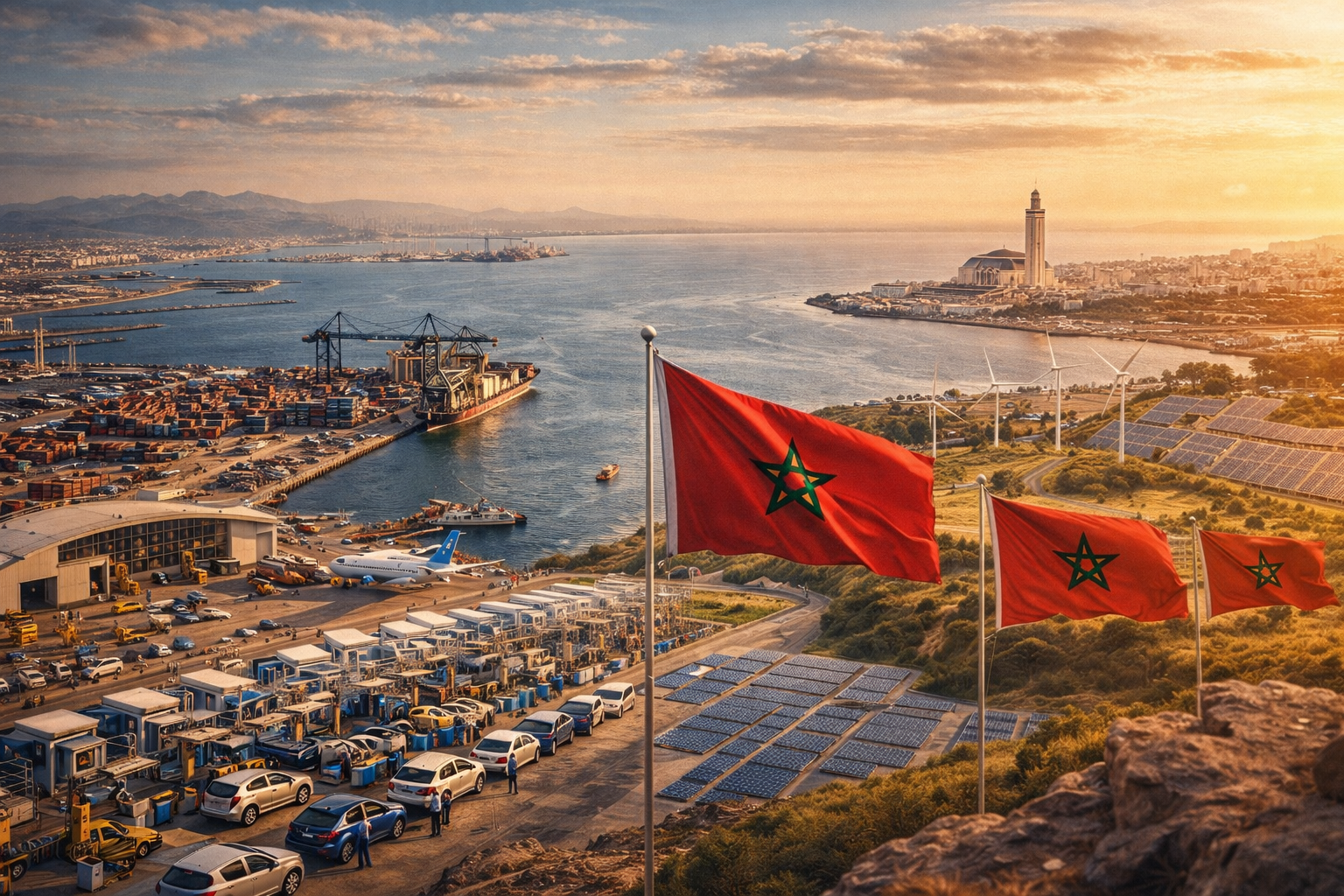
Why Morocco Punches Above Its Weight
In Africa’s crowded investment landscape, Morocco occupies a distinctive and increasingly influential position. It is not the continent’s largest market, nor does it attract the biggest headline investment volumes. Yet year after year, Morocco consistently outperforms expectations—drawing high-quality, export-oriented investment with a level of predictability rare in emerging markets.
Morocco’s appeal rests on a clear formula: political stability, proximity to Europe, and disciplined industrial policy. Together, these have turned the country into one of Africa’s most efficient platforms for global manufacturing and logistics.
Political Stability as an Investment Asset
Continuity in a Volatile Region
For global investors, Morocco’s most valuable asset is not cheap labour or incentives—it is continuity.
- Stable political system with long-term policy direction
- Limited exposure to internal conflict or abrupt regime shifts
- Consistent messaging to international investors
In a region where uncertainty often dominates risk assessments, Morocco offers something increasingly scarce: institutional predictability. This stability lowers risk premiums and supports long-horizon investments in manufacturing and infrastructure.
EU Proximity: Geography That Actually Delivers
Close Enough to Compete, Far Enough to Save Costs
Morocco’s geographic position gives it a structural advantage few African countries can match.
- Immediate proximity to European markets
- Short shipping times to Southern and Western Europe
- Integration into European supply chains
For manufacturers, this makes Morocco a nearshoring alternative—close enough to meet EU delivery timelines, yet cost-competitive compared to European production bases.
This advantage has grown as global firms seek to shorten supply chains without abandoning scale.
Industrial Policy That Is Targeted, Not Diffuse
Picking Sectors—and Executing
Morocco’s industrial strategy stands out for its focus.
Rather than attempting to develop every sector at once, policymakers concentrated on:
- Automotive manufacturing
- Aerospace
- Renewable energy
- Logistics and export infrastructure
These sectors received:
- Dedicated industrial zones
- Skills training pipelines
- Infrastructure alignment
- Investment facilitation support
The result is not speculative growth, but embedded industrial ecosystems.
Where the Investment Goes
1. Automotive Manufacturing
Morocco has become one of Africa’s leading automotive production hubs.
- Major global manufacturers producing for export
- Deep supplier networks
- Integration with European automotive value chains
Vehicles and components manufactured in Morocco are shipped primarily to Europe, reinforcing the country’s export-led model.
2. Aerospace: A Quiet Success Story
Morocco’s aerospace sector is smaller—but strategically important.
- Precision manufacturing for global aerospace firms
- Concentration around Casablanca and export zones
- Strong skills development and quality standards
This sector underscores Morocco’s ability to move beyond low-value manufacturing.
3. Renewables: Energy as Industrial Support
Energy policy plays a supporting role in Morocco’s investment appeal.
- Large-scale solar and wind projects
- Focus on energy security and cost predictability
- Alignment with European climate and sustainability standards
Renewables are not just an environmental choice, but a competitiveness strategy for industry.
4. Logistics and Trade Infrastructure
Morocco’s export ambitions depend on logistics—and the country has invested accordingly.
- Modern ports and logistics corridors
- Trade facilitation focused on speed and reliability
- Strong connections to both European and African markets
This infrastructure ensures that manufacturing output can move efficiently, reinforcing investor confidence.
Why Morocco’s Model Works
Morocco does not attempt to absorb investment indiscriminately. Instead, it optimises for:
- Export orientation
- Integration into global value chains
- Medium- to long-term industrial presence
This selectivity limits speculative inflows—but improves investment durability.
The Limits of the Model
Morocco’s success does not come without constraints.
- Smaller domestic market limits consumption-driven growth
- Dependence on European demand
- Slower expansion outside targeted sectors
Yet these limits are structural trade-offs, not policy failures.
Editorial Takeaway: Efficiency Over Volume
Morocco may not attract the largest investment flows in Africa—but it attracts some of the most efficient. Its success lies in clarity of purpose: stability, proximity, and execution.
For global firms seeking an export-oriented base linked to Europe, Morocco offers one of the continent’s most compelling propositions. In an era of supply-chain recalibration, that advantage is becoming more—not less—valuable.
- El Niño 2026: The Climate Phenomenon Reshaping Weather, Food Security and the Global Economy
- Rahul Gandhi’s Political Evolution: From Reluctant Heir to a More Assertive Challenger to the BJP
- India’s Middle East Strategy Explained: Energy, Alliances and the Battle for Strategic Autonomy
- The Rise of Private Military Technology Companies: Who Is Building the Future of Warfare?
- Riyadh Under Attack: Why Saudi Security Matters to the Entire World


