


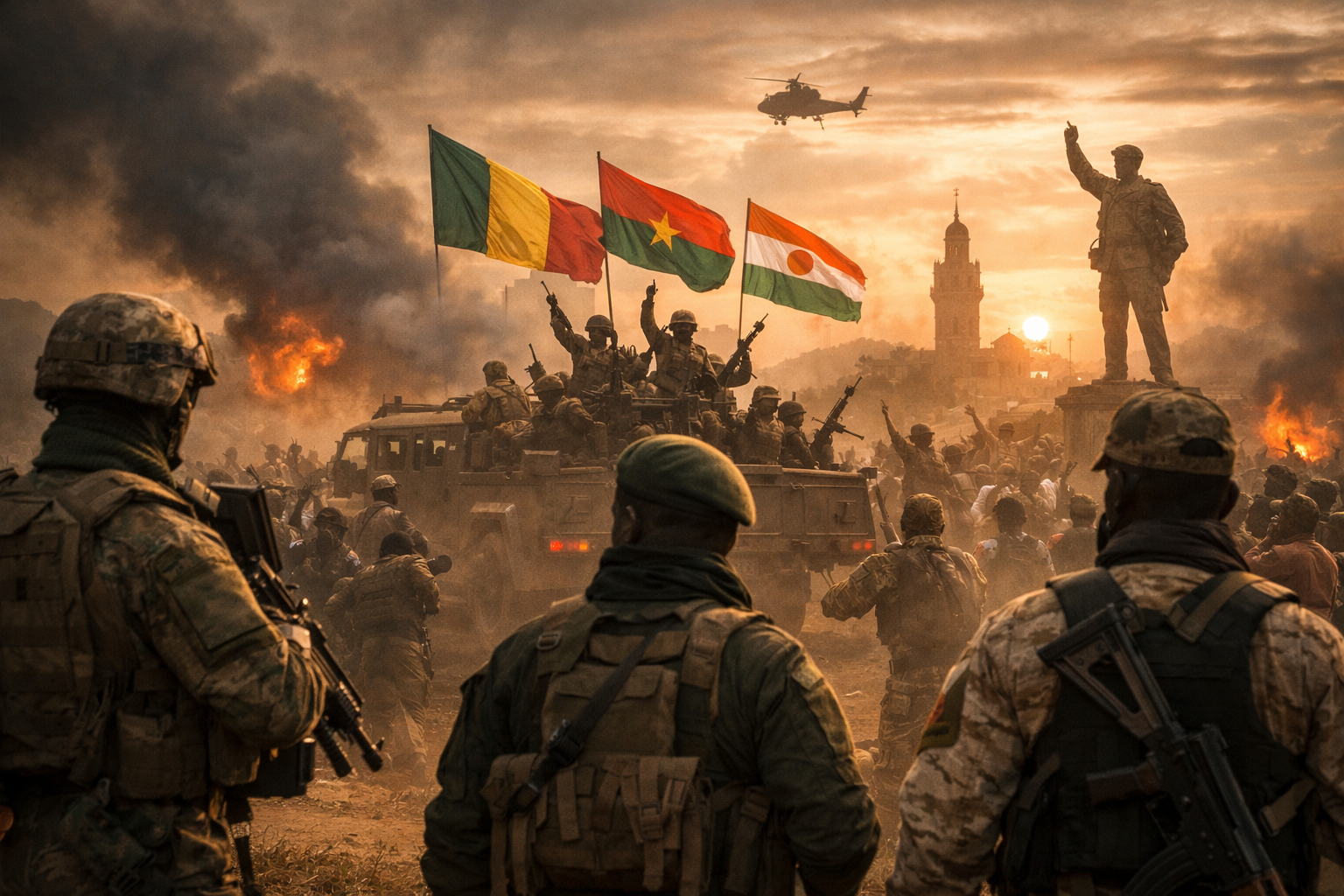
A wave of military takeovers across the Sahel is reshaping the political map of Africa and exposing deep structural failures in decades of governance and security investment
Introduction: When the Coup Became a Pattern
Military coups were, for a period in the 1990s and 2000s, considered a declining phenomenon in Africa. The spread of multi-party electoral systems, conditionality attached to international development assistance, and the normative frameworks established by the African Union all contributed to a narrative of democratic consolidation. That narrative has been shattered by events in the Sahel.
Mali experienced military coups in 2020 and 2021. Guinea’s civilian government was overthrown in 2021. Sudan’s democratic transition was derailed by a military takeover in October 2021, which subsequently collapsed into full-scale civil war in 2023. Burkina Faso experienced two coups in 2022. Niger’s elected government was overthrown in July 2023. Gabon’s president was removed by the military in August 2023. The cumulative result is what analysts now call a ‘coup belt’ — a geographic band stretching across the Sahel in which military governments control territory spanning millions of square kilometres and hundreds of millions of people. Understanding this pattern requires examining the structural conditions that have made military seizures of power both feasible and, in some cases, initially popular.
Section I: The Security Crisis at the Root of the Coup Wave
The Expanding Jihadist Insurgency
The most immediate cause of the coup wave in West Africa has been the failure of civilian governments to manage the jihadist insurgency that has spread from northern Mali since approximately 2012. Groups affiliated with al-Qaeda (JNIM) and the Islamic State (ISGS) have conducted increasingly sophisticated attacks across a vast, poorly governed territory, generating one of the world’s fastest-growing displacement crises. In Burkina Faso by 2023, the insurgency had effectively cut off large portions of the country’s territory from government control, creating populations increasingly receptive to military promises of decisive security action that civilian governments had failed to deliver.
| 2.7M+ People displaced by violence in Burkina Faso alone by mid-2023 The Sahel region collectively hosts one of the world’s largest and fastest-growing internal displacement crises. The combination of jihadist violence, inter-community conflict, and state authority collapse has created humanitarian conditions providing political context for military governance claims across the region. |
The Failure of Counter-Terrorism Partnerships
The security failure was not for want of international support. France maintained Operation Barkhane for nearly a decade, deploying thousands of troops. The United States maintained training programmes and intelligence-sharing across the region. The UN’s MINUSMA peacekeeping mission operated for a decade in Mali. Despite these investments, the security situation deteriorated steadily. The jihadist groups proved adaptive, decentralised, and skilled at exploiting local grievances — intercommunal tensions, land and water disputes, ethnic marginalisation — in ways that counter-terrorism operations could not address militarily.
| “The security crisis in the Sahel was not primarily a military problem. It was a governance and development crisis that expressed itself through violence. Military operations could suppress violence temporarily but could not address its roots. That disconnect between diagnosis and prescription is why a decade of counter-terrorism investment did not reverse the deterioration.” — Dr. Jean-Hervé Jezequel Sahel Project Director, International Crisis Group |
Section II: The Structural Drivers
Governance Failures and Institutional Weakness
Beyond the security crisis, the coup wave reflects deeper structural weaknesses in civilian governance institutions. Many Sahelian states maintain civilian government facades masking actual power distributions that remain with security services, traditional elites, and patronage networks. Electoral systems have often functioned as mechanisms for elite rotation rather than genuine accountability. Military institutions — better resourced, more cohesive, and more nationally coherent than civilian bureaucracies — represent one of the few state structures with genuine organisational capacity. In countries where civilian institutions have failed to provide security, services, or economic opportunity, the military can present itself credibly as an alternative.
The Russian Presence
The coup wave has coincided with significant expansion of Russian influence through the Wagner Group and its successor arrangements. In Mali, Burkina Faso, and the Central African Republic, Russian private military companies have assumed security roles previously filled by French or international forces — offering security cooperation without the governance conditions and human rights standards attached to Western partnerships. This approach has proven attractive to military governments seeking operational support without accountability constraints, representing a significant geopolitical shift in sub-Saharan Africa’s orientation.
Section III: Demographic and Climate Pressures
The Sahel’s political instability is inseparable from its economic and demographic context. The region has among the highest total fertility rates and youngest median ages in the world, producing rapidly growing youth populations facing chronic unemployment and limited economic opportunity. Climate change is intensifying competition for water and agricultural land between farming communities and pastoralist herders — a traditional source of inter-communal tension that jihadist groups have been skilled at exploiting for recruitment and territorial control. The combination of demographic pressure, climate stress, governance failure, and violent insurgency creates conditions of profound social stress that no security-focused intervention can resolve alone.
Conclusion: Beyond the Sahel
The emergence of Africa’s coup belt represents a significant challenge to the post-Cold War framework of African governance. The demonstrated failure of a decade of counter-terrorism investment to reverse the Sahel’s security situation raises fundamental questions about externally led security sector reform. The expansion of Russian influence creates great-power competition in sub-Saharan Africa that established international institutions were not designed to manage. And the combination of demographic pressure, climate stress, governance failure, and violent insurgency driving the coup wave exists in varying forms across a much wider area of the African continent. The Sahel’s coup belt is not an isolated regional anomaly. It is an early indicator of pressures accumulating at the intersection of governance failure, security crisis, demographic change, and geopolitical competition that will shape the trajectory of a significant portion of the world’s fastest-growing region through the coming decades.
Pakistan and the Afghan War: From Strategic Depth to Regional Escalation


