


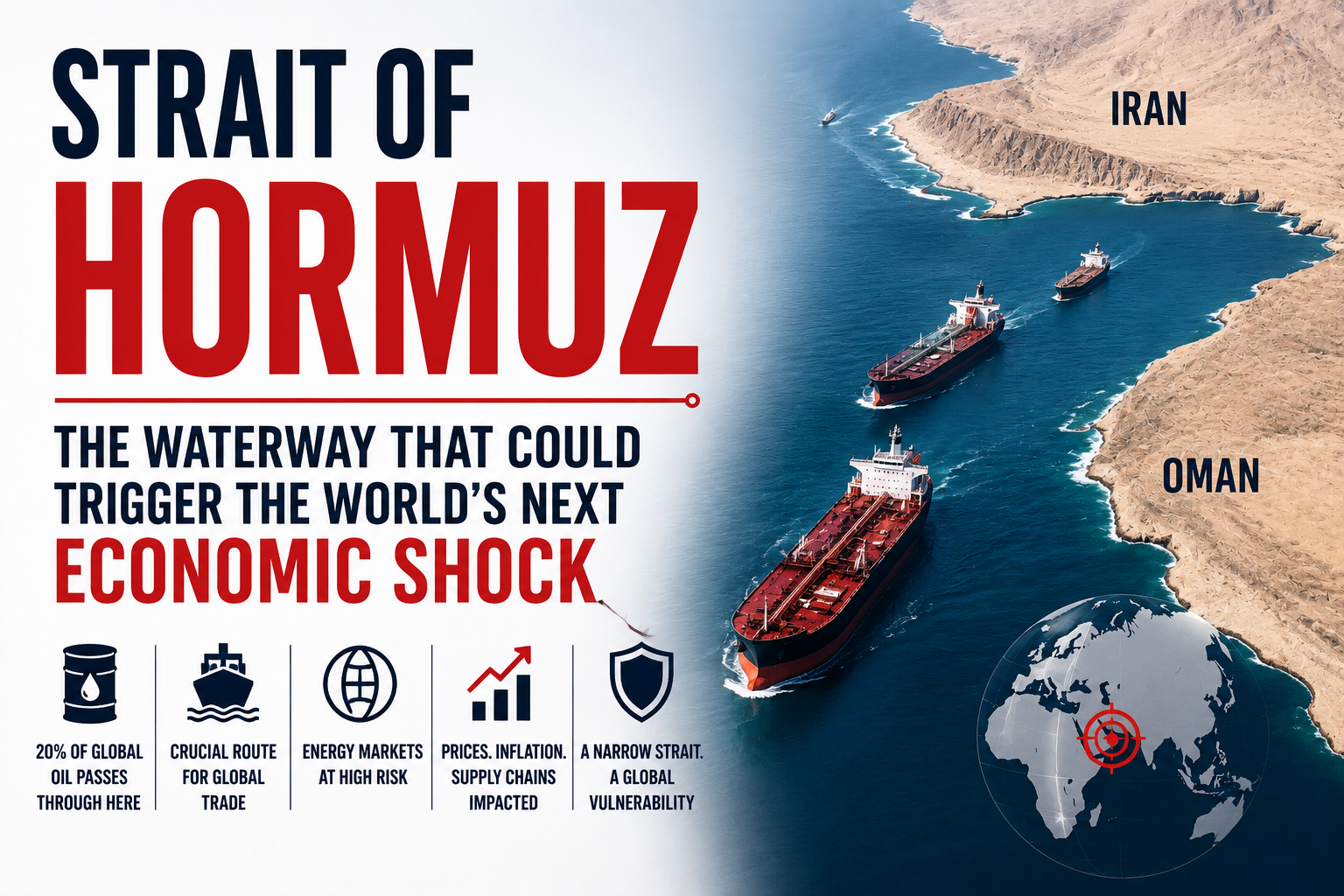
Why a 33-Kilometer Strait Holds the Global Economy Hostage
Most people have never seen the Strait of Hormuz.
Yet almost everyone depends on it.
Every time a car is fueled, an airplane takes off, a factory begins production, or a cargo ship crosses the oceans, there is a chance that energy flowing through this narrow stretch of water has played a role.
Stretching between Iran and Oman at the entrance to the Persian Gulf, the Strait of Hormuz is one of the most strategically important maritime chokepoints on Earth.
It is the primary gateway through which much of the Gulf’s oil and liquefied natural gas reaches international markets.
When tensions rise between Iran, the United States, and regional powers, global markets immediately turn their attention to Hormuz.
The reason is simple.
If the Strait were disrupted, the consequences would extend far beyond the Middle East.
It would become a global economic crisis.
Why the Strait of Hormuz Matters
The Strait of Hormuz is one of the world’s busiest energy corridors.
Oil from Saudi Arabia, Iraq, Kuwait, the United Arab Emirates, Qatar, and Iran itself passes through these waters before reaching Asia, Europe, and North America.
The Strait also serves as a critical route for liquefied natural gas exports, particularly from Qatar, one of the world’s largest LNG suppliers.
Although only a narrow shipping lane, it functions as one of the most important arteries of the global economy.
Its strategic importance far exceeds its physical size.
Why Hormuz Is Back in the Headlines
The collapse of U.S.–Iran diplomacy has once again brought the Strait into focus.
Historically, Iranian officials have repeatedly suggested that if the country’s oil exports were severely restricted or if Iran faced direct military confrontation, it could respond by threatening navigation through the Strait.
While an outright closure would be extremely difficult to sustain, even the perception of risk can have enormous economic consequences.
Shipping companies monitor security developments continuously.
Insurance premiums rise rapidly.
Oil traders respond almost instantly.
Financial markets become volatile.
Sometimes, uncertainty itself becomes the crisis.
Can Iran Actually Close the Strait?
This is one of the most debated questions in international security.
Technically, permanently closing the Strait would be extraordinarily difficult.
The United States and its allies maintain significant naval capabilities in the region.
Many Gulf states also possess increasingly sophisticated maritime security forces.
However, complete closure is not necessary to create disruption.
Iran could employ a range of asymmetric tactics:
Naval mines.
Fast attack boats.
Drone operations.
Missile threats.
Cyberattacks targeting shipping infrastructure.
Harassment of commercial vessels.
Even isolated incidents could force shipping companies to reroute vessels or temporarily suspend operations.
The objective would not necessarily be permanent closure.
It could simply be increasing uncertainty and economic pressure.
The Immediate Economic Impact
If commercial shipping through Hormuz were significantly disrupted, global markets would react within hours.
Energy prices would likely rise sharply.
Insurance premiums for tankers would increase.
Shipping costs would climb.
Financial markets would become more volatile.
Import-dependent economies would face higher fuel bills.
Inflationary pressures would intensify.
Countries across Asia would be particularly exposed because many rely heavily on Gulf energy supplies.
The impact would not remain regional.
It would quickly become global.
Asia Has the Most to Lose
The world’s fastest-growing economies are among the largest importers of Gulf energy.
China.
India.
Japan.
South Korea.
Singapore.
These countries depend heavily on secure maritime energy routes.
A prolonged disruption would increase production costs across manufacturing industries.
Electricity generation.
Transportation.
Heavy industry.
Petrochemicals.
The ripple effects would extend through global supply chains.
The world’s manufacturing centers would feel the consequences almost immediately.
Europe Would Also Feel the Pressure
Although Europe has diversified energy imports in recent years, the continent remains sensitive to disruptions in global oil and LNG markets.
Any major supply shock in the Gulf would affect prices worldwide.
European consumers would likely face higher fuel costs.
Industries with high energy consumption would experience additional pressure.
Inflation could rise again just as many central banks seek to stabilize economic growth.
Energy security remains inseparable from geopolitical stability.
Insurance Could Become the Hidden Crisis
Shipping does not stop only because of conflict.
It often slows because of insurance.
War-risk premiums for vessels operating near conflict zones can increase dramatically.
Higher insurance costs eventually reach importers and consumers.
Shipping companies may decide that certain voyages are no longer commercially viable.
The result is fewer available vessels, longer delivery times, and higher freight costs.
The Red Sea crisis demonstrated how quickly insurance can reshape global shipping patterns.
Hormuz could have an even greater impact because of its central role in energy markets.
Could Alternative Routes Replace Hormuz?
Some Gulf producers have invested in pipelines that bypass the Strait.
Saudi Arabia and the United Arab Emirates possess limited alternative export routes.
However, these alternatives cannot fully replace Hormuz’s capacity.
Much of the region’s energy exports remain dependent on maritime transport through the Strait.
There is currently no equivalent route capable of handling comparable volumes over the long term.
Hormuz therefore remains strategically indispensable.
The Military Dimension
The Strait of Hormuz has become one of the world’s most heavily monitored waterways.
The United States Fifth Fleet operates in the region.
Regional navies conduct regular patrols.
International coalitions increasingly cooperate on maritime security.
Any attempt to significantly disrupt commercial navigation would likely trigger a coordinated international response.
This reality acts as an important deterrent.
At the same time, it also increases the risk that even a relatively small incident could escalate rapidly.
Crowded waterways leave little room for miscalculation.
What Would It Mean for India?
Few major economies have as much at stake as India.
India imports a significant share of its crude oil from Gulf producers.
Any disruption through Hormuz could result in:
Higher fuel prices.
Rising transportation costs.
Imported inflation.
Pressure on the rupee.
Increased shipping costs.
Higher fertilizer and petrochemical prices.
The Indian economy has become more resilient over the past decade.
Nevertheless, sustained disruption in Gulf energy flows would create meaningful economic challenges.
Frequently Asked Questions
Why is the Strait of Hormuz important?
The Strait of Hormuz is the primary maritime gateway connecting the Persian Gulf with global markets, making it one of the world’s most strategically important energy shipping routes.
Can Iran permanently close the Strait?
A long-term closure would be extremely difficult because of the presence of powerful international naval forces. However, limited disruptions could still significantly affect global markets.
Which countries would be most affected?
Major energy importers including India, China, Japan, South Korea, and many European economies would experience higher energy costs and increased economic uncertainty.
Would oil prices increase immediately?
Energy markets typically react quickly to geopolitical risk. Even credible threats to shipping can increase prices before any physical disruption occurs.
Could this trigger a global recession?
A prolonged disruption causing sustained high energy prices could slow global growth and increase inflation. Whether it results in recession would depend on the duration and scale of the disruption, as well as the policy responses of governments and central banks.
The World’s Most Important Chokepoint
The Strait of Hormuz represents one of globalization’s greatest vulnerabilities.
Modern economies depend on reliable energy supplies.
Reliable energy depends on secure shipping.
Secure shipping depends on geopolitical stability.
When even one part of that chain breaks down, the consequences spread across continents.
Factories slow production.
Airlines pay more for fuel.
Consumers face higher prices.
Governments confront inflation and economic uncertainty.
The collapse of U.S.–Iran diplomacy has reminded the world that the Strait of Hormuz is not merely a narrow stretch of water between Iran and Oman.
It is a strategic pressure point where regional conflict can become a global economic crisis.
The likelihood of a complete closure remains low.
But the possibility of disruption—even temporary disruption—is enough to keep governments, markets, and businesses watching every development with extraordinary attention.
In the twenty-first century, few places better illustrate the connection between geography, geopolitics, and economics than the Strait of Hormuz.
And as tensions rise once again, this narrow waterway may become the single most important maritime corridor in the world.
The Collapse of U.S.–Iran Peace Talks: What Comes Next for the Middle East?


