


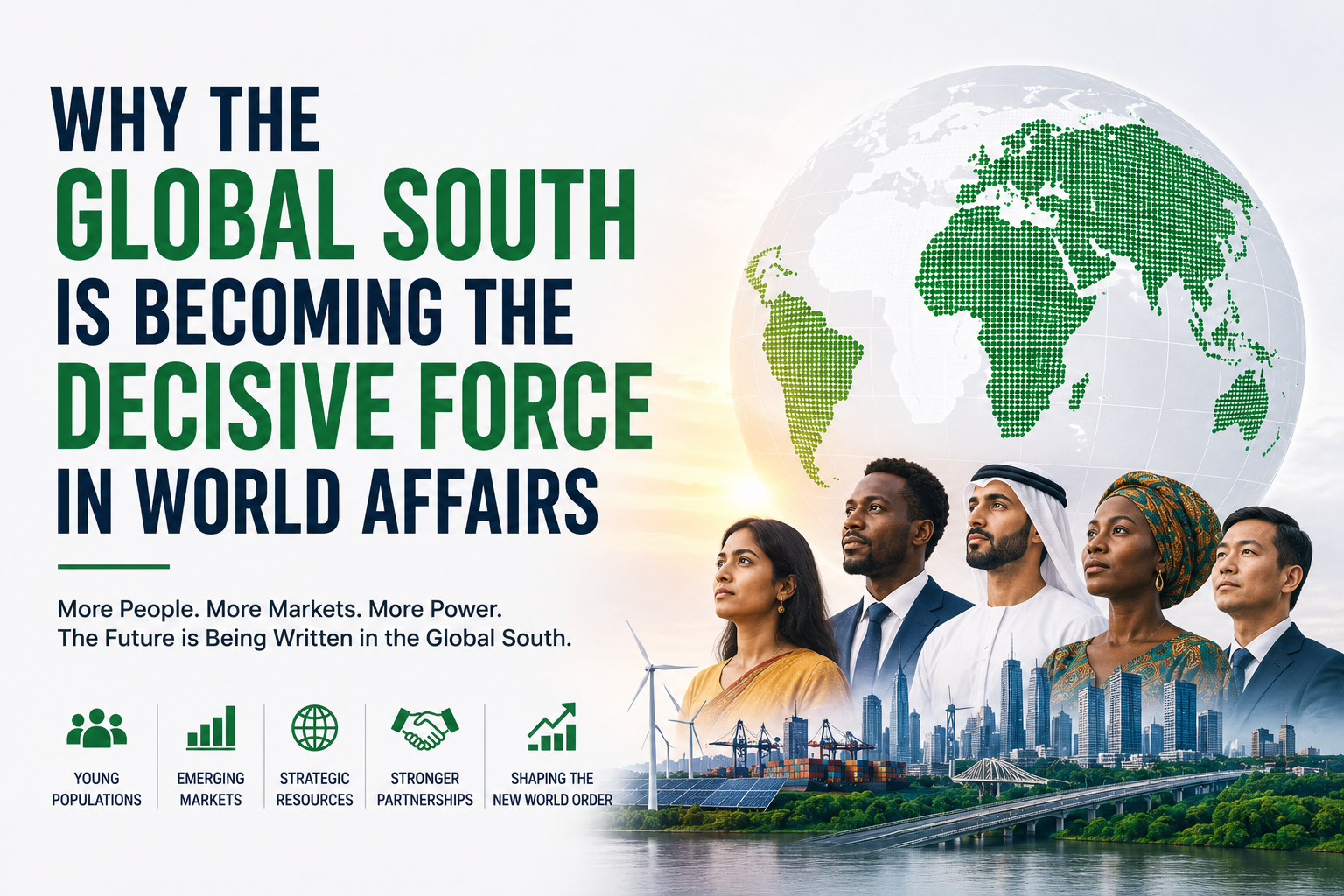
The Rise of the World’s New Center of Gravity
For centuries, global affairs were largely shaped by the industrialized nations of Europe and North America.
Colonial empires dominated trade and resources.
The Cold War divided the world into competing blocs led by Washington and Moscow.
The post-Cold War era witnessed an international order heavily influenced by Western institutions and economic power.
Today, that balance is changing.
The countries collectively known as the Global South are becoming increasingly influential in shaping the future of international politics, economics, and diplomacy.
This transformation is not merely about population size or economic growth.
It is about leverage.
The Global South now possesses many of the resources, markets, demographics, and strategic partnerships that major powers increasingly need.
As great-power competition intensifies, the ability of developing and emerging economies to shape global outcomes is growing rapidly.
The twenty-first century may become the first era in modern history where the Global South emerges not as a peripheral actor, but as a decisive force in world affairs.
What Is the Global South?
The Global South is not a formal political alliance.
Nor is it simply a geographical description.
The term generally refers to developing and emerging economies across Asia, Africa, Latin America, the Middle East, and parts of Oceania.
The Global South includes countries with vastly different political systems, cultures, and economic structures.
India.
Brazil.
Indonesia.
Saudi Arabia.
South Africa.
Nigeria.
Mexico.
Vietnam.
The United Arab Emirates.
Despite their differences, many share common experiences.
Colonial histories.
Development challenges.
Infrastructure needs.
Demands for greater representation in international institutions.
A desire for a more balanced and inclusive global order.
Increasingly, these shared interests are producing collective influence.
Demography Is Shifting Global Power
The most important geopolitical resource of the twenty-first century may be people.
Much of the developed world faces aging populations and declining birth rates.
Europe.
Japan.
South Korea.
China.
Several advanced economies are experiencing demographic slowdowns that will affect labor markets, economic growth, and social spending.
The Global South presents a very different picture.
Africa is expected to account for a significant share of global population growth over the coming decades.
South Asia remains one of the youngest regions in the world.
Southeast Asia continues to enjoy relatively favorable demographic trends.
These populations represent more than workers.
They represent consumers.
Innovators.
Entrepreneurs.
Future taxpayers.
Military recruits.
The center of human activity is increasingly shifting toward the Global South.
And demographics eventually translate into economic and geopolitical influence.
The New Engines of Economic Growth
The Global South is becoming increasingly important to the global economy.
Many emerging economies have transformed from commodity suppliers into manufacturing centers, technology hubs, and consumer markets.
India is emerging as one of the world’s fastest-growing major economies.
Indonesia is becoming central to global battery and electric vehicle supply chains.
The Gulf states are evolving into investment and logistics hubs.
Vietnam and Mexico are benefiting from manufacturing diversification.
Africa’s rapidly growing urban populations are creating some of the world’s most promising consumer markets.
Economic growth is becoming more geographically distributed.
The concentration of economic activity in North America and Western Europe is gradually diminishing.
The future global economy will increasingly depend on demand generated across emerging markets.
The Battle for Resources
The energy transition is transforming the strategic value of the Global South.
Many of the minerals required for the technologies of the future are concentrated in developing countries.
Lithium.
Cobalt.
Copper.
Nickel.
Rare earth elements.
These resources are essential for electric vehicles, renewable energy systems, batteries, advanced electronics, and artificial intelligence infrastructure.
The countries that control these resources are becoming increasingly important.
At the same time, many Global South countries are major producers of energy, food, and agricultural commodities.
As resource competition intensifies, their geopolitical leverage grows.
Control over strategic resources increasingly translates into diplomatic influence.
The Geopolitics of Non-Alignment
The Cold War forced many countries to choose sides.
Today’s Global South increasingly rejects such binary choices.
Many countries pursue strategic autonomy.
They engage simultaneously with the United States, China, Europe, Russia, and regional partners.
India maintains relationships with multiple competing powers.
Saudi Arabia has expanded partnerships with both East and West.
Brazil pursues an independent foreign policy while maintaining diverse economic relationships.
Indonesia emphasizes neutrality and pragmatic engagement.
This approach provides flexibility.
It also increases leverage.
As major powers compete for influence, Global South countries can often negotiate from positions of increasing strength.
They are no longer merely participants in international politics.
They are increasingly agenda setters.
The Rise of New Institutions and Coalitions
The Global South is becoming increasingly organized.
New institutions and coalitions are reshaping international governance.
BRICS.
The African Continental Free Trade Area.
Regional development banks.
Middle East investment partnerships.
South-South cooperation initiatives.
These arrangements do not necessarily seek to replace existing institutions.
Rather, they seek to increase representation and create alternative mechanisms of cooperation.
Many developing countries believe that global governance structures still reflect the realities of the mid-twentieth century rather than those of the twenty-first century.
The demand for reform is growing.
The Global South is increasingly capable of advancing those demands collectively.
Why Great Powers Need the Global South
The competition between major powers has elevated the strategic importance of the Global South.
The United States seeks partnerships on supply chains, energy security, and regional stability.
China depends heavily on markets, resources, and infrastructure partnerships across the developing world.
Europe increasingly looks to emerging economies for trade diversification, green energy cooperation, and critical minerals.
Even Russia has sought stronger relationships with countries across Asia, Africa, and Latin America.
No major power today can achieve its strategic objectives without meaningful engagement with the Global South.
This dependence is increasing.
And with dependence comes influence.
The Limits of the Global South
The rise of the Global South should not be romanticized.
Significant challenges remain.
Infrastructure deficits.
Income inequality.
Political instability.
Debt vulnerabilities.
Governance challenges.
Educational gaps.
Climate risks.
Many countries continue to struggle with institutional weaknesses that constrain long-term development.
The Global South is also highly diverse.
Its interests do not always align.
It is unlikely to emerge as a single geopolitical bloc.
Its influence will likely come not from unity but from collective weight.
Its diversity is a challenge.
But it is also a source of resilience.
Frequently Asked Questions
What is the Global South?
The Global South generally refers to developing and emerging economies across Asia, Africa, Latin America, the Middle East, and parts of Oceania that share historical development challenges and increasing geopolitical importance.
Why is the Global South becoming more influential?
Rapid population growth, expanding consumer markets, strategic resources, manufacturing capabilities, and increasing diplomatic leverage are making the Global South central to global politics and economics.
Is the Global South replacing the West?
No. The emerging international system is becoming more multipolar rather than replacing one center of power with another. Influence is becoming more distributed.
Why do major powers compete for influence in the Global South?
The Global South controls important markets, resources, strategic geography, and diplomatic partnerships that are increasingly necessary for achieving economic and geopolitical objectives.
Will the Global South become a unified political bloc?
Probably not. The Global South is extremely diverse. Its influence is more likely to come from collective economic and demographic weight than from political unity.
The Decisive Century of the Global South
International politics is undergoing one of its most profound transformations since the end of the Cold War.
The center of gravity of the world economy is moving.
The geography of growth is changing.
Demographic momentum is shifting.
Strategic resources are becoming increasingly concentrated in emerging economies.
The Global South is no longer simply the recipient of global decisions made elsewhere.
It is becoming an active architect of the international system.
The future of energy security, supply chains, climate cooperation, technology adoption, and economic growth increasingly depends on countries across Asia, Africa, Latin America, and the Middle East.
The twenty-first century may not belong exclusively to the United States or China.
It may belong to the regions that possess the people, the resources, and the markets that everyone else increasingly needs.
The rise of the Global South does not signify the end of Western influence.
It signifies the end of a world in which influence flowed predominantly in one direction.
A more multipolar and interconnected order is emerging.
And in that new order, the Global South may prove to be the decisive force that shapes the century.


