


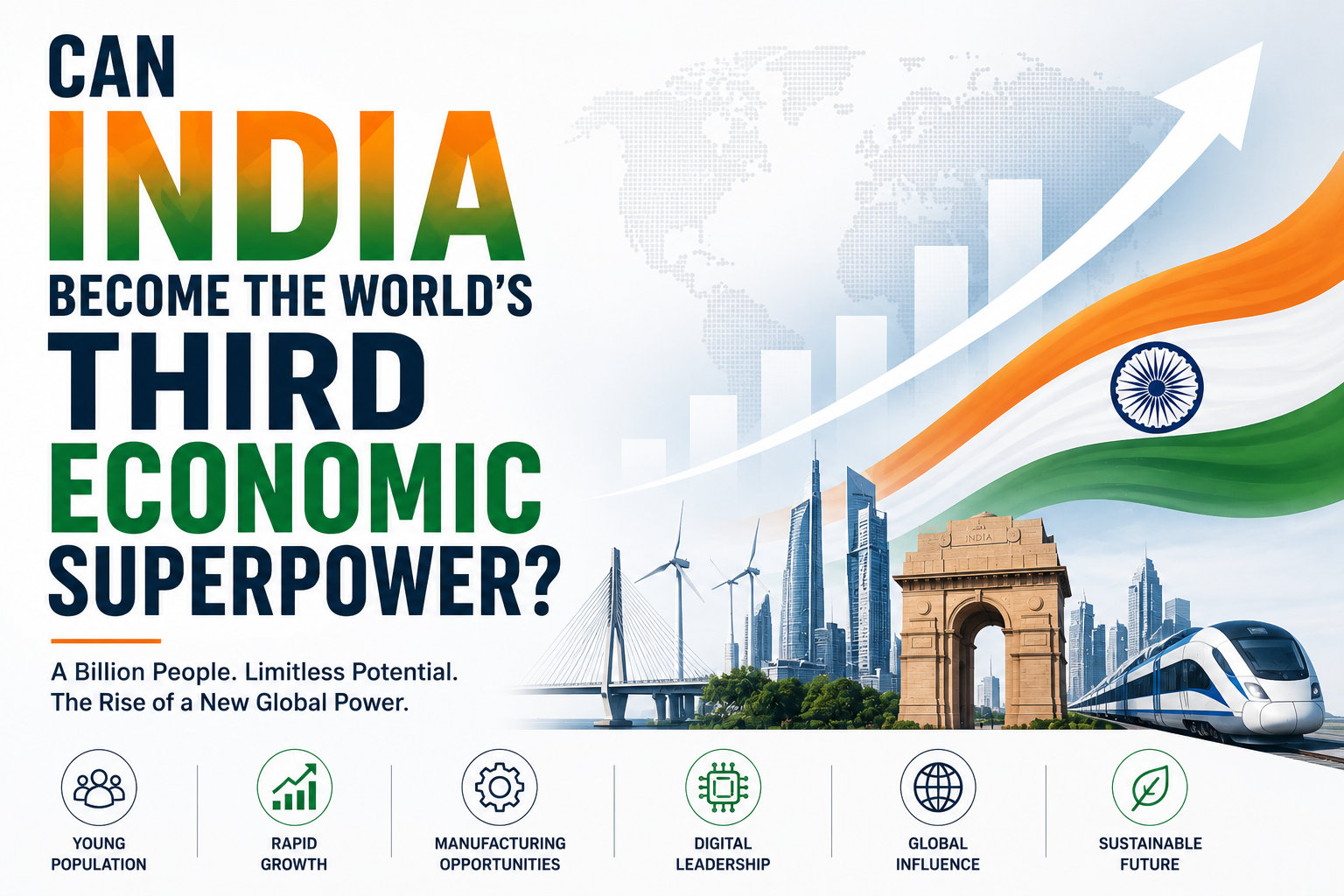
The World’s Most Important Economic Question?
In the span of just a few decades, India has transformed itself from a relatively closed economy into one of the world’s fastest-growing major markets.
Its digital revolution has reached hundreds of millions of people.
Its services industry has become globally competitive.
Its manufacturing ambitions are expanding.
Its infrastructure is undergoing unprecedented investment.
Its startups are attracting international capital.
And its population has surpassed China’s, making India the world’s most populous nation.
The question increasingly being asked in boardrooms, ministries, and investment forums around the world is no longer whether India will become an economic giant.
It is whether India can become the world’s third economic superpower.
The possibility is no longer theoretical.
It has become one of the defining economic questions of the twenty-first century.
The Demographic Advantage
History suggests that demographics matter.
Young populations create workers.
Workers generate production.
Production creates income.
Income drives consumption and investment.
Much of the developed world faces a demographic challenge.
Europe is aging.
Japan’s population is shrinking.
China’s working-age population has begun to decline.
Several advanced economies face increasing dependency ratios and labor shortages.
India presents a very different picture.
It remains one of the world’s youngest major economies.
More than half its population is below the age of thirty-five.
Every year, millions of Indians enter the workforce.
No major economy possesses a demographic opportunity of comparable scale.
This advantage could become India’s most important economic asset.
But demographics are not destiny.
A young population becomes an advantage only if jobs, skills, education, and productivity grow alongside it.
The demographic dividend must be converted into economic value.
The Scale of the Indian Market
Size matters in economics.
India’s domestic market is enormous.
Its expanding middle class is becoming one of the world’s most important consumer groups.
Rising incomes are driving demand across sectors:
Housing.
Automobiles.
Consumer electronics.
Financial services.
Healthcare.
Education.
Travel.
Digital services.
The country’s digital infrastructure has also dramatically expanded financial inclusion and economic participation.
Millions of people who previously lacked access to formal banking systems are increasingly participating in the economy.
A large and growing domestic market provides something many export-dependent economies lack.
Resilience.
Countries with strong internal demand often possess greater capacity to absorb external shocks.
This makes India increasingly attractive to global investors.
The Manufacturing Opportunity
For decades, manufacturing was viewed as India’s missing piece.
China became the factory of the world.
Vietnam emerged as an export powerhouse.
Mexico benefited from nearshoring.
India’s manufacturing growth often lagged expectations.
That picture is beginning to change.
The reorganization of global supply chains is creating new opportunities.
Companies increasingly seek alternatives to excessive dependence on single-country manufacturing models.
India’s large workforce, expanding infrastructure, and policy initiatives are positioning it as an increasingly attractive destination.
Electronics manufacturing has grown rapidly.
Renewable energy investments are expanding.
Semiconductor ambitions are accelerating.
Defense production is increasing.
Global manufacturers are diversifying production footprints.
India is increasingly becoming part of that strategy.
If sustained over the next decade, manufacturing could significantly increase India’s economic scale.
The Digital Revolution
Perhaps India’s most underestimated achievement has been its digital transformation.
Digital public infrastructure has dramatically expanded access to services.
Digital payments have become mainstream.
Government services are increasingly delivered electronically.
Entrepreneurship is accelerating.
Financial inclusion has expanded.
Technology adoption has become widespread.
This transformation matters because digital infrastructure reduces transaction costs and increases productivity.
Economic development increasingly depends on digital capabilities.
India possesses significant advantages.
A large technology workforce.
Globally competitive software capabilities.
Rapid digital adoption.
Growing artificial intelligence ambitions.
The future global economy will increasingly reward countries that can combine demographics with technology.
India possesses the potential to do both.
Why the World Needs India
India’s rise is occurring at a moment of profound global change.
Supply chains are being reorganized.
Manufacturing is diversifying.
Technology ecosystems are becoming increasingly strategic.
The world economy is searching for new centers of growth.
India is uniquely positioned.
It offers scale.
Talent.
Markets.
Demographic momentum.
Strategic geography.
As the world’s largest democracy and one of its fastest-growing major economies, India is increasingly viewed as indispensable to the future of global economic expansion.
International investors recognize this.
Governments recognize this.
Multinational corporations increasingly recognize this.
India’s importance extends far beyond its borders.
The future of global growth increasingly depends on India’s success.
The Infrastructure Challenge
Great economic powers require great infrastructure.
India has made remarkable progress.
Highways.
Airports.
Ports.
Metro systems.
Digital connectivity.
Renewable energy investments.
Logistics improvements.
The scale of infrastructure investment has expanded dramatically.
Yet significant challenges remain.
Urbanization is accelerating rapidly.
Cities require massive investments in transportation, housing, water systems, and public services.
Manufacturing competitiveness depends heavily on logistics efficiency.
Infrastructure gaps still increase costs for businesses.
The challenge is not whether India is building infrastructure.
It is whether it can build fast enough to meet the demands of its growth ambitions.
Education and Human Capital
The demographic dividend represents opportunity.
Human capital determines whether that opportunity is realized.
India produces world-class engineers, entrepreneurs, and technology professionals.
Its higher education institutions have contributed significantly to global innovation.
Yet the challenge extends beyond elite talent.
A modern economy requires broad-based skills development.
Vocational training.
Educational quality.
Healthcare access.
Women’s workforce participation.
Labor productivity.
The transition from a lower-middle-income economy to an economic superpower ultimately depends on people.
Economic transformation requires millions of productive workers rather than thousands of exceptional individuals.
Human capital may become the decisive variable in India’s economic future.
The Geopolitical Advantage
India’s rise is not occurring in isolation.
Geopolitics is creating additional opportunities.
The rivalry between the United States and China is reorganizing supply chains.
Countries increasingly seek resilient economic partnerships.
Businesses are diversifying manufacturing footprints.
Investors seek growth markets outside traditional centers of production.
India benefits from this environment.
Its strategic autonomy allows it to engage multiple partners simultaneously.
It maintains relationships across competing geopolitical blocs.
Its geographic position makes it central to Indo-Pacific trade routes.
Its growing diplomatic influence increases its attractiveness as an economic partner.
Geopolitics may accelerate India’s rise.
But it cannot substitute for domestic execution.
The Obstacles That Remain
India’s economic future is promising.
But it is not guaranteed.
Important challenges remain.
Employment generation.
Educational outcomes.
Income inequality.
Agricultural productivity.
Urban governance.
Regulatory complexity.
Energy security.
Environmental sustainability.
The sheer scale of India’s development challenge is unprecedented.
Transforming the lives of more than a billion people requires exceptional policy execution over many years.
Economic superpower status cannot be declared.
It must be built.
Frequently Asked Questions
Is India likely to become the world’s third-largest economy?
Many long-term economic projections suggest India has the potential to become the world’s third-largest economy by nominal GDP during the coming decade if current growth trajectories continue.
What is India’s biggest economic advantage?
Its demographic profile. India possesses one of the world’s youngest populations and one of the largest future workforces.
What sectors could drive India’s growth?
Manufacturing, digital services, renewable energy, infrastructure, semiconductors, financial services, and technology-enabled industries could become major growth engines.
What are India’s biggest challenges?
Employment generation, human capital development, infrastructure expansion, urbanization, and improving productivity remain critical challenges.
Can demographics alone make India an economic superpower?
No. Demographic potential must be converted into productive employment, skills development, and sustained economic growth.
The Window of Opportunity
History occasionally presents countries with extraordinary opportunities.
India may be living through one of those moments.
Few countries have simultaneously possessed:
The world’s largest population.
One of its youngest workforces.
A massive domestic market.
Rapid digital adoption.
Growing geopolitical importance.
And expanding global investor interest.
These advantages are significant.
But they represent potential rather than certainty.
The difference between becoming a large economy and becoming an economic superpower lies in execution.
If India can successfully build infrastructure, generate productive employment, improve human capital, and sustain high growth over the next two decades, its rise could become one of the most important economic transformations in modern history.
The question is no longer whether India matters.
It already does.
The question is whether India can convert this extraordinary moment into lasting economic power.
The answer may shape not only India’s future, but the future of the global economy itself.


