


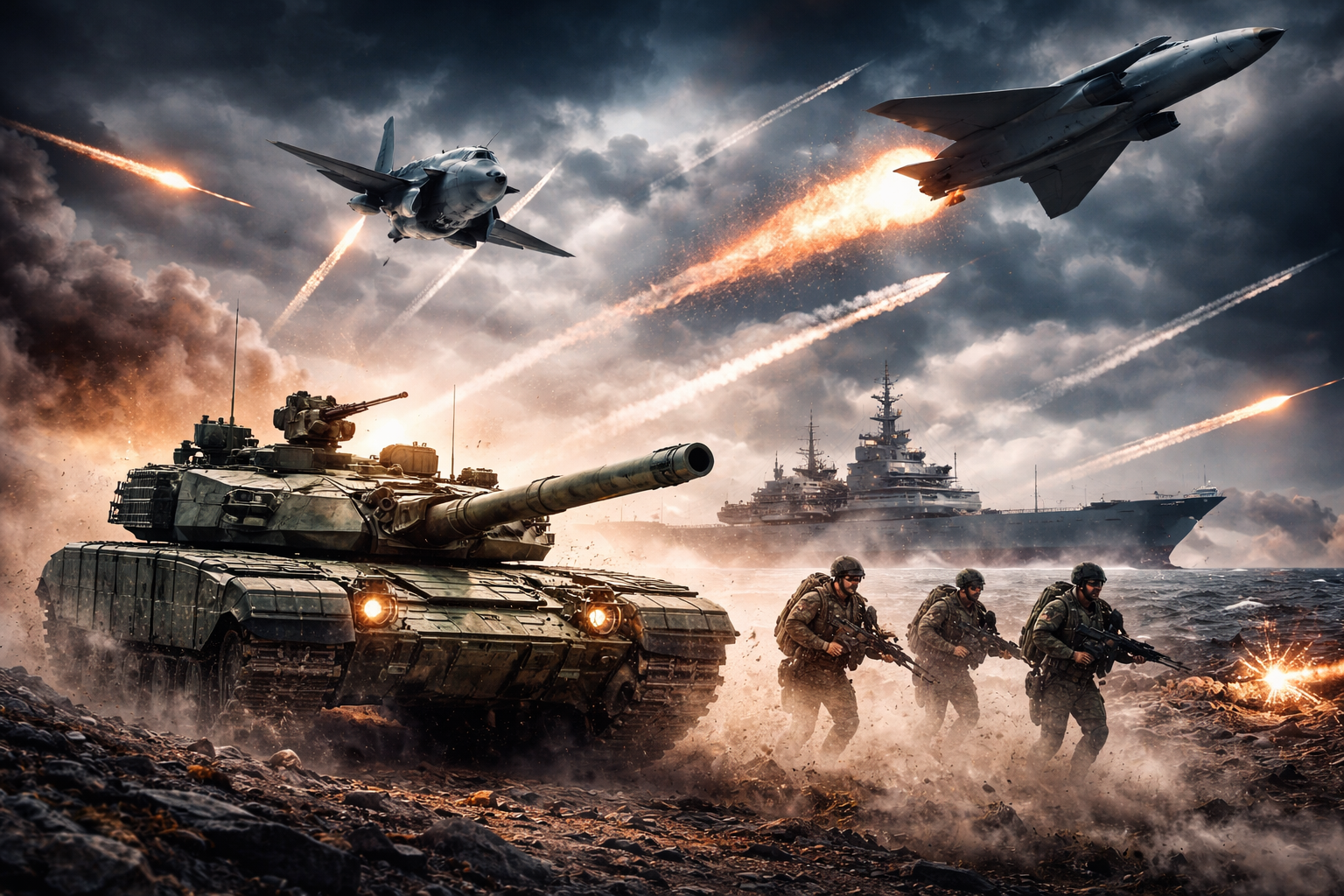
Military spending worldwide is reaching levels not seen since the Cold War but the new arms race looks very different from its twentieth-century predecessor
Introduction: The Return of the Arms Build-Up
In the optimistic years following the Cold War’s end, military spending declined across much of the world. The concept of a ‘peace dividend’ entered the mainstream political vocabulary of Western democracies. Defence budgets shrank, force structures were reduced, and sustained military competition between major powers came to be seen by many as a feature of a superseded historical era. That era has ended.
Global military expenditure reached approximately $2.2 trillion in 2023, according to the Stockholm International Peace Research Institute — the ninth consecutive year of increase, the highest level in absolute terms since the Cold War, and the product of multiple simultaneous drivers: the Ukraine war and its demonstration that high-intensity conventional warfare in Europe is possible; the intensification of China-US strategic competition; the expansion of Iranian and North Korean missile capabilities; and the emergence of new technology domains — drones, hypersonic weapons, cyber, artificial intelligence — in which every major military power is simultaneously investing at pace.
Section I: The Ukraine Effect on European Rearmament
The single most dramatic driver of the new global arms build-up is the Russia-Ukraine war and its effect on European security calculations. For three decades following the Cold War, European NATO members reduced defence spending, allowed conventional ammunition stockpiles to decline to peacetime levels, and focused military forces on expeditionary operations rather than high-intensity territorial defence. Russia’s full-scale invasion of Ukraine ended that calculus decisively. Germany announced a €100 billion special defence fund — the largest single defence commitment in German post-war history. Poland is on a trajectory toward 4 percent of GDP in defence spending. Every NATO member is now at or moving toward the 2 percent target.
| $2.2 Trillion Global military expenditure in 2023 — ninth consecutive year of increase Per SIPRI. The United States alone accounts for approximately 37 percent of the global total — more than the next ten countries combined. The nine consecutive annual increases represent the longest sustained global rearmament trend since the Cold War. |
| “Europe is undergoing the most significant rearmament since the 1950s. What is remarkable is not just the scale of the spending commitments but the speed at which the political consensus shifted — from ‘the peace dividend is permanent’ to ‘we need to rebuild our military capacity’ in roughly eighteen months.” — Dr. Bastian Giegerich Director, Defence and Military Analysis, International Institute for Strategic Studies (IISS) |
The Munitions Production Challenge
The Ukraine war has exposed a critical vulnerability: Western defence industrial bases cannot produce conventional munitions at the rates required by high-intensity warfare. The United States’ pre-war 155mm artillery shell production of approximately 14,000 rounds per month was publicly identified as dramatically insufficient for a proxy support role in the conflict. Emergency expansion programmes have been launched across the NATO alliance, but meaningful production capacity increases take years to achieve and require industrial investment decisions that are only now being made.
Section II: New Technology Domains of Competition
The Drone Revolution
Ukraine has provided the most comprehensive real-world demonstration of military drone capabilities in history. First-person view attack drones have demonstrated the ability to destroy main battle tanks at a cost of hundreds of dollars per vehicle kill. Loitering munitions have demonstrated precision long-range strike at costs orders of magnitude below conventional precision missiles. Every major military in the world is simultaneously investing in drone capabilities and counter-drone systems — from electronic warfare jammers to directed energy weapons — creating entirely new procurement categories that did not exist at significant scale a decade ago.
Hypersonic Weapons
Russia, China, and the United States are all developing and deploying hypersonic weapons — systems travelling at Mach 5 and above that, in manoeuvring variants, can defeat existing missile defence architectures. Russia has deployed the Kinzhal and Tsirkon systems. China has demonstrated the DF-ZF hypersonic glide vehicle. The strategic implication is that hypersonic weapons potentially restore offensive dominance by defeating the missile defence systems that provide a layer of strategic stability — a development with significant arms control implications.
| “The hypersonic competition is fundamentally about missile defence. If you can deploy weapons that defeat your adversary’s missile defence, you shift the offensive-defensive balance in ways that could undermine the strategic stability that mutual deterrence has provided for decades.” — Dr. James Acton Co-Director, Nuclear Policy Programme, Carnegie Endowment for International Peace |
China’s Military Modernisation
China’s People’s Liberation Army is undergoing the most comprehensive modernisation programme of any major power — explicitly oriented toward achieving world-class military capability by 2049. Chinese official defence spending reached approximately $225 billion in 2023, with independent estimates typically placing actual expenditure 30 to 50 percent above official figures. The naval building programme has added more new warships over the past decade than the entire current Royal Navy. The J-20 fifth-generation fighter is deployed in significant numbers. The rocket force has dramatically expanded its ballistic and cruise missile inventory. Space, cyber, and electronic warfare capabilities are increasingly competitive across every domain.
Conclusion: A More Complex and More Dangerous Arms Environment
The new global arms build-up differs from the Cold War arms race in fundamental respects. It is multipolar rather than bipolar, involving at minimum three major military powers alongside significant regional actors. It encompasses simultaneously drones, hypersonic weapons, cyber capabilities, artificial intelligence, and directed energy systems rather than the nuclear delivery system competition that defined Cold War rivalry — making it harder to manage through the bilateral arms control frameworks that provided a degree of Cold War strategic stability.
Whether the current arms build-up is primarily defensive — states responding rationally to real security threats — or whether it is generating the security dilemmas and miscalculation risks that make the environment more dangerous, is a question that the historical record of simultaneous major arms build-ups across competing powers does not answer encouragingly.


