


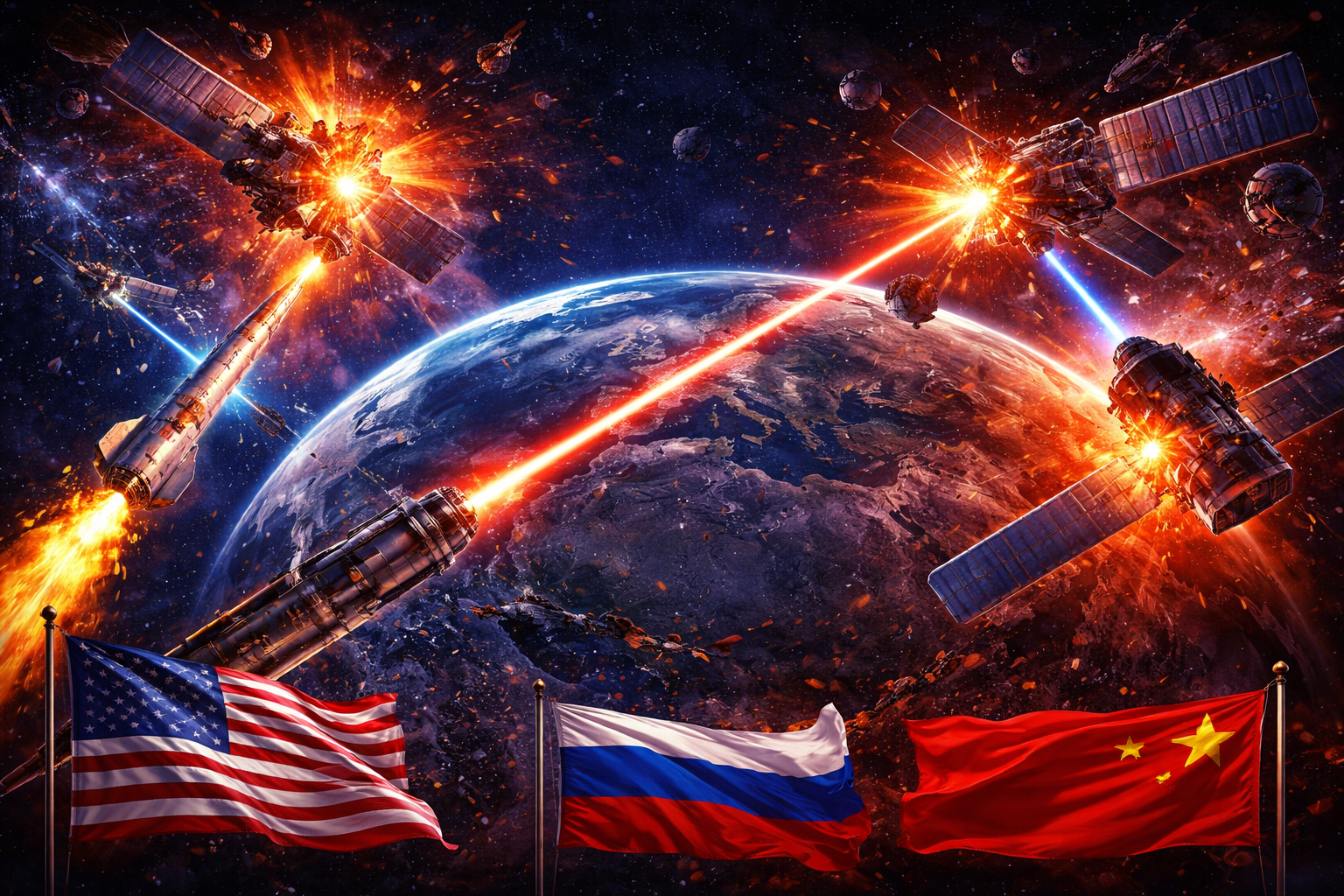
Earth’s orbit is becoming the next strategic battlefield and the major powers are racing to develop the capabilities to dominate it
Introduction: The New High Ground
Military strategists have long described space as the ultimate high ground — a domain from which surveillance, communications, navigation, and targeting systems supporting all military operations on earth are increasingly dependent on satellite infrastructure. For the first decades of the space age, this dependency was treated as a manageable vulnerability, with the implicit understanding among the major powers that attacking each other’s satellites would be an extraordinarily escalatory act that no rational actor would undertake except in the context of full-scale war.
That understanding is eroding. Every major power is now developing dedicated military space capabilities — including weapons designed to disable, disrupt, or destroy adversary satellites. Anti-satellite weapons have been tested in ways that created debris fields threatening the long-term sustainability of Earth’s orbital environment. Satellite communications and GPS navigation — systems that underpin not just military operations but commercial aviation, shipping, financial transactions, and agricultural technology — are now recognised as potential targets in any major military conflict. The era of space as a sanctuary from military competition is over.
Section I: Why Space Matters Militarily
The dependency of modern military operations on space-based systems is difficult to overstate. GPS navigation provides precision guidance for virtually all modern precision munitions — including the artillery shells, cruise missiles, and drone guidance systems that have been central to the Ukraine conflict. Military communications satellites provide the secure, high-bandwidth links between commanders and forces in the field that enable the networked warfare doctrine of modern armed forces. Reconnaissance satellites provide intelligence on adversary force movements, military construction, and weapons deployments that inform every level of military planning. Early warning satellites detect missile launches within minutes of ignition, providing the warning time on which nuclear deterrence depends.
In a conflict with a peer adversary, degrading these space-based capabilities would significantly impair the ability of the dependent military to conduct operations at the sophistication and tempo it has planned for. This is precisely why developing the capability to degrade adversary satellites has become a military priority — and why protecting one’s own satellites from such attacks has become an equally important challenge.
| ~2,000 Active military and dual-use satellites currently in orbit across all nations The US maintains the largest military satellite constellation, followed by China and Russia. The dependency of modern precision warfare on GPS, communications, and surveillance satellites makes space infrastructure a primary target in any peer military conflict — and a primary vulnerability requiring active defence. |
| “The satellites that GPS, military communications, and missile early warning depend on are the nervous system of modern warfare. Disrupting them in the opening phase of a conflict — before ground forces engage — has become a central element of Chinese and Russian military planning. The vulnerability is real and is not yet adequately addressed.” — Brian Weeden Director of Programme Planning, Secure World Foundation |
Section II: The Anti-Satellite Weapons Race
Direct-Ascent Anti-Satellite Weapons
China demonstrated its direct-ascent anti-satellite capability in January 2007, destroying a defunct Chinese weather satellite with a ground-launched missile and creating approximately 3,000 pieces of trackable debris in an orbit that remained hazardous for years. Russia conducted a similar test in November 2021, destroying a defunct Soviet-era satellite and generating a debris field large enough to require the International Space Station crew to shelter in place multiple times. India conducted an ASAT test in 2019. The United States has not publicly tested a direct-ascent ASAT weapon in recent decades, but has acknowledged the development of such capabilities.
Co-Orbital and Electronic Warfare Capabilities
Beyond direct-ascent weapons, space-faring nations are developing more sophisticated — and more deniable — capabilities for disrupting satellite operations. Co-orbital weapons are satellites capable of manoeuvring close to adversary satellites and physically interfering with them — through jamming, laser dazzling, robotic arm interference, or proximity manoeuvres that can cause catastrophic damage without leaving the obvious signature of a kinetic impact. Electronic warfare systems capable of jamming GPS signals and satellite communications are already operational; both Russia and China have used GPS jamming in regional contexts.
Section III: The Governance Challenge
The development of anti-satellite capabilities takes place in a governance vacuum. The Outer Space Treaty of 1967 prohibits the placement of nuclear weapons or other weapons of mass destruction in orbit and on celestial bodies, and declares that space shall be free for exploration and use by all states for peaceful purposes. But it does not specifically prohibit conventional weapons in space, the development of anti-satellite capabilities, or the testing of weapons that destroy satellites. Attempts to negotiate a treaty on the prevention of an arms race in outer space have not produced a binding agreement.
The absence of agreed rules creates several risks. The dual-use nature of many space capabilities — the same satellite that conducts commercial imaging also conducts military surveillance; the same rocket that launches commercial payloads also launches military ones — makes distinguishing military from civilian space activity difficult, creating ambiguity that can lead to misinterpretation. The debris generated by ASAT tests threatens all satellite operators — commercial and civil as well as military — creating a collective action problem where individual military advantage through ASAT testing comes at the cost of shared orbital sustainability.
Conclusion: The Next Strategic Battlefield
The militarisation of space represents a strategic challenge for which international governance frameworks are not yet adequate. The dependency of modern military operations — and of the global civilian economy — on satellite infrastructure creates vulnerabilities that every major military power has recognised and is planning to exploit. The development of ASAT capabilities, electronic warfare against satellites, and the hardening of satellite constellations against attack are all accelerating simultaneously, in the absence of the arms control frameworks that managed analogous competitions in the nuclear and conventional domains during the Cold War.
Managing the strategic stability risks of space militarisation while preserving the enormous civilian benefits of space-based infrastructure — GPS navigation, satellite communications, Earth observation for climate monitoring and disaster response — is one of the most complex governance challenges of the current era. It requires both the technical expertise to understand what is happening in orbit and the diplomatic creativity to build agreements adequate to the complexity of a domain where civilian and military uses are often inseparable.
Who Profited From the Iraq War?


