


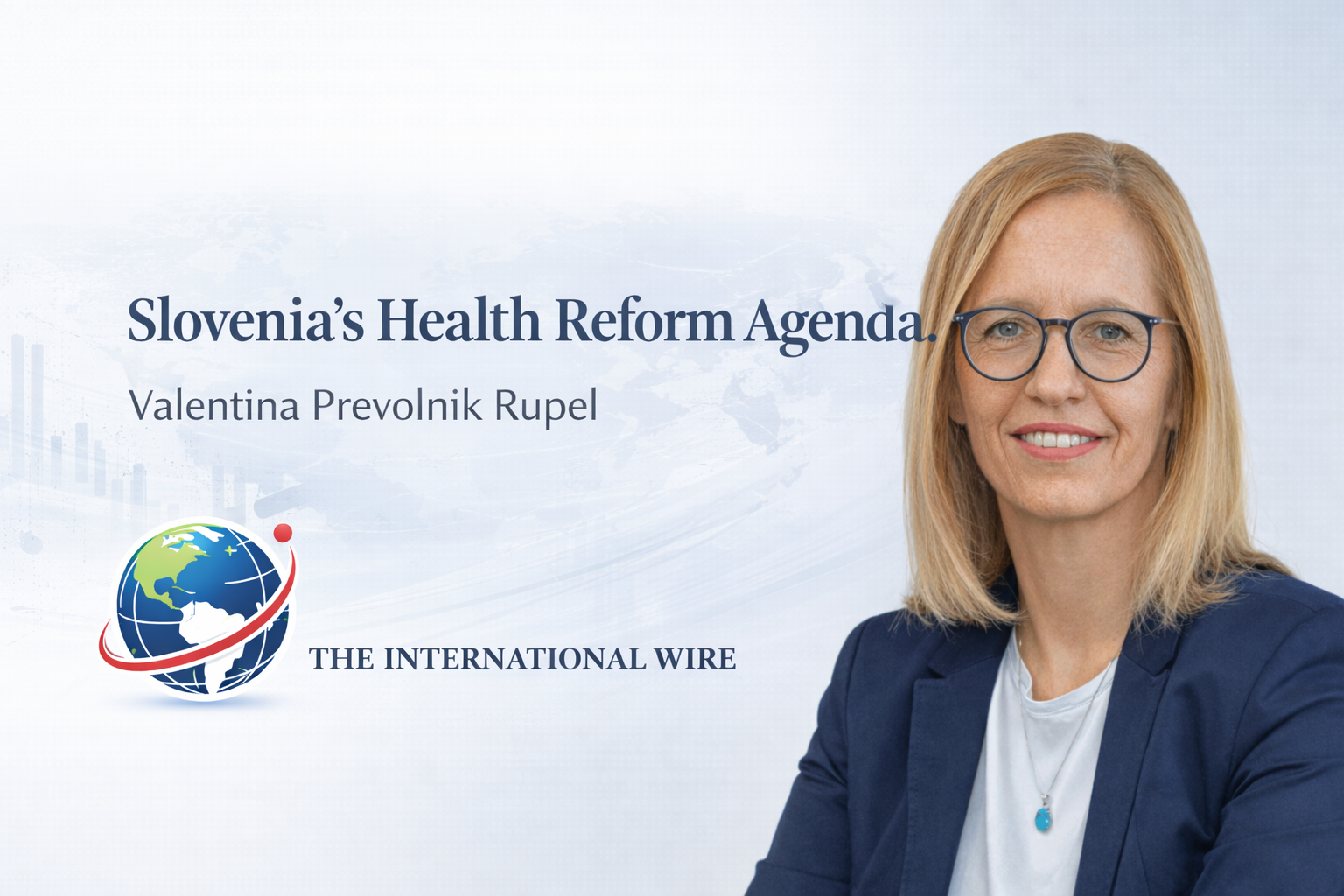
Health systems across Europe face mounting fiscal pressure, ageing populations, workforce shortages and rising expectations of care quality. In Slovenia, reform is being shaped by a policymaker who bridges research and governance.
Valentina Prevolnik Rupel, Minister of Health of the Government of Slovenia, brings nearly three decades of experience in health economics and health system research. Before entering ministerial office, she served as Senior Researcher at the Institute for Economic Research, worked within the Ministry of Health of Slovenia, and advised the Health Insurance Institute of Slovenia on health technology assessment and insurance reform.
Her academic work spans value-based healthcare, patient-reported outcomes, health-related quality of life, and the EQ-5D measurement framework — positioning her uniquely at the intersection of evidence and policy.
In conversation with Danish Shaikh, Editor at The International Wire, Minister Prevolnik Rupel discusses Slovenia’s reform priorities, sustainable health financing, health system resilience, digitalisation, and the role of value-based healthcare in Europe’s next phase of public sector reform.
You bring a long research background into ministerial office. How does academic evidence shape your reform agenda today?
I believe that each person collects their experience throughout life and forms a set of values, beliefs and knowledge which lead them in their understanding and decision-making. My background is research in health economics and health related quality of life, which is deeply embedded in my thinking and everyday work. Although the work is hard and demanding, I try to obtain as much data and opinions from various stakeholders before the important decisions are made. Furthermore, I really believe that newly implemented measures need to be carefully observed, followed and evaluated – the starting implementation is rarely perfect and we all should realize this and be open to the improvements and the adaptation to further optimize the processes in order to reach the best outcomes for the patients. In this way, we really work for the best of the patients.
Slovenia’s health system combines solidarity-based insurance with fiscal discipline. What reforms are currently most urgent?
Our first priorities have been accessibility, quality of care and financial sustainability. To achieve this, we implemented several measures; some will have effect in short term, some in medium or long-term time span. One of the most important measures is the introduction of new DRG weights according to national cost analysis in acute hospital care. This is the first update of DRG weights after the introduction of DRG payment model in 2001. Payment models are being updated in some specialist areas and a new primary care financing model was introduced as well. The payment models need to be updated regularly, otherwise the payments do not follow costs and the providers are forced to adapt and provide services that might not be needed by patients in order to assure financial health of the hospital or health care centre. This leads to the fact that patients’ needs are not the priority and the focus of care provision, which is definitely something that we do not want.
A very important step was the adoption of Health Care Quality Assurance Act in November 2024, which introduced systematic health technology assessment for all health care technologies as well as organized and systematic reporting and processing of adverse events and safety incidents. Furthermore, the reporting of quality indicators by all health care providers and their analysis by the independent Agency for Quality in Health Care will be gradually introduced in Slovenian health care system. The goal is to transform the health care system from input-oriented to outcome-oriented and to adapt the processes of the providers to improve the outcomes.
One of the priority areas is digitalization and introduction of artificial intelligence, which are introduced to enable higher transparency and connectivity to optimize the patient pathways through the health care system as well as to lessen the administrative burden of health care personnel. In the area of digitalization several central national solutions are planned and being implemented in different phases of development – one of the most important is the creation of a unified and interoperable health information system that would improve patient scheduling, data traceability, and overall capacity planning with the aim of reducing waiting lists.
Measures regarding human resources tackled the areas where we have the highest lack of physicians, e.g. family physicians. The number of family physicians as well as physicians in general has been increasing, the number of nurses has been increasing as well. The interest in specializations which are most deficient, has increased – the measures of opening more spaces in the universities, financial incentives, specializations in nursing that offer more creative career developments and pay reforms already showed positive results.
In the future, we need to continue in the same direction and put even more emphasis on the management of the health care institutions. Also, we should always keep in mind that prevention and health promotion programmes are the ones that are most cost-effective and bring highest value for money in terms of health.
What role should value-based healthcare play in improving outcomes while controlling costs?
Value based healthcare represents strong support in cost control by encouraging the use of interventions that provide highest value for invested money. By measuring and rewarding the results or outcomes of care, value-based healthcare also promotes better health outcomes and incentives providers to deliver effective, patient-centred and coordinated care. Value-based approach supports innovation in payment and care delivery models (e.g. bundle payment, outcome-based reimbursement, pay-for-performance, integrated care pathways). These approaches encourage strong collaboration among providers and improve continuity of care, which can decrease complications, hospital readmissions and other wasteful spending in health.
Having said that, value-based healthcare should play central role in improving health outcomes while performing better cost control and their oversight and at the same time shifting the focus of the health system from volume of services provided to the value of achieved outcomes for patients.
In accordance with national PROMS and PREMS Strategy we implemented monitoring of PROMs and PREMs indicators. We participated in the OECD project PaRIS in the first cycle of research on the experiences of chronic patients in family medicine clinics. Now, activities are underway to include them in the second cycle of the research. Both, but especially PROMs, represent a comprehensive approach to assessing delivered care by measuring health outcomes as well as patients’ experiences during the care process.
The two biggest challenges that I see are the refusal and misunderstanding of the transparency that VBHC undoubtedly brings along and the implementation of PROMs in the central information system nationwide. It is of utmost importance that we all understand that the introduction of PROMs is not a tool for punishment of the providers – it is the opportunity to improve and share good practices with those providers whose patients can profit from the improvement of the processes.
How can patient-reported outcomes, including EQ-5D measures, be integrated into national policy decisions?
Patient-reported outcomes, including EQ-5D measures, can be integrated into national policy decisions by systematically collecting them across the health system and analysing them at the national level. In Slovenia, for example, EQ-5D-5L and other PROMs are collected through national registries and standardised outcome indicator sets for major disease areas, then uploaded into a central digital health infrastructure where the data can be analysed and compared across providers. These results help policymakers and clinicians evaluate whether treatments actually improve patients’ health, guide resource allocation, and support evidence-based improvements in care. When used appropriately, the analysis of patient-reported outcomes can inform national policy in several ways. It allows health authorities to benchmark providers, identify best practices, and direct resources toward interventions that produce the greatest improvements in patients’ quality of life. At the same time, these data can support evidence-based decision-making and strengthen value-based health care, ensuring that health systems focus not only on delivering services but also on achieving meaningful outcomes for patients.
However, the process requires strong legislation, reliable data infrastructure, and trust among clinicians and policymakers. Outcomes must be properly risk-adjusted and used as tools for learning and improvement rather than punishment, ensuring that patient-reported data genuinely contribute to better national health policies and higher-quality care.
How should Slovenia balance public provision and private sector participation in healthcare delivery?
In my opinion, the balance between public provision and private sector participation should be based on the principles of solidarity in the fund collection, universal inclusion and access and equal provision of service for equal need. This can be achieved by ensuring that the public healthcare system remains the backbone of healthcare delivery. At the same time, we recognise that the private sector can play a complementary role, particularly in increasing capacity and improving responsiveness. It is the task of the payer to buy health care services to satisfy the needs (and not wishes) of the population.
The key is not in choosing between public and private, but in setting clear rules and responsibilities. Private providers, especially those with concessions, are still an integral part of the health care network and must operate under the same standards, obligations and quality requirements as public providers. At the same time, we are strengthening mechanisms to ensure that public resources are used transparently and efficiently, and that work in the private sector does not undermine the functioning of the public system. This is why we have introduced clearer conditions for additional work and stronger oversight.
Our goal is therefore a well-regulated, transparent and patient-centred system, where both public and private providers contribute to better access and quality of care, however always respecting the principles of solidarity, universality and equal access according to the needs.
Workforce shortages are affecting many European systems. What structural solutions are required?
In recent years, we have moved from a reactive to a more systemic approach to health workforce management. With the establishment of a dedicated Healthcare Human Resources Division at the Ministry of Health, an institutional basis for long-term planning and coordination was created. In 2025, several key measures were introduced, including salary system reform to address pay imbalances, financial incentives for specializations in shortage areas such as family and emergency medicine, and financing additional training positions in clinical psychology. Entry into healthcare professions was strengthened through targeted scholarships, a new program for medicine and higher number of places at the study of medicine, new specialization pathways for nurses, improved recognition of professional qualifications and shortened administrative procedures for professionals coming from abroad and funding for mentorship support for young professionals; and more. At the same time, strategic and legislative steps were taken, including the preparation of the Health Workforce Strategy 2026–2036, the adoption of the Nursing and Midwifery Act and introducing various digital initiatives such as automated workforce scheduling or national speech-to-text solution interned for health care workers. Together, these measures have created a more coordinated framework for workforce development.
It is essential that this progress continues. Demographic trends, population ageing and the age structure of the workforce will further increase demand for health professionals. Therefore, workforce management must remain a long-term national priority through consistent implementation of the Health Workforce Strategy 2026–2036, alignment of education and training capacities with system needs, stronger career pathways, further digitalization and data-based workforce planning. Workforce shortages cannot be solved with a single measure; they require sustained, strategic and system-level management as a key pillar of a stable, accessible and high-quality healthcare system.
How is digital health transforming care coordination and efficiency in Slovenia?
Digital health is increasingly transforming care coordination, patient pathways and the efficiency of healthcare delivery in Slovenia. Over the past decade, Slovenia has developed a national digital health ecosystem that connects healthcare providers, enables electronic exchange of clinical data and supports coordinated care across different levels of the healthcare system. These developments are now being further strengthened through the Healthcare Digitalisation Act, which establishes governance, interoperability standards and long-term coordination of digital health infrastructure, as well as through strategic investments financed under Slovenia’s Recovery and Resilience Plan (RRF/NOO).
The foundation of digital healthcare in Slovenia is the national eHealth ecosystem, which already provides several widely used digital services. These include ePrescription, eReferral and eAppointment, which allow physicians to prescribe medicines electronically, issue referrals digitally and enable patients to book specialist appointments online. These services significantly reduce administrative burden, improve transparency of waiting lists and streamline patient pathways across healthcare providers.
Another key component is the Central Patient Data Registry (CRPP), which serves as Slovenia’s national health document repository. CRPP aggregates clinical documentation generated by different healthcare providers and allows authorised healthcare professionals to access patient records in real time. By providing a comprehensive overview of medical documentation across institutions, CRPP improves continuity of care, supports clinical decision-making and reduces unnecessary duplication of diagnostic tests.
The digital transformation of healthcare is now being accelerated through several strategic projects financed through Slovenia’s Recovery and Resilience Plan. One of the most important initiatives is the development of the national electronic health record (eKarton), which will introduce a unified electronic health record based on structured clinical data and a common data model. The system will enable healthcare professionals to access a comprehensive and structured overview of patient health data.
Care coordination is also being improved through the Central Appointment Scheduling System, which upgrades the existing national eAppointment service. This system introduces a central scheduling mechanism acting as a single source of truth for waiting lists and appointment availability across healthcare providers, enabling more efficient patient routing and better management of waiting times. Many other central solutions are being implemented currently, such as Emergency Medical Services Information System (IS NMP), which supports digital documentation and coordination of emergency medical teams and the central radiological system (cPACS), which enables the storage and exchange of radiological imaging data at the national level.
Together, these existing digital services, the new legislative framework and the ongoing investment projects supported by Recovery and Resilience Plan form a comprehensive digital health ecosystem aimed at improving care coordination, strengthening data availability and increasing the efficiency of healthcare delivery. While digitalisation alone cannot address structural challenges such as workforce shortages, it plays a crucial role in reducing administrative burden, improving patient pathways and enabling a more integrated and data-driven healthcare system in Slovenia.
What reforms are being considered to strengthen primary care?
Our central reform plan at the primary level is the Strategy for the Development of Primary Health Care until 2031, adopted in 2024. The strategy clearly emphasizes that the primary level must form the foundation of the system, as it enables better accessibility, continuity of care, and more efficient use of resources. The goal of the strategy is to ensure high-quality and continuous health care for patients throughout their entire life course. An important part of the reform is an integrated approach in which, in addition to physicians, graduate nurses, reference clinics, and other health professionals also play an important role. Such a model enables better management of chronic diseases and places greater emphasis on prevention. Another important element is the reduction of administrative burdens and increased digitalization, which will allow physicians to devote more time to patients. The strategy also emphasizes better integration of the primary level with other parts of the health system, particularly with specialist services, hospitals, and community-based services. An important part of the reforms is also addressing workforce challenges, specially making family medicine more attractive to young physicians and ensuring more stable and better supported teams in community health centres.
How can health literacy be improved among ageing populations?
The national health literacy survey showed that almost half of the adults in Slovenia face significant problems understanding health information. More than half of the population has issues finding information and accessing specialist treatment. One in four Slovenians trust online information without checking it and are therefore exposed to a greater risk of incorrect or even harmful health information. Through the National Health Literacy Strategy 2025–2035, we are building a healthcare system that is easier to understand, more accessible, and more supportive when individuals make decisions about their health. Special emphasis is placed on the communication of health professionals. At the same time, we are strengthening community-based health promotion programmes that help older adults maintain functional ability, independence and an active life.
How should governments measure “quality of care” beyond expenditure metrics?
Governments should evaluate the quality of care through healthcare outcomes, patient safety, adherence to standards, and patient experience, rather than focusing only on the expenditure side. High quality healthcare is best measured through transparent, evidence based systems that track clinical results, monitor safety incidents, follow nationally defined quality standards, and include patient reported outcomes and experiences. These types of indicators provide a much more accurate picture of how well a healthcare system performs compared to expenditure metrics alone.
In line with this approach, the Slovenian government established a national public agency for quality in healthcare to ensure a unified, evidence based system for monitoring and improving quality. The agency was created following the Health Care Quality Assurance Act, which mandates defining national principles of quality, patient safety, and health technology assessment.
What reforms are needed to reduce waiting times without increasing structural deficits?
To reduce the number of people waiting, numerous measures in many areas need to be implemented. First, a reliable system is needed that can accurately count the number of people waiting. It is estimated that due to various small issues in the system (such as not closing the referral document once the visit is concluded), the number of people waiting is overestimated for around one third. During this mandate, the Ministry updated rules for monitoring waiting lists and the introduction of a new system for measuring factual (and not planned) waiting times, which is still in the process of full implementation. With the revised methodology introduced in August 2024, patients are now classified as waiting beyond the permissible time only once the allowed period has elapsed, ensuring more accurate and reliable reporting.
Secondly, measures need to be undertaken to promote the work in areas where people are waiting most. In this mandate, we concentrated on the first visits with the specialist as first visits are the ones where patient’s diagnosis and further treatment is confirmed or the patient can leave the health care system. Therefore, the Ministry defined minimum numbers of first specialist visits by specialty and offered financial incentives in a form of a 30% higher price for first visits. At the same time, a penalty was introduced in case the plan of first visits was not met in a form of a 10% financial decrease of the total plan.
These measures have stabilized the growth of total waiting numbers for first specialist visits and reduced the number of patients waiting beyond permissible times. In specialties included in the new model with minimum first-visit requirements and incentives, the number of patients waiting beyond the limit fell by 10% between 31 August 2024 and 31 December 2025. However, trends vary across specialties: while areas such as ophthalmology and psychiatry did not record significant changes, the number of patients waiting decreased up to almost 30% in cardiology, urology, infectious diseases, gynaecology, and diabetology. In contrast, some specialties—such as physical and rehabilitation medicine and general surgery—experienced increases.
How should prevention policy be redesigned in light of ageing trends?
In Slovenia, a life-course approach to prevention has been adopted, meaning that preventive measures begin during pregnancy and continue throughout childhood, adolescence, and adulthood. The aim is to reduce the risk of the most common chronic diseases later in life.
Considering the ageing trends, prevention policies should place greater emphasis on healthy ageing, shifting the focus from merely preventing diseases to maintaining functional ability, independence, and quality of life in older age. Slovenia is currently testing new approaches to address frailty, dementia, to increase vaccination coverage, implement fall-prevention programmes, and introduce systematic medication reviews.
In addition, it is important to promote age-friendly environments by encouraging safe physical activity, ensuring accessible transport, and fostering supportive communities. At the same time, greater investment in preventive care is needed to help reduce the long-term healthcare costs associated with ageing populations.
Where does Slovenia stand in comparison to other EU health systems?
Slovenia’s health system performs strongly in a European context, often achieving results that are at or above the EU average, despite lower-than-average health spending.
The most basic indicators, such as life expectancy, show, that Slovenia is slightly better than the EU average. Healthy life years expectancy is much higher than EU average, especially for women, meaning that people not only live longer, but spend more of those years in good health.
Slovenia is also among the countries where the more equitable health systems in Europe. According to the 2025 EuroHealthNet study, Slovenia is one of the two countries where the health gaps between education groups were shrinking, while overall health was also significantly improving for everyone.
In child health, Slovenia ranks among the very best in the EU, with one of the lowest infant mortality rates—around 1.8 per 1,000 live births, which places us at the very top among Member States.
We are also recognised as a leader in preventive healthcare, particularly through national screening programmes such as ZORA (cervical cancer), SVIT (colorectal cancer) and DORA (breast cancer) which achieve high participation and strong outcomes. Besides that, we are expanding prevention further through pilot programmes like LUKA for lung cancer and PETER for prostate cancer.
In short, Slovenia may spend less than some other countries, but it consistently delivers strong results—especially in prevention, equity and key health outcomes, which position it as an efficient and well-performing health system within the EU.
Looking ahead to 2030, what would define a resilient Slovenian health system?
Looking ahead to 2030, a resilient Slovenian health system would be defined firstly by strong and accessible prevention, screening programs and health promotion, strong primary health care, a stable and well-supported health workforce, and better integration across all levels of care. Stability will be ensured if we plan strategically, especially regarding workforce and investments. The demand in health care will always surpass the supply as the technological advancements are fast and we are an ageing society. All in all, we need to define what the priorities are, what the needs are and behave sustainably. Last but not least, I cannot underestimate the role of the environment and the importance of measuring the impact that the healthcare system has in terms of pollution and carbon emissions. Measuring this impact and implementing mitigation measures at every step of our activities and decision-making is essential.
Rapid-Fire
What sustains your optimism?
I still believe in good in people.
Prevention or treatment — priority first?
Prevention and health promotion.
Most underestimated reform lever?
Time and energy for discussion with all stakeholders
Data-driven or politically negotiated policymaking?
Both, but data-driven in the phase of preparation
Hospital reform — urgent or gradual?
Gradual, always, also in the field of investment
One indicator you monitor closely?
Waiting lists for first visits
Public trust — fragile or resilient?
Fragile, but increasing
One European system Slovenia can learn from?
All of them, but not one to copy entirely
Long-term reform or short-term crisis management?
Long-term measures in a form of continuous small steps, based on evaluation
Health expenditure — investment or cost?
Investment, no doubt.

Prof. Valentina Prevolnik Rupel holds a PhD from the Faculty of Economics in Ljubljana; her thesis (2008) was entitled “The impact of quality of life on priority setting and the efficiency of resource allocation in healthcare”.
In her career, she has worked as a researcher and scientific advisor at the Institute for Economic Research in Ljubljana (IER), where she focused on the fields of health and long-term care. She has been the Chair of the IER Scientific Council, a lecturer at the DOBA Faculty of Applied Business and Social Studies in Maribor, and a member of the Prime Minister’s Strategic Council for Health. She has also worked as an advisor to the Minister of Health and counsellor to the Director-General of the Health Insurance Institute of Slovenia.
Her fields of expertise are health outcome measurement and the development of healthcare quality indicators and value-based care, while her broader remit includes healthcare financing and health insurance and health technology assesment.
Before being appointed Minister of Health of the Republic of Slovenia on 13 October 2023, she held the position of the State Secretary at the Ministry of Health.
The Arctic Race: How Melting Ice Is Redrawing Global Power


