


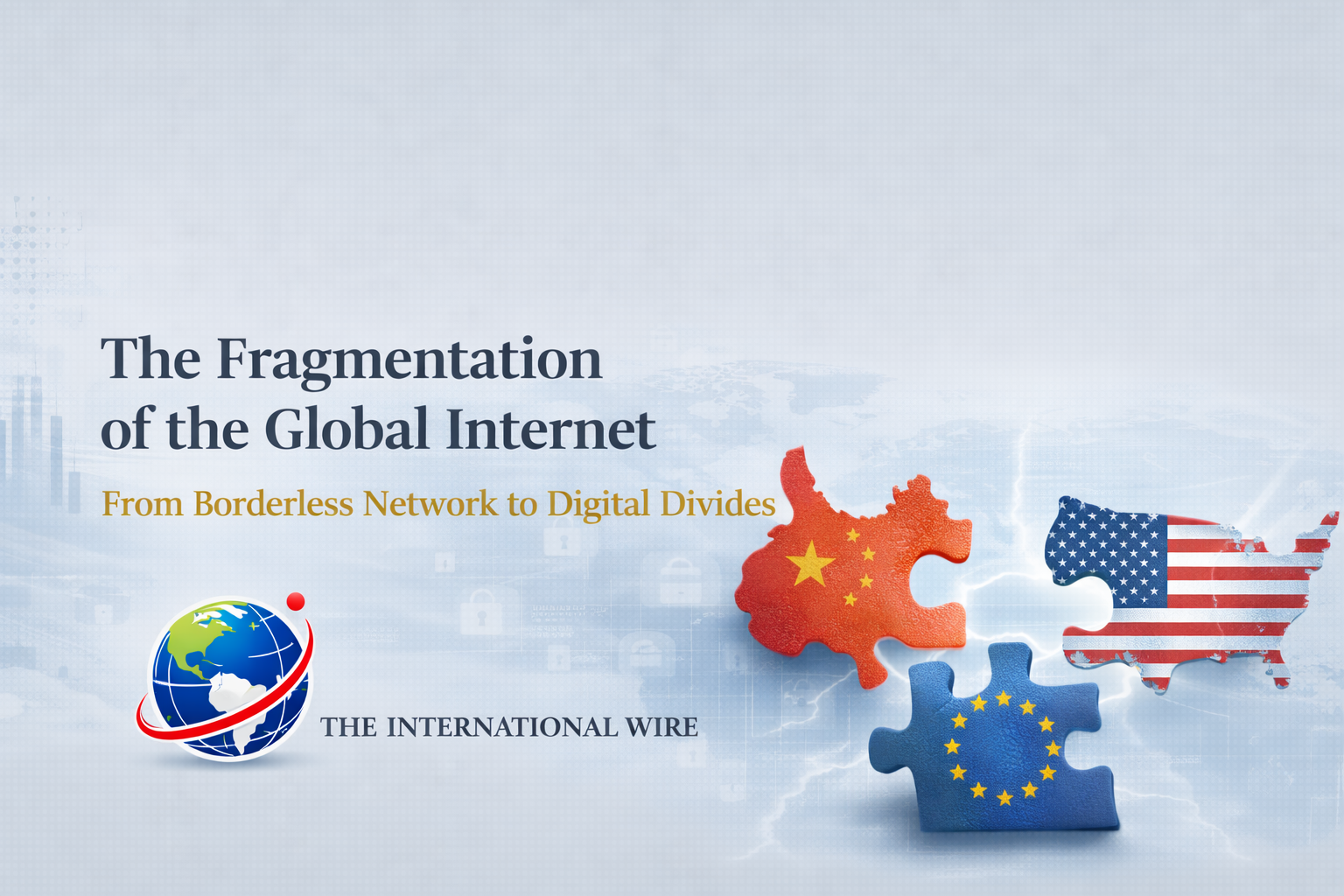
The vision of one global internet is fracturing replaced by competing national digital ecosystems with profound implications for trade, innovation, and freedom
Introduction: The End of One Global Internet
Tim Berners-Lee, the inventor of the World Wide Web, envisaged a single global information space accessible to all, regardless of geography, nationality, or political system. For approximately two decades following the web’s launch in the early 1990s, this vision appeared to be materialising. The internet was growing, connecting previously isolated communities, enabling new forms of economic activity and political expression, and creating a genuinely shared global information environment.
That vision is now under sustained and accelerating pressure. The internet of 2026 is not the internet of 2006. A growing number of countries have implemented technical, regulatory, and legislative measures that restrict the free flow of information across borders, require data to be stored domestically, block or severely restrict access to major global platforms, and assert national regulatory authority over content and digital commerce in ways that effectively partition the global network into a collection of national and regional digital ecosystems. The trend has acquired a name: the ‘splinternet’ — and its implications for global commerce, political expression, and technological innovation are profound.
Section I: The Dimensions of Fragmentation
China’s Sovereign Internet
China’s approach to internet governance represents the most extensive and technically sophisticated implementation of what it calls ‘internet sovereignty’ — the principle that states have the right to control the internet within their borders as they control other aspects of their territory. The Great Firewall of China blocks access to most major Western internet platforms — Google, Facebook, YouTube, Twitter, Instagram, WhatsApp — while domestic Chinese equivalents have developed into substantial platforms in their own right: Baidu for search, WeChat for messaging, Weibo for social media, Alibaba for e-commerce, Tencent Video and iQiyi for streaming.
The result is not simply a censored version of the global internet — it is a separate digital ecosystem with its own platforms, its own standards, its own commercial logic, and its own global ambitions. Chinese platforms are expanding internationally, particularly in developing markets where they face less regulatory resistance than in Europe or North America. The architectural and governance principles of China’s internet are being exported alongside its platforms — offering a model of state-managed digital governance that is attracting interest among governments seeking more control over their domestic information environments.
Data Localisation and National Regulation
Beyond China, a growing number of countries have implemented data localisation requirements — regulations requiring that data collected on citizens be stored within national borders and subject to national legal jurisdiction. Russia, India, Indonesia, and others have implemented various forms of data localisation. The European Union’s General Data Protection Regulation (GDPR), while not a data localisation requirement per se, imposes restrictions on the transfer of European citizen data to countries without ‘adequate’ data protection standards that effectively create barriers to seamless cross-border data flows.
| “The splinternet is not a future scenario — it is the present reality. The question is no longer whether the internet will fragment but how extensively and along what dimensions. The commercial, political, and security implications of a world with multiple incompatible digital ecosystems have barely begun to be worked through.” — Dr. Milton Mueller Professor, School of Public Policy, Georgia Tech; author on internet governance |
Section II: The Economic Consequences
The fragmentation of the internet creates significant friction costs for the global digital economy. Businesses operating across multiple digital jurisdictions must navigate different regulatory requirements, implement different data handling protocols, and potentially maintain separate technical infrastructure for different markets. The seamless global e-commerce and digital services market that the internet enabled is becoming more complex, more expensive to operate in, and more uncertain in its regulatory trajectory.
The innovation implications may be more significant in the long term. The global internet enabled a form of innovation ecosystem in which ideas, talent, and investment moved freely across borders, and in which technological development in one location rapidly propagated globally. A fragmented internet creates isolated innovation pools in which progress made in one digital ecosystem does not automatically transfer to others, potentially slowing the overall pace of global technological advancement and creating divergent technological trajectories in different regions.
Conclusion: Navigating the Splinternet
The fragmentation of the internet is neither inevitable in its current trajectory nor amenable to simple reversal. The forces driving it — national security concerns about foreign-controlled digital infrastructure, political concerns about the content moderation decisions of foreign platforms, economic concerns about the dominance of foreign technology companies, and differing societal values about privacy, free expression, and state authority — are real and will not disappear through advocacy for the original vision of one global internet.
Managing the splinternet — preserving enough interoperability to maintain the commercial and informational benefits of global digital connectivity while accommodating the genuine diversity of regulatory approaches and national interests that drive fragmentation — is the central challenge of twenty-first century internet governance. The alternative — a world of multiple entirely incompatible digital ecosystems with no shared technical standards, no cross-border data flows, and no common information space — would be a profound narrowing of the technology’s potential and a significant loss for the global economy and for the free exchange of ideas that has been one of the internet’s most significant contributions to human progress.


