


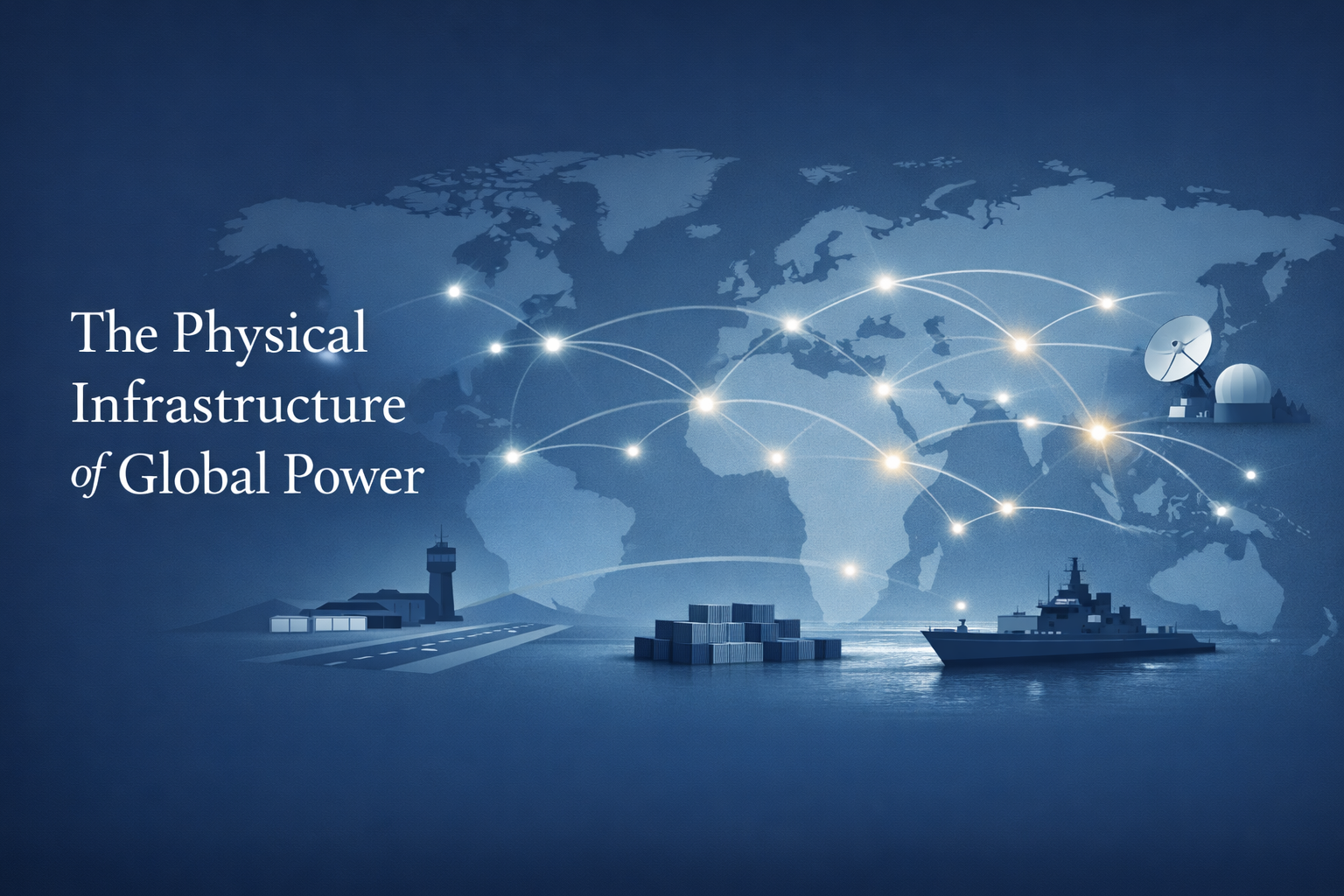
The network of overseas military installations maintained by major powers is one of the least-examined dimensions of global strategic competition
Introduction: The Physical Infrastructure of Global Power
Military power is not purely a function of the weapons, personnel, and technology that a state’s armed forces possess. It is also a function of where those forces can be deployed from — the global network of bases, ports, airfields, logistics facilities, and pre-positioned equipment that determines how rapidly and how effectively military capability can be brought to bear in any given location. A navy that possesses the world’s most powerful aircraft carriers is limited in its global reach if it can only operate from home ports. An air force with the world’s most advanced fighters cannot project power to the other side of the world without access to forward basing or aerial refuelling infrastructure.
The geography of military basing is therefore a direct expression of strategic ambition and strategic reach. And the dramatic asymmetry in this geography — between the United States, with its extensive global network of military installations in over 80 countries, and every other power — is one of the most significant and least publicly discussed dimensions of global military competition. Understanding who has bases where, and why, is essential to understanding the real military balance of the current era.
Section I: The American Basing Empire
The United States maintains approximately 750 military installations in more than 80 countries outside US territory — a global military footprint that is without parallel or precedent in modern history. This network includes large-scale permanent bases: Ramstein Air Base in Germany, the largest American air base outside the continental United States; Camp Humphreys in South Korea, the largest American overseas military installation by area; Naval Station Rota in Spain, home to a significant portion of the US Navy’s European presence; Diego Garcia in the British Indian Ocean Territory, a critical logistics and air power base for operations in the Indian Ocean and Middle East.
It also includes dozens of smaller facilities: radar installations providing early warning and missile tracking, signals intelligence posts intercepting communications, pre-positioning facilities storing equipment that can be drawn on by forces deploying rapidly to a crisis, and access arrangements that allow American aircraft or naval vessels to use foreign facilities on a rotational basis without maintaining permanent garrisons.
| 750+ US military installations in more than 80 countries outside US territory No other nation in history has maintained a comparable global military footprint. The United States spends more on defence than the next ten countries combined, but the overseas basing network multiplies that spending’s strategic effect by enabling rapid power projection to any point on the globe. Maintaining the network itself costs an estimated $150 billion annually. |
The Strategic Logic of Forward Basing
The strategic logic of maintaining this extensive overseas network rests on several interconnected rationales. Forward bases reduce response times to crises: forces based in Japan or Guam can reach a Taiwan Strait contingency far faster than forces deploying from the continental United States. Pre-positioned equipment in Europe or the Middle East can be fielded within days by airlift of personnel, without the weeks required to ship heavy equipment by sea. Intelligence installations provide persistent coverage of adversary activities that satellite systems alone cannot replicate.
Forward bases also send signals to allies and adversaries — demonstrating commitment to alliance relationships, deterring potential aggressors by ensuring that any attack on an ally would immediately engage US forces, and maintaining the credibility of security guarantees that depend on physical presence as much as formal treaty obligations. The withdrawal or significant reduction of American forces from a region tends to create uncertainty about alliance reliability that can itself be destabilising.
Section II: China’s Emerging Global Base Network
China has been explicit in its ambition to develop a global military logistics network — a series of overseas facilities providing support, resupply, and eventually operational capability for Chinese naval and air forces operating far from the Chinese mainland. China’s first acknowledged overseas military facility, in Djibouti, opened in 2017. Reports have identified potential Chinese base development discussions or activities in various locations including Cambodia, the Solomon Islands, Equatorial Guinea, Myanmar, and the United Arab Emirates. The extent and pace of Chinese overseas base development remains subject to significant uncertainty, but the trajectory is clear.
The development of Chinese overseas basing capability represents a fundamental change in the global military geography. For the first time since the end of the Cold War, a non-American power is systematically building the infrastructure of global military reach. The implications for American strategic planning — which has operated on the assumption of overwhelming forward basing advantage — are significant.
Section III: Russia and Other Powers
Russia maintains military facilities in a smaller number of countries than either the United States or China’s aspirations suggest — primarily in the post-Soviet space and in countries with which Russia has close military relationships: Syria (Tartus naval facility and Khmeimim air base), Belarus, Tajikistan, Kyrgyzstan, Kazakhstan, Armenia, and the semi-autonomous enclaves of Abkhazia and South Ossetia in Georgia. Russia’s forward military presence has been extended by the activities of the Wagner Group and its successor arrangements in sub-Saharan Africa, which provide an informal military footprint not captured in formal base statistics.
France, the United Kingdom, and other major powers maintain smaller overseas military presences reflecting their colonial histories and post-colonial relationships. France’s network of bases in West and Central Africa — currently undergoing significant changes as military governments in the Sahel have expelled French forces — has historically provided Paris with a power projection capability well beyond what France’s overall military expenditure would suggest.
Conclusion: The Geography of Strategic Competition
The global network of military bases is the physical infrastructure of great-power competition — the geography of strategic reach, alliance credibility, and power projection capability that underpins everything else in the military balance. Understanding it is essential to understanding the real military balance of the current era, which is far more asymmetric in America’s favour than raw military spending comparisons suggest, and which is beginning to be contested by China’s methodical development of its own overseas logistics and basing infrastructure.
The management of this basing network — maintaining it where it serves alliance relationships and strategic requirements, adapting it to new threats and new technologies, and navigating the political complexities of hosting arrangements that involve significant sovereignty sensitivities — is a core element of the foreign and defence policy of every major power that aspires to global strategic reach. Its geography maps, more honestly than almost any other indicator, the true shape of global military competition.


