


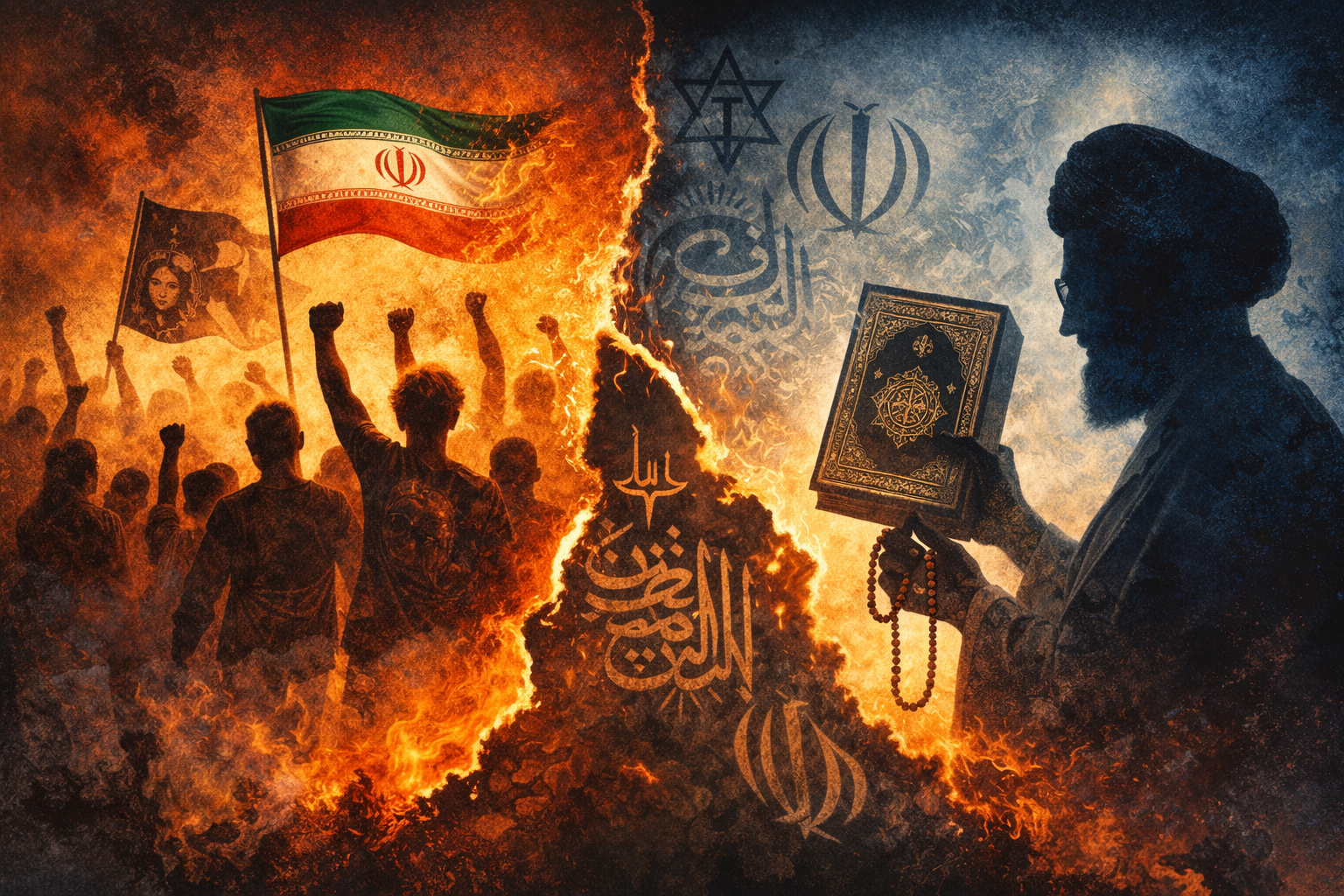
How Iran built a governing architecture that distributes power, defies decapitation, and continues to function even when its leadership is under direct attack
What Is Iran’s Mosaic Leadership?
Iran‘s mosaic leadership is a deliberately decentralised governing system in which political authority, military command, and strategic decision-making are distributed across multiple overlapping institutions — so that the elimination of any single leader or node cannot collapse the system. It is not a product of accident or bureaucratic drift. It is by design.
When analysts and strategists discuss why Iran is so difficult to coerce — why decades of sanctions, targeted assassinations, cyberattacks, and military strikes have not produced the behavioural changes their architects sought — the answer lies substantially in this architecture. Unlike the centralised authoritarian systems that fell or fractured when their apex leadership was removed or discredited, Iran’s Islamic Republic was constructed with institutional redundancy at its core. Power is not held in one place. It is embedded everywhere.
The events of March 2026 — in which direct US–Israeli military strikes targeted Iranian military infrastructure, nuclear facilities, and senior leadership — have provided the most severe test of this architecture in the Islamic Republic’s history. The early evidence suggests the system is functioning as its designers intended. This analysis explains how, why, and what that means for the world.
| 47 Years The Islamic Republic has survived — through revolution, war, sanctions, assassinations, and now direct military strikes Established in 1979, the Islamic Republic has outlasted multiple predictions of its imminent collapse, surviving the eight-year Iran-Iraq War, the death of its founder, maximum pressure economic sanctions, the Stuxnet cyberattack, the assassination of top military commanders, and now direct military confrontation. Its survival is structural, not accidental. |
Section I: What Is Mosaic Leadership — and Where Did It Come From?
The concept of ‘mosaic’ as applied to Iranian strategic doctrine derives from the military realm, where Iran’s armed forces — particularly the Islamic Revolutionary Guard Corps — have developed what defence analysts describe as a mosaic defence: a distributed force architecture in which units are structured to continue operating independently even if central command is disrupted, communications are severed, or higher headquarters are destroyed. Each piece of the mosaic can function on its own, guided by pre-established doctrine and ideology, while remaining part of a coherent larger pattern.
The Iranian state’s governing architecture mirrors this military doctrine. Rather than a system with a single apex — a Saddam Hussein, a Muammar Gaddafi — whose removal dissolves the structure around it, Iran’s Islamic Republic was built by Ayatollah Khomeini with an explicit philosophy of distributed theocratic governance. The principle of Velayat-e Faqih — the guardianship of the Islamic jurist — places supreme religious and political authority in the Supreme Leader, but it does so within a framework of overlapping institutions, each with independent legitimacy, parallel functions, and ideological cohesion that does not depend on any individual’s survival.
| “What makes Iran’s system distinctive is not the Supreme Leader position itself — it is the institutional architecture surrounding it. The clerical establishment, the IRGC, the parallel councils, the regional networks — these are not subordinate to the Supreme Leader in the way that a ministry is subordinate to a prime minister. They have their own institutional weight, their own constituencies, and their own capacity to continue functioning under disruption.” — Dr. Vali Nasr Dean Emeritus, Johns Hopkins School of Advanced International Studies; former Senior Advisor, US State Department |
This architecture was not merely ideological improvisation. It was the product of Khomeini’s deliberate response to the vulnerability he observed in the Shah’s centralised monarchy — a system that, when the Shah was removed, left a vacuum that the revolution could fill. The Islamic Republic was designed so that no single removal could create such a vacuum. Authority was distributed, legitimised through multiple overlapping frameworks, and embedded in institutions with deep social and ideological roots.
Iran was not built to be led by one man. It was built to be governed by a system — one that continues to function regardless of which individuals occupy its nodes.
Section II: The Architecture of Distributed Power — Four Layers
Iran’s mosaic leadership operates across four distinct but interconnected layers. Understanding each layer is essential to understanding why the system is so difficult to disable through conventional means — whether economic, military, or diplomatic.
| 1 APEX | The Supreme Leader — Strategic Continuity Holds constitutional authority over the military, judiciary, media, and strategic policy. But the Supreme Leader’s role is directive and ideological rather than operational. The system does not require the Supreme Leader to personally manage crisis response — it requires that the Supreme Leader’s authority provides the ideological legitimation for autonomous action at lower levels. |
| 2 CORE | The IRGC — Operational Independence The Islamic Revolutionary Guard Corps is the primary engine of Iran’s military and strategic operations. It operates with significant autonomy from civilian government, controls missile programmes, regional proxy networks, and internal security. Its provincial and regional unit structure allows independent operation when central command is unavailable or disrupted. |
| 3 STRUCTURE | Parallel Institutions — Political Redundancy The Guardian Council, Expediency Council, President, Parliament (Majles), and Assembly of Experts create a deliberate layering of authority in which no single institution monopolises governance. When one body is weakened or disrupted, others continue to function. This redundancy is a feature, not a design flaw. |
| 4 DEPTH | Proxy & Regional Networks — Strategic Extension Hezbollah in Lebanon, Hashd al-Sha’bi in Iraq, Houthi forces in Yemen, and various Palestinian factions represent Iran’s outer layer of strategic depth. These are not merely foreign policy instruments — they are autonomous extensions of Iran’s deterrence architecture that continue operating independently of Tehran’s direct command. |
Section III: How Mosaic Leadership Functions Under Fire — March 2026
The events of March 2026 have provided real-world validation of the mosaic leadership concept under conditions that no theoretical analysis could fully anticipate. The US–Israeli strike campaign, which began on 28 February, targeted the very nodes that a conventional decapitation strategy would prioritise: nuclear facilities, IRGC command infrastructure, air defence networks, and senior military leadership.
The results have confounded those who predicted rapid Iranian collapse or fundamental strategic paralysis. The Iranian state has not collapsed. Military operations — including missile strikes, proxy activations, and maritime harassment — have continued. Strategic messaging has remained coherent. Leadership replacement in affected command structures has occurred with a speed that surprised outside observers.
| HOW THE SYSTEM RESPONDS TO DECAPITATION Pre-defined protocols: IRGC units carry standing orders for continuation of operations under disruption scenarios, developed and rehearsed over decades of contingency planning. Pre-embedded succession: Replacement leadership for key command positions is identified, prepared, and positioned in advance — not appointed reactively after a loss. Ideological self-direction: IRGC commanders at regional and provincial level are selected for ideological coherence. They do not require explicit orders to continue operating in alignment with the system’s strategic objectives. |
The specific mechanisms that have enabled continuity in the March 2026 environment illustrate the mosaic principle in practice. When senior IRGC figures were killed or incapacitated in the opening strikes, command authority devolved to pre-identified successors without public ceremony or extended interregnum. When communication infrastructure was degraded, regional commands operated under standing doctrine rather than requiring continuous coordination from a disrupted centre. When international pressure sought to exploit any appearance of governmental instability, parallel institutions — the Guardian Council, the Expediency Council — provided a visible demonstration of continued institutional function.
| “The Iranians have spent decades specifically war-gaming the decapitation scenario and building institutional responses to it. What Western analysts sometimes miss is that the system’s resilience is not just about backup leadership — it is about a shared ideology that makes thousands of people capable of acting in the system’s interest without being directly commanded to do so.” — Dr. Afshon Ostovar Senior Fellow, CNA; author of ‘Vanguard of the Imam: Religion, Politics, and Iran’s Revolutionary Guards’ |
Section IV: The IRGC — The Mosaic’s Operational Engine
No analysis of Iranian mosaic leadership is complete without understanding the specific role of the Islamic Revolutionary Guard Corps as the system’s operational backbone. Established in 1979 specifically to provide a military force loyal to the revolution rather than to the state in a conventional sense, the IRGC has evolved into a comprehensive parallel military, intelligence, economic, and diplomatic institution whose reach extends from missile production facilities in underground tunnels to business empires worth billions of dollars to proxy forces operating across four Arab countries.
The IRGC’s relevance to the mosaic concept lies in its structural design. Unlike conventional militaries — which are built around hierarchical chains of command that break when links in that chain are severed — the IRGC combines hierarchical elements with horizontal networks and ideologically autonomous units. The Quds Force, responsible for external operations and proxy relationships, operates with significant strategic independence. Provincial IRGC units have operational autonomy within defined parameters. And the IRGC’s deep penetration of Iranian economic and social life means that even in a conflict scenario that degrades its conventional military functions, its institutional presence in Iranian society remains.
| 125,000+ Estimated IRGC personnel, plus approximately 90,000 in the Basij paramilitary The IRGC’s force structure is distributed across the country in provincial commands, supplemented by the Basij volunteer militia. This geographic distribution means there is no single military strike — or even set of strikes — that could simultaneously neutralise IRGC operational capacity across all of Iran’s territory. |
The IRGC’s missile programme — housed in deeply buried, hardened facilities across multiple sites — reflects the same mosaic principle applied to weapons infrastructure. No single strike, however precise, can simultaneously destroy all missile production and storage capacity. The redundancy is engineered. When one facility is destroyed, the programme continues at others. This is why, a month into direct military confrontation, Iran has retained and demonstrated significant ballistic missile capability.
The IRGC was not designed to protect Iran’s leadership. It was designed to continue functioning even if Iran’s leadership is removed. That distinction is everything.
Section V: The Proxy Network — Strategic Depth as Distributed Power
Iran’s network of proxy forces and allied non-state actors across the Middle East is frequently analysed primarily as a foreign policy instrument — a way of projecting power and creating leverage beyond Iran’s borders. But in the context of mosaic leadership, these networks serve a deeper strategic function: they represent the outer layer of the mosaic itself, capable of continuing to impose costs on Iran’s adversaries independently of whatever is happening to Iran’s central state.
Hezbollah in Lebanon represents the most sophisticated and most capable element of this outer layer. Built over four decades with Iranian investment, training, weapons supply, and strategic guidance, Hezbollah has developed an institutional depth and operational autonomy that allows it to function independently for extended periods without direct Iranian command. It has its own financial networks, its own intelligence services, its own political presence in Lebanese governance, and its own strategic doctrine that is aligned with but not entirely subordinate to Tehran’s direction.
| “Hezbollah is not simply an Iranian proxy — it is an independent strategic actor with its own interests, its own domestic constituency, and its own long-term objectives. Iran created the conditions for its development, but Hezbollah’s resilience under pressure comes from its own institutional depth, not just from Iranian support. That is by design — Iran wanted a partner that could continue to function even if Iran itself were under severe pressure.” — Dr. Matthew Levitt Fromer-Wexler Fellow and Director, Stein Program on Counterterrorism and Intelligence, Washington Institute for Near East Policy |
The strategic logic of the proxy network in the mosaic framework is deterrence through geographic diffusion. An adversary targeting Iran cannot simultaneously and decisively neutralise Hezbollah in Lebanon, Hashd al-Sha’bi in Iraq, Houthi forces in Yemen, and Palestinian groups in Gaza. The outer layer of the mosaic continues to operate — imposing costs, creating dilemmas, and maintaining strategic pressure — regardless of what is happening at the centre. This geographic diffusion is as important to Iranian strategic resilience as any element of the domestic institutional architecture.
Section VI: The Limits and Risks of the Mosaic Model
Mosaic leadership is a sophisticated and demonstrably resilient strategic architecture. But it is not without significant costs and risks that its designers have had to accept as the price of the resilience they have purchased.
The Coordination Problem
Decentralisation that enables survival under disruption is the same decentralisation that makes large-scale coordinated operations more difficult to execute with precision. Autonomous units operating under pre-defined doctrine can continue functioning, but they may not achieve the strategic coordination that a crisis moment requiring complex, multi-front adaptation demands. This is not a fatal flaw — it is a known trade-off that Iran has consciously accepted in favour of resilience.
The Escalation Risk from Autonomy
The most immediately dangerous risk of the mosaic model in a live conflict environment is the possibility of escalation triggered by autonomous unit action rather than central strategic decision. An IRGC provincial commander who interprets pre-defined doctrine as authorising an action that central leadership would have withheld can create facts on the ground that neither side intended and neither side can easily reverse. The March 2026 environment, with communication channels under stress and multiple autonomous actors simultaneously active, is precisely the environment in which this risk is highest.
Internal Power Competition
The long-term political risk of distributed authority is that the entities wielding it develop competing interests, competing constituencies, and competing visions of the system’s future. The IRGC’s economic empire, its institutional prestige, and its political weight have already created tensions with civilian governmental institutions that periodically surface in Iranian domestic politics. Under sustained external pressure, these tensions may intensify rather than consolidate — potentially creating the internal fragmentation that external military pressure has failed to produce.
| “The IRGC’s institutional power within the Iranian system has grown to the point where it is no longer simply the revolutionary guard of the Islamic Republic — it is, in many respects, a co-equal governing institution. That creates resilience against external attack, but it also creates an internal power dynamic that is genuinely uncertain. Whether sustained external pressure consolidates or fractures that internal balance is the most important domestic variable in Iran’s trajectory.” — Dr. Suzanne Maloney Vice President and Director, Foreign Policy Programme, Brookings Institution; Iran specialist |
The Limits of Ideology as Coordination
The mosaic model’s coherence depends fundamentally on a shared ideological framework — the revolutionary principles of the Islamic Republic, the authority of Velayat-e Faqih, and the commitment to the system’s survival that motivates autonomous action at every level. This ideological coordination works reliably when the system’s legitimacy is broadly accepted within the institutions. If sustained military and economic pressure, combined with internal governance failures, erodes that ideological coherence, the mosaic could fragment rather than cohere. Iran’s leadership understands this vulnerability — which is why ideological indoctrination within the IRGC and the Basij is treated as a strategic priority, not a secondary concern.
Section VII: Why Mosaic Leadership Matters for the World — The Strategic Implications
Understanding Iran’s mosaic leadership model is not merely an academic exercise in comparative political science. It has direct implications for the international community’s ability to manage, contain, and ultimately resolve the current conflict — and for the broader question of how the international system deals with states that have deliberately engineered their own resilience against the forms of pressure that the existing system relies upon.
Coercive Tools Are Less Effective Than Assumed
The most immediate policy implication is that the coercive tools the US–Israeli coalition has deployed — leadership strikes, infrastructure destruction, economic pressure — are significantly less effective against a mosaic system than against a centralised one. This does not mean they are without effect; they impose real costs, they degrade specific capabilities, and they create strategic stress. But they cannot produce the capitulation or collapse that decapitation of a centralised system might achieve, because there is no single apex whose removal changes the system’s fundamental calculus.
Conflict Duration and the Diplomacy Requirement
A system designed for resilience rather than decisive victory implies a conflict dynamic oriented toward endurance rather than decision. If Iran’s architecture is optimised for survival under sustained pressure, the military path to resolution faces a fundamental problem: it may be able to impose costs indefinitely without producing strategic change. This suggests that diplomatic engagement — even while military operations continue — is not merely desirable but logically necessary for any resolution that goes beyond military stalemate.
The Model Others Are Studying
Iran’s mosaic leadership is being studied with close attention by other states that anticipate operating in contested security environments against superior conventional military power. The institutional architecture, the proxy network model, the distributed military doctrine, and the governance philosophy of distributed authority are all being examined as potential templates. The strategic diffusion of this model — if it continues — has implications for the international community’s ability to deter and manage conflicts beyond the specific case of Iran.
Iran’s mosaic system is not just a response to the current conflict. It is a template — one that answers the question of how a medium power survives direct confrontation with superior force. Others are taking notes.
Frequently Asked Questions
| What is Iran’s mosaic leadership system? Iran’s mosaic leadership is a deliberately decentralised governing system in which authority is distributed across multiple overlapping institutions — the Supreme Leader, the IRGC, parallel political councils, and proxy networks — rather than concentrated in a single chain of command. This means that destroying or disabling any single component does not collapse the overall system. It was designed explicitly to ensure the Islamic Republic’s survival under severe pressure, including targeted military strikes on leadership. |
| Why is Iran’s government so hard to destroy or destabilise? Iran’s system was deliberately engineered for resilience through institutional redundancy, decentralised command structures, ideological cohesion, and a regional proxy network that extends its strategic depth beyond its borders. Unlike centralised authoritarian systems — such as Saddam Hussein’s Iraq — the Islamic Republic has no single point of failure whose removal dissolves state authority. This is the product of deliberate design, not bureaucratic accident. |
| What role does the IRGC play in Iran’s mosaic leadership? The Islamic Revolutionary Guard Corps serves as the operational core of Iran’s mosaic system. With an estimated 125,000+ personnel organised in provincial commands with significant operational autonomy, plus oversight of Iran’s missile programme and regional proxy forces, the IRGC is designed to continue functioning independently even when central command is disrupted. It carries standing orders for continuation of operations under decapitation scenarios, with pre-identified succession structures and ideological self-direction at the unit level. |
| Has Iran’s mosaic leadership system been tested by the current war? Yes. The US–Israeli strikes beginning 28 February 2026 — targeting nuclear facilities, IRGC command infrastructure, and senior leadership — represent the most severe test of Iran’s mosaic system in the Islamic Republic’s history. Early evidence suggests the system is functioning as designed: command roles in affected structures were rapidly filled, military operations continued across multiple theatres, proxy networks maintained activity, and governance institutions continued to function visibly. |
| What are the weaknesses of Iran’s mosaic leadership model? The principal risks of the mosaic model include: coordination failures in complex operations requiring precise multi-front synchronisation; escalation triggered by autonomous unit action outside central strategic intent; long-term internal power competition between the IRGC and civilian institutions; and the dependence on ideological cohesion that, if eroded by sustained pressure and governance failures, could produce fragmentation rather than consolidation under stress. |
| How does Iran’s proxy network fit into the mosaic leadership model? Iran’s proxy forces — Hezbollah in Lebanon, Hashd al-Sha’bi in Iraq, Houthi forces in Yemen, Palestinian groups in Gaza — represent the outer layer of the mosaic. They are not merely foreign policy instruments but autonomous extensions of Iran’s strategic architecture that continue imposing costs on adversaries independently of what is happening to Iran’s central state. Their geographic distribution means no single strike or set of strikes can neutralise the entire outer layer simultaneously. |
| How does Iran’s leadership model compare to other authoritarian systems? Most authoritarian systems concentrate power in a single leader or narrow ruling circle, creating vulnerability to decapitation. Iraq under Saddam Hussein, Libya under Gaddafi, and Syria under Assad all exhibited this concentrated-power vulnerability to varying degrees. Iran’s Islamic Republic was explicitly designed to avoid this, creating overlapping institutions, distributed authority, and ideological cohesion that can sustain the system without any particular individual. This makes it fundamentally more resilient than most comparable authoritarian systems. |
| Can military strikes alone resolve the Iran conflict? Iran’s mosaic leadership architecture suggests that military strikes alone — even very effective ones — are insufficient to produce strategic resolution. A system designed for resilience under military pressure can absorb costs, continue operating, and outlast campaigns that would collapse a centralised system. This structural reality implies that diplomatic engagement, even concurrent with military operations, is a logical necessity for any outcome beyond indefinite military stalemate. |
Conclusion: Power Embedded Everywhere — The Deepest Strategic Lesson
Iran’s mosaic leadership is, ultimately, a statement about how power can be organised in a world where targeted military force, economic pressure, and information operations are the primary instruments of geopolitical coercion. It is an answer — imperfect, costly, but functional — to the question of how a medium power survives sustained confrontation with superior force.
The Islamic Republic was not designed to win wars in the conventional sense. It was designed to survive them. To absorb losses of leaders, infrastructure, and specific capabilities while continuing to function as a coherent political-military system with the will and capacity to impose costs on adversaries indefinitely. In this limited but fundamental sense, March 2026 has demonstrated that the design works.
What the mosaic model cannot do is win — decisively, quickly, or at acceptable cost. Its resilience is defensive in character: it prevents defeat without enabling victory. And this creates the defining strategic paradox of the current confrontation: a system that cannot be easily destroyed is a system that must eventually be negotiated with. Coercion without a credible path to political settlement produces stalemate, not resolution.
For the international community, the strategic lesson of Iran’s mosaic leadership extends beyond the current conflict. It represents a model for how states facing the coercive instruments of the existing international order can organise themselves to resist pressure without defeating it. If that model diffuses — if other states facing similar pressures adopt similar institutional architectures — the coercive diplomacy toolkit that major powers rely upon becomes less effective across a wider range of contexts. That is a strategic implication that extends well beyond the specific geography of the Iran–Israel confrontation.
| “The deepest lesson of Iran’s mosaic system is not about Iran. It is about power in the twenty-first century. When targeted strikes, sanctions, and information operations become the default instruments of statecraft, states with the sophistication and will to engineer their own resilience against those instruments acquire a durable advantage. Iran has done that. Others are learning from it.” — Dr. Ray Takeyh Hasib J. Sabbagh Senior Fellow for Middle East Studies, Council on Foreign Relations; author of ‘The Last Shah’ |
The mosaic is not invincible. It has limits, vulnerabilities, and internal tensions that sustained pressure will test over time. But it is resilient in exactly the ways that the instruments of the current confrontation were not designed to overcome. Understanding that — precisely and honestly — is the prerequisite for any strategy that aims at something better than indefinite, costly, unresolved stalemate.
What If the Biggest Hole in Global Climate Policy Isn’t Coal or Oil — It’s War?


