


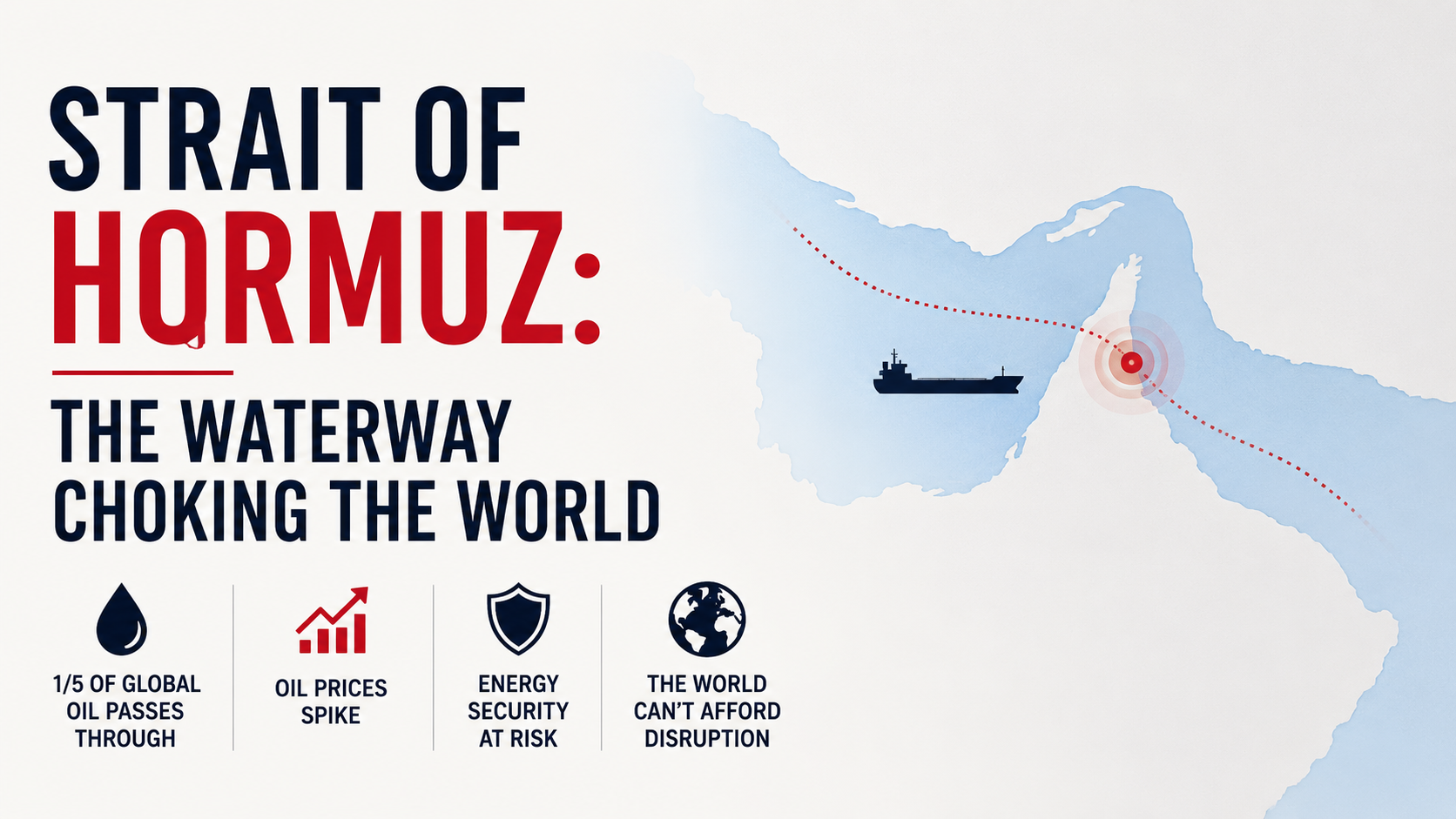
The Strait of Hormuz is one of the most strategically important waterways on Earth — a narrow maritime corridor through which a massive portion of the global economy flows every single day.
For decades, globalization operated on an assumption so deeply embedded in modern economics that most governments rarely questioned it:
that critical maritime trade routes would remain open, stable, and protected from major geopolitical disruption.
The Strait of Hormuz exposed how fragile that assumption really is.
Roughly one-fifth of global oil supplies and significant volumes of liquefied natural gas (LNG) pass through this narrow passage connecting the Persian Gulf to the Arabian Sea. The economies of:
- India
- China
- Japan
- South Korea
- Much of Europe
…remain heavily dependent on energy flows that move through Hormuz.
The moment instability rises near the Strait:
- Oil prices surge
- Shipping insurance costs spike
- Currency markets react
- Inflation fears intensify
- Supply chain anxieties spread globally
The danger is not simply military confrontation in the Gulf.
The danger is systemic economic vulnerability concentrated in one geographically narrow chokepoint.
The world economy has become structurally dependent on uninterrupted maritime trade.
Hormuz is one of the clearest demonstrations of how vulnerable that system remains.
Where Does the Strait of Hormuz Stand in 2026?
The Strait of Hormuz today sits at the center of overlapping geopolitical tensions involving:
- Iran
- The United States
- Gulf Arab states
- Global energy markets
- Maritime security alliances
- Great-power competition
The waterway remains under constant strategic monitoring because even temporary disruption can create immediate global consequences.
Several trends have intensified the Strait’s importance in recent years:
- Rising Asian energy demand
- LNG market expansion
- Maritime drone warfare
- Naval militarization
- Energy market volatility
- Supply chain fragility
At the same time, regional instability involving:
- Iran–U.S. tensions
- Proxy conflicts
- Maritime seizures
- Sanctions enforcement
- Drone and missile threats
…has repeatedly reminded global markets how exposed the world economy remains to Gulf instability.
The result is a paradox:
the global economy is becoming technologically advanced and digitally interconnected while remaining physically dependent on vulnerable maritime infrastructure built around narrow geographic chokepoints.
Section I: The Geography of Global Dependence
The Strait of Hormuz is geographically small but economically enormous.
At its narrowest navigational point, the shipping lanes are only a few kilometers wide in each direction.
Yet through this corridor passes:
- Gulf crude oil exports
- LNG shipments from Qatar
- Petrochemical cargo
- Strategic energy supplies for Asia and Europe
This creates extraordinary concentration risk.
Unlike diversified overland trade systems, maritime energy flows often depend on a limited number of critical routes.
Hormuz is particularly sensitive because:
- There are limited immediate alternatives
- Regional military tensions remain persistent
- Energy demand remains high
- Shipping traffic is dense and continuous
Even temporary disruption can create cascading global effects.
The Strait therefore functions not merely as a shipping route, but as a structural pressure point inside globalization itself.
“The global economy depends on a handful of maritime arteries. Hormuz is one of the most important — and one of the most vulnerable.”
— International Maritime Security Analyst
Section II: Why Instability in Hormuz Affects the Entire World
The impact of instability near Hormuz extends far beyond the Middle East.
Oil Market Shock
Global oil markets react instantly to perceived risks around the Strait because:
- Supply disruption fears reduce market confidence
- Traders price in future uncertainty
- Energy-importing economies become vulnerable
Even without actual closure of the Strait, perceived instability alone can push prices upward sharply.
Shipping Insurance Costs
Maritime insurers rapidly increase war-risk premiums during periods of Gulf tension.
This raises costs for:
- Oil transport
- LNG shipping
- Commercial trade
- Industrial supply chains
Those costs eventually spread through the wider economy.
Inflationary Pressure
Higher energy costs affect:
- Transportation
- Manufacturing
- Food logistics
- Electricity generation
- Airline operations
As a result, Hormuz instability can contribute directly to global inflation.
Currency and Financial Market Volatility
Energy-importing countries often experience:
- Currency pressure
- Trade imbalance concerns
- Stock market volatility
This is particularly significant for heavily energy-dependent Asian economies.
Section III: The Most Vulnerable Economies
Several major economies remain especially exposed to Hormuz-related instability.
India
India imports a substantial share of its energy needs from the Gulf region.
Disruption risks threaten:
- Fuel prices
- Industrial production
- Inflation management
- Fiscal stability
India therefore increasingly views maritime security as a core national economic priority.
China
China remains one of the world’s largest energy importers.
Its dependence on Gulf energy flows creates strategic vulnerability despite efforts to diversify:
- Pipeline routes
- Renewable energy
- Strategic reserves
The Strait remains central to Chinese energy security calculations.
Japan and South Korea
Both economies rely heavily on imported energy and possess limited domestic hydrocarbon resources.
Hormuz disruptions could rapidly affect:
- Manufacturing
- Industrial exports
- Electricity costs
- Supply chain reliability
Europe
Although Europe has accelerated diversification following multiple geopolitical crises, Gulf energy flows still influence:
- LNG pricing
- Energy markets
- Industrial competitiveness
The result is a globally interconnected vulnerability network centered on one maritime corridor.
Section IV: The Militarization of Maritime Trade
One of the most important shifts in recent years is the increasing militarization of commercial shipping routes.
Modern maritime trade now intersects directly with:
- Naval deterrence
- Drone warfare
- Missile systems
- Cybersecurity
- Strategic surveillance
Commercial shipping is no longer viewed as politically neutral infrastructure.
Instead, critical trade routes increasingly function as strategic assets requiring military protection.
This has accelerated:
- Naval deployments
- Maritime coalitions
- Gulf patrol operations
- Military base expansion
- Strategic port investments
The world is rediscovering a historical reality:
economic power depends heavily on secure maritime control.
Section V: The Long-Term Global Shift
The Hormuz crisis is accelerating structural changes across the global economy.
Renewable Energy Expansion
Countries increasingly see renewable energy not only as a climate issue, but as:
- Strategic diversification
- Energy independence
- National resilience
Reducing dependence on imported hydrocarbons lowers exposure to geopolitical chokepoints.
Alternative Shipping Corridors
Governments are investing in:
- Pipeline networks
- Alternative port infrastructure
- Rail connectivity
- Regional logistics systems
However, these systems cannot fully replace Gulf energy flows in the short term.
Strategic Petroleum Reserves
Many countries are expanding emergency reserves to cushion temporary supply disruptions.
This reflects growing awareness that energy insecurity is now a permanent geopolitical risk rather than a temporary anomaly.
Regional Diversification
The crisis is also accelerating efforts to diversify:
- LNG suppliers
- Energy import sources
- Trade routes
- Manufacturing hubs
But such transitions require years — sometimes decades.
Frequently Asked Questions
Why is the Strait of Hormuz so important?
The Strait of Hormuz carries a major share of global oil and LNG exports. It connects Gulf energy producers to international markets and is essential for global energy stability.
Could the Strait of Hormuz actually close?
A complete long-term closure would be extremely difficult due to international naval presence and the economic consequences for regional states themselves. However, even temporary disruption or perceived risk can severely impact global markets.
Which countries are most vulnerable?
Major energy-importing economies such as:
- India
- China
- Japan
- South Korea
- European states
…are particularly vulnerable to supply disruptions and price spikes.
Why do oil prices rise so quickly during Gulf tensions?
Energy markets react to anticipated risk, not only actual disruption. Traders price in future uncertainty immediately when geopolitical tensions escalate near critical supply routes.
Is the world reducing dependence on Hormuz?
Yes, gradually through:
- Renewable energy investment
- Alternative pipelines
- LNG diversification
- Strategic reserves
However, the transition remains incomplete and will take years.
Conclusion: The Fragility Beneath Globalization
The Strait of Hormuz represents one of the clearest contradictions of the modern global economy.
The world built an advanced system of:
- digital finance
- AI infrastructure
- global manufacturing
- high-speed logistics
- interconnected trade
…while remaining deeply dependent on a handful of vulnerable physical chokepoints.
Hormuz demonstrates that geography still shapes global power.
A narrow waterway can still:
- destabilize currencies
- disrupt industries
- raise inflation
- threaten energy security
- reshape geopolitical strategy
The global economy increasingly understands that:
- energy security is national security
- maritime security is economic security
- supply chain resilience is strategic resilience
The long-term response is already underway through:
- renewable energy expansion
- alternative transport corridors
- strategic reserves
- regional diversification
But those transitions require time.
Until then, the world economy remains partially hostage to a narrow stretch of water between the Gulf and the Arabian Sea.
The Strait of Hormuz is not merely a shipping route.
It is one of the pressure valves of the global system itself.


