


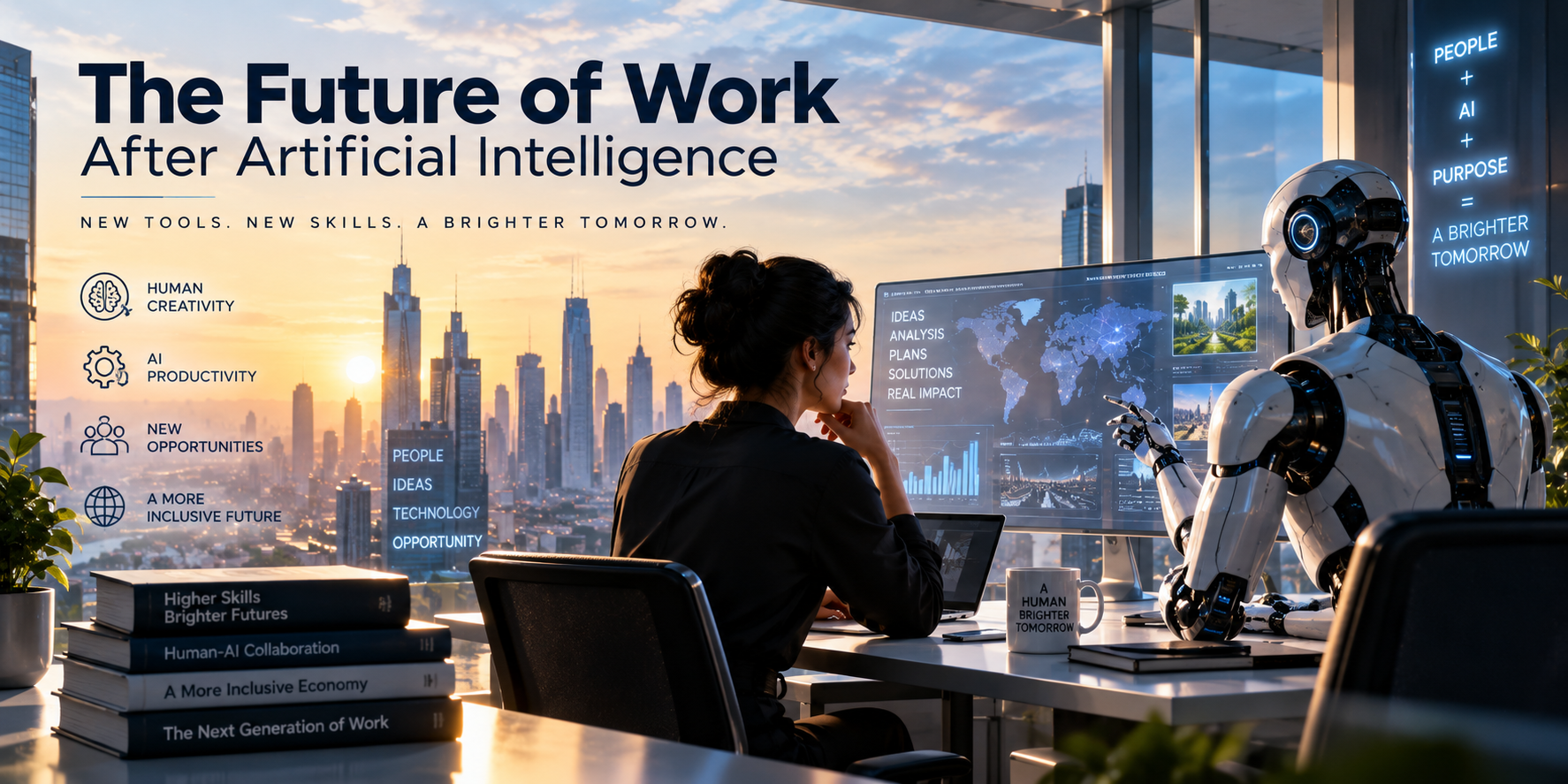
AI is not simply changing the jobs people do. It is changing what a job is.
For more than two centuries, technology has repeatedly altered the relationship between humans and work.
The industrial machine replaced physical effort.
The computer replaced enormous amounts of manual calculation.
The internet transformed communication, commerce and information.
Smartphones made work mobile.
Artificial intelligence is different because it is moving into a territory that was once considered distinctly human: reasoning, writing, analysis, coding, research, design, decision support and knowledge creation.
The question is therefore no longer simply whether AI will eliminate jobs.
The bigger question is:
What happens to work when intelligence becomes abundant, cheap and available on demand?
The answer is beginning to emerge.
The workplace of the future may contain fewer people performing repetitive cognitive tasks, more people directing AI systems, smaller teams producing larger amounts of output, and entirely new occupations built around managing the relationship between humans and machines.
But the transition will not be painless.
The International Labour Organization estimates that one in four workers globally is in an occupation with some degree of exposure to generative AI. Yet its research suggests that transformation of jobs is more likely than wholesale replacement because most occupations still contain tasks requiring human input.
At the same time, the World Economic Forum estimates that structural changes could create 170 million jobs and displace 92 million by 2030, producing a net increase of 78 million jobs.
The numbers point toward a future that is neither mass unemployment nor business as usual.
It is something more complicated:
The reinvention of work itself.
From Jobs to Tasks
One of the biggest mistakes in the AI debate is treating a job as a single activity.
A salesperson does not merely sell.
A lawyer does not merely write documents.
A doctor does not merely interpret information.
A marketer does not merely create content.
A software engineer does not merely write code.
Every occupation is actually a collection of hundreds or thousands of tasks.
AI can automate some of those tasks while leaving others largely untouched.
This distinction is critical.
The ILO’s 2025 analysis examined nearly 30,000 occupational tasks to assess exposure to generative AI. Its conclusion was not that entire professions would suddenly disappear, but that different components of those professions would be affected at different levels.
This means the future may not look like:
AI replaces accountant.
It may look more like:
AI prepares the analysis → accountant verifies it → accountant explains the implications → human makes the consequential decision.
The job survives.
But the job changes.
The End of the Traditional Knowledge Worker?
For decades, companies organized knowledge workers around a relatively simple model.
Hire a person.
Give that person software.
Give them information.
Give them a manager.
Give them a set of responsibilities.
Measure their output.
AI introduces another participant into this structure.
The intelligent machine.
And increasingly, it is not just a chatbot answering questions.
AI agents can search information, analyze data, create documents, write software, interact with applications and execute defined workflows.
Microsoft’s 2026 Work Trend Index describes this emerging environment as one in which AI and agents take on more execution while humans increasingly direct work, make decisions and own outcomes. Its research surveyed 20,000 AI-using workers across 10 countries and analyzed large volumes of anonymized Microsoft 365 productivity signals.
This creates a fundamental organizational shift.
The traditional question was:
How many employees do we need?
The emerging question is:
What combination of people, software and AI agents do we need to achieve the outcome?
That is a much bigger transformation.
The Rise of the AI-Enabled Employee
The first generation of workplace AI largely acted as an assistant.
Write this email.
Summarize this document.
Create this presentation.
Analyze this spreadsheet.
Generate this code.
The next generation is becoming more collaborative and increasingly agentic.
An employee may have several specialized AI systems working alongside them:
- One researches markets.
- One analyzes competitors.
- One prepares reports.
- One monitors customers.
- One generates content.
- One analyzes contracts.
- One writes software.
- One monitors operational performance.
The employee becomes less of an individual producer and more of an orchestrator of intelligence.
This changes the economics of productivity.
A highly capable employee may be able to accomplish what previously required a small team.
A small company may therefore be capable of competing with much larger organizations.
And a new entrepreneur may be able to build a company with a remarkably small human workforce.
The Rise of the “Agent Boss”
One of the most interesting developments is the emergence of a new managerial responsibility:
managing machines.
Microsoft’s 2025 Work Trend Index found that organizations were already considering roles focused on managing and developing AI agents, while leaders increasingly expected workers to train, manage and redesign processes around agents.
This could eventually create a new hierarchy.
Not:
CEO → VP → Manager → Employee
But increasingly:
Leader → Human teams + AI agents → Automated workflows
The manager’s role changes from monitoring whether people completed tasks to determining:
- What should be automated?
- What should remain human?
- Which AI should perform the task?
- What level of autonomy should it have?
- Who checks its output?
- Who is accountable when it fails?
The future manager may therefore resemble a systems architect of work.
What Happens to Middle Management?
AI could have an especially profound impact on middle management.
Many managerial responsibilities involve information aggregation.
Collect the reports.
Prepare the dashboard.
Summarize performance.
Track deadlines.
Prepare meeting notes.
Identify anomalies.
Generate forecasts.
Follow up with employees.
Much of this can increasingly be assisted or automated.
But management is not simply information processing.
Leadership requires persuasion, trust, conflict resolution, judgment and accountability.
That creates an interesting paradox.
AI may reduce some administrative management work while making genuine leadership more valuable.
The manager of the future may spend less time asking:
“Where is the report?”
and more time asking:
“Why are we doing this?”
The Most Valuable Human Skill May Be Judgment
AI can generate ten strategies.
It cannot automatically determine which strategy is appropriate for a particular organization, customer, culture or moment.
AI can analyze a market.
It does not automatically understand every political, social or emotional consequence of entering that market.
AI can produce a sales proposal.
It does not necessarily understand the relationship dynamics between a CEO and a prospective customer.
AI can identify patterns.
Humans still have to decide what those patterns mean.
That makes judgment increasingly important.
The World Economic Forum expects analytical thinking to remain the most sought-after core skill among employers, while resilience, flexibility, leadership, creative thinking and lifelong learning are also expected to rise in importance. At the same time, AI and big data, cybersecurity and technological literacy are among the fastest-growing skill areas.
The future worker therefore needs two types of intelligence:
Machine fluency + human judgment.
The New Premium on Human Skills
There is an irony at the heart of the AI revolution.
As machines become better at producing information, some human qualities may become more valuable precisely because they are harder to automate.
Empathy.
Trust.
Leadership.
Negotiation.
Persuasion.
Curiosity.
Courage.
Context.
Relationship building.
Ethical reasoning.
Creativity.
The ability to understand what another human actually wants.
Imagine two salespeople.
One sends 500 AI-generated emails.
The other understands a customer’s business deeply, identifies a strategic problem, brings the right stakeholders together and builds trust over a two-year relationship.
AI can help both.
But the second salesperson is performing a fundamentally different kind of work.
The future may reward people who can use AI to amplify human relationships rather than simply automate communication.
The Disappearance of Entry-Level Work?
This may be one of the most important unresolved questions.
Historically, junior employees learned by doing relatively simple tasks.
A young lawyer reviewed documents.
A junior analyst prepared spreadsheets.
A new marketer wrote basic content.
A junior programmer fixed small bugs.
A young consultant prepared presentations and research.
Those tasks were not merely productive.
They were training grounds.
AI can increasingly perform many of them.
That creates a potential problem.
If AI performs the beginner tasks, how does the next generation acquire expertise?
This could force companies to rethink career development.
Instead of learning by performing repetitive work for several years, young professionals may need to learn through:
- simulations,
- AI-assisted apprenticeships,
- real-world projects,
- mentorship,
- customer exposure,
- cross-functional assignments,
- increasingly complex decision-making.
The career ladder could become shorter but steeper.
The New Career Ladder
The traditional career path often looked like:
Junior → Senior → Manager → Director → Executive
The AI-enabled path may increasingly become:
Learner → AI-augmented contributor → Problem owner → Strategic decision-maker
Experience will still matter.
But experience measured simply in years may become less meaningful.
Someone with five years of experience who knows how to use AI effectively could potentially outperform someone with ten years of experience using outdated workflows.
This will create a new form of inequality:
AI fluency inequality.
The Workers Who Benefit Most
The biggest beneficiaries may not necessarily be programmers.
AI is spreading into virtually every knowledge-intensive function.
Sales professionals can use AI for prospect research, account intelligence, personalization and proposal development.
Lawyers can use it for document review and research.
Doctors can use it for information synthesis and administrative work.
Financial professionals can use it for analysis and modelling.
Teachers can use it for lesson creation and personalized learning.
Engineers can use it for design and simulation.
Managers can use it for planning and decision support.
Entrepreneurs can use it to compress the time required to launch a business.
The common factor is not occupation.
It is ability to combine domain expertise with AI capability.
The Small-Team Company
One of the biggest consequences of AI may be organizational rather than technological.
Imagine a company with:
- 20 human employees
- dozens of specialized AI agents
- automated finance
- AI-assisted sales
- automated customer support
- AI-powered marketing
- software development agents
- automated analytics
Such a company could potentially operate with capabilities that previously required hundreds of employees.
This could produce a new generation of extremely lean companies.
The advantage would not necessarily come from having the most employees.
It could come from having the best combination of people, data, software and AI agents.
This could lower barriers to entrepreneurship.
But it could also increase competitive pressure.
If every company has access to similar AI capabilities, the differentiator moves elsewhere.
Data Becomes Part of the Workforce
AI is only as useful as the information surrounding it.
Companies will increasingly compete over:
Data + models + workflows + talent + proprietary knowledge.
A generic AI model may know how to write a sales email.
A company’s internal AI system could know:
- which customers are profitable,
- why deals were lost,
- which products generate the highest margins,
- which objections repeatedly appear,
- which contracts contain risks,
- which employees possess specific expertise.
This creates a new strategic asset:
organizational intelligence.
The companies that successfully capture their employees’ knowledge and convert it into AI-accessible systems may build significant advantages.
The Death of the 9-to-5?
AI could theoretically reduce working hours.
If a task that previously required eight hours can be completed in two, society could choose to work less.
But productivity gains do not automatically become leisure.
Companies could instead raise expectations.
If AI allows a worker to produce twice as much, the organization may simply expect twice as much output.
This creates the possibility of what might be called the AI productivity paradox:
AI makes work faster.
But workers become busier because organizations increase the volume of work.
Microsoft’s research has already highlighted the problem of the “infinite workday,” in which digital communication and constant interruptions can expand rather than reduce the perceived working day.
The technology therefore does not determine the future of work by itself.
Management choices do.
The Gig Economy Faces Another Transformation
AI may also reshape freelance and gig work.
Routine digital services are increasingly exposed to automation.
Basic copywriting.
Simple graphic design.
Data entry.
Transcription.
Basic research.
Routine coding.
Translation.
Simple customer support.
These services once created flexible income opportunities for millions of workers.
As automation increases, some of that demand may decline.
Recent reporting has highlighted pressure on platforms such as Fiverr and Upwork as AI increasingly handles simpler remote tasks, while automation is also expanding into physical gig work such as transportation and delivery.
The gig economy may therefore divide into two directions:
high-value human expertise and highly automated services.
The middle could become increasingly competitive.
AI Will Create Jobs That Do Not Exist Today
Every major technological revolution creates occupations that were previously difficult to imagine.
The internet created web developers, SEO specialists, app developers and social-media professionals.
The smartphone created mobile developers and entire platform economies.
AI is already generating roles such as:
- AI product managers
- AI trainers
- AI workflow designers
- AI governance specialists
- AI safety professionals
- AI auditors
- AI implementation consultants
- AI security specialists
- AI agent managers
- AI operations specialists
Many more will emerge.
The World Economic Forum’s projections similarly identify AI, machine learning, big data and technology-related roles among the fastest-growing occupations, alongside jobs in healthcare, education, agriculture, logistics and the green economy.
The important lesson is that technology does not simply destroy categories of work. It also creates new categories.
The New Corporate Operating Model
The corporation of the future could be dramatically different.
Today’s organization is largely built around departments:
Sales → Marketing → Finance → HR → Operations → Technology
AI makes it possible to organize more work around outcomes.
For example:
Acquire customer → AI researches prospect → human builds relationship → AI prepares proposal → human negotiates → AI manages documentation → AI monitors account → human handles strategic relationship.
The organization becomes a network of human and machine capabilities.
This could make companies:
- flatter,
- faster,
- smaller,
- more specialized,
- more data-driven,
- more automated.
But it could also make them harder to manage.
The New Risk: Who Is Accountable?
An AI system can make a recommendation.
An AI agent can execute a workflow.
But when something goes wrong, who is responsible?
The employee?
The manager?
The company?
The software provider?
The person who approved the system?
This question becomes increasingly important as AI moves from generating information to taking actions.
Human oversight will therefore remain critical, especially in high-stakes areas such as healthcare, finance, law, security and public services.
The future workplace cannot simply be:
“Let AI decide.”
It will increasingly need to be:
“Let AI execute within clearly defined boundaries, while humans remain accountable for consequential decisions.”
AI Will Change the Meaning of Expertise
For much of modern history, expertise meant knowing information that other people did not know.
A lawyer knew the law.
An accountant knew accounting rules.
A programmer knew programming languages.
A financial analyst knew how to build models.
AI challenges this model because information becomes increasingly accessible.
Expertise therefore shifts from:
Knowing everything
to:
Knowing what matters.
The expert of the future may not be the person who remembers the most facts.
It may be the person who can:
- Frame the right problem.
- Ask the right questions.
- Evaluate AI output.
- Recognize errors.
- Understand context.
- Make decisions.
- Take responsibility.
That is a profound change.
Education Has to Change
If AI can write an essay, solve a mathematical problem, summarize a book and generate code, education cannot continue measuring only the ability to produce those outputs.
Schools and universities will need to place greater emphasis on:
Problem solving.
Critical thinking.
Communication.
Research.
Collaboration.
Ethics.
Creativity.
Real-world projects.
Students will need to learn how to work with AI rather than simply compete against it.
The same principle applies to corporate training.
One-off training courses will become less useful.
Continuous learning will become part of the job itself.
The Global Workforce Will Not Experience AI Equally
AI will not affect every country in the same way.
Advanced economies may experience rapid adoption because companies have greater access to capital, infrastructure and digital systems.
Emerging economies may experience both opportunity and disruption.
For countries whose economies depend heavily on information-intensive services, AI could create enormous productivity gains while simultaneously challenging existing employment models.
India is particularly significant in this discussion because of the scale of its technology and business-services workforce.
Microsoft’s India findings from its 2025 Work Trend Index reported that 93% of Indian business leaders surveyed intended to use AI agents to extend workforce capabilities within 12–18 months, while 59% said they were already using agents to automate workstreams or business processes across teams.
For India, the question is therefore not simply whether AI will eliminate jobs.
It is whether the country can move from being a major provider of human digital labour to becoming a major provider of AI-enabled human and organizational intelligence.
The New Global Divide
The industrial era divided economies partly according to who controlled factories.
The information era divided them according to who controlled technology and data.
The AI era could create another divide:
Who controls intelligent infrastructure?
That includes:
- computing power,
- semiconductor supply chains,
- AI models,
- data,
- energy,
- cloud infrastructure,
- talent,
- intellectual property,
- AI-enabled companies.
Countries that successfully combine these resources could gain significant economic advantages.
The future of work is therefore also a question of national competitiveness.
The Skills That Will Matter Most
The worker of 2035 may need a different combination of abilities from the worker of 2025.
Technical skills
- AI literacy
- Data analysis
- Cybersecurity
- Automation
- Digital systems
- AI workflow design
Cognitive skills
- Analytical thinking
- Problem solving
- Critical thinking
- Strategic reasoning
- Decision-making
Human skills
- Communication
- Leadership
- Negotiation
- Empathy
- Collaboration
- Relationship building
Adaptive skills
- Curiosity
- Resilience
- Flexibility
- Continuous learning
- Ability to work through uncertainty
The World Economic Forum estimates that 39% of workers’ existing skill sets could be transformed or become outdated by 2030, while 59 out of every 100 workers could require training or reskilling.
The most valuable career strategy may therefore be simple:
Never stop becoming useful.
What Happens to the CEO?
AI will change leadership as profoundly as it changes individual jobs.
The CEO of the future will increasingly need to answer five questions:
1. What should humans do?
Identify work where judgment, relationships and accountability matter.
2. What should machines do?
Automate repetitive, predictable and information-heavy tasks.
3. Where should humans and machines collaborate?
Identify areas where AI expands human capability rather than replacing it.
4. How do we redesign the organization?
AI cannot simply be added to an old operating model.
Processes, roles, incentives and structures may all need to change.
5. How do we preserve trust?
Customers and employees need to know where AI is being used, how decisions are made and who remains accountable.
The companies that merely buy AI software may see incremental productivity.
The companies that redesign work around AI could see much larger structural changes.
The Company of 2035
Imagine a company in 2035.
A new employee joins.
Instead of receiving a laptop filled with software, they receive an AI-enabled work environment.
Their AI understands the company’s products.
It knows the internal knowledge base.
It understands customer history.
It can access authorized business systems.
It helps research problems.
It prepares drafts.
It monitors workflows.
It suggests decisions.
It learns the employee’s preferences.
The employee does not work alone.
They work with a digital workforce.
But the human remains responsible for the outcomes that matter.
That could become the defining architecture of work after AI.
The Great Productivity Opportunity
The optimistic scenario is enormous.
If AI increases productivity, economies could produce more with fewer resources.
Companies could lower costs.
Small businesses could gain capabilities once available only to large corporations.
Scientists could accelerate research.
Doctors could spend more time with patients.
Teachers could personalize education.
Employees could eliminate repetitive administrative work.
Entrepreneurs could build companies faster.
Workers could spend more time on meaningful activities.
In that scenario, AI becomes not a replacement for human potential but an amplifier of it.
Microsoft’s 2026 research argues that AI and agents can expand human agency when organizations redesign work around them rather than simply adding AI to existing processes.
But There Is a Less Comfortable Scenario
The alternative is also possible.
AI could increase productivity without increasing worker bargaining power.
Companies could automate large numbers of tasks while concentrating gains among owners and highly skilled workers.
Entry-level opportunities could shrink.
Work could become more closely monitored.
Algorithmic management could expand.
Workers could be expected to produce continuously because AI makes production cheaper.
The result could be an economy that is technologically more productive but socially more unequal.
This is why the future of work is not merely a technology question.
It is an economic and institutional question.
The Real Competition May Be Between Organizations
The most important competition may not be:
Humans vs AI.
It may be:
AI-enabled organizations vs organizations that remain AI-assisted.
The distinction matters.
An AI-assisted company adds tools to existing workflows.
An AI-enabled company redesigns the workflow itself.
That means the real transformation happens when organizations stop asking:
“Where can we use AI?”
and start asking:
“If we were building this company from scratch today, what would work look like if AI were available from day one?”
That is a much more disruptive question.
The Future of Work Will Be More Human in Some Ways
There is a paradox here.
As machines become better at information processing, humans may become more valuable for the things that make organizations human.
Trust.
Purpose.
Leadership.
Relationships.
Creativity.
Meaning.
Ethics.
Courage.
AI may actually force society to confront an old question:
What is work for?
Is work simply about producing economic output?
Or is it also about identity, dignity, community, learning and purpose?
The answer will shape how AI is integrated into society.
The 2035 Workplace
The workplace of 2035 will probably not be entirely automated.
Nor will it look like today’s office with AI assistants added to every desk.
It will likely be a hybrid environment.
Humans will define objectives.
AI will accelerate execution.
Agents will manage workflows.
Humans will handle ambiguity.
AI will analyze enormous amounts of information.
Humans will exercise judgment.
Machines will provide scale.
People will provide accountability.
And the most valuable employees may be those who can move comfortably between both worlds.
The End of Work — or the Beginning of a New Kind of Work?
Every major technological revolution produces the same fear:
What happens when machines can do what humans do?
History provides no guarantee that the transition will be painless.
But it does show that technology changes the composition of employment rather than simply following a permanent path toward fewer jobs.
The AI transition may be faster and more disruptive because it reaches into cognitive work.
The ILO’s evidence suggests that job transformation is currently a more plausible global outcome than widespread job elimination, while the WEF expects substantial simultaneous job creation and displacement through 2030.
The real challenge is therefore not stopping AI.
It is preparing people and institutions for the speed of change.
The workers who thrive may not be those who know the most.
They may be those who learn fastest, think clearly, work effectively with machines and remain distinctly human where humanity matters most.
The future of work after artificial intelligence will not belong entirely to humans.
And it will not belong entirely to machines.
It will belong to those who learn how to make the two work together.


