


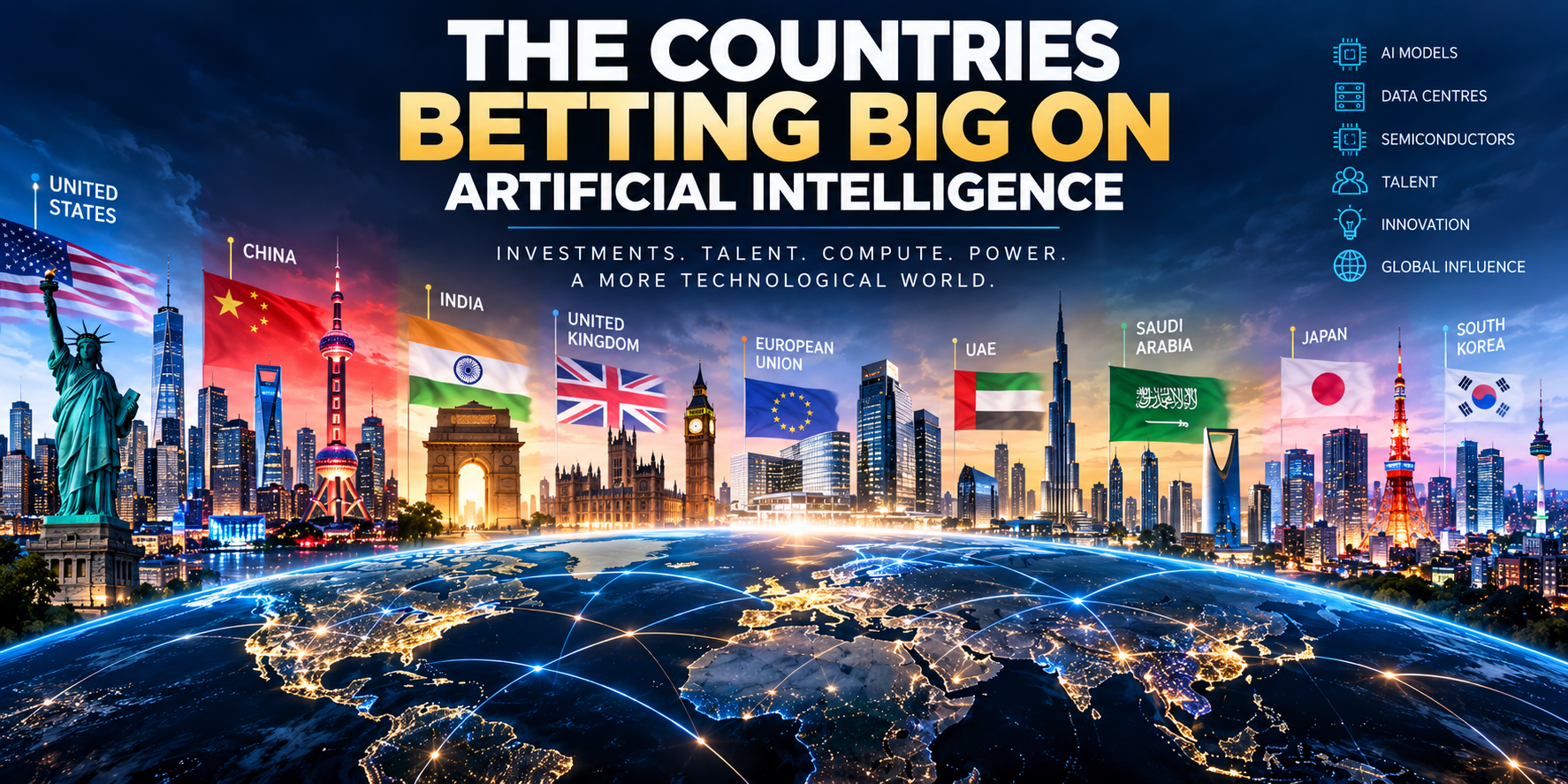
From Washington and Beijing to New Delhi, Riyadh and Abu Dhabi, governments are pouring resources into AI. The competition is about far more than technology—it is about economic growth, national security and who will shape the next global order.
Artificial intelligence is becoming one of the defining strategic investments of the 21st century.
Governments that once competed over oil, manufacturing, trade routes and semiconductor production are now competing over computing power, advanced AI models, data infrastructure and the talent required to develop them.
The stakes are enormous.
AI could transform manufacturing, healthcare, finance, education, scientific research, logistics and defence. It could increase productivity across entire economies, create new industries and alter the balance of technological power between nations.
But the economic benefits may not be distributed equally.
Countries that control advanced chips, frontier AI models, cloud infrastructure and essential intellectual property could capture a disproportionate share of the value. Others may become dependent on foreign technology even as they adopt AI across their economies.
This explains why governments are increasingly pursuing what is known as AI sovereignty: the ability to develop, access, deploy and govern AI capabilities according to domestic economic and strategic priorities.
The scale of the movement is striking. The Center for a New American Security’s Sovereign AI Index tracked 184 government-backed projects across 67 countries by the first half of 2026, reflecting a widening effort to develop domestic AI infrastructure, models and data capabilities.
Yet not every country is following the same strategy.
The United States is building on its technology companies and investment ecosystem. China is combining industrial policy with domestic technology development. India is leveraging its digital infrastructure and talent. Gulf states are deploying capital to build AI infrastructure and diversify their economies. European and Asian economies are pursuing their own combinations of research, manufacturing and strategic autonomy.
The global AI race is no longer a single contest. It is a collection of interconnected battles over infrastructure, intelligence, industry and influence.
The United States: Betting on Scale, Chips and Frontier Models
<AsyncImage query=”United States hyperscale AI data center server racks advanced computing facility cinematic blue lighting” aspectRatio=”16:9″ width=”100%”/>
The United States occupies a central position in the global AI ecosystem because it combines several advantages: leading technology companies, venture capital, advanced semiconductor design, cloud computing infrastructure, research universities and access to international talent.
Its strategy is not confined to government-funded research. Much of its AI expansion is driven by private companies investing in models, data centres, specialised processors and AI-enabled products.
According to Stanford HAI, U.S. private AI investment reached approximately $285.9 billion in 2025, with 1,953 newly funded AI companies recorded that year. The corresponding figures for China were $12.4 billion and 161 companies. These statistics illustrate the scale of America’s private investment ecosystem, although they do not measure the full value of public spending or state-directed investment elsewhere.
The United States is also investing in the physical foundations of AI.
Large data centres require advanced accelerators, enormous quantities of electricity, cooling systems and high-speed networks. These requirements have made AI infrastructure a strategic concern involving technology companies, utilities, policymakers and national-security agencies.
Washington’s challenge is to maintain technological leadership while addressing electricity constraints, infrastructure costs, talent competition and the security implications of advanced computing.
Its position is also shaped by a critical dependency: much of the world’s most advanced semiconductor manufacturing takes place outside the United States, particularly in Taiwan. American leadership in chip design therefore does not eliminate vulnerabilities in the broader supply chain.
The American approach combines private-sector innovation with government support, research funding, infrastructure development and export controls.
Its central objective is to maintain a competitive advantage across the AI value chain—from advanced chips and cloud computing to frontier models and commercial applications.
China: Building an AI Ecosystem Around Domestic Capability
<AsyncImage query=”China futuristic AI research campus advanced semiconductor technology industrial robotics computing laboratory” aspectRatio=”16:9″ width=”100%”/>
China’s AI strategy is closely connected to its broader ambition to strengthen domestic technological capabilities and reduce dependence on foreign suppliers.
Its approach combines government planning, research institutions, major technology companies, industrial deployment and investment in computing infrastructure.
Unlike the United States, where private venture capital accounts for a particularly large share of reported AI investment, China’s system also relies heavily on state guidance, industrial policy and government-backed funding. Direct comparisons based only on private investment therefore understate important differences between the two ecosystems.
China has substantial capabilities in AI research, industrial automation, robotics and the deployment of technology across manufacturing and consumer markets.
Its AI ecosystem also benefits from a large domestic market and extensive industrial data.
A particularly important development is the growing competitiveness of Chinese AI models. Stanford HAI reported that the performance gap between leading American and Chinese models had narrowed sharply, with top models trading the lead at different points since early 2025. As of March 2026, the leading model in its comparison held an advantage of just 2.7%.
That does not mean the two countries have identical capabilities. They face different constraints in access to advanced chips, computing infrastructure, capital and international markets.
For Beijing, the strategic challenge is to develop competitive AI systems while strengthening the domestic semiconductor and hardware ecosystem on which those systems depend.
The competition is therefore about more than which country produces the most capable chatbot.
It concerns the relationship between AI, manufacturing, scientific research, industrial productivity and national security.
India: Turning Digital Scale into AI Power
<AsyncImage query=”India modern technology district AI data center campus digital infrastructure skyline at dusk” aspectRatio=”16:9″ width=”100%”/>
India is pursuing a different path.
Its traditional strengths include software services, engineering talent, a large domestic market and extensive digital public infrastructure. The country’s AI strategy seeks to build on those advantages by expanding access to computing, supporting domestic models and encouraging AI applications across the economy.
The government’s IndiaAI Mission was approved in March 2024 with an outlay of ₹10,371.92 crore over five years. Its seven pillars include computing infrastructure, foundation models, datasets, application development, skills, startup financing and safe and trusted AI.
The strategy addresses a central problem: AI development can be prohibitively expensive for smaller companies and researchers when access to advanced computing is limited.
India is therefore trying to broaden access to compute while supporting models and applications tailored to local needs.
Multilingual AI is one potential area of differentiation. Systems that work effectively across Indian languages could expand access to digital services in healthcare, education, agriculture, finance and public administration.
India also has a significant opportunity to move beyond supplying software services to developing AI products and intellectual property for international markets.
However, major challenges remain. Advanced chips, frontier research, electricity, data-centre capacity and the retention of highly specialised talent will influence how far India can progress.
The strategic question is whether India can convert its large technology workforce and domestic market into deeper control over the AI value chain.
Its ambition is not necessarily to dominate every part of AI. It is to develop enough domestic capability to participate in the global industry as a technology builder rather than primarily as a consumer or implementation partner.
The United Arab Emirates: Using Capital to Build an AI Hub
<AsyncImage query=”Abu Dhabi futuristic data center campus glass architecture desert city skyline AI computing infrastructure” aspectRatio=”16:9″ width=”100%”/>
The United Arab Emirates is pursuing one of the most infrastructure-focused AI strategies in the world.
Its objective is to combine capital, international partnerships, digital infrastructure and technology investment to establish itself as a major AI hub.
The UAE has several advantages. It possesses substantial investment capacity, established global business connections, modern telecommunications infrastructure and experience attracting international companies.
Abu Dhabi has become particularly important through its AI and technology ecosystem, including G42 and its associated infrastructure and research activities.
A major U.S.–UAE partnership announced in 2025 included plans for a five-gigawatt AI campus, illustrating the scale of the country’s ambitions. Subsequent developments in 2026 around access to advanced American computing technology highlighted how AI infrastructure is increasingly linked to international security arrangements and technology-export rules.
This creates both an opportunity and a constraint.
The UAE can deploy capital rapidly to build data centres and attract global technology partners. But hosting advanced computing infrastructure does not automatically confer independence over the chips, models and software that power it.
The country must also develop research talent, domestic companies, energy capacity and applications that generate lasting economic value.
Its broader goal is to use AI to diversify an economy historically associated with hydrocarbons, trade, aviation, tourism and finance.
For the UAE, AI is both a technology investment and an economic transformation strategy.
Saudi Arabia: Turning Energy and Capital into AI Infrastructure
<AsyncImage query=”Saudi Arabia futuristic Riyadh skyline at dusk modern technology district large data center architecture” aspectRatio=”16:9″ width=”100%”/>
Saudi Arabia is treating AI as part of its wider economic diversification programme under Vision 2030.
The kingdom has financial resources, energy infrastructure, large development projects and state-backed investment institutions that can support capital-intensive technology initiatives.
Its National Strategy for Data and AI, launched in 2020 and led by the Saudi Data and Artificial Intelligence Authority, aims to attract investment, expand AI talent, improve regulation and scale applications across the economy.
A 2026 IMF assessment identified AI as an important component of Saudi Arabia’s economic transformation and noted that national targets for AI workforce development and investment had exceeded interim targets for 2025. The IMF also highlighted AI applications in healthcare, education, finance and energy.
Saudi Arabia’s approach combines infrastructure development with the use of AI in domestic industries.
The potential applications are extensive. AI can support energy operations, predictive maintenance, industrial automation, financial services, urban planning and government administration.
The kingdom is also interested in attracting international technology firms and developing a domestic technology ecosystem.
Yet large investments alone will not guarantee technological independence. Saudi Arabia will need skilled researchers, competitive companies, reliable infrastructure and sustained demand for AI products and services.
Its challenge is to turn financial resources and infrastructure into a productive AI economy that can continue growing beyond individual investment projects.
The European Union: Strategic Autonomy and Industrial AI
<AsyncImage query=”European advanced industrial research laboratory robotics engineers precision manufacturing AI technology modern facility” aspectRatio=”16:9″ width=”100%”/>
Europe’s AI strategy is shaped by a different set of priorities.
The European Union wants to remain technologically competitive while protecting data, managing risk and maintaining a regulatory framework that supports public trust.
Its approach includes research funding, AI infrastructure, industrial applications and efforts to expand access to advanced computing.
The European Commission has also pursued AI gigafactories intended to provide the infrastructure required to develop and train next-generation AI models. The broader ambition is to strengthen Europe’s technological autonomy and reduce dependence on external providers for strategically important capabilities.
Europe has important assets: world-class universities, industrial engineering, advanced manufacturing, scientific research and established markets for enterprise technology.
Germany has strengths in manufacturing and industrial automation. France has major research and engineering capabilities. Other European countries contribute expertise in robotics, cybersecurity, cloud infrastructure and specialised AI applications.
The challenge is coordination.
The European market is large, but investment, computing infrastructure and technology companies are spread across different national systems. Europe must convert its research and industrial strengths into companies and infrastructure capable of competing globally.
Regulation is also part of its strategy, although rules alone cannot create a competitive AI industry. Europe will need capital, computing resources, skilled workers and commercially successful products to complement its governance framework.
Its AI future may therefore depend on how effectively it connects research, industrial demand and technology investment across the continent.
The United Kingdom: Research, Safety and Commercialisation
The United Kingdom is attempting to translate its research base into economic and strategic advantages.
Its strengths include leading universities, AI research institutions, financial services, technology startups and an established ecosystem of international investors.
The UK has also invested in AI supercomputing and research infrastructure, while making AI adoption across public services and industry a national priority.
Stanford HAI’s 2026 AI Index recorded approximately $5.9 billion in private AI investment in the UK during 2025, placing it among the leading countries outside the United States and China by this measure. The country also recorded 172 newly funded AI companies that year.
The UK faces a familiar challenge for research-intensive economies: converting scientific breakthroughs into globally competitive commercial businesses.
It must compete for talent and capital while ensuring that companies can access sufficient computing power.
Its future position will depend on whether it can connect research excellence with investment, industrial adoption and the creation of scalable AI products.
Japan and South Korea: AI Meets the Hardware Economy
<AsyncImage query=”East Asian advanced semiconductor fabrication cleanroom robotics AI chip manufacturing technology” aspectRatio=”16:9″ width=”100%”/>
Japan and South Korea are approaching AI through capabilities that extend beyond software.
Both countries have significant strengths in electronics, advanced manufacturing and industrial technology. South Korea is particularly important in the semiconductor memory industry, while Japan has established capabilities in manufacturing equipment, materials, robotics and precision engineering.
These industries are central to the AI economy.
Advanced models require specialised processors and memory. Data centres require efficient power systems and components. Factories can use AI to improve production, inspection, logistics and maintenance.
South Korea’s semiconductor ecosystem gives it an important role in the infrastructure underpinning AI, while Japan’s industrial base creates opportunities for integrating AI into manufacturing and robotics.
Stanford HAI’s 2026 AI Index also identifies South Korea as a leader in AI patents per capita, illustrating the importance of its research and innovation base.
Neither country needs to reproduce the entire American AI ecosystem to remain strategically important.
Their ability to supply essential hardware, develop industrial applications and integrate AI into advanced manufacturing can give them significant influence over the wider technology value chain.
Canada: Research Talent and AI Innovation
Canada has long been an important centre for AI research, with established academic communities and expertise in machine learning.
Its strategy combines research institutions, startup development, computing infrastructure and efforts to encourage commercial adoption.
Canada also benefits from proximity to the United States, although that relationship creates a strategic tension: access to the American technology market can accelerate growth, but it can also make it difficult to retain companies and talent domestically.
The country’s long-term opportunity lies in connecting research strength with investment and commercialisation.
That means ensuring that Canadian-developed AI technologies can scale into global businesses rather than being absorbed entirely into larger foreign ecosystems.
Israel: AI, Cybersecurity and Defence Technology
Israel’s AI ecosystem is shaped partly by its technology startup sector and its established expertise in cybersecurity, software and defence-related technologies.
AI has potential applications across cyber defence, intelligence analysis, surveillance, autonomous systems and enterprise security.
The country also has an active venture-capital environment and a concentration of technology entrepreneurs.
These strengths create opportunities for specialised AI companies that focus on security and high-value applications rather than attempting to compete across every layer of the AI stack.
At the same time, the use of AI in military and surveillance systems raises questions about accountability, reliability, privacy and the consequences of automated decisions.
Israel illustrates how national security can become both a driver of AI investment and a source of difficult governance challenges.
Singapore: A Small Country with a Strategic AI Role
Singapore demonstrates that population size is not the only determinant of AI ambition.
Its strategy is based on a combination of international business, advanced digital infrastructure, research, skills development and close links with global technology companies.
The country is also an important financial and logistics centre, creating demand for AI in banking, trade, shipping, supply-chain management and public services.
The World Economic Forum identifies Singapore and the UAE as examples of countries pursuing broad AI ecosystems through government-led or government-incentivised investment and partnerships with major technology providers.
Singapore’s model is not to reproduce the scale of the United States or China. It is to become a strategically important location where companies can develop, test and deploy AI technologies across regional markets.
Its experience illustrates how a smaller economy can use infrastructure, talent, governance and international connectivity to establish a specialised position in the AI industry.
The Countries Are Not Competing for Exactly the Same Prize
The phrase AI race can be misleading because it suggests that all countries are pursuing one objective.
In reality, governments are making different bets across the AI value chain.
| Country or region | Main areas of strategic focus |
|---|---|
| United States | Frontier models, cloud infrastructure, advanced chips, private investment |
| China | Domestic AI ecosystem, industrial deployment, research and hardware development |
| India | Affordable compute, indigenous models, multilingual applications and digital infrastructure |
| UAE | AI infrastructure, international partnerships, capital and economic diversification |
| Saudi Arabia | Data and AI infrastructure, public-sector adoption and economic diversification |
| European Union | Industrial AI, research, infrastructure and technological autonomy |
| United Kingdom | Research, startups, computing infrastructure and commercialisation |
| Japan | Industrial AI, robotics, semiconductor materials and manufacturing technology |
| South Korea | Semiconductors, memory, robotics and industrial AI |
| Canada | Research, talent, startups and commercialisation |
| Israel | Cybersecurity, defence applications and specialised AI companies |
| Singapore | Enterprise AI, finance, logistics and regional technology services |
These are broad strategic emphases, not exclusive categories. Most countries invest in several parts of the AI ecosystem, and national priorities can change as technologies and markets evolve.
The Real Bottleneck: Chips, Electricity and Computing Power
One reason AI investment has become a geopolitical issue is that the technology depends on physical infrastructure.
A powerful model cannot operate at scale without computing resources. Those resources require advanced processors, semiconductor manufacturing, data centres, networks and dependable electricity.
The United States has a substantial infrastructure advantage. Stanford HAI’s 2026 AI Index counted 5,427 data centres in the country, more than ten times the number in any other country. The same report highlights the importance of advanced semiconductor manufacturing, including the concentration of leading-edge production in Taiwan.
This creates a strategic challenge for countries seeking greater independence.
Building a data centre does not automatically create a sovereign AI industry. A country may host servers while depending on foreign suppliers for the processors, models, cloud software and technical expertise that make those servers useful.
The same applies to energy. Governments can announce large computing projects, but delivering them requires electricity supply, grid connections, cooling infrastructure and access to water where water-based cooling is used.
The competition is consequently extending into industrial policy, energy planning, semiconductor supply chains and international technology partnerships.
AI Sovereignty Does Not Mean Complete Independence
As more countries pursue domestic AI capabilities, the idea of AI sovereignty has become central to national strategy.
But sovereignty is not an all-or-nothing condition.
A country may operate its own data centres while relying on foreign chips. It may develop domestic language models using externally developed software. It may build AI applications on international cloud platforms while retaining control over its data and deployment decisions.
These arrangements can still provide meaningful capabilities.
The strategic question is which dependencies matter most and whether they create unacceptable economic or security risks.
The World Economic Forum’s analysis of national AI investment strategies identifies different approaches, ranging from comprehensive efforts to build across the AI value chain to more selective strategies focused on particular capabilities.
For many countries, the realistic objective will be to secure access to critical technology, develop domestic expertise and maintain multiple international partnerships—not to manufacture every component at home.
The Investment Gap Is Only Part of the Story
Money matters, but investment totals alone do not explain which countries will create lasting value from AI.
The United States’ private investment lead is substantial. Yet China has demonstrated that strong research and industrial deployment can coexist with a different investment structure. Countries such as South Korea have strengths in specialised hardware, while India has a large potential market for multilingual and population-scale applications.
Stanford HAI’s 2026 report shows that the geography of AI capability varies by indicator. The United States leads in private investment and hosts the largest number of data centres; China has a strong position in research publications, citations, patent output and industrial robot installations; and South Korea stands out in AI patents per capita.
This matters because AI leadership is not measured by one number.
The number of GPUs does not reveal the quality of a country’s models. Investment does not guarantee commercial success. Research publications do not automatically produce profitable companies. And a large domestic market does not guarantee that local firms will capture its value.
The outcome will depend on how effectively countries connect infrastructure, research, talent, industry and demand.
The Economic Stakes: Productivity, Jobs and Industrial Power
AI investment is ultimately a bet on economic transformation.
Companies expect AI to reduce the cost of certain tasks, accelerate research, improve forecasting, automate workflows and create new products.
Governments expect it to strengthen competitiveness, improve public services and support national industries.
If those expectations are realised, AI could influence the productivity of entire sectors—from manufacturing and logistics to healthcare and financial services.
But the gains are unlikely to be distributed evenly.
Countries with access to advanced infrastructure and strong companies may capture more of the value. Others may adopt foreign platforms without developing much domestic intellectual property.
Within countries, AI could also reshape labour markets, with some tasks automated and new roles created around implementation, supervision, research and product development.
The policy challenge is therefore not merely to attract AI investment. It is to ensure that investment translates into productive capacity, new businesses, skilled employment and wider economic benefits.
What Could Separate the Long-Term Leaders?
The next phase of the AI race will depend on several connected capabilities.
1. Research and model development. Countries need the ability to produce, adapt and evaluate advanced AI systems.
2. Computing infrastructure. Access to chips, data centres and affordable compute will determine how widely AI can be developed and deployed.
3. Energy and industrial capacity. AI infrastructure depends on electricity, supply chains and the ability to build physical systems at scale.
4. Talent and education. Researchers, engineers, entrepreneurs and workers capable of using AI will influence adoption and innovation.
5. Commercialisation. Research must become products, services and companies that customers are willing to use.
6. Governance and trust. Safety, privacy, accountability and predictable rules will affect public adoption and international cooperation.
7. Global partnerships. No country is fully independent of international technology, research and supply chains. The ability to build partnerships while managing strategic dependencies will remain important.
These factors interact. A country with excellent researchers but insufficient computing infrastructure may struggle to scale. A country with vast data centres but limited talent may depend on foreign models. And a country with strong technology but weak commercialisation may fail to capture the economic returns.
The Next Phase of the Global AI Race
The global AI competition is entering a phase in which infrastructure and industrial capacity are becoming as important as software.
The United States is building on its private investment and technology ecosystem. China is strengthening domestic capabilities and industrial deployment. India is expanding its compute and model-development ambitions. Gulf states are using capital and international partnerships to attract AI infrastructure. Europe and several Asian economies are pursuing specialised strengths and greater technological autonomy.
These strategies may overlap, but they are not identical.
Some countries want to build frontier models. Others want to manufacture essential components, host computing infrastructure, apply AI across established industries or become regional hubs for research and deployment.
The result may be a global AI economy that is interconnected but unevenly distributed, with different countries controlling different layers of the technology.
The central question is not simply which country will spend the most.
It is which countries can convert their investments into durable capabilities, productive companies and influence over the technologies that shape the world economy.
Conclusion: AI Is Becoming a Measure of National Power
Artificial intelligence is moving beyond the technology sector.
It is becoming an economic asset, an industrial capability, a research platform and a national-security concern.
The countries investing heavily in AI are making a long-term bet that access to intelligent systems will influence productivity, competitiveness and global influence for decades.
But investment announcements are only the beginning.
The harder work lies in building infrastructure, training people, creating useful products, securing supply chains and ensuring that AI delivers measurable benefits.
The global AI race will not be decided by a single model, one data centre or one investment fund.
It will be shaped by the ability to connect compute, capital, talent, research, energy and commercial execution into a sustainable ecosystem.
The next era of global power will be influenced not only by who develops artificial intelligence, but by who can turn it into economic and strategic capability.
And that is why countries across the world are betting so heavily on AI.
Frequently Asked Questions
Which countries are investing heavily in artificial intelligence?
The United States, China, India, the United Kingdom, France, Germany, Japan, South Korea, Canada, Saudi Arabia, the United Arab Emirates, Israel and Singapore are among the countries investing in AI infrastructure, research, companies or adoption. Their strategies and investment models differ significantly.
Which country has the highest private AI investment?
According to Stanford HAI’s 2026 AI Index, the United States recorded approximately $285.9 billion in private AI investment in 2025, followed by China at $12.4 billion. These figures measure private investment and do not represent all government or state-directed spending.
Why are governments investing in AI?
Governments see AI as a potential source of productivity growth, industrial competitiveness, scientific progress, improved public services and national-security capability. They are also seeking to reduce strategic dependence on foreign technology providers.
What is sovereign AI?
Sovereign AI refers to a country’s ability to develop, access, deploy and govern AI capabilities in line with its domestic priorities. It does not necessarily require complete independence from foreign technology.
Why are data centres important to the AI race?
Data centres provide the computing infrastructure required to train and operate AI systems. Their strategic value depends on access to advanced chips, electricity, cooling, networks, software and technical expertise.
Is India investing in its own AI ecosystem?
Yes. India’s AI strategy includes the IndiaAI Mission, computing infrastructure, support for indigenous models, national datasets, AI skills, startup financing and responsible-AI initiatives. The mission was approved with an outlay of ₹10,371.92 crore over five years.
Will AI investment determine which country becomes the leading AI power?
Investment is an important factor, but it is not sufficient on its own. Research quality, computing infrastructure, semiconductor access, talent, energy, commercialisation and international partnerships also shape national AI capabilities.


