


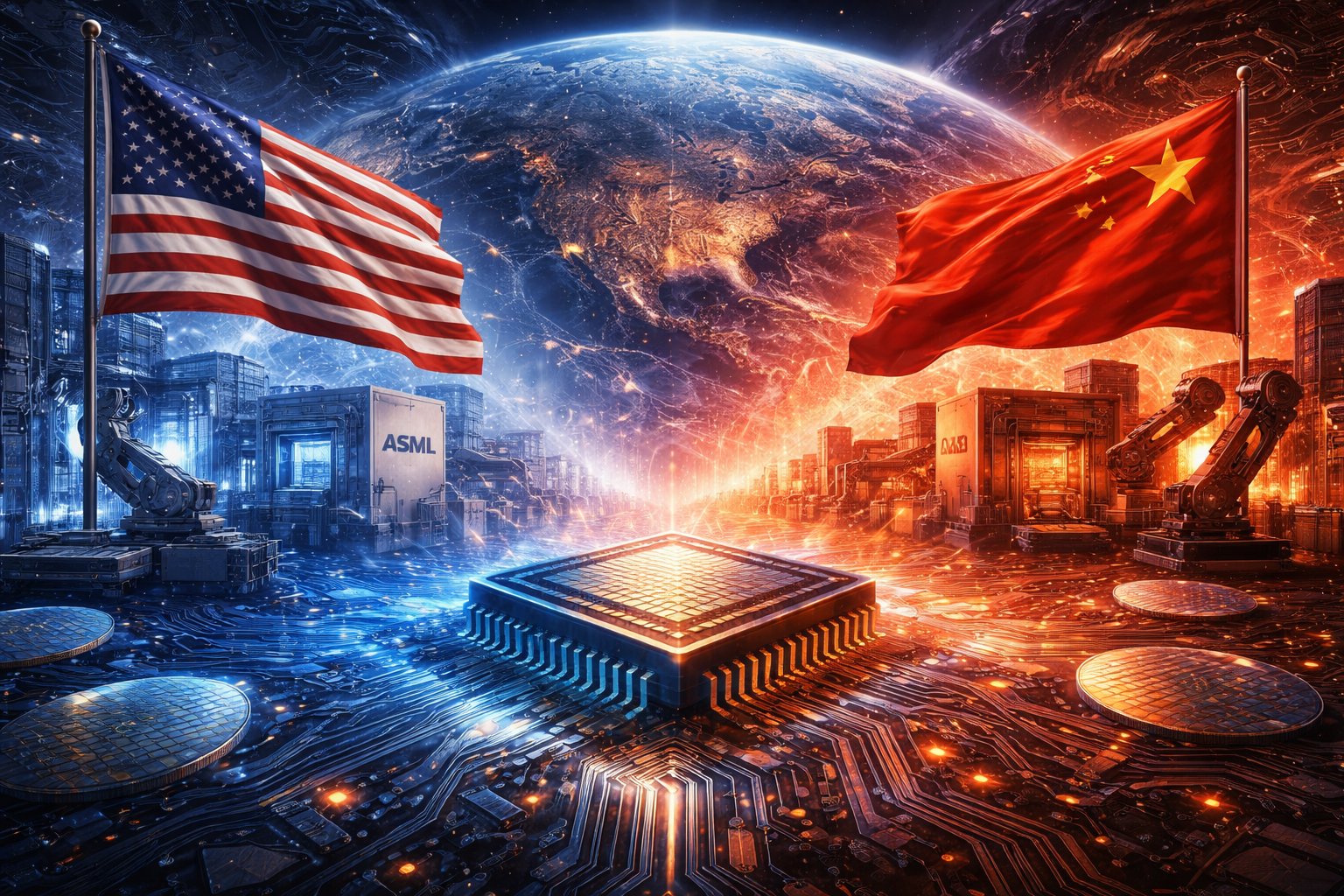
Microchips have become the strategic resource of the digital age and the competition for chip dominance is reshaping alliances, trade policy, and national security
Introduction: The Chip at the Centre of Everything
The semiconductor — a microchip etched with billions of transistors onto a sliver of silicon — has become the foundational technology of the twenty-first century economy. Every smartphone, every electric vehicle, every server in every data centre, every advanced weapons system, every AI computation, every industrial robot depends on semiconductors to function. They are the nervous system of the modern world — invisible, ubiquitous, and increasingly the subject of the most consequential geopolitical competition of our time.
The global semiconductor industry is characterised by extraordinary geographic concentration and extraordinary technical complexity. The most advanced chips in the world — those at the leading edge of the technology curve, manufactured at feature sizes measured in a few nanometres — can only be produced by a tiny number of manufacturers using equipment that can only be made by an even smaller number of suppliers. This concentration has created dependencies that governments, strategists, and supply chain managers are only now beginning to fully appreciate — and that the COVID-era semiconductor shortage of 2020-2022, which temporarily halted automotive production lines and contributed to consumer electronics shortages worldwide, made viscerally real.
Section I: The Architecture of Semiconductor Dependency
TSMC and the Taiwan Concentration
Taiwan Semiconductor Manufacturing Company (TSMC) produces approximately 90 percent of the world’s most advanced semiconductor chips at the leading edge of the technology curve. No other company in the world can currently manufacture chips at comparable levels of sophistication in comparable volumes. This concentration means that Taiwan — a small island at the centre of the most significant unresolved geopolitical dispute in the Indo-Pacific — is the single point of failure for the global technology supply chain. A disruption to TSMC’s manufacturing operations, whether from conflict, natural disaster, or supply chain breakdown, would affect every technology-intensive industry on earth.
ASML and the Lithography Monopoly
The equipment necessary to manufacture advanced semiconductors is itself extraordinarily concentrated. ASML, a Dutch company based in Eindhoven, produces the extreme ultraviolet (EUV) lithography machines that are essential for manufacturing chips at the most advanced process nodes. ASML is the only company in the world capable of producing EUV lithography equipment — a position of unique technological monopoly that reflects decades of investment, thousands of patents, and a global supply chain of hundreds of specialised suppliers that cannot be replicated quickly.
| ~90% of leading-edge semiconductor manufacturing concentrated at TSMC in Taiwan ASML, based in the Netherlands, is the sole supplier of the EUV lithography equipment necessary to manufacture chips at the most advanced nodes. This double concentration — in manufacturing at TSMC and in manufacturing equipment at ASML — creates what economists call single points of failure at the foundation of the global technology economy. |
| “The semiconductor supply chain is the most concentrated critical supply chain in the global economy, concentrated in geographic locations that happen to be at the centre of the world’s most significant geopolitical tensions. That is not a coincidence — it reflects where the investment, talent, and infrastructure were built — but it creates risks that the global economy is only beginning to price correctly.” — Chris Miller Author, Chip War: The Fight for the World’s Most Critical Technology; Tufts University |
Section II: The US-China Competition for Chip Dominance
The United States has moved to use its leverage in the global semiconductor supply chain as an instrument of strategic competition with China — most dramatically through the October 2022 export control package that restricted China’s access to advanced semiconductors and to the equipment and software necessary to manufacture them. The controls targeted not just American companies but any company globally that used American technology in its semiconductor manufacturing process — a sweeping assertion of extraterritorial jurisdiction that affected ASML, TSMC, and semiconductor equipment manufacturers worldwide.
China’s response has been to dramatically accelerate its domestic semiconductor development programme, investing hundreds of billions of yuan in chipmaking infrastructure, equipment development, and the recruitment of semiconductor engineering talent. SMIC, China’s largest chipmaker, has made notable progress in manufacturing chips at more advanced nodes than its import restrictions might suggest should be possible. China is unlikely to close the semiconductor technology gap with TSMC in the near term, but the gap may narrow more quickly than American export controls were designed to prevent.
The competition extends to the equipment layer. China is investing in domestic development of lithography machines, deposition equipment, and the full range of semiconductor manufacturing tools whose export to China has been restricted. The timeline for China to achieve genuine self-sufficiency in semiconductor manufacturing equipment is measured in years to decades — but the strategic imperative driving the investment is clear and the political will to sustain it is evident.
Section III: The Reshoring Response
The United States, European Union, Japan, South Korea, and other technology-intensive economies have responded to the concentration risk exposed by the COVID shortage and the strategic implications of the US-China competition with major investments in domestic semiconductor manufacturing. The US CHIPS and Science Act of 2022 authorised approximately $52 billion in direct semiconductor manufacturing subsidies and research investment. The EU Chips Act targets doubling Europe’s share of global semiconductor production. Japan has secured TSMC investment in a new manufacturing facility in Kumamoto. South Korea has announced multi-trillion-dollar investment plans in domestic semiconductor clusters.
These investments will gradually reduce the geographic concentration risk in semiconductor manufacturing — but the timelines are long (new fabrication facilities take years to build and commission), the costs are enormous, and the technical gap between new entrants and established manufacturers is not closed merely by building new facilities. Building a competitive semiconductor manufacturing industry requires not just capital and equipment but the deep pools of engineering talent and the accumulated operational expertise that the current leaders have built over decades.
Conclusion: The Chip as a Strategic Asset
The semiconductor has joined oil, food, and water as a resource whose supply and price carry strategic implications extending well beyond their economic value. The competition for chip dominance — over manufacturing capability, over equipment supply, over the intellectual property underpinning chip design, and over the talent that makes all of it possible — is a central dimension of the US-China strategic competition and a defining challenge for the economies that depend on a stable, secure global semiconductor supply chain. How that competition resolves will shape the technological landscape of the coming decades in ways that dwarf any previous technology transition in its breadth and in the speed with which it is unfolding.
Who Profited From the Iraq War?


