


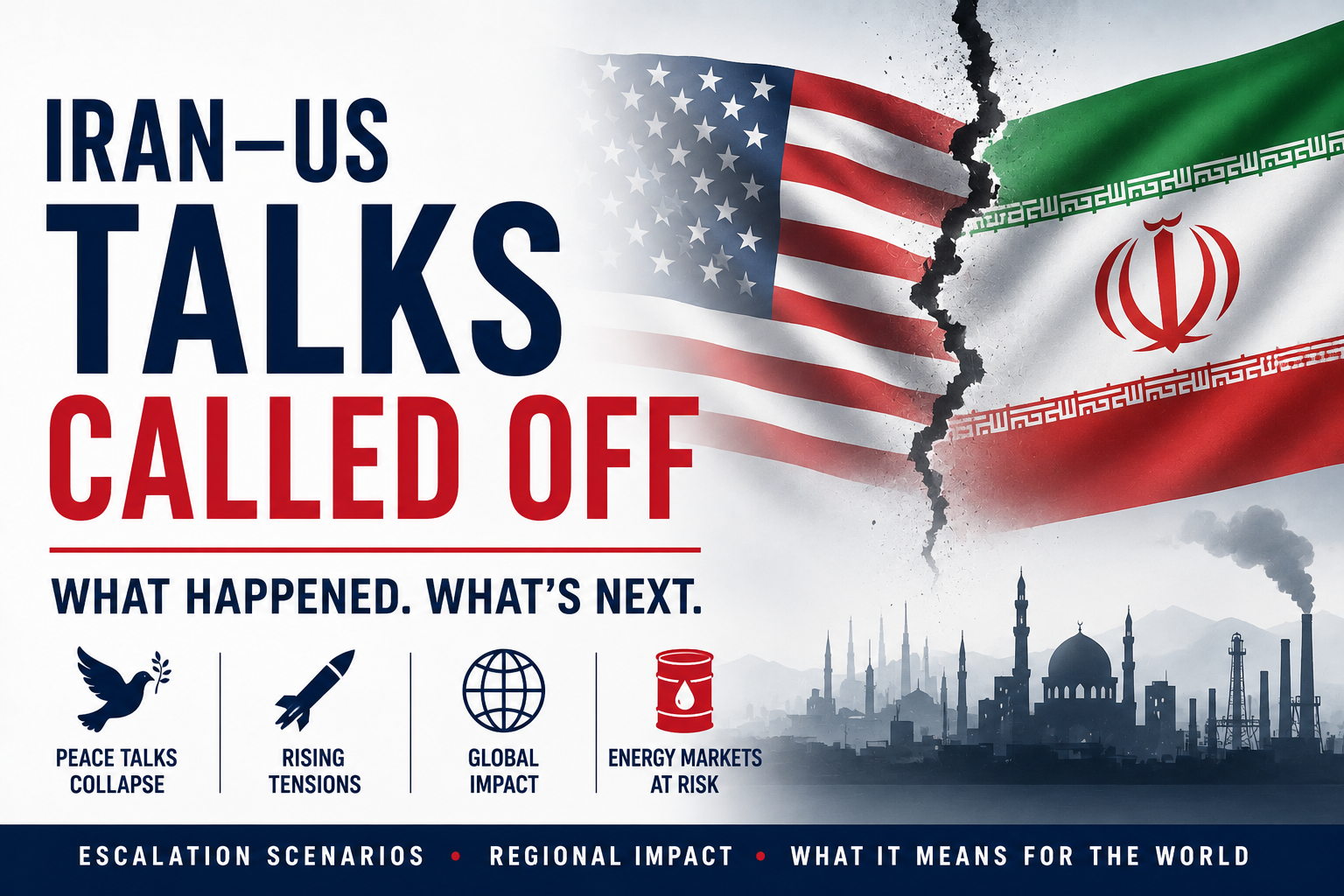
A Fragile Opportunity Lost
For a brief moment, diplomacy appeared to offer a path away from one of the most dangerous confrontations in the Middle East in decades.
Indirect negotiations between the United States and Iran—facilitated by regional mediators—had raised cautious hopes that military escalation could give way to political dialogue.
That optimism has rapidly faded.
Renewed military exchanges, mutual accusations of ceasefire violations, and increasingly hardline rhetoric have effectively derailed the peace process, pushing the region back toward confrontation.
The collapse of diplomacy is significant not simply because negotiations have stopped.
It removes one of the few remaining mechanisms capable of preventing miscalculation between two adversaries that now possess unprecedented military capabilities and competing regional ambitions.
The consequences extend far beyond Iran and the United States.
They affect Israel.
The Gulf.
Global energy markets.
International shipping.
And the future of geopolitical stability across the Middle East.
Why the Peace Talks Collapsed
The negotiations were always fragile.
Deep disagreements remained over Iran’s nuclear program, sanctions relief, regional security, and military activities.
Recent military actions dramatically widened those divisions.
As fighting resumed, both governments accused each other of undermining diplomatic efforts.
Political leaders on both sides increasingly shifted from negotiation toward deterrence.
Once military operations resumed, political space for compromise narrowed considerably.
In conflicts involving questions of national security and domestic legitimacy, leaders often find it politically easier to escalate than to make concessions.
The collapse of talks therefore reflects both military realities and domestic political calculations.
Khamenei’s Funeral: More Than a National Ceremony
The funeral of Ayatollah Ali Khamenei has become one of the most politically significant events in modern Iranian history.
Held amid heightened security and enormous public mobilization, the ceremonies were intended to demonstrate continuity, national unity, and institutional resilience following the assassination of Iran’s long-serving Supreme Leader. Reports indicate that the burial culminated at the Imam Reza Shrine in Mashhad.
For Tehran, the funeral served several strategic purposes.
It projected stability.
It reinforced revolutionary legitimacy.
It sought to reassure domestic audiences that the Islamic Republic remains functional despite extraordinary external pressure.
It also sent a message abroad.
Iran’s leadership wanted allies and adversaries alike to understand that leadership transitions would not fundamentally alter its strategic posture.
Why Najaf Would Have Been Symbolically Significant
Although recent reporting indicates that Khamenei was buried in Mashhad rather than Najaf, speculation about Najaf highlighted an important geopolitical question.
Najaf, in Iraq, is among the holiest cities in Shia Islam and the seat of Grand Ayatollah Ali al-Sistani, whose school of religious thought differs in important ways from Iran’s doctrine of Wilayat al-Faqih (Guardianship of the Islamic Jurist).
Had Khamenei’s burial taken place in Najaf, it would likely have been interpreted as:
- An attempt to reinforce Iran’s religious legitimacy across the wider Shia world.
- A symbolic effort to project unity between major Shia centers.
- A geopolitical message extending beyond Iran’s borders into Iraq and the broader Middle East.
Instead, burial in Mashhad emphasized Khamenei’s personal ties to Iran and reinforced the Islamic Republic’s national narrative rather than a broader transnational religious symbolism.
The Mystery Surrounding Mojtaba Khamenei
Perhaps the most intriguing aspect of Iran’s leadership transition is not who succeeded Ali Khamenei—but who has not been seen.
Mojtaba Khamenei, who has reportedly assumed the position of Supreme Leader in this evolving situation, has remained absent from public view since the attack that killed his father.
Multiple reports suggest security concerns and injuries sustained during the strike are among the reasons for his absence, although Iranian authorities have released only written statements attributed to him and have provided no sustained public appearances.
His absence has fueled speculation across the region.
Questions include:
- What is his actual physical condition?
- How much authority does he personally exercise?
- Is the Islamic Revolutionary Guard Corps (IRGC) temporarily exercising greater operational influence?
- Could prolonged absence affect perceptions of legitimacy?
In authoritarian systems, symbolism matters.
Visible leadership projects confidence.
Invisible leadership often generates uncertainty.
Whether Mojtaba eventually appears publicly may become an important indicator of political stability inside Iran.
Could the Conflict Escalate Again?
Although diplomacy has stalled, escalation is not inevitable.
Several pathways remain possible.
Scenario One: Controlled Retaliation
Both sides continue exchanging limited military strikes while avoiding direct full-scale war.
This remains the most likely near-term scenario because neither Washington nor Tehran appears eager for an open-ended regional conflict.
Scenario Two: Maritime Escalation
Iran could increase pressure in the Strait of Hormuz or nearby maritime routes.
Shipping disruptions would affect global energy markets, insurance costs, and international trade.
Even limited incidents could generate significant economic consequences.
Scenario Three: Regional Proxy Expansion
Groups aligned with Iran across Iraq, Lebanon, Syria, and Yemen could increase attacks on regional military or commercial targets.
This would broaden the conflict geographically without necessarily triggering conventional interstate war.
Scenario Four: Direct U.S.–Iran Military Confrontation
This remains the highest-risk scenario.
Direct strikes against military infrastructure, energy facilities, or strategic assets could rapidly expand into a wider regional conflict involving multiple states.
Although all major actors understand the risks, miscalculation remains possible.
What Does This Mean for Israel?
Israel would likely remain on heightened military readiness.
Any renewed escalation involving Iran could increase missile threats, cyber operations, and proxy activity along multiple fronts.
Israeli security planners are also likely to continue focusing on Iran’s nuclear capabilities and regional military networks.
For Israel, the strategic objective extends beyond immediate military exchanges.
It concerns preventing Iran from rebuilding capabilities that could alter the regional balance of power.
The Global Economic Consequences
Few regional conflicts carry as much economic significance as one involving Iran.
The reasons are straightforward.
The Middle East remains central to global energy production.
Critical shipping routes pass through the Gulf and nearby waterways.
Energy prices influence inflation worldwide.
Insurance costs affect international shipping.
Supply chains depend on maritime stability.
Should tensions intensify, the consequences could include:
- Higher oil and natural gas prices.
- Increased freight and insurance costs.
- Greater inflationary pressure.
- Volatility in financial markets.
- Delays in global supply chains.
- Increased defence spending by regional states.
The conflict therefore extends well beyond geopolitics.
It becomes an economic issue affecting consumers worldwide.
The Future of U.S.–Iran Relations
The collapse of talks does not necessarily mean diplomacy has ended permanently.
History demonstrates that negotiations between adversaries often resume after periods of confrontation.
However, future discussions are likely to begin from a position of even deeper mistrust.
Military deterrence will probably dominate the short term.
Diplomacy may return only after both sides conclude that continued escalation produces diminishing strategic returns.
Whether that realization comes quickly—or after another dangerous cycle of confrontation—remains uncertain.
Frequently Asked Questions
Why were the peace talks cancelled?
Recent military escalation, disagreements over nuclear issues, sanctions, and mutual accusations effectively derailed ongoing diplomatic efforts.
Why is Mojtaba Khamenei’s absence important?
His prolonged absence has generated speculation regarding his health, security, and the internal balance of power within Iran’s leadership.
Why would Najaf have been significant?
Najaf is one of Shia Islam’s most influential religious centers. Burial there would likely have carried symbolism extending beyond Iran’s borders, particularly regarding religious leadership and regional influence.
Could the conflict become a wider regional war?
Yes. While not inevitable, maritime incidents, proxy attacks, or direct military exchanges could draw additional regional actors into the conflict.
How does this affect the global economy?
Higher energy prices, disrupted shipping routes, increased insurance premiums, financial market volatility, and supply chain disruptions would all have worldwide economic consequences.
A New Phase in Middle Eastern Geopolitics
The collapse of U.S.–Iran diplomacy represents more than the failure of another round of negotiations.
It marks the beginning of a more uncertain strategic environment.
Iran is undergoing its most significant leadership transition in nearly four decades.
The United States continues balancing deterrence with the desire to avoid another prolonged regional war.
Israel remains focused on long-term security threats.
The Gulf states seek stability while preparing for uncertainty.
Meanwhile, the global economy watches closely.
The Middle East still sits astride the world’s most important energy routes and maritime chokepoints.
Every escalation carries consequences far beyond the region.
The next phase of this crisis is unlikely to be defined by a single decisive battle.
Instead, it may unfold through cycles of diplomacy, deterrence, proxy conflict, cyber operations, and economic pressure.
Whether those cycles ultimately lead back to negotiations—or toward a broader regional confrontation—may become one of the defining geopolitical questions of the coming decade.


