


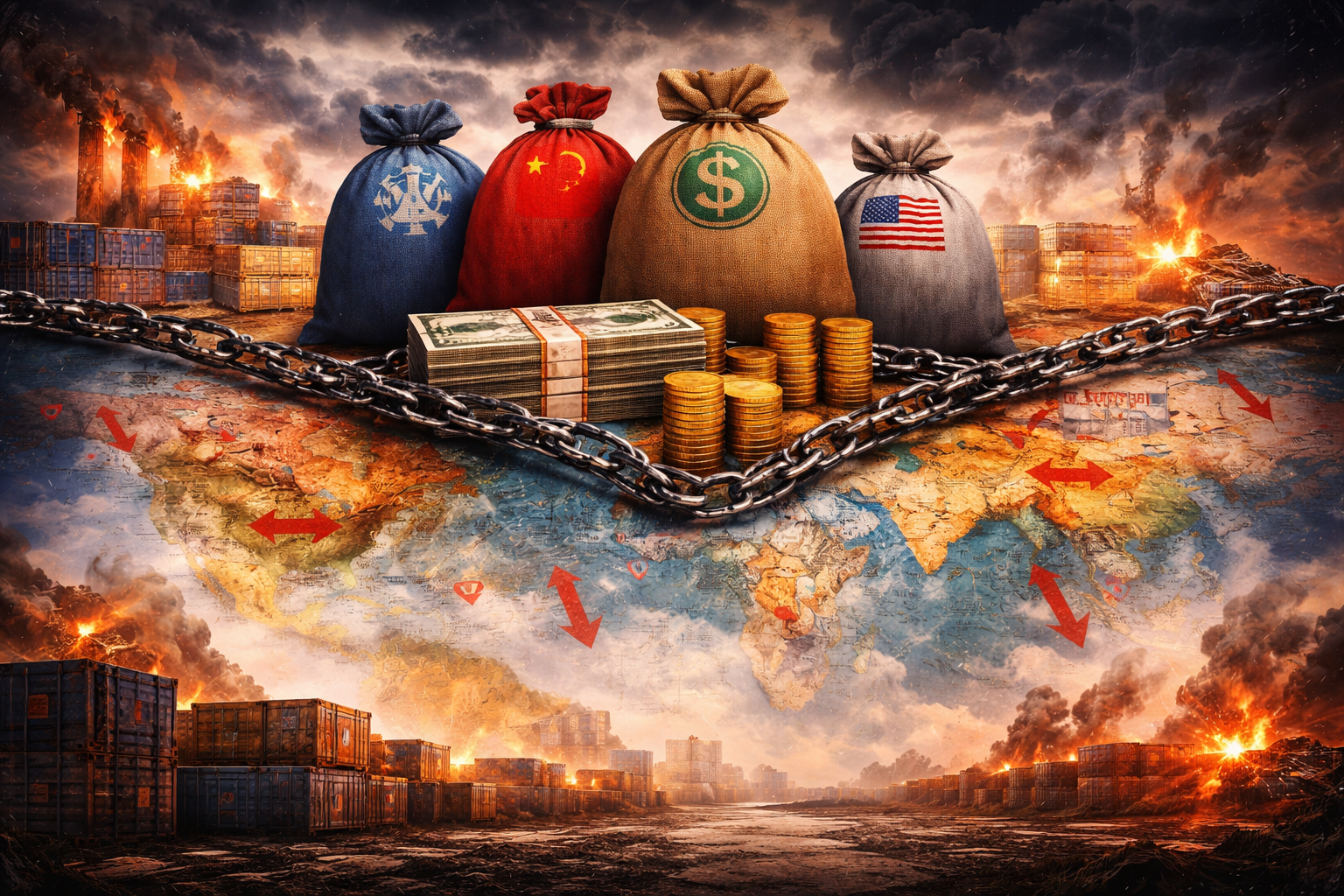
Global debt levels have reached historic highs, and developing countries face mounting pressure that could trigger a wave of financial instability
Introduction: The Debt Mountain and Its Implications
In the aftermath of the COVID-19 pandemic, global debt reached levels unprecedented in modern history. Governments borrowed heavily to fund emergency health responses, economic support programmes, and infrastructure investment designed to support recovery. Central banks maintained ultra-low interest rates that made this borrowing affordable. Total global debt — government, corporate, and household — reached approximately $300 trillion by 2023, according to the Institute of International Finance, representing roughly 330 percent of global GDP.
The subsequent normalisation of interest rates — as central banks in the United States, Europe, and elsewhere raised rates sharply to combat the inflation triggered by post-pandemic demand and supply chain disruption — transformed the debt landscape. For wealthy countries with deep domestic financial markets, access to reserve currencies, and large domestic investor bases, higher interest rates raised borrowing costs significantly but did not threaten fiscal sustainability. For developing countries that had borrowed in foreign currencies — primarily US dollars — during the low-rate era, the combination of higher rates, stronger dollar exchange rates, and slowing global growth created a debt service burden that in many cases became unsustainable.
Section I: The Developing World Debt Squeeze
The Perfect Storm for Vulnerable Economies
The debt stress in developing countries is not a single crisis but a collection of overlapping pressures that affect different countries in different combinations. Countries that had borrowed heavily in US dollars face a double burden when dollar interest rates rise: their debt service costs increase in absolute terms, while the local currency value of their dollar-denominated debt increases as currencies depreciate. Countries dependent on commodity exports face commodity price cycles that can rapidly transform export revenues. Countries dependent on tourism faced a COVID-era collapse followed by uneven recovery.
The combination of these pressures has pushed a significant number of developing countries into debt distress — a condition in which a country cannot service its existing debt obligations without either defaulting, restructuring, or implementing domestic spending cuts so severe that they undermine public service provision and social stability. Zambia defaulted in 2020. Sri Lanka’s debt crisis in 2022 produced acute food and energy shortages and widespread civil unrest that forced the president’s resignation. Ghana sought IMF support in 2022 for a debt crisis that required significant austerity measures. Ethiopia, Pakistan, and several other countries have navigated various degrees of debt distress through the period.
| ~$300 Trillion Total global debt by 2023 — approximately 330% of global GDP Per the Institute of International Finance. The combination of post-pandemic borrowing and subsequent interest rate increases has created the most significant global debt overhang since World War II, with the stress falling most heavily on developing countries that borrowed in foreign currencies during the low-rate era. |
| “The debt crisis facing developing countries is structural, not cyclical. It reflects a fundamental mismatch between the debt levels accumulated during the low-rate era and the capacity to service those debts at higher rates, in a slower-growth global economy, with weakened fiscal positions. The IMF and World Bank cannot resolve this through standard programmes alone.” — Dr. Kenneth Rogoff Professor of Economics, Harvard University; former Chief Economist, IMF |
Section II: The Restructuring Challenge
The China Dimension
A significant complicating factor in resolving developing country debt distress is the role of China as a major bilateral creditor. China’s Belt and Road Initiative has provided loan financing for infrastructure projects across developing Asia, Africa, and Latin America — making China one of the largest bilateral lenders to developing countries, and making Chinese participation essential in any comprehensive debt restructuring. The frameworks established during previous debt crises — primarily the Paris Club of official creditors — were designed for a world in which Western governments were the dominant bilateral lenders. They were not designed to accommodate a large creditor that operates outside those frameworks.
Debt restructuring negotiations involving Chinese creditors have proven slower and more complex than the IMF’s programme timelines assume. The Common Framework for Debt Treatment, established by the G20 in 2020 specifically to address this challenge, has produced limited results, with negotiations in several of its cases — including Zambia, Ethiopia, and Chad — taking years to reach agreements that multilateral creditors regard as insufficient. The result is a gap between what the IMF assesses as necessary for debt sustainability and what can be achieved through restructuring negotiations with a creditor base that includes major official creditors operating outside established frameworks.
Section III: The Broader Economic Implications
The developing world debt crisis carries broader economic implications beyond the immediate fiscal stress on affected countries. Countries under acute debt pressure typically implement significant cuts to public expenditure — including health, education, and social protection — that impose real costs on populations already vulnerable to economic shocks. Investment in infrastructure, climate adaptation, and economic diversification is deferred or cancelled. The human capital accumulation that is the foundation of long-term economic development slows.
The geopolitical implications are also significant. Countries under severe economic stress are more susceptible to political instability — as Sri Lanka demonstrated dramatically — and more receptive to offers of financial support that come with fewer policy conditions attached but potentially more significant strategic implications. The debt crisis is therefore not merely an economic challenge but a governance and geopolitical challenge in which the capacity of the international financial system to provide effective, timely, and adequately resourced support to countries in distress has direct implications for their political trajectories.
Conclusion: The Long Shadow of the Debt Mountain
The global debt accumulated during the extraordinary borrowing conditions of the 2010s and the COVID era will shadow economic policy for years to come. For developing countries at the sharp end of the debt distress spectrum, the challenge is immediate and structural. For advanced economies, the legacy of high debt levels constrains the fiscal space available for public investment, limits the policy response available in future crises, and creates long-term pressures on social spending that will become more acute as populations age and public pension and healthcare costs grow. Managing the global debt overhang — through a combination of growth, restructuring where necessary, and governance reform of international financial architecture — is one of the least visible but most consequential economic policy challenges of the current era.
Who Profited From the Iraq War?


