


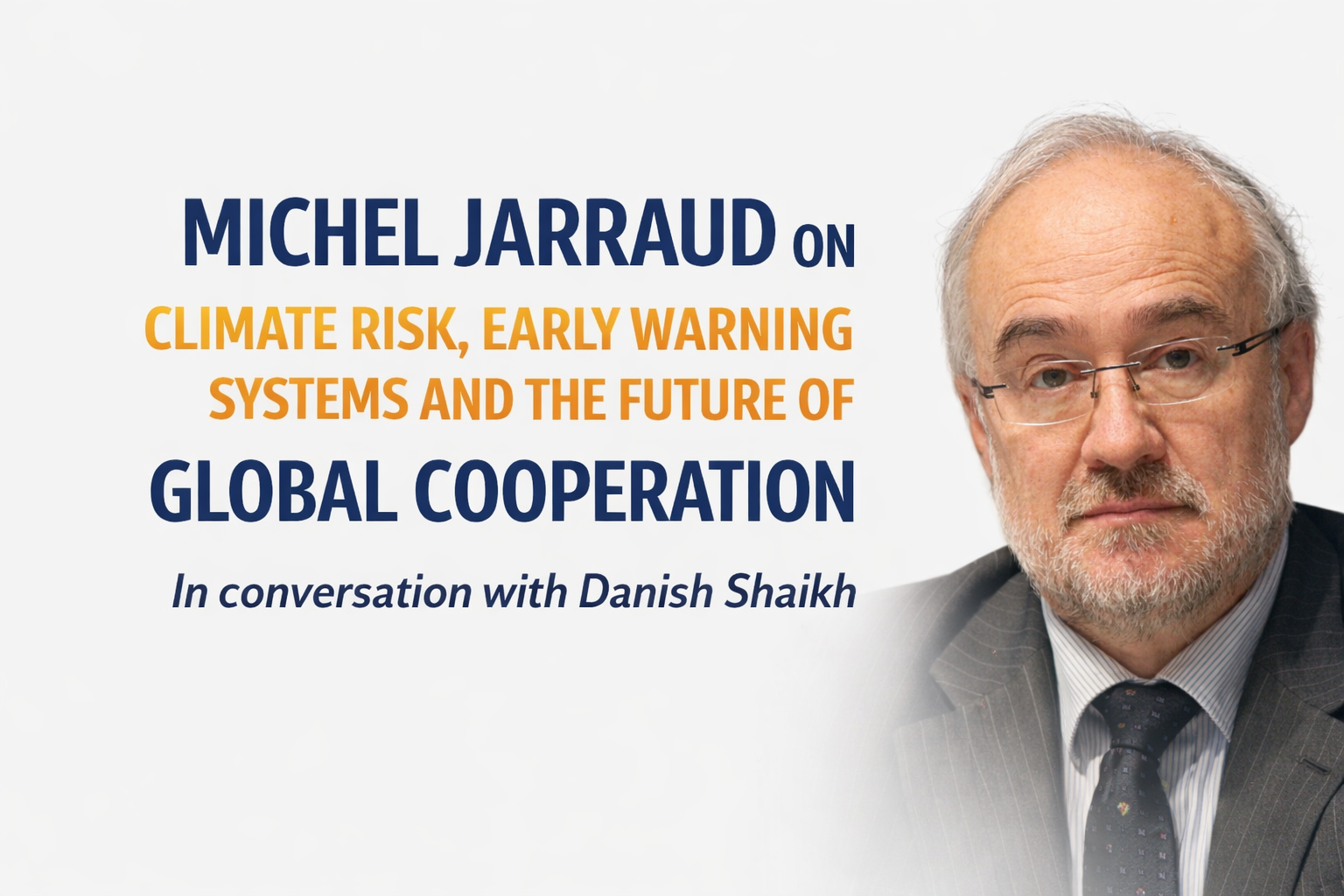
Extreme weather events are no longer episodic disruptions but structural features of the global economy. From drought-linked food insecurity to intensifying flood cycles, the intersection of climate science, risk management and multilateral coordination has moved to the centre of policy debate.
Few figures have shaped modern meteorological governance as significantly as Michel Jarraud, Secretary-General Emeritus of the World Meteorological Organization. During more than three two decades at WMO — including 12 years as Secretary-General — Jarraud oversaw the expansion of global early warning systems, climate monitoring a global frameworks for climate services and hydrological cooperation. He also chaired UN-Water, coordinating international water governance and action at a time of rising scarcity concerns. Earlier in his career, he held senior leadership roles at the European Centre for Medium-Range Weather Forecasts and Météo-France, helping to modernise operational forecasting and global data exchange.
In conversation with Danish Shaikh, Editor at The International Wire, Jarraud reflects on the evolution of climate science diplomacy, early warning systems, water security, and the institutional reforms needed to confront accelerating climate risk.
During your tenure at the World Meteorological Organization, when did climate risk shift from a scientific concern to a systemic economic threat in government thinking?
It was a progressive shift: as evidence grew in the 70s and 80s about the increasing concentrations in the atmosphere of greenhouse gases, in particular CO 2 of anthropogenic origine, WMO (the World Meteorological Organization) and UNEP (the United Nations Environment Programme) created in 1988 the IPCC (Intergovernmental Panel on Climate Change) which has issued regular (every 6 to 7 years) Assessment Reports with the most up to date scientific information with respect to the state of the climate, its future evolution and evaluation of the risks and of various mitigation options. It goes through the most thorough scientific peer review in any scientific disciplines and has been key in informing negotiations under the UNFCCC (UN Framework Convention on Climate Change) and its successive COPs as well as decision makers at all levels in all countries.
Are current global early warning systems genuinely universal, or do critical coverage gaps persist in the Global South?
Huge progress has been achieved over the last 30 years, but significant gaps still exist, in particular in a number of LDCs (Least Developed Countries). Over this period, and as more than 90% of all natural extreme events are weather, water or climate related, WMO has been at the forefront of promoting the development of multi-hazards early warning systems, which have contributed to a significant reduction in particular in the loss of lives. Recently a new initiative was launched with the strong support of the UN Secretary General, the EW4All (Early Warnings for All) to address the remaining gaps. To invest in such activities has extremely high benefit to cost ratios, often more than 10 to 20.
Has political fragmentation weakened multilateral cooperation in meteorological data sharing?
The importance of global exchange of essential meteorological data has been a core principle of international cooperation ever since the founding of the IMO (the International Meteorological Organization, the predecessor of WMO) in 1873. It was further developed, since the second World War, even at the peak of the Cold War. The global real time free and unrestricted exchange of such essential data is now reflected in the WMO Convention. The potential threats are not so much related to political fragmentation, but rather to the growing role of private operators and to the weakening support to the concept of global public goods.
Are National Meteorological and Hydrological Services (NMHSs) underfunded relative to the economic risks they are expected to manage?
It is indeed the case in a number of countries, not only developing ones. However, it is not only with respect to managing risks, and saving lives, which as mentioned above is an essential mission of NMHSs. Many studies have highlighted the considerable benefits for the economy and the environment of increased investments in NMHSs, in most countries..
What are the structural weaknesses in the current global climate governance architecture?
This is a challenging issue: Good governance requires authoritative information, (WMO and IPCC make a significant contribution in this respect), it also must have an international negotiation dimension (which is performed under the UN-FCCC umbrella), and action taken at national, local or even individual levels. Despite some notable progress over the last decades, one of the main weaknesses is the translation of knowledge into action.
Is adaptation financing keeping pace with escalating extreme weather intensity?
The fight against climate change must have two complementary action pillars. First, mitigation: it is essential to address the root causes, and to minimize anthropogenic emissions of greenhouse gases in the atmosphere, in order to avoid consequences which cannot be managed. Second, adaptation, which is about manging what cannot be avoided. With respect to extreme events, both their frequency and intensity will significantly increase and the effects are already seen today in many parts of the world. Both adaptation and mitigation are severely underfunded at this stage and this is a major and difficult subject of discussion in the negotiations under the COPs of the UN-FCCC, despite the growing evidence that the cost of action today is much less than the cost for future generations of present inaction.
How do you assess the credibility gap between climate science warnings and political action?
This is caused to a significant extent by a time horizon gap: Although the impact of anthropogenic climate change is already visible in most parts of the world, and the dramatic long term impact is supported by overwhelming scientific evidence, many political decisions are driven by short term or even very short term considerations. In addition, a growing number of political leaders are deliberately ignoring such scientific evidence, or even trying to suppress it. In some countries, such as USA, funding for climate research is undercut, scientific independence is threatened and support to essential international cooperation is undermined.
Have early warning systems been oversold as a solution without equivalent investment in preparedness and response capacity?
I do not think so: WMO has always promoted an end-to-end approach to disaster prevention when dealing with extreme events. It means that preparedness, early warnings, response, resilience building, education, and many other aspects are all essential elements. Perfect early warnings would be useless if they do not reach people at risk, if local and national actors do not have the means to act on the warnings, or if individuals do not know how to act. Communication and education dimensions are vital. After extreme events, it is also essential that response strategies take into account the need to “build back better” in order to increase resilience.
How did your experience at ECMWF shape your understanding of European strategic autonomy in weather forecasting?
ECMWF is a jewel of European scientific cooperation. In the1970s, European countries decided to join efforts in order to become the world leader in Medium Range Weather Forecasting, that is for the range 3 to 10 days ahead. None of them had the necessary resources to achieve it alone. They seconded their best experts to ECMWF and gave this Centre the necessary financial support to acquire the most
powerful super computers available. It worked beyond expectations as, for now more than 50 years, ECMWF has indeed been the world leader for this type of forecast and has been an inspiration for other major countries. It also makes available a significant part of its products to all countries in the world, including all developing and least developed countries, through an agreement with WMO. It is an outstanding demonstration of the benefits of international cooperation.
Should meteorological infrastructure be considered part of critical national security architecture?
It is already so in most countries, as protection against extreme events is a critical contribution to national security. Also in a number of countries, the NMHSs are responsible for providing meteorological support to national Defense missions. In a few other countries, there is a separate Met Service supporting such activities. A new aspect is linked to climate change, which is generally recognized also as a security threat, but with a regional or global dimension. However, this aspect is not really addressed at the international level, such as by the Security Council of the United Nations, because of the strong opposition by some countries.
Is climate-related water scarcity likely to become a greater source of geopolitical tension than energy security?
The two are closely related. A significant increase in regions facing major water stress is one of the likely consequences of anthropogenic climate change. It is already a source of geopolitical tensions and it will be even more so in decades to come. Energy security is an essential element of sustainable development, and as we could see in recent conflicts it is not only generating tensions, but it is often a key military target. There are many important interactions between water and energy: water can be a direct source of energy (Hydropower). Water is also essential for cooling power plants such as the nuclear ones. Energy is required to operate water desalinization plants and so on. Because of these multiple interaction, the water-energy nexus has been identified as a key one in the context of the 2030 Sustainable Development Agenda.
During your time chairing UN-Water, what coordination failures most hindered effective water governance?
UN-Water is actually one of the most effective inter-organizations coordinating mechanism in the multilateral intergovernmental System. However, in many countries similar coordination mechanisms are lacking, and hydrological information, including for risks of extreme water events (floods and drought) are not always integrated in planning at national, regional or local levels.
What institutional reforms would most strengthen the authority of global meteorological coordination?
International meteorological coordination is a core mission of WMO. The key is not so much about some fundamental institutional reform, but rather about stronger commitment and support by Member States, both at the international and national levels.
Are developing economies overly dependent on external forecasting models?
The development of sophisticated global numerical weather prediction models is beyond the capacity of most countries, even developed ones. That is why a number of countries have opted to either rely upon products from advanced Centres, and/or for cooperation solutions. Also as mentioned above all major centres with global numerical prediction facilities are, as advocated by WMO, making available a significant range of their products to all WMO Members: this is the case among others by ECMWF, USA, France, Germany, UK, China, … Many small developing countries focus, for example through limited area models, on adding value with the use of high resolution local information.
How should policymakers interpret uncertainty ranges in climate modelling without paralysing decision-making?
Most weather predictions (and climate simulations) come with probability ranges. Decision makers should take it into account in a way which is consistent with their business, but many are not really prepared to do it and some education is required. The probabilities feed decision matrices which can be very different for different businesses: just as an example if there is a 40% probability of moderate frost for the next day, the decisions will be very different for some farmers or for a factory.
What lessons were not learned from major climate disasters of the past two decades?
I would rather say that a number of lessons have been learned: More emphasis is put on prevention and on resilience building. The link between climate change and the increase in the frequency and intensity of a number of extremes is now demonstrated by much stronger scientific evidence. Despite recent setbacks in some countries, such evidence is a key element of climate negotiations. However the urgency of acting both on the mitigation and the adaptation fronts is not always recognised, or even denied by some. This translates into grossly insufficient financial and political support. Also, the recent multiplication of crises and conflicts in several parts of the world, generates a number of very short term priorities, often at the expense of longer term strategic investments, such as those required to fight climate change.
Has multilateral climate diplomacy become procedurally complex but operationally weak?
The two issues are linked. Multilateral climate diplomacy is indeed complex, but we have no alternative, as the climate crisis cannot be solved at the national level in any country, nor through a necessarily reduced number of bilateral agreements. Because of the diverse and often conflicting priorities of various actors, the translation of diplomatic agreements, such as the 2015 Paris Accord, into operational activities is indeed weakened. In addition action is often linked to national priorities and we see a significant erosion of global solidarity.
Are we underestimating compound risks — where climate events intersect with food, migration and financial instability?
Not really. As mentioned above the interactions between climate change risks and most of the other 16 Sustainable Development Goals (SDGs) are well documented and understood. However for reasons mentioned above, action is hindered by insufficient political will and financing.
If you were redesigning the global meteorological system today, what structural change would you prioritise first?
The answer to this question would require very long developments. The system has never been frozen and has continuously evolved to respond to scientific and technological developments, but also in response to major crises, such as during the Cold War. WMO has shown its capacity to adapt and respond to major challenges. The global system has many strengths, but also some weaknesses. In particular, it is becoming increasingly important to involve more proactively non-State actors: civil society, local authorities, private sector … It is also important to establish more bridges between various groups, in particular meteorological and climate scientist, economist, social scientists.

Michel Jarraud, Secretary-General Emeritus of the World Meteorological Organization (WMO), is among the most influential figures in modern meteorology, having bridged scientific innovation and global climate governance over a four-decade career. Trained as a specialist in numerical weather prediction, he began his professional journey at Météo-France before moving to the European Centre for Medium-Range Weather Forecasts (ECMWF), where he contributed to the development of one of the world’s leading operational forecasting models. His early work, focused on mathematical techniques for atmospheric modelling, helped shape the accuracy and reliability of modern weather prediction systems.
Jarraud transitioned from scientific research to leadership roles in the late 1980s, serving as Director of France’s national forecasting division and later as Deputy Director of ECMWF. His tenure at the WMO from 1995 to 2015—first as Deputy Secretary-General and then as Secretary-General—marked the defining phase of his career. During this period, he positioned the organisation at the centre of international climate discourse, strengthening coordination within the UN system and advancing global cooperation on weather, climate, and water-related challenges. As a member of the UN Chief Executives Board and Chair of UN-Water, he played a key role in aligning scientific expertise with policy frameworks, particularly in the context of climate risk and sustainable development.
Since stepping down, Jarraud has remained active in advisory and academic roles, including as a special advisor on climate issues to the African Union’s ARC insurance initiative and as an invited professor in Geneva. His contributions have been widely recognised through honorary doctorates and distinctions, including the European Meteorological Society’s silver medal. His career reflects a rare combination of technical depth and institutional leadership, underscoring the growing importance of science-driven policymaking in addressing global environmental challenges.
Also Read: What If the Biggest Hole in Global Climate Policy Isn’t Coal or Oil — It’s War?


