


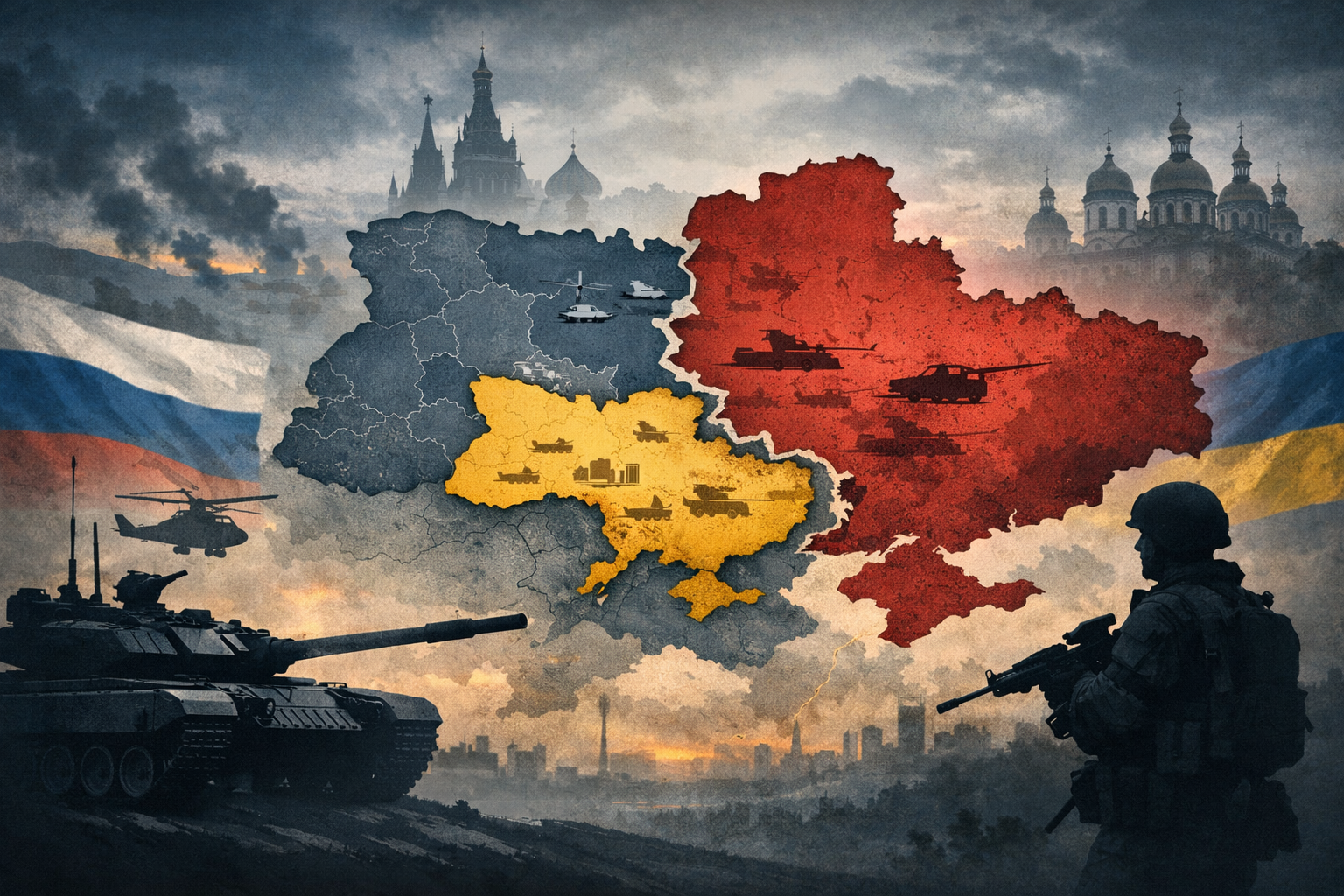
How the Soviet Union built a command architecture that guarantees nuclear retaliation even after the destruction of its leadership — and why it still matters in 2026
What Is Russia’s Dead Hand System?
Russia‘s Dead Hand — known formally as Perimeter — is a semi-automated nuclear command-and-control system originally developed by the Soviet Union. Its purpose is singular and absolute: to guarantee a nuclear retaliatory strike even if Russia’s entire leadership chain has been destroyed in a first strike. It does not require a surviving decision-maker to authorise a launch. Under defined conditions, it can issue that order itself. It is not a weapon of first use. It is an architectural guarantee that no first strike — however successful — can prevent its own consequences.
Most nuclear doctrines rest on a deceptively simple assumption: that leadership survives long enough to retaliate. Deterrence, in its conventional form, is a human transaction — a calculation made between rational actors who remain alive and in communication when the stakes are highest.
But what if the leaders are gone? What if a sufficiently precise, sufficiently rapid nuclear first strike eliminates the command structures, destroys the communication networks, and kills the decision-makers before they can transmit the order to respond? This is the decapitation scenario — the nightmare at the centre of Cold War nuclear planning — and it is the problem that Russia’s Dead Hand system was built to make permanently irrelevant.
In the environment of 2026 — characterised by hypersonic delivery systems, advanced cyber operations targeting command infrastructure, and renewed strategic competition between nuclear-armed states — the logic that produced Dead Hand has not aged. It has intensified. Understanding this system is no longer a matter of Cold War history. It is a prerequisite for understanding the strategic landscape we currently inhabit.
| ~1,500 Deployed Russian nuclear warheads capable of being activated under Perimeter protocols Russia maintains the world’s largest nuclear arsenal. The Dead Hand system was designed to ensure that a substantial portion of that arsenal can be launched without surviving human commanders — through a network of command rockets that transmit launch orders directly to ICBMs, submarines, and strategic bombers. |
Section I: The Problem Dead Hand Was Built to Solve
By the late Cold War, both the United States and the Soviet Union had developed the technical capability to conduct what strategists called decapitation strikes — attacks precisely designed not to destroy the adversary’s cities or military forces in the field, but to eliminate the leadership, command infrastructure, and communication networks that would be required to authorise and transmit a retaliatory strike.
The strategic logic was coldly rational: if you could eliminate the ability to respond before the response could be ordered, you had effectively broken the chain of mutually assured destruction. A sufficiently successful first strike would not be answered. The deterrence model — the entire architecture of nuclear peace — would collapse in the space of minutes.
Soviet strategic planners understood this vulnerability with brutal clarity. Their response was not to harden leadership bunkers further, or to disperse decision-makers more widely — though they did both of those things too. Their deeper response was to design a system that removed the requirement for surviving leadership altogether. If no human decision-maker is required to authorise retaliation, then eliminating human decision-makers does not eliminate retaliation.
| “The Soviets understood something that Western strategists sometimes refused to accept: that deterrence based on human decision-making has a vulnerability. If you can eliminate the humans fast enough, you can eliminate the deterrent. Perimeter was the Soviet answer to that vulnerability — and it is an answer that remains in place today.” — Dr. Bruce Blair Former Minuteman ICBM launch control officer; Co-founder, Global Zero; Senior Research Scholar, Princeton University |
Section II: How the Dead Hand System Works — The Architecture of Guaranteed Response
The precise operational details of the Perimeter system remain classified, and Russian authorities have been strategically selective about what they confirm. But open-source analysis — drawing on Soviet-era defector accounts, declassified documents, and statements by Russian officials — has produced a reasonably clear picture of the system’s architecture and logic.
| 1 ACTIVATION | Crisis Activation — Not Permanent Operation Dead Hand is not in a state of continuous readiness. It is activated by senior leadership during periods of acute strategic tension or confirmed threat. This design choice reflects an important deliberate constraint: the system is not intended to operate autonomously under normal conditions, but to be switched on as a deterrence signal and emergency backup when the risk of decapitation becomes real. |
| 2 SENSORS | Multi-Sensor Attack Detection Once activated, the system monitors a network of sensors measuring seismic activity consistent with nuclear detonations, radiation levels, atmospheric pressure changes from blast waves, and — critically — the status of communication links to senior command centres. No single sensor triggers the system. It is designed to require convergent evidence across multiple indicators before concluding that a nuclear attack has occurred. |
| 3 VERIFICATION | Command Communication Assessment The system continuously monitors whether it can reach the human leadership chain — the General Staff, the Defence Ministry, the Presidential command authority. If attack indicators are present AND communication with senior command has been severed simultaneously, the system interprets this as evidence that a decapitating strike has occurred. This dual-condition requirement is the primary safeguard against accidental triggering. |
| 4 LAUNCH | Command Rocket Launch — Automated Retaliation If both conditions are met, the system launches a specialised set of command rockets — not warheads, but signal transmitters — that fly across Russian territory broadcasting encrypted launch authorisation codes to every element of the nuclear arsenal: ICBMs in their silos, strategic bombers on alert, and nuclear submarines at sea. These receive the codes and execute their pre-programmed strike orders without further human authorisation. |
“Even if you eliminate us, you cannot eliminate our response.”
The strategic message embedded in Dead Hand’s design
Section III: Is Perimeter Still Operational? What Russia Has Confirmed
For many years after the Soviet Union’s collapse, the existence of Perimeter was denied or left ambiguous by Russian authorities. The system first entered Western public consciousness in substantive form through Seymour Hersh’s reporting and subsequently through David Hoffman’s definitive account in ‘The Dead Hand.’ Russian officials initially neither confirmed nor denied.
That posture has gradually shifted. Russian military officials and strategic commentators have made periodic statements that confirm the system’s existence and continued operation — typically in the context of signalling to the United States and NATO that escalation carries guaranteed costs. General Sergei Karakayev, commander of Russia’s Strategic Missile Forces, confirmed in 2011 that Perimeter remained operational. Other statements from Russian officials have followed, with increasing directness, in the years since.
Most analysts assess that the system has been substantially modernised since its Soviet-era design. The original infrastructure was developed in the 1970s and 1980s. Four decades of technological evolution — in sensors, communications, computing, and hardening against cyber and electronic warfare — make it virtually certain that the version operational today is architecturally similar but technically far more sophisticated than its Cold War predecessor.
| What Analysts Believe About Dead Hand’s Current Status Operational status: Active and integrated into Russia’s strategic nuclear posture Modernisation: Substantially upgraded since Soviet-era design, with newer sensors and cyber-hardened communications Activation threshold: Engaged during elevated strategic tension; likely activated during periods of direct NATO-Russia confrontation Integration: Connected to Russia’s broader nuclear command and control architecture, including the Kazbek briefcase system Transparency: Deliberately partial — Russia confirms existence to deter, withholds specifics to maintain uncertainty |
Section IV: The Strategic Logic — Deterrence Without Trust
To understand why a system as extreme as Dead Hand was built — and why it continues to form part of Russia’s nuclear posture — it is necessary to understand the concept of deterrence at its most fundamental level, and the specific failure mode that Dead Hand was designed to eliminate.
Classical deterrence theory holds that a potential aggressor can be dissuaded from attacking if they believe the costs of doing so will outweigh the gains. In the nuclear context, this takes the form of mutually assured destruction: both sides possess enough survivable nuclear capability that any first strike will be met with a retaliatory strike of catastrophic magnitude. The rational actor, calculating this outcome, does not strike.
But classical deterrence theory contains an embedded assumption that Dead Hand’s architects identified as exploitable: it depends on the existence of a surviving rational actor who can make and transmit the decision to retaliate. Remove that actor — through a fast, precise decapitation strike — and deterrence fails at exactly the moment it is most needed.
Dead Hand closes this gap by making the retaliatory decision — under defined conditions — prior to any attack, and embedding it in machinery rather than in human cognition. The decision has, in a sense, already been made. What the system provides is not a response to a strike but the execution of a pre-committed response. Deterrence is transformed from a transaction between living decision-makers into a structural feature of the weapons architecture itself.
Dead Hand does not prevent war in real time. It makes the consequences of war inescapable — even after those who started it are gone.
| “What Perimeter represents is the most extreme form of what strategists call ‘doomsday machine’ logic. It creates certainty of retaliation that is independent of human survival. The problem is that the same certainty that makes it effective as a deterrent also makes it catastrophic if it ever triggers in error.” — Dr. Daniel Ellsberg Strategic analyst; Former RAND Corporation researcher; Author of ‘The Doomsday Machine: Confessions of a Nuclear War Planner’ |
Section V: The Risks — Automation at the Edge of Extinction
The properties that make Dead Hand strategically powerful are inseparable from the properties that make it strategically dangerous. This is not a design flaw that can be corrected through better engineering — it is the fundamental tension at the heart of automated nuclear deterrence, and it cannot be resolved without dismantling the system’s core purpose.
| The Principal Risk Categories of Dead Hand False positive triggering: Sensors could misinterpret natural seismic events, technical malfunctions, or cyber interference as evidence of nuclear attack. In activated status, misread data could initiate launch sequences. Reduced de-escalation capacity: Automation compresses or eliminates the decision space in which political leaders could choose restraint, reassess intelligence, or communicate with adversaries to prevent escalation from becoming irreversible. Cyber vulnerability: A system that monitors communications and sensor networks is a system that adversaries may attempt to deceive or manipulate through cyber operations — potentially triggering the very response it was designed to guarantee only under genuine attack. Escalation acceleration: The known existence of automated retaliation systems may push adversaries toward faster strike timelines and pre-emptive doctrines — compressing decision time on all sides and increasing crisis instability. Opacity and misunderstanding: The deliberate ambiguity Russia maintains about Perimeter’s exact parameters means that adversary understanding of its triggers may be incorrect — creating risk of inadvertent activation through misread escalation signals. |
The history of near-misses in nuclear command and control provides sobering context for these risks. In 1983, Soviet officer Stanislav Petrov correctly identified an alert from his early-warning satellite system as a false alarm — potentially preventing a retaliatory launch based on sensor error. In the same year, NATO exercise Able Archer 83 was read by Soviet intelligence as a potential cover for a real attack, triggering genuine alarm in Moscow. These episodes involved human decision-makers who could exercise judgment in ambiguous situations. Dead Hand, by design, reduces the role of that judgment under precisely the most ambiguous and high-stakes conditions.
| 30 minutes Approximate flight time of ICBMs between Russia and the United States The time compression of nuclear exchange is the foundational pressure driving automated deterrence systems. From launch detection to impact, decision-makers have minutes — not hours. Dead Hand was designed for a world in which those minutes may not be available to authorise a response. In 2026, hypersonic delivery systems compress that window further still. |
Section VI: Dead Hand in the Strategic Environment of 2026
Three converging trends in the 2026 strategic environment have given Dead Hand — a system conceived in the 1970s — renewed and amplified relevance. Each trend directly affects the calculus that produced the system, and each makes the logic of automated deterrence more, not less, compelling from a Russian strategic perspective.
| 1 SPEED | Hypersonic Weapons — The Decision Window Collapses Russia’s Avangard hypersonic glide vehicle and other hypersonic delivery systems travel at speeds that compress warning time for their targets to minutes or less. When adversaries acquire equivalent or superior hypersonic capability, the window available to Russia’s leadership for confirmation and response narrows to the point where human decision-making may be physically impossible. Dead Hand becomes less a backup and more the primary response mechanism. |
| 2 CYBER | Command Infrastructure Under Cyber Attack Modern cyber operations specifically target command-and-control systems — the communications networks, early warning data links, and leadership communication channels that nuclear deterrence depends on. A sophisticated cyber attack could degrade or simulate the loss of these communications, creating exactly the conditions Dead Hand monitors for. This creates a paradox: the greater the cyber threat to command systems, the more attractive automated backup becomes — and the higher the risk of cyber-triggered false activation. |
| 3 DOCTRINE | Leadership Targeting — Decapitation Goes Mainstream Precision strike capabilities have made credible leadership targeting a standard element of military planning across multiple states. The possibility of decapitation strikes is no longer a Cold War theoretical — it is a practical option available to advanced military powers. Russia’s assessment that its leadership is a viable target in a major conflict makes the logic of leadership-independent retaliation more operationally relevant than at any point since the Cold War’s end. |
In this environment, Dead Hand is not a relic awaiting decommissioning. It is an adaptation — a system whose foundational logic has become more applicable as the strategic landscape has evolved. Russian defence planners are almost certainly not considering its retirement; they are considering its enhancement.
| “We tend to think of these automated systems as products of Cold War extremism that we’ve moved beyond. But the logic that produced them — the vulnerability of human decision-making to decapitation, the compression of warning time, the need for credible second-strike guarantee — that logic has not weakened. In several respects, the environment of 2026 makes it stronger.” — Dr. James Acton Co-Director, Nuclear Policy Program, Carnegie Endowment for International Peace |
Frequently Asked Questions
| What is Russia’s Dead Hand system? Russia’s Dead Hand — formally known as Perimeter — is a semi-automated nuclear command-and-control system originally developed by the Soviet Union. It is designed to guarantee a nuclear retaliatory strike even if Russia’s entire leadership and communication chain has been destroyed in a first strike. Under defined conditions, it can transmit launch authorisation codes to the entire Russian nuclear arsenal — ICBMs, submarines, and bombers — without requiring a surviving human commander to issue the order. |
| Is Russia’s Dead Hand system still active in 2026? Based on public statements by Russian military officials — including General Sergei Karakayev’s 2011 confirmation — and assessments by Western defence analysts, Perimeter is believed to remain operational and integrated into Russia’s nuclear posture. Most analysts assess it has been substantially modernised since its Soviet-era design, incorporating contemporary sensor technology and cyber-hardened communications. Russia maintains deliberate ambiguity about its exact parameters as a matter of strategic policy. |
| How does Dead Hand differ from other nuclear command systems? Most nuclear command systems require a surviving human authority — whether the head of state, defence minister, or designated successor — to authorise a retaliatory strike. Dead Hand is distinct in that it is designed to bypass this requirement under specific conditions: if attack indicators are present and communication with senior command has been simultaneously severed, it can initiate the launch process without human authorisation. This makes it uniquely robust against decapitation — and uniquely dangerous if its sensors misread conditions. |
| What could accidentally trigger Dead Hand? The system is designed with dual-condition requirements — attack indicators must be present AND leadership communication must have been severed — to reduce false triggering. However, risks include: sensor misinterpretation of natural seismic events as nuclear detonations; cyber attacks that simultaneously generate false attack signals and degrade communication links; technical malfunctions; or cascading failures during a conventional conflict that inadvertently replicate the signature of a nuclear decapitation strike. These risks are why arms control experts consistently identify automated nuclear systems as a priority concern. |
| Does the United States have an equivalent to Dead Hand? The United States has deliberately not built an equivalent automated launch system, reflecting a different strategic and doctrinal choice. US nuclear doctrine has emphasised presidential authority and human decision-making in all launch scenarios, even at the cost of some vulnerability to decapitation. The US does maintain survivable second-strike capacity through its nuclear submarine fleet — Ohio-class SSBNs at sea are the primary second-strike guarantee — but launch authority remains with human commanders, not automated systems. |
| Why does Dead Hand matter for nuclear arms control? Automated nuclear systems like Dead Hand create fundamental challenges for arms control, transparency, and crisis stability. Unlike human-operated systems, they cannot be subject to the kind of bilateral communication and reassurance that has historically reduced crisis escalation risk. Their existence incentivises adversaries toward faster timelines and pre-emptive doctrines. Arms control frameworks — including New START and its potential successors — have focused on warhead and delivery vehicle numbers, not on the command systems that govern their use. Dead Hand represents a dimension of nuclear risk that existing arms control architecture has not addressed. |
| How does Dead Hand relate to Russia’s nuclear doctrine in 2026? Russia’s publicly stated nuclear doctrine identifies conditions under which nuclear weapons may be used — including in response to existential threats to the state, use of weapons of mass destruction against Russia, or conventional attacks that threaten Russia’s nuclear forces or command structures. Dead Hand is the implementation mechanism that makes those doctrinal commitments credible even if the leadership issuing them has been eliminated. In the context of heightened NATO-Russia tensions in 2026, Russian officials have made repeated — and increasingly explicit — references to nuclear deterrence capabilities, widely interpreted as signals that include Perimeter. |
Conclusion: The Logic of the Unthinkable — What Dead Hand Tells Us About Nuclear Order
Russia’s Dead Hand system is, at its core, a philosophical statement about the nature of deterrence — and about the willingness to accept a particular kind of logic to its absolute conclusion. That conclusion is this: if deterrence is to be guaranteed, and if human decision-makers cannot be guaranteed to survive, then deterrence must be embedded somewhere that survives human decision-makers. It must be embedded in the machinery itself.
This is deterrence without trust — deterrence that does not require the adversary to believe that rational decision-makers will respond, because the response does not depend on rational decision-makers surviving. It is, in the language of strategic theory, the doomsday machine made real: a device that guarantees the consequences of attack regardless of what attack does to those who set it.
The paradox that Dead Hand embodies is the paradox at the heart of all nuclear strategy: to prevent the unthinkable, states prepare for it with absolute seriousness, building systems of such terrible credibility that the threat to use them becomes genuinely credible. In doing so, they create the very instruments whose use would constitute the worst outcome in human history.
In 2026, that paradox has not resolved. If anything, the strategic environment — faster weapons, more capable cyber tools, greater leadership vulnerability, and reduced arms control architecture — has made it more acute. Dead Hand is not a system waiting to be retired. It is a system whose logic continues to find new justifications in an evolving world.
Understanding it — precisely, honestly, and without euphemism — is the prerequisite for any serious engagement with the question of how nuclear-armed states can reduce the risks they have created for each other and for everyone else.
| “The deepest lesson of Perimeter is not about Russia. It is about what humans do when they convince themselves that security requires certainty — and that certainty requires removing the possibility of human error. In a nuclear world, removing the human is not a solution. It is the ultimate expression of the problem.” — Dr. William Perry Former United States Secretary of Defense (1994–1997); Co-Author, ‘The Button: The New Nuclear Arms Race and Presidential Power’ |
What If the Biggest Hole in Global Climate Policy Isn’t Coal or Oil — It’s War?


