


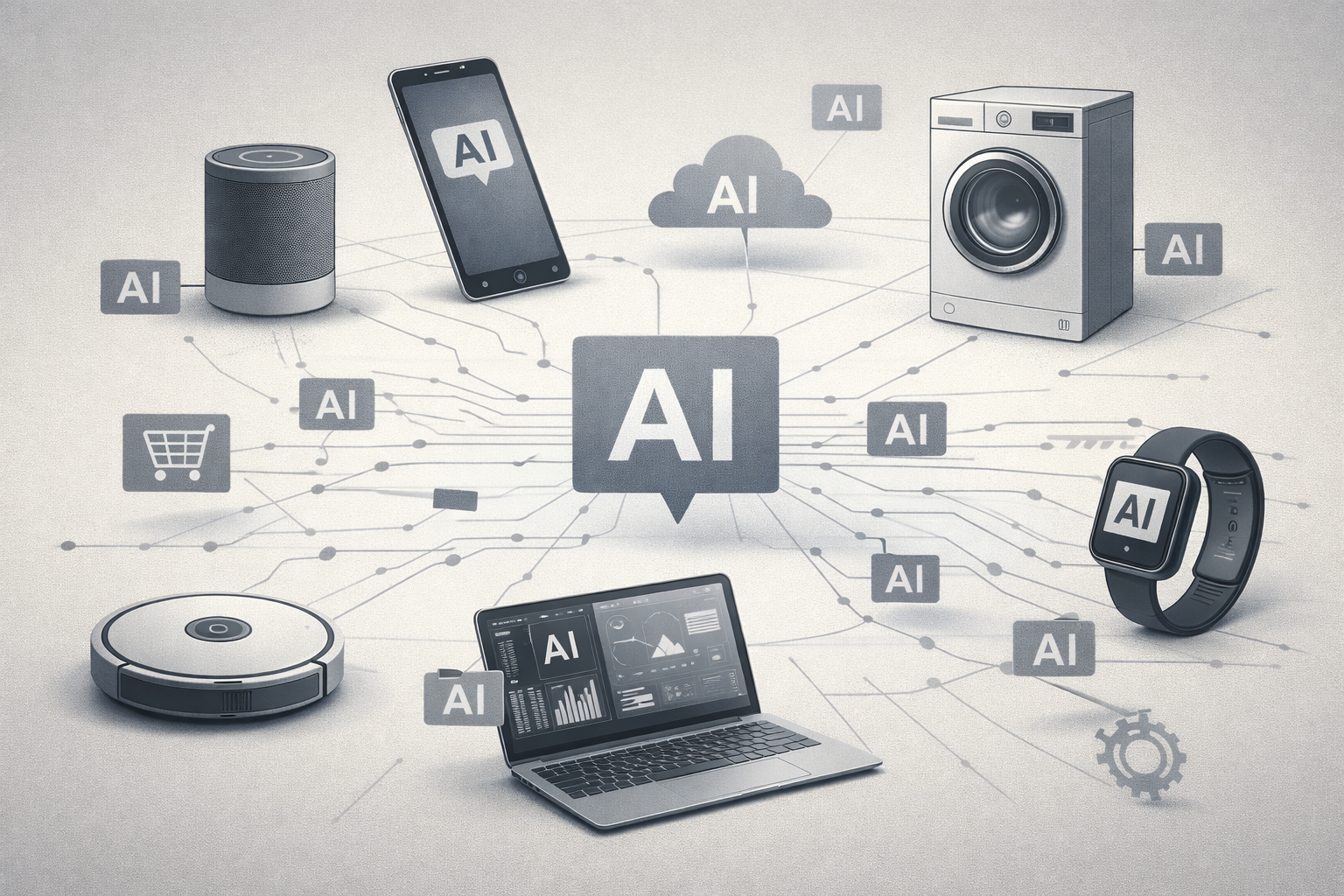
Artificial intelligence was once a technical descriptor. Today, it is a sales strategy.
Across industries from consumer electronics and finance to healthcare, retail, and enterprise software, the label “AI-powered” has become less a statement of capability than a signal of modernity. Products that would once have been described as automated, rules-based, or data-driven are now routinely presented as artificial intelligence, regardless of whether learning, reasoning, or adaptation is meaningfully involved.
This inflation of language is not accidental. It reflects a broader shift in how companies market innovation in an environment where attention is scarce, differentiation is difficult, and investors and consumers alike are primed to respond to a single, powerful term.
From Capability to Keyword
At its core, artificial intelligence refers to systems that can learn from data, adapt to new inputs, and perform tasks that typically require human judgment. In practice, however, the term has been stretched far beyond this definition.
A recommendation engine becomes “AI-driven personalisation.”
A rules-based chatbot becomes an “AI assistant.”
A workflow automation tool becomes an “AI platform.”
In many cases, the underlying technology is neither new nor especially intelligent. Statistical models, if-then logic, and deterministic automation—tools that have existed for decades—are rebranded under the AI umbrella because the label now carries commercial value.
AI, in this sense, has shifted from a description of how a system works to a shorthand for innovation itself.
Why the Incentives Encourage Overuse
There are strong incentives for companies to describe products as AI-enabled, even when the claim is tenuous.
For consumers, AI suggests sophistication, efficiency, and future-readiness. For enterprises, it signals competitiveness and relevance. For investors, it implies scalability and alignment with long-term technological trends.
In crowded markets, “AI” functions as a trust shortcut. It reduces the need for detailed explanation. A product described as AI-powered is assumed to be smarter than one that is not, even if the distinction is largely semantic.
This is particularly visible in consumer products. Smart appliances, fitness devices, cameras, and even household tools increasingly advertise AI features that amount to basic pattern recognition or preset optimisation. The technology may work well—but its intelligence is often overstated.
Automation Is Not Intelligence
One of the most common sources of confusion is the conflation of automation with intelligence.
Automation follows instructions.
Machine learning identifies patterns.
Artificial intelligence, properly defined, adapts and improves with experience.
Yet in marketing language, these distinctions are routinely collapsed. Any system that reduces human effort is framed as AI, even if it cannot learn, reason, or operate beyond predefined parameters.
This matters because it shapes expectations. When AI is presented as a universal solution, failures are perceived not as design limitations but as broken promises. Over time, this erodes trust—not only in specific products, but in the concept of AI itself.
The Enterprise Version of the Same Problem
The same pattern appears in enterprise and industrial contexts, albeit with higher stakes.
Software platforms rebrand analytics dashboards as AI insights. Customer-relationship tools describe predictive scoring as artificial intelligence. Back-office automation is repackaged as cognitive transformation.
In many cases, these tools are valuable. But the AI label obscures the real work required to deploy them effectively: data quality, process redesign, governance, and human oversight.
By framing AI as a plug-and-play solution, vendors downplay the organisational change needed to extract value. Buyers, in turn, may invest in tools without investing in capability, leading to disappointing outcomes that are blamed on the technology rather than its misuse.
A Buzzword at Risk of Exhaustion
The overuse of “AI” follows a familiar pattern. Terms such as “digital,” “cloud,” and “big data” went through similar cycles—initially precise, then expansive, and eventually diluted.
What distinguishes AI is the scale of expectation attached to it. Artificial intelligence is not merely a technological upgrade; it is often framed as a transformative force that will reshape work, decision-making, and power itself.
When everything is labelled AI, the term loses its ability to distinguish genuine breakthroughs from incremental improvement. The result is a noisy market in which serious advances coexist with superficial rebranding.
Why Precision Matters Now
This is not an argument against AI, nor a denial of its genuine impact. Advances in machine learning, natural language processing, and data-driven decision systems are real and consequential.
But clarity matters—especially as AI becomes embedded in sensitive domains such as healthcare, finance, security, and governance. When language is imprecise, accountability weakens. If a system fails, it becomes harder to determine whether the fault lies with flawed intelligence, poor data, or simple automation masquerading as something more.
For consumers, clearer language enables informed choice. For organisations, it supports better procurement and deployment decisions. For society, it preserves trust in technologies that will increasingly shape everyday life.
Beyond the Label
The real question is not whether a product uses AI, but whether it works—and under what conditions.
As the term continues to be used as a marketing shortcut, its power as a technical descriptor diminishes. What will matter more, over time, is performance, transparency, and measurable outcomes.
Artificial intelligence does not need exaggeration to be valuable. But it does need precision to remain credible.
Until that happens, “AI” will remain what it has increasingly become: not a guarantee of intelligence, but a convenient way to sell almost anything.


