


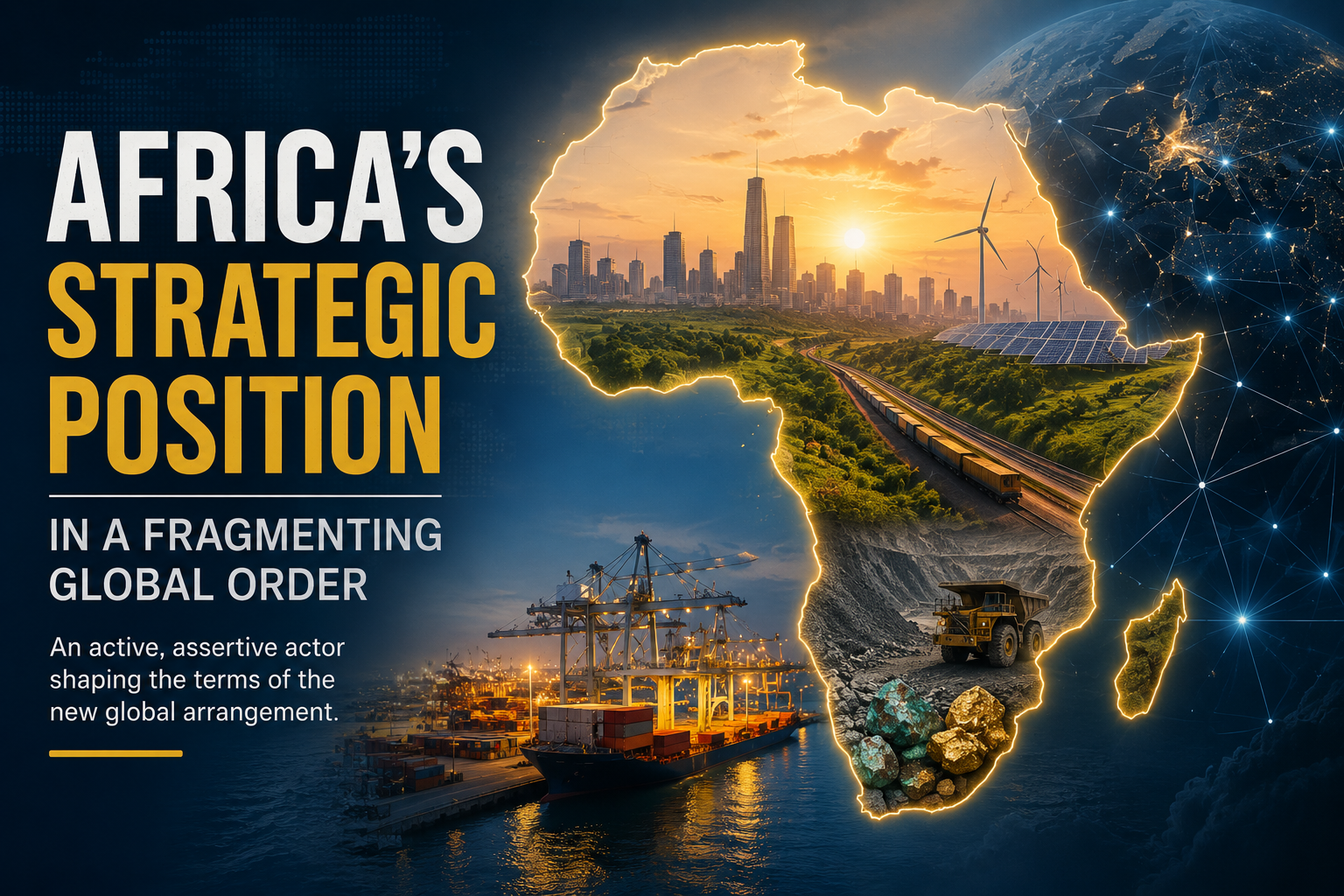
As the rules-based international order fractures along great-power fault lines, Africa is not simply a theatre of external competition — it is an active, increasingly assertive strategic actor whose choices are shaping the terms of the new global arrangement
Where Does Africa Stand in the New Global Order?
Africa in 2026 occupies a position of structural strategic importance that no major external power can ignore — and that African states are, with increasing confidence, leveraging on their own terms. The continent holds the majority of global reserves of several critical minerals essential to the clean energy transition. It represents the world’s fastest-growing population and consumer market. It controls votes in multilateral institutions that are increasingly consequential in a world where the legitimacy of the rules-based order is contested. And it is home to the largest regional bloc in the United Nations. African states are not passive recipients of great-power competition. They are strategic actors — choosing partners, setting conditions, and increasingly refusing to accept the binary choices that Cold War frameworks imposed. The era of automatic African alignment with Western-defined international norms is over. What replaces it is still being negotiated.
The fragmentation of the post-Cold War international order has not affected all regions equally. For Africa, the transition from a unipolar world to a multipolar one has created a set of strategic opportunities that are, in some dimensions, more significant than those available at any point since decolonisation. The Cold War divided Africa along ideological lines, creating client relationships that constrained strategic autonomy. The post-Cold War era brought a different form of constraint — the conditionality frameworks of Western-led international financial institutions, the normative dominance of Western-defined governance standards, and the implicit expectation of alignment with a rules-based order whose rules were written primarily in Washington, Brussels, and London.
The fracture of that order is creating space for a different kind of African agency. The entry of China, Russia, Turkey, the Gulf states, and India as significant actors in African economic and security affairs has given African governments genuine alternatives — in financing, in arms, in diplomatic support, and in the narrative frameworks through which their development challenges are understood. Whether those alternatives are ultimately better for African populations than the Western frameworks they are displacing is a question that African governments are now in a position to decide for themselves, rather than having answered for them.
This does not mean that Africa’s strategic position in 2026 is uniformly strong, or that the opportunities of multipolarity are equally available to all African states. The continent’s strategic fragmentation — between the more stable, better-governed states of East and Southern Africa and the deepening instability of the Sahel and parts of Central Africa — means that the picture is not uniform. But the direction of travel is toward greater strategic assertiveness, greater insistence on reciprocity in partnerships, and greater willingness to position African states as active shapers rather than passive recipients of the global order.
| 30%+ Share of global reserves of key clean energy transition minerals held by African countries — including cobalt, manganese, graphite, and lithium — making the continent structurally indispensable to every major economy’s decarbonisation strategy Critical mineral dependency is the most powerful structural lever in Africa’s strategic toolkit. Every major economy competing in the clean energy transition — the United States, the European Union, China, Japan, South Korea — requires African mineral resources at scale. This dependency is not temporary; it will intensify as the clean energy build-out accelerates over the coming decades. African governments that understand and exploit this leverage are in a qualitatively different negotiating position than their predecessors occupied in the commodity cycles of the twentieth century. |
Section I: The Structural Sources of African Strategic Power
Africa’s emerging strategic position rests on four structural foundations that are, in combination, more significant than any of them individually — and that are creating a new basis for African engagement with the global system that is less dependent on external validation and more grounded in genuine leverage.
| 1 MINERALS | Critical Minerals — The Clean Energy Leverage The Democratic Republic of Congo holds over 70% of the world’s cobalt reserves, essential for electric vehicle batteries and grid storage. South Africa holds 80% of global platinum group metal reserves, critical for hydrogen fuel cells and industrial catalysts. Zimbabwe, Namibia, and Mali hold significant lithium deposits. Mozambique is a major graphite producer. Zambia and the DRC together dominate global copper supply. The International Energy Agency projects that demand for these minerals will increase by 400–600% by 2040 under net-zero scenarios. Every major economy’s decarbonisation strategy is structurally dependent on African mineral supply — creating a leverage position that, if managed strategically, is unlike anything Africa has held in the global economic system. |
| 2 DEMOS | Demographic Weight — The Long-Term Strategic Asset Africa’s population is projected to reach 2.5 billion by 2050 and to account for the majority of global population growth through the remainder of the century. Africa’s median age is 19 — compared to 38 in Europe and 43 in Japan. The continent will represent the world’s largest working-age population by the 2040s. This demographic trajectory is simultaneously a development challenge — requiring massive investment in education, healthcare, and economic opportunity — and a strategic asset: a growing consumer market, a deepening labour force, and an increasing weight in global institutions. The states that invest effectively in human capital development now will capture this demographic dividend; those that do not will face the demographic penalty. |
| 3 VOTES | Multilateral Voting Weight — The Institutional Leverage Africa’s 54 member states represent 28% of the UN General Assembly. In a world where the legitimacy of international institutions and the framing of global norms is increasingly contested, that voting weight is a real form of strategic influence. African states collectively determined the framing of several key UN General Assembly resolutions on the Russia-Ukraine conflict, refusing the binary alignment that Western governments sought. African bloc coherence in multilateral forums — imperfect and contested, but real — is a lever that African governments are increasingly willing to use explicitly as a condition of diplomatic cooperation with external partners. |
| 4 LOCATION | Geographic Position — Strategic Chokepoints and Regional Connectivity Africa’s geographic position gives it strategic relevance across multiple domains. The Horn of Africa and the Red Sea corridor — already under stress from Houthi disruption in 2025-26 — passes through waters adjacent to Djibouti, Somalia, Eritrea, and Egypt, making African coastal states central to any resolution of maritime security challenges in the region. The Sahel instability corridor has direct implications for European migration pressure and for the containment of jihadist movements with global reach. And the continent’s vast territory and underdeveloped infrastructure make it the largest single opportunity for infrastructure investment and connectivity development in the global economy. |
Section II: Great-Power Competition in Africa — The New Terms of Engagement
The competition for African alignment among major external powers has intensified dramatically over the past five years, and the terms of that competition have shifted in ways that reflect Africa’s improved negotiating position. The old model — in which Western governments and international financial institutions set the terms of engagement through conditionality, and African governments largely accepted those terms because the alternatives were limited — no longer describes the operational reality.
China’s engagement model, built around infrastructure financing, resource partnerships, and explicit non-interference in domestic governance, has given African governments a reference point against which to assess Western offers and to signal their alternatives. The Belt and Road Initiative’s African infrastructure lending — now under revision as multiple projects encounter debt sustainability problems — created significant leverage for China in the short term but has also generated African frustration with debt terms, labour practices, and the limited technology transfer associated with Chinese construction contracts. The honeymoon phase of China-Africa engagement is over; what is emerging is a more transactional relationship in which African governments are pushing harder on terms.
Russia’s presence in Africa, amplified significantly by Wagner Group and its successor formations in the Sahel, has carved out an influence position in fragile state environments that Western actors have largely abandoned. Mali, Burkina Faso, Niger, and the Central African Republic have expelled French and European security presences and replaced them with Russian security contractors. The security outcomes — measured in civilian protection and state stability — have in most cases been poor. But the political outcomes — measured in African government autonomy from Western normative pressure — have been valued sufficiently by the relevant governments to sustain the relationships.
| “Africa’s strategic position in 2026 is defined by a genuine and historically unprecedented level of choice. African governments are being courted by the United States, the European Union, China, Russia, India, Turkey, and the Gulf states simultaneously — each offering a different model of partnership, a different set of conditions, and a different vision of what Africa’s role in the global order should be. The question is whether African institutions and African civil society are positioned to convert that choice into outcomes that benefit African populations rather than simply offering African elites better terms for the same extractive relationships.” — Prof. Ndubisi Obiorah Director, Africa Policy Programme, London School of Economics; former adviser to the African Union Commission |
Section III: The Sahel Fracture — Where African Strategic Potential Meets African Strategic Fragility
The most serious challenge to Africa’s emerging strategic position is internal — the deepening instability of the Sahel region, which by 2026 represents the world’s most acute concentration of active insurgencies, displaced populations, and governance collapse. Mali, Burkina Faso, Niger, and Chad are simultaneously the states most aggressively asserting sovereignty against Western frameworks and the states least capable of converting that assertion into improved outcomes for their populations.
The Sahel’s instability is not simply a security problem. It is a governance crisis produced by the intersection of climate stress — the Sahel is warming at 1.5 times the global average, with dramatic impacts on agricultural viability and pastoralist-farmer conflict — demographic pressure, state capacity collapse, and the exploitation of state weakness by jihadist movements with ideological connections to Al-Qaeda and ISIS. The military coups that have swept the region since 2020 have replaced governments without replacing the structural conditions that made those governments vulnerable.
The humanitarian consequences are severe: over 2.8 million people are internally displaced across the Sahel as of 2026, with displacement accelerating as insurgent territorial control expands and civilian protection deteriorates. The regional spillover is significant: instability is moving southward into Gulf of Guinea coastal states — Benin, Ghana, Togo, Côte d’Ivoire — that were previously insulated from Sahel-originating violence. And the European dimension — migration pressure and the potential for attack planning in ungoverned territories — ensures that Sahel instability remains a priority concern for external actors regardless of African preferences for strategic autonomy from Western security frameworks.
| Africa’s Strategic Landscape — Key Variables in 2026 Critical minerals diplomacy: African Union member states are in active negotiation with the US (Minerals Security Partnership), EU (Critical Raw Materials Act partnerships), and China over the terms of mineral extraction and processing — with increasing insistence on domestic processing requirements, technology transfer, and revenue sharing. Sahel security vacuum: The withdrawal of French forces from Mali, Burkina Faso, and Niger, and the partial drawdown of the US presence in Niger, has created security vacuums that Russian contractors, local militias, and jihadist movements are competing to fill — with deeply negative outcomes for civilian populations. AU institutional development: The African Continental Free Trade Area (AfCFTA), now in active implementation phase, represents the world’s largest free trade area by number of participating countries. Its success in creating genuine intra-African trade growth will be a major determinant of African economic sovereignty. Debt sustainability: Multiple African countries are in debt distress or approaching it — a consequence of the infrastructure financing boom of the 2010s, COVID-19 fiscal impacts, and the interest rate environment of 2022-24. The G20 Common Framework for debt restructuring has been widely assessed as inadequate; African governments are pushing for reform. |
Frequently Asked Questions
| Why is Africa strategically important in 2026? Africa’s strategic importance in 2026 rests on four structural foundations: critical mineral reserves essential to the global clean energy transition; a young and rapidly growing population that will represent the majority of global demographic growth through the century; a 54-state multilateral voting bloc that represents 28% of the UN General Assembly; and geographic position controlling key strategic corridors including the Red Sea approach and the Sahel buffer zone. These foundations give African states genuine leverage in the great-power competition that defines the current international environment — leverage that African governments are increasingly willing to exercise explicitly. |
| What is the Wagner Group’s role in Africa? The Wagner Group — and its successor formations following Yevgeny Prigozhin’s death in August 2023, now operating under more direct Russian state control as the Africa Corps — has established significant security presences in Mali, Burkina Faso, Niger, the Central African Republic, Libya, Sudan, and Mozambique. It provides palace guard and counterinsurgency services to governments that have expelled Western security partners, in exchange for mining concessions, political alignment with Russian positions in multilateral forums, and displacement of Western influence. Its security effectiveness has been poor — civilian casualties in areas of Wagner/Africa Corps operation are significantly higher than in comparable operations by other security forces — but its political utility to the governments it serves has sustained the relationships. |
| What is Africa’s position on the Russia-Ukraine conflict? African states have maintained a studied non-alignment on the Russia-Ukraine conflict that reflects both genuine strategic calculation and the exercise of leverage in multilateral institutions. The majority of African states abstained or voted against the UN General Assembly resolutions condemning Russia’s invasion or calling for Russian withdrawal — not necessarily because they support Russia’s position, but because they object to the expectation of automatic alignment with Western-defined positions, because several African states maintain significant relationships with Russia in arms, energy, and food supply, and because non-alignment is a signal of strategic autonomy that has value in the current competitive environment. |
| How significant is China’s role in Africa? China is Africa’s largest bilateral trading partner and, through the 2010s, its largest infrastructure financier. The Belt and Road Initiative delivered significant infrastructure investment across the continent — ports, railways, roads, energy facilities — with benefits that were real but accompanied by debt terms that are now generating significant stress in multiple African economies. The honeymoon phase of China-Africa engagement has passed; African governments are pushing harder on debt restructuring, local content requirements, technology transfer, and the labour practices of Chinese construction operations. China remains a central actor in African economic affairs, but the relationship is more contested and more transactional than it was a decade ago. |
Conclusion: Africa Is Not the Prize — It Is a Player
The framing of Africa as the ‘prize’ in great-power competition — the passive terrain over which the United States, China, Russia, and Europe compete for influence — fundamentally misrepresents the dynamics of the current moment. Africa is not the prize. It is, increasingly, a player — one whose choices are shaping the terms of the new global arrangement rather than simply responding to the choices of others.
That does not mean all African choices are wise, that all African governments are acting in the interests of their populations, or that the structural challenges of underdevelopment, governance fragility, and Sahel instability are not severe. They are. The strategic opportunity of multipolarity is real; whether it is converted into development outcomes or simply into better terms for elite rent-extraction will depend on the quality of African governance and the strength of African civil society institutions.
What is clear is that the era in which African states could be treated as the passive objects of external strategy — set up to receive assistance, sign commitments, and align with predetermined positions — is over. The diplomatic, economic, and normative tools through which external powers managed African alignment in the post-Cold War era are no longer sufficient. The new relationship will be negotiated on different terms, with African agency as a structural feature rather than an exception. Understanding and adapting to that reality is the central requirement of any external power that wants to maintain significant engagement with the continent.
Africa is not the prize in great-power competition. It is a player — and the great powers that fail to recognise the difference will find their African strategies producing results they did not intend.
Maritime Health Risks: The MV Hondius Hantavirus Outbreak and Its Implications


