


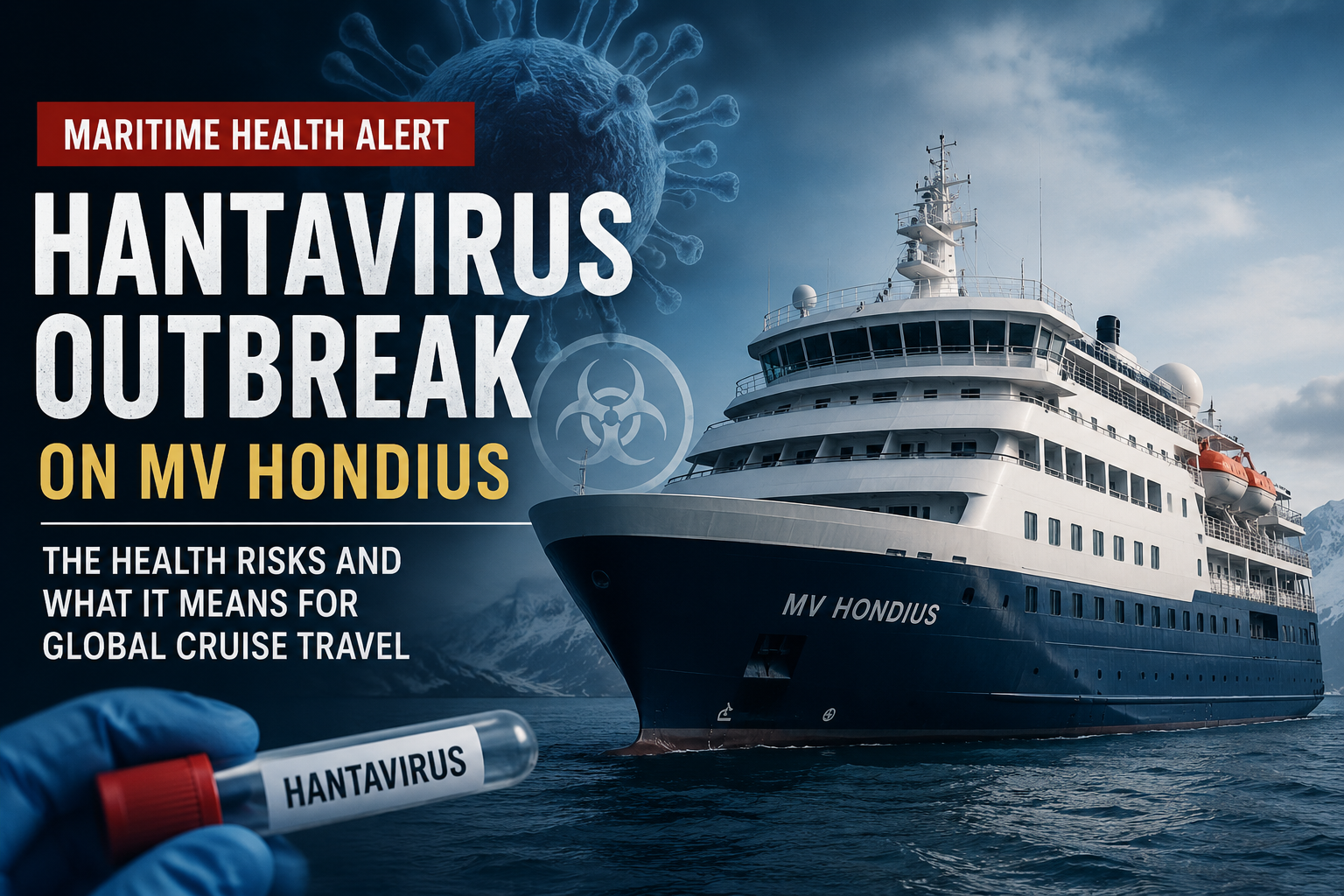
When a hantavirus cluster was confirmed aboard the expedition cruise vessel MV Hondius in Antarctic waters in April 2026, it exposed structural vulnerabilities in maritime biosecurity that extend far beyond one ship — and raised urgent questions about health governance in some of the world’s most isolated operating environments
What Happened on the MV Hondius?
In April 2026, multiple crew members aboard the MV Hondius — an expedition cruise vessel operating in sub-Antarctic waters — were confirmed or suspected to have contracted hantavirus infection. Hantavirus is a rodent-borne disease with no vaccine and no specific antiviral treatment; its most severe form, Hantavirus Pulmonary Syndrome, carries a case fatality rate of 35–40%. The outbreak prompted emergency medical evacuations, vessel quarantine protocols, and an investigation into the source of rodent exposure aboard the ship. The incident is significant not only as a public health event but as an indicator of systemic gaps in maritime biosecurity frameworks — gaps that affect expedition vessels, cargo ships, and port communities globally.
The MV Hondius is, by the standards of expedition cruising, a well-equipped and professionally operated vessel. Built in 2019 as an ice-class expedition ship, it operates in some of the most remote waters on earth — the Antarctic Peninsula, South Georgia, the Falkland Islands — carrying researchers, naturalists, and adventure travellers to environments that are accessible to very few people and that are, by definition, far from the emergency medical infrastructure that serious illness requires. When a hantavirus cluster emerged among the ship’s crew in April 2026, the medical response faced the compound challenge of managing a dangerous and unusual pathogen in a setting where evacuation to advanced care required hours or days rather than minutes.
Hantavirus infection is an uncommon but serious disease caused by viruses carried primarily by rodents — most commonly transmitted through inhalation of aerosolised rodent excreta, urine, or saliva. It does not spread person-to-person, which limits outbreak scale but does not reduce severity in those infected. Hantavirus Pulmonary Syndrome, the most dangerous clinical presentation, progresses from flu-like symptoms to acute respiratory failure with striking speed, and the window for effective intervention is narrow. In a remote maritime environment, the combination of rapid clinical deterioration, limited onboard intensive care capacity, and extended evacuation timelines creates a medical emergency of exceptional acuity.
The questions raised by the Hondius incident extend beyond the immediate clinical management of the affected crew. They concern the structural adequacy of maritime biosecurity frameworks for the vessel types and operational environments where contemporary shipping, research, and expedition travel actually occur — and the governance gaps that allow rodent stowaways, the primary vector of hantavirus transmission, to remain a persistent feature of the maritime environment despite decades of pest control requirements.
| 35–40% Case fatality rate of Hantavirus Pulmonary Syndrome (HPS) — among the highest of any rodent-borne pathogen in regular human circulation There is no approved vaccine for hantavirus infection in most of the world, and no specific antiviral therapy with demonstrated efficacy against established HPS. Management is entirely supportive: oxygen supplementation, mechanical ventilation in severe cases, and cardiovascular support. The high case fatality rate reflects both the severity of the pathogen and the narrow window between symptom onset and potential respiratory failure — a window that is compressed further in maritime settings where advanced care requires evacuation. |
Section I: Hantavirus — The Pathogen, Its Transmission, and Why Maritime Settings Are High Risk
Hantaviruses are a family of RNA viruses carried asymptomatically by specific rodent reservoir species. Different hantavirus strains are associated with different rodent hosts: Sin Nombre virus with the North American deer mouse, Andes virus with the South American long-tailed pygmy rice rat, Seoul virus with the common Norway rat, Puumala virus with the European bank vole. Human infection occurs through inhalation of aerosolised particles from infected rodent excreta — droppings, urine, or nesting material — or less commonly through direct contact with rodent saliva or bites.
The clinical presentation divides broadly into two syndromes. Hantavirus Pulmonary Syndrome (HPS), caused primarily by New World hantaviruses in the Americas, presents initially with fever, myalgia, and headache before progressing to acute pulmonary oedema and respiratory failure — often within 48–72 hours of the prodromal phase. Haemorrhagic Fever with Renal Syndrome (HFRS), caused primarily by Old World hantaviruses including Seoul and Puumala viruses, presents with haemorrhagic manifestations and acute renal failure. Both are serious; HPS is the more immediately life-threatening in the absence of intensive care support.
Maritime environments carry specific hantavirus transmission risks that are not adequately recognised in most shipping biosecurity frameworks. Rodent infestation — particularly by Norway rats and roof rats, which are globally distributed and competent hantavirus hosts — is a persistent challenge across vessel types. Port calls bring vessels into contact with local rodent populations; cargo loading and unloading provides ingress pathways; food storage areas and engine rooms create habitats that are structurally difficult to make rodent-proof. Pest control requirements exist under international maritime frameworks, but their implementation varies enormously and their surveillance mechanisms are limited.
| “What makes the maritime environment particularly concerning for hantavirus is the combination of rodent exposure risk and evacuation constraint. On land, a hantavirus patient who progresses to HPS can be in an intensive care unit within hours. On a vessel operating in remote waters, you are managing a disease that can kill in 48 hours with equipment suited to stabilisation rather than intensive care. The clinical window is the same; the resources available within it are not.” — Dr. Aileen Chang Infectious Disease Specialist; Consultant, International Maritime Health Association; lead author on rodent-borne pathogen protocols for expedition vessels |
Section II: What the Hondius Outbreak Revealed — Four Systemic Gaps
The Hondius incident is best understood not as an isolated operational failure but as a diagnostic event — one that made visible four systemic gaps in maritime health and biosecurity governance that have existed for years without generating sufficient political or regulatory attention.
| 1 BIOSEC | Rodent Control — The Gap Between Requirement and Reality International maritime regulations — specifically the International Health Regulations (IHR) administered by the WHO and the standards of the International Maritime Organization (IMO) — require vessels to maintain pest control programmes and to carry documentation of their implementation. But inspection is infrequent, documentation standards vary, and the effectiveness of pest control programmes is not systematically assessed against actual rodent presence. Norway rats are adaptive, behaviourally sophisticated, and capable of reinfesting treated vessels rapidly at subsequent port calls. The regulatory requirement exists; the surveillance system to verify it is functioning does not. |
| 2 MEDICAL | Onboard Medical Capability — Designed for Stabilisation, Not Critical Care International maritime medical requirements specify minimum onboard medical supplies and crew medical training, but these standards were designed for vessels operating within reasonable evacuation range of advanced medical facilities. Expedition vessels operating in Antarctic waters, Arctic environments, or other remote regions may be 24–72 hours from the nearest hospital with ICU capability. Hantavirus Pulmonary Syndrome can progress from prodrome to respiratory failure in that timeframe. The medical equipment and training requirements that apply to expedition vessels have not been calibrated for the severity and speed of the pathogens those vessels may encounter in their specific operating environments. |
| 3 PROTOCOLS | Outbreak Detection and Reporting — Delayed and Fragmented The reporting chain for suspected infectious disease outbreaks on maritime vessels — from shipboard medical officer to ship’s captain to flag state authority to WHO under IHR obligations — involves multiple institutional hand-offs and variable timelines. In the Hondius case, as in previous maritime outbreak incidents, the time between first clinical presentation and formal public health notification created a window during which exposure management was not yet coordinated with shore-based health authorities. Faster, standardised digital reporting protocols with direct links to port health authorities and WHO have been recommended repeatedly; implementation has been uneven. |
| 4 EVACUATION | Remote Medical Evacuation — High Consequence, Inadequate Planning Medical evacuation from vessels in Antarctic or sub-Arctic waters requires coordination between ship operators, flag state authorities, Antarctic Treaty consultation mechanisms, regional rescue coordination centres, and receiving medical facilities. This coordination is managed on an ad-hoc basis without standardised protocols that specify decision thresholds, responsible authorities, or pre-positioned evacuation assets. The result is that evacuation timelines are driven by improvisation rather than by pre-planned response frameworks — with direct consequences for clinical outcomes in time-critical conditions like HPS. |
Section III: Broader Implications — Maritime Biosecurity in a Post-COVID World
The Hondius hantavirus outbreak occurs in a global health security environment that was, notionally, transformed by the COVID-19 pandemic. The pandemic exposed the inadequacy of global health surveillance systems, the under-investment in preparedness infrastructure, and the consequences of treating health security as a secondary concern until a crisis made the costs of that treatment undeniable. Governments committed, in the aftermath of COVID-19, to strengthening the IHR framework, increasing health security investment, and building the early warning systems that pandemic preparedness requires.
The Hondius incident tests how much of that commitment has translated into the specific domain of maritime health — an area that received relatively limited attention in post-COVID health security reforms despite being one of the most significant pathways through which novel pathogens enter new geographic areas. The maritime environment connects every continent, handles the majority of global trade, and brings human populations into contact with rodent vectors and novel pathogen exposures at a scale that land-based biosecurity frameworks cannot substitute for. Strengthening maritime biosecurity is not a niche concern — it is a structural component of global health security.
The expedition cruise sector specifically warrants attention. The past decade has seen dramatic growth in expedition travel to Antarctica, the Arctic, and other remote environments, bringing larger numbers of crew and passengers into environments where pathogen exposure risks are imperfectly understood and where the distance from advanced medical care is maximal. Biosecurity standards for this sector have not kept pace with its growth.
| Key Regulatory Gaps in Maritime Biosecurity Relevant to the Hondius Incident IHR maritime provisions: The WHO’s International Health Regulations contain specific provisions for ships, including requirements for Ship Sanitation Certificates — but inspection is conducted infrequently and assessment criteria for rodent risk are not standardised across port states. IMO medical standards: The Maritime Labour Convention (MLC) 2006 sets minimum standards for onboard medical care, but these standards are not differentiated by operating environment — a vessel in the English Channel is held to the same standard as one operating in Antarctic waters. Expedition vessel regulation: Expedition cruise vessels fall under a patchwork of regulatory frameworks — SOLAS, MARPOL, MLC, Antarctic Treaty requirements — with no single authority responsible for biosecurity standards specific to remote-environment operations. Zoonotic pathogen surveillance: There is no systematic surveillance programme for rodent-borne pathogen presence on maritime vessels — neither self-reporting requirements nor independent testing of rodent populations in vessel pest control programmes. |
Frequently Asked Questions
| What is hantavirus and how is it transmitted? Hantaviruses are RNA viruses carried asymptomatically by specific rodent species — primarily mice and rats. Human infection occurs most commonly through inhalation of aerosolised particles from infected rodent droppings, urine, or saliva, or through direct contact with rodent material. Hantavirus does not spread person-to-person, which limits outbreak size but does not reduce severity. The most dangerous form, Hantavirus Pulmonary Syndrome (HPS), carries a case fatality rate of 35–40% and can progress from initial flu-like symptoms to fatal respiratory failure within 48–72 hours. There is no approved vaccine and no specific antiviral treatment. |
| Why was the MV Hondius incident particularly serious? The combination of a high-mortality pathogen and a remote operating environment created a compounding clinical risk. The MV Hondius was operating in sub-Antarctic waters — potentially 24–72 hours from an ICU facility — when the hantavirus cases were identified. Hantavirus Pulmonary Syndrome can become life-threatening within the evacuation window available in that environment. The incident also exposed gaps in maritime biosecurity protocols: rodent control verification, outbreak reporting chains, and medical evacuation coordination were all found to require improvement. |
| How do rodents get onto expedition vessels? Rodent infestation of ships occurs primarily during port calls, through hawsers and mooring lines, through cargo loading and unloading, and through gaps in hull structure and ventilation systems. Norway rats and roof rats are globally distributed, behaviourally sophisticated, and highly adaptable to shipboard environments — finding harborage in engine rooms, cargo holds, and food storage areas that are structurally difficult to make rodent-proof. Pest control requirements exist under international maritime regulations, but inspection is infrequent and re-infestation between inspections is common. Ship Sanitation Certificates, which document pest control status, are issued after inspections that may be months old by the time a vessel encounters a new port. |
| What changes to maritime biosecurity are needed? Priority reforms include: differentiated medical equipment and training standards for expedition vessels operating beyond reasonable evacuation range, calibrated to the pathogens of specific operating regions; mandatory pre-departure rodent risk assessments with independent verification rather than operator self-certification; standardised digital outbreak reporting protocols with direct links to WHO and port health authorities; pre-planned medical evacuation frameworks for Antarctic and Arctic operating areas with defined decision thresholds and pre-positioned assets; and systematic zoonotic pathogen surveillance in maritime pest control programmes. |
| Is hantavirus a risk to passengers on cruise ships? The risk to passengers on conventional cruise vessels operating in port-intensive itineraries is very low — hantavirus requires direct exposure to rodent excreta, and passengers on large cruise ships have minimal exposure to the below-deck areas where rodents would most likely be present. The risk is meaningfully higher for crew members, particularly those working in engine rooms, cargo spaces, and food storage areas where rodent exposure is more probable. On expedition vessels operating in regions where hantavirus-carrying rodent species are endemic — South America, North America, parts of Asia — and which call at remote ports with potentially high rodent populations, the risk profile warrants specific biosecurity attention. |
Conclusion: One Outbreak, One Ship, One Warning
The MV Hondius hantavirus outbreak is, in scale, a limited event: a small number of cases on a single vessel, managed with significant operational difficulty but without the mass casualty outcome that the pathogen’s lethality makes possible. In its implications, it is considerably more significant — a documented failure of maritime biosecurity frameworks that, in a different set of circumstances, could produce a very different outcome.
The maritime environment is not peripheral to global health security. It is central to it — a network of connections between every port, every continent, and every pathogen reservoir on earth. The rodent stowaways that are the vector of hantavirus transmission are also potential vectors for plague, leptospirosis, and other serious zoonotic diseases. The gaps in inspection, reporting, and medical preparedness that allowed the Hondius incident to develop as it did are gaps in a system that handles more than 90% of global trade and that connects billions of people to the global health security architecture.
The post-COVID commitment to health security preparedness will be measured not only by pandemic response capability but by the unglamorous, technically demanding work of closing the specific gaps that specific incidents expose. The Hondius outbreak has exposed several of them clearly. Whether that clarity produces regulatory action, or fades into the institutional memory as an interesting case study, will determine whether the next maritime hantavirus incident — and there will be one — produces a better outcome.
One vessel, one cluster, one warning — that the maritime biosecurity framework has not kept pace with the environments, the pathogens, or the consequences of getting it wrong.
Universal Healthcare Was a Promise. Economics Is Rewriting It


