


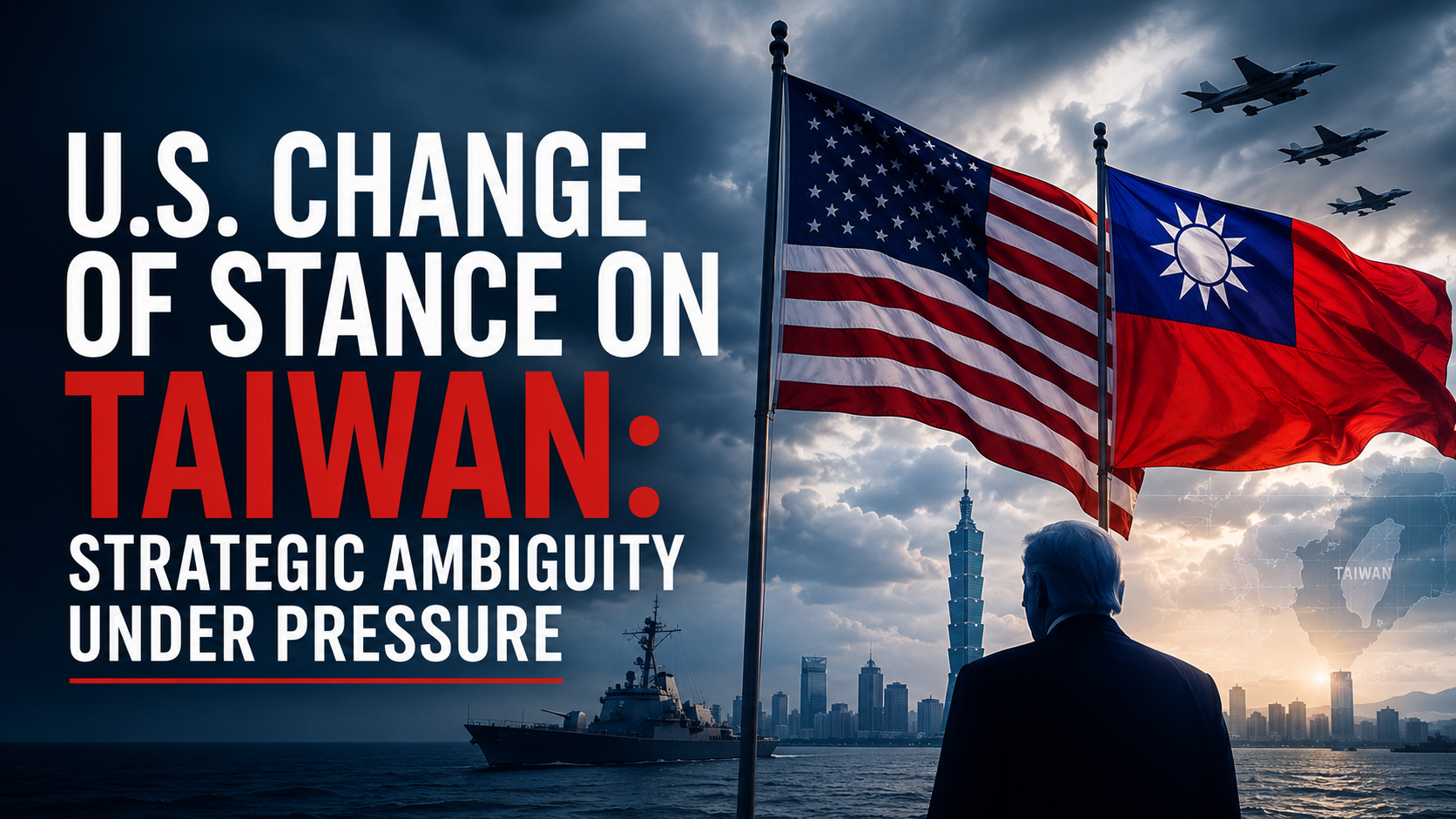
For decades, the United States maintained a carefully calibrated policy toward Taiwan built around “strategic ambiguity” — supporting Taiwan militarily and politically without formally recognizing it as an independent state or explicitly committing to military intervention in the event of a Chinese attack. That policy helped preserve relative stability across the Taiwan Strait while allowing Washington to deter Beijing without formally crossing China’s red lines.
In 2026, however, that balance is under increasing strain.
The combination of rising Chinese military power, intensifying U.S.–China strategic competition, semiconductor dependency, and shifting American global priorities is creating growing uncertainty around Washington’s long-term commitment to Taiwan’s defense. Recent reports suggesting delays or recalibration in aspects of U.S. arms support to Taiwan — amid Middle East military pressures and broader strategic resource constraints — have amplified concerns in Taipei and across Asia, even as senior American officials publicly insist that official U.S. policy remains unchanged.
The deeper question is no longer whether the United States supports Taiwan in principle. It clearly does. The real question is whether Washington is reassessing the scale of risk it is willing to absorb in order to deter or confront China in the Indo-Pacific.
What is emerging is not necessarily abandonment, but a more uncertain, transactional, and strategically constrained version of American commitment — one that could reshape the future of the Asia-Pacific security order itself.
Where Does Taiwan Stand in 2026?
Taiwan in 2026 occupies one of the most strategically sensitive positions in the global system.
It is simultaneously:
- The center of advanced semiconductor manufacturing
- A frontline territory in U.S.–China strategic competition
- A critical node in Indo-Pacific maritime security
- A symbolic sovereignty issue for Beijing
- A test case for American deterrence credibility
The island’s geopolitical importance has grown dramatically over the past decade as the global economy became increasingly dependent on Taiwanese semiconductor production, particularly advanced chips produced by companies such as TSMC. Taiwan’s semiconductor sector is now deeply integrated into:
- Artificial intelligence infrastructure
- Military systems
- Consumer electronics
- Automotive manufacturing
- Global data centers
This technological centrality means that any conflict involving Taiwan would not remain a regional military crisis. It would become an economic shock with global consequences.
At the same time, China’s military posture toward Taiwan has become increasingly aggressive. Chinese military aircraft and naval operations around Taiwan have expanded significantly, while Beijing continues to describe reunification as a core national objective that cannot be postponed indefinitely.
The United States, meanwhile, continues to increase military cooperation, training coordination, and arms support for Taiwan — but without abandoning the formal One China framework that has underpinned diplomatic relations since the 1970s.
The result is a highly unstable equilibrium in which all major actors are increasing deterrence measures while attempting to avoid triggering open conflict.
Section I: The Historical Framework — How Strategic Ambiguity Worked
The modern Taiwan framework emerged from the diplomatic restructuring of the 1970s.
Following the normalization of U.S.–China relations under President Richard Nixon and later formal diplomatic recognition of the People’s Republic of China in 1979, Washington adopted the “One China” policy — acknowledging Beijing’s position that Taiwan is part of China while deliberately avoiding an explicit position on Taiwan’s sovereignty status.
At the same time, Congress passed the Taiwan Relations Act, which allowed the United States to continue providing defensive support and military assistance to Taiwan despite the absence of formal diplomatic recognition.
This produced the doctrine later known as strategic ambiguity.
Under this approach:
- The U.S. would support Taiwan militarily
- China would be deterred from invasion
- Taiwan would be discouraged from declaring formal independence
- Neither side would receive absolute clarity about American military intervention
For decades, this ambiguity reduced incentives for escalation.
The framework functioned effectively partly because:
- China’s military capabilities remained limited
- Taiwan avoided formal independence declarations
- The U.S. retained overwhelming Indo-Pacific military dominance
- Economic integration between China and the global economy deepened
That environment no longer exists.
China’s military modernization has accelerated dramatically. The People’s Liberation Army Navy has become one of the world’s largest naval forces. Chinese missile systems increasingly threaten U.S. bases and carrier operations in the Western Pacific. At the same time, Taiwan’s strategic importance to the global technology economy has grown exponentially.
Strategic ambiguity was built for a different geopolitical era.
“The Taiwan issue is no longer simply about territorial sovereignty. It has become the intersection point of military deterrence, semiconductor dependency, alliance credibility, and great-power competition. That makes it far more dangerous than previous Taiwan Strait crises.”
— Regional Security Analyst, Indo-Pacific Strategic Studies Forum
Section II: The Current Reality — What Is Changing in 2026
The current Taiwan situation is defined less by formal policy change than by strategic recalibration.
Washington officially insists its position remains unchanged:
- Support for the One China framework
- Opposition to unilateral status changes
- Continued support for Taiwan’s self-defense
Yet operational realities are creating visible tensions inside that framework.
Military Resource Pressure
The United States now faces simultaneous global security burdens:
- Indo-Pacific competition with China
- Middle East instability
- European commitments linked to Russia
- Expanding naval deployment requirements
This has intensified debate inside Washington over force allocation, military sustainability, and defense-industrial limitations.
Recent concerns over slowed arms delivery timelines to Taiwan have reinforced fears that America’s military commitments may be stretching beyond available production capacity.
Taiwan’s leadership increasingly understands that future defense may depend heavily on:
- Domestic resilience
- Asymmetric warfare preparation
- Civil defense expansion
- Distributed military infrastructure
Rather than assuming unlimited American intervention capacity.
China’s Expanding Pressure Campaign
China’s strategy toward Taiwan increasingly combines:
- Military intimidation
- Economic leverage
- Diplomatic isolation
- Cyber operations
- Information warfare
Beijing appears to prefer gradual pressure over immediate invasion. The objective is not necessarily immediate military conquest, but long-term erosion of Taiwan’s confidence, international space, and strategic certainty.
Chinese pressure now extends into:
- Maritime patrol expansion
- Encirclement-style naval exercises
- Economic coercion
- Diplomatic pressure on third countries
- Influence operations targeting Taiwanese politics
The cumulative effect is designed to normalize Chinese strategic dominance around Taiwan without necessarily triggering direct war.
Taiwan’s Internal Dilemma
Taiwan itself faces a growing strategic dilemma.
A stronger Taiwanese identity has emerged over the past two decades, particularly among younger generations. Public opinion increasingly favors maintaining de facto independence even without formal declaration.
At the same time, Taiwan understands that:
- Formal independence could trigger Chinese military action
- Overdependence on the U.S. creates strategic vulnerability
- Economic exposure to China remains significant
Taiwan therefore continues navigating a narrow path between deterrence and provocation.
Section III: Future Scenarios — The Range of Outcomes
The future of Taiwan no longer revolves around a single invasion scenario. Instead, several parallel trajectories are becoming increasingly plausible.
Continued Strategic Ambiguity (Most Likely Near-Term)
The most likely short-term outcome remains continuation of the current framework:
- No formal Taiwanese independence
- No Chinese invasion
- Ongoing military pressure
- Expanding deterrence preparations
- Periodic geopolitical crises
This scenario preserves relative stability while maintaining constant strategic tension.
However, it also increases the risk of accidental escalation due to:
- Naval incidents
- Airspace encounters
- Cyber conflict
- Miscalculation during military exercises
Strategic Clarity Shift (Possible)
Some U.S. policymakers increasingly advocate moving from strategic ambiguity toward “strategic clarity” — explicitly committing to Taiwan’s defense.
Supporters argue this would strengthen deterrence against Beijing.
Critics warn it could:
- Accelerate Chinese military timelines
- Trigger arms escalation
- Reduce diplomatic flexibility
- Increase risk of preemptive confrontation
Beijing would likely interpret explicit U.S. guarantees as movement toward permanent Taiwanese separation.
Gradual Taiwanese Self-Reliance (Increasingly Likely)
Another emerging scenario involves Washington quietly shifting toward a more self-reliance-oriented Taiwan strategy.
Under this approach:
- Taiwan expands domestic defense production
- Civilian mobilization increases
- Asymmetric warfare capabilities grow
- U.S. support continues but becomes less open-ended
This reflects growing recognition inside Washington that future conflicts with China could involve extremely high military and economic costs.
Economic Bargaining Framework (Long-Term Possibility)
A more controversial possibility is that Taiwan becomes increasingly linked to broader U.S.–China negotiations involving:
- Trade agreements
- Technology restrictions
- Semiconductor supply chains
- Maritime security
- Global financial systems
While unlikely to involve outright abandonment, Taiwan could become part of a larger strategic bargaining environment between Washington and Beijing.
This prospect creates deep concern in Taipei because uncertainty itself can undermine deterrence.
Frequently Asked Questions
What is strategic ambiguity?
Strategic ambiguity is the long-standing U.S. policy of supporting Taiwan’s defense without explicitly guaranteeing military intervention if China attacks. The objective is to deter both Chinese invasion and Taiwanese declarations of formal independence while preserving flexibility for Washington.
Why is Taiwan so important globally?
Taiwan is central to:
- Advanced semiconductor manufacturing
- Indo-Pacific shipping routes
- U.S.–China strategic competition
- Global technology infrastructure
Disruption to Taiwan’s semiconductor production alone could severely impact global supply chains, AI systems, telecommunications, automotive production, and defense industries.
Does the United States officially recognize Taiwan?
No. The United States officially recognizes the People’s Republic of China as the legal government of China under the One China policy. However, Washington maintains extensive unofficial relations with Taiwan and provides military and political support through the Taiwan Relations Act.
Could China invade Taiwan?
China possesses growing military capability to pressure or potentially invade Taiwan, but such an operation would involve enormous military, economic, and political risks. Most analysts believe Beijing currently prefers pressure, coercion, and long-term strategic erosion over immediate full-scale invasion.
Why are U.S.–China tensions over Taiwan increasing?
Several factors are driving escalation:
- Chinese military modernization
- Taiwan’s growing strategic importance
- Semiconductor dependency
- U.S.–China technological rivalry
- Expanding Indo-Pacific military competition
- Nationalist political pressures in both Beijing and Washington
Conclusion: The End of Comfortable Ambiguity
The Taiwan question is entering a new phase in which the assumptions that sustained stability for decades are becoming increasingly difficult to maintain.
Strategic ambiguity worked in an era where:
- China was weaker militarily
- Globalization reduced geopolitical confrontation
- Taiwan’s economic role was important but not systemically critical
- U.S. military dominance in Asia was largely uncontested
That world has changed.
Today Taiwan sits at the intersection of:
- Great-power rivalry
- Semiconductor dependency
- Maritime security
- Technological competition
- National identity politics
The danger is not only intentional conflict. The greater danger may be cumulative strategic uncertainty — a situation where all actors increase deterrence simultaneously while becoming less certain about each other’s limits and intentions.
China may test American resolve if it perceives hesitation.
Taiwan may militarize more aggressively if it fears abandonment.
The United States may seek greater burden-sharing as global military pressures expand.
The result is an Indo-Pacific environment that is becoming more heavily armed, more economically interconnected, and more strategically unstable at the same time.
The era of comfortable strategic ambiguity may be ending.
What replaces it could define the future balance of power in Asia for decades to come.
Structured in the analytical long-form format inspired by the uploaded reference document.


