


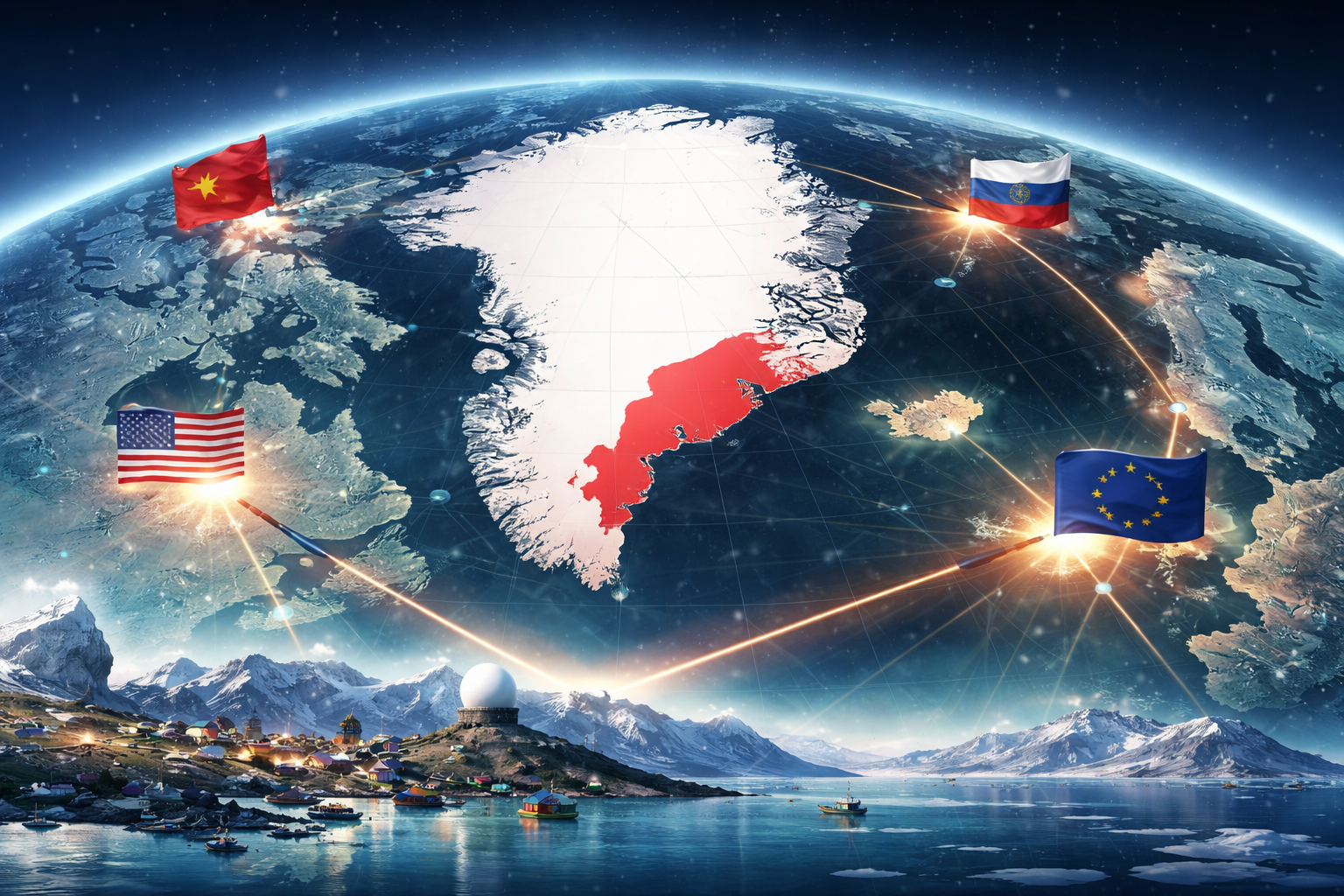
The framing of climate change as an environmental issue is functionally obsolete. Climate risk is now a structural force reshaping economies, destabilising regions, redefining national security, and concentrating geopolitical power around the states that control the infrastructure of climate management
Why Is Climate a Security Issue?
Climate change became a security issue when its consequences began to intersect directly with the conditions that produce political instability, resource conflict, and strategic competition — and it became a strategic issue when the infrastructure required to manage those consequences began to concentrate power among the states that control it. Water scarcity is fuelling geopolitical tensions in regions where hydrological systems are under stress. Infrastructure shocks from extreme weather are disrupting economic systems and testing state capacity. Meteorological and forecasting data is emerging as a strategic resource that shapes defence operations, economic decision-making, and disaster response. Climate is no longer a sector to be managed at the margins of economic and security policy. It is a system-level force that is reshaping the distribution of power, stability, and growth.
The intellectual transition that climate change required of policymakers — from environmental problem to economic risk to security challenge — has taken decades to complete, and it is still incomplete in many of the institutional frameworks that govern responses to it. The UNFCCC was established to manage emissions. The IPCC was established to assess scientific consensus. The COP process was established to negotiate commitments. All of these institutions were designed for a world in which climate change was, primarily, a problem to be solved rather than a force to be managed — a condition to be reversed rather than a structural reality to be adapted to.
That framing is now functionally obsolete. The emissions that have already entered the atmosphere guarantee a level of climate change that will produce consequences for economies, societies, and security environments regardless of what is achieved in future mitigation efforts. The question for most of the policy community has shifted from how to prevent climate change to how to manage its consequences — and the consequences are increasingly visible, increasingly costly, and increasingly political.
Extreme weather events that were once characterised as anomalies are now recurring features of the global system. The economic costs — infrastructure damage, agricultural disruption, energy system stress, insurance losses — are measurable and growing. The security implications — water stress, food system disruption, displacement, and the amplification of existing political conflicts — are being integrated into national security frameworks by defence establishments that were previously resistant to treating climate as a strategic variable. And the geopolitical implications — the emergence of climate infrastructure as a new dimension of strategic power, the water security nexus as a source of inter-state tension, and the divergence between climate-vulnerable and climate-resilient states — are reshaping the international order in ways that the established frameworks of geopolitical analysis are only beginning to incorporate.
| $38 trillion Estimated annual economic loss from climate change impacts by 2049 under current trajectory — equivalent to approximately 17% of projected global GDP The IMF’s 2023 assessment of climate’s macroeconomic impact produced figures that transformed the debate about climate investment from an environmental cost-benefit calculation to a fiscal risk management imperative. At projected impact levels, the cost of climate inaction substantially exceeds the cost of climate adaptation and mitigation investment — which means that framing climate spending as a burden on economic growth inverts the actual risk calculus. The fiscal risk of inaction is orders of magnitude larger than the fiscal cost of action. |
Climate as Threat Multiplier — How Environmental Stress Becomes Security Crisis
The concept of climate as a ‘threat multiplier’ — a force that amplifies existing vulnerabilities, intensifies existing conflicts, and accelerates existing pressures rather than creating entirely new ones — has gained increasing acceptance in security establishments over the past decade. What the concept captures is the mechanism through which environmental stress translates into political instability: not through direct causation, but through the intensification of conditions that make political systems fragile.
Water scarcity is the most direct and consequential manifestation of this dynamic. Climate change is altering precipitation patterns, accelerating glacial melt, increasing evaporation rates, and shifting the seasonal availability of water resources across multiple regions simultaneously. In the Nile basin, the Grand Ethiopian Renaissance Dam has become a focal point for Egyptian-Ethiopian-Sudanese tensions that are driven partly by genuine fears about downstream water availability under climate-stressed conditions. In South Asia, Himalayan glacial retreat threatens the medium-term viability of river systems that support hundreds of millions of people and that cross multiple national boundaries. In the Middle East, water stress is a structural feature of political landscapes already characterised by conflict and fragility.
Food system disruption compounds the water security challenge. Agricultural productivity is sensitive to temperature increases, precipitation changes, and the increasing frequency of extreme weather events in ways that translate climate risk into food price volatility, supply chain disruption, and the economic stress that has historically been a precondition for political instability. The 2010-2011 food price spike — driven partly by climate-related agricultural disruptions — is widely assessed as one of the contributing factors to the Arab Spring uprisings. The relationship between climate stress, food system disruption, and political instability is not hypothetical. It is demonstrated.
| “Climate change doesn’t cause wars — human decisions cause wars. But climate change systematically degrades the conditions under which peaceful human decisions are more likely: adequate food, accessible water, functioning economies, and the reasonable expectation of a stable future. When those conditions deteriorate, the probability of violent conflict increases. That is what we mean when we say climate is a threat multiplier — not that drought pulls triggers, but that it loads them.” — Dr. Katharine Mach Professor, Rosenstiel School of Marine, Atmospheric and Earth Science, University of Miami; lead author, IPCC Working Group II |
Early Warning, Late Action — The Institutional Gap Between Knowledge and Response
One of the most instructive paradoxes of the contemporary climate governance landscape is the divergence between the sophistication of climate prediction systems and the inadequacy of the institutional response to what they predict. Early warning capabilities have advanced dramatically over the past three decades. Meteorological satellites, ocean buoy networks, atmospheric monitoring systems, and computational modelling have produced a forecasting infrastructure of extraordinary power — capable of providing advance warning of extreme weather events at timescales and geographic resolutions that were impossible a generation ago.
Yet the translation of that warning capability into effective preparedness response remains deeply inadequate across much of the world. Early warning systems are one link in a chain that must also include effective communication to at-risk populations, governance structures capable of acting on warnings in the available time window, physical infrastructure resilient enough to withstand the events being warned against, and financial resources to support response and recovery. In least-developed countries and in many middle-income ones, multiple links in this chain are weak or absent — which means that improved prediction capability translates into more precise knowledge of impending disasters without meaningfully improving the capacity to manage them.
The investment pattern reinforces this imbalance. Early warning systems are technically tractable, internationally visible, and generate compelling return-on-investment narratives — the World Meteorological Organization estimates that a 24-hour advance warning of a hazardous weather event can reduce resulting damage by 30%, and that early warning systems generate benefits 10 to 20 times their cost. They therefore attract funding and institutional attention. Broader adaptation investment — infrastructure resilience, community-level preparedness, governance capacity, and the less technically legible work of building the institutional systems that convert warnings into effective action — is less visible, less tractable, and consistently underfunded.
| 1 DETECTION | Early Warning — Where Progress Has Been Made Meteorological and hydrological monitoring systems have advanced significantly, with satellite coverage, ocean observation networks, and atmospheric modelling providing unprecedented predictive capability for extreme weather events. The WMO’s Early Warnings for All initiative represents the most ambitious effort to date to extend this capability to the most vulnerable populations globally. Detection capability, while still uneven, is the strongest link in the preparedness chain. |
| 2 COMMS | Communication — The Last-Mile Problem Warning systems that reach national meteorological services do not automatically reach the farmers, coastal communities, and urban poor whose lives and livelihoods are at greatest risk. The last-mile communication challenge — converting technical forecasts into actionable information for specific at-risk populations, in formats and languages they can use, through channels they trust — remains one of the most persistent gaps in preparedness systems. Technology is improving this: mobile phone penetration enables direct alert delivery; social media accelerates information diffusion. Institutional coordination remains the binding constraint. |
| 3 RESPONSE | Institutional Response Capacity — The Governance Gap Converting a warning into effective protective action requires governance structures with the authority, resources, and coordination capacity to act in the available time window. This is the weakest link in the chain across most of the developing world. Fragmented local governance, unclear institutional responsibilities, insufficient pre-positioned resources, and limited coordination between national and local systems mean that accurate and timely warnings frequently fail to produce effective protective action — not because the warning was not received, but because the institutional capacity to act on it was absent. |
| 4 RECOVERY | Post-Event Recovery — The Cycle That Must Be Broken The current reactive model of climate disaster management — warn, respond, rebuild — recreates the vulnerability it was supposed to address by reconstructing the same infrastructure in the same high-risk locations with the same inadequate resilience standards. Breaking this cycle requires recovery frameworks that integrate risk reduction into reconstruction, that use post-disaster reconstruction windows to build resilience rather than simply restore previous conditions, and that are financed at sufficient scale and duration to enable genuine transformation rather than rapid reinstatement of the status quo ante. |
Water, Data, and Power — The Geopolitics of Climate Infrastructure
The most consequential geopolitical dimension of climate change in the coming decades may not be the direct impact of extreme weather events — destructive as those will be — but the strategic competition over the infrastructure required to manage climate risk: water systems, forecasting infrastructure, data networks, and the institutional architectures that govern access to these resources.
Water is the most immediate and tangible dimension of this competition. Transboundary river systems — which supply water to some of the world’s most populated and most politically volatile regions — are under increasing stress from climate change, population growth, and upstream infrastructure development. The political architecture governing these systems, where it exists at all, was designed for a different hydrological reality and is under increasing strain. As water availability declines in some regions and becomes more variable in others, the states that control upstream access, storage infrastructure, and distribution systems will exercise increasing leverage over downstream populations that have no alternative supply.
Climate data and forecasting infrastructure is emerging as a less visible but strategically significant dimension of the same dynamic. Meteorological systems — once understood as purely scientific infrastructure — now play roles that are directly relevant to defence operations (weather affects military planning and operations), economic decision-making (financial markets use weather data for agricultural commodity forecasting), energy system management (renewable energy dispatch depends on weather forecasting), and disaster response (emergency management agencies depend on prediction systems). The European Centre for Medium-Range Weather Forecasts (ECMWF) represents the most sophisticated example of how shared investment in forecasting infrastructure can generate strategic advantage — while also demonstrating that this infrastructure, like all strategic infrastructure, is subject to competition over access, control, and financing.
| “We are moving into an era where meteorological data is strategic data — where the ability to predict weather at high resolution and long range is as significant for economic competitiveness and security planning as the ability to predict financial markets or anticipate adversary military moves. The countries and institutions that control the best forecasting infrastructure will not just manage climate risk better than those that don’t. They will exercise a form of informational power that we are only beginning to understand.” — Prof. Peter Bauer Deputy Director for Research, ECMWF; former coordinator of the World Weather Research Programme |
The Governance Gap — Why Knowledge Does Not Produce Action
The persistent failure to translate overwhelming scientific knowledge about climate risk into adequate policy response is not primarily a problem of insufficient information or insufficient technology. It is a problem of governance — of the political, institutional, and financial structures that determine how collective action problems are managed in a fragmented international system.
The global climate governance architecture — built around the UNFCCC, the COP process, and voluntary national commitments — was designed for a world in which the primary challenge was building sufficient international consensus to justify action. That design reflected the political realities of the 1990s, when scientific consensus was still contested, major economies were unwilling to accept binding commitments, and the primary obstacle to action was legitimacy rather than execution. The architecture was therefore optimised for the production of agreements rather than the delivery of outcomes.
In 2026, the failure mode has changed. Scientific legitimacy is no longer the binding constraint — the IPCC’s assessments command overwhelming consensus, and the real-world evidence of climate impacts has converted even previously sceptical constituencies. The binding constraint is execution: the capacity of national governments to implement the commitments they have made, the availability of finance to support adaptation in vulnerable countries that contributed minimally to the problem, and the institutional coordination required to manage the cross-sectoral, cross-jurisdictional nature of climate response at the scale and speed required.
| The Four Execution Gaps in Global Climate Governance Finance delivery: The $100 billion per year climate finance commitment made in Copenhagen in 2009 was not met until 2022, and the quality of finance counted toward the commitment — including loans rather than grants — has been consistently contested by recipient countries. The $1.3 trillion per year assessed as necessary for adequate developing country adaptation and mitigation remains a political commitment without a delivery architecture. National implementation: The gap between Nationally Determined Contributions submitted under the Paris Agreement and the policies actually implemented at national level is substantial across most major emitters. The institutional capacity to implement complex, cross-sectoral policy programmes is the binding constraint that NDC accounting frameworks do not measure. Loss and damage: The Loss and Damage Fund established at COP27 and operationalised at COP28 represents a political breakthrough but a delivery challenge: determining eligibility, establishing causation, and disbursing funds at the scale required by the most vulnerable countries requires institutional infrastructure that is still being built. Adaptation investment: Global adaptation finance represents approximately 10% of total climate finance — a proportion that reflects the prioritisation of mitigation (which generates measurable emissions reductions) over adaptation (which prevents losses that are harder to quantify). The consequence is systematic underfunding of the preparedness, resilience, and institutional capacity-building that vulnerable populations most immediately need. |
Frequently Asked Questions
| Why is climate change considered a national security issue? Climate change has been formally integrated into national security frameworks by defence establishments in the United States, United Kingdom, European Union, and multiple other countries because its consequences directly affect the conditions for political stability, military operations, and strategic competition. Water scarcity amplifies inter-state and intra-state conflict risk. Food system disruption creates economic stress that has historically preceded political instability. Extreme weather events destroy infrastructure and test state capacity. And the competition over climate infrastructure — water systems, forecasting data, adaptation finance — is emerging as a new dimension of geopolitical rivalry. The US Department of Defense has assessed climate change as a risk multiplier since 2014; that assessment has only strengthened as the evidence has accumulated. |
| How effective are climate early warning systems? Early warning systems for extreme weather events are among the most cost-effective investments in climate risk management — generating estimated benefits 10 to 20 times their cost and significantly reducing mortality from events they successfully predict and communicate. Their effectiveness is highest where the full chain from detection to communication to institutional response to recovery is functioning; lowest where the detection capability exists but institutional response capacity is absent. The primary gap is not in prediction technology but in the governance systems, local infrastructure, and financial resources required to act effectively on accurate warnings. |
| What is the geopolitics of water and how does climate change affect it? Transboundary water systems — river basins, shared aquifers, and regional precipitation patterns — are shared resources whose governance has always been politically complex. Climate change is intensifying this complexity by altering water availability, increasing variability, and creating new scarcity conditions in regions that previously had adequate supply. Upstream states with the infrastructure to capture and store water gain leverage over downstream populations that depend on the same systems. The combination of climate stress, population growth, and inadequate governance frameworks for shared water systems is one of the highest-probability pathways from environmental change to geopolitical conflict over the coming decades. |
| Why has the global climate governance system failed to deliver adequate action? The UNFCCC-COP architecture was optimised for building consensus around voluntary commitments — which it has achieved, producing the Paris Agreement and successive rounds of Nationally Determined Contributions. Its failure mode is execution: the gap between the commitments made in international negotiations and the policies implemented by national governments, the gap between the finance committed and the finance delivered, and the gap between the institutional frameworks agreed and the operational capacity to implement them. These are governance and execution failures, not primarily scientific or political ones. The knowledge exists. The commitments exist. The delivery systems do not. |
| How is climate data becoming a strategic resource? High-resolution, long-range weather and climate forecasting is becoming strategically significant because its applications extend well beyond meteorology: defence operations planning, agricultural commodity markets, renewable energy dispatch optimisation, infrastructure resilience assessment, and disaster response all depend on forecasting quality. States and institutions that control the most capable forecasting infrastructure — through investment in satellites, ocean observation systems, and modelling capacity — have informational advantages with both economic and security dimensions. The emerging question is whether climate data should be governed primarily as a public good (as the traditional WMO framework envisions) or as a strategic asset subject to access restrictions and competitive control. |
The Infrastructure of Survival — Who Controls the Climate Century
Climate change has completed its transition from environmental concern to structural force — a system-level pressure that is reshaping the conditions under which economies grow, political systems function, and states exercise power. The institutions built to manage it as an environmental problem are not adequately designed for this reality. The governance frameworks optimised for producing agreements are not producing the execution that the agreements require. And the investment patterns that have prioritised mitigation over adaptation, and technological solutions over institutional capacity, have left the most vulnerable populations with sophisticated knowledge of impending risks and inadequate capacity to manage them.
The geopolitical implications are becoming clearer. The states that will exercise the most influence in the climate century are not necessarily the largest emitters or the largest economies. They are the states that build and control the infrastructure of climate management: the water systems that distribute increasingly scarce hydrological resources, the forecasting infrastructure that enables strategic planning under climate uncertainty, the financial systems that channel adaptation investment, and the institutional architectures that convert knowledge of risk into effective protective action. Climate infrastructure is becoming a new dimension of strategic power — and the competition to build and control it is accelerating.
For the international community, the central challenge is whether the frameworks, the finance, and the political will can be assembled to manage this transition in ways that are equitable — that protect the populations most vulnerable to climate impacts who contributed least to causing them — as well as effective. The answer will be determined not by the quality of the science, which is not in question, but by the quality of the governance. And on that dimension, the gap between what is known and what is done remains the defining failure of the current era.
Climate is no longer a sector to be managed at the margins of policy. It is a system-level force — and the states that control the infrastructure required to manage it will shape the geopolitical landscape of the century.
Sanctions Without Strategy: Why the Global Counter-terrorism Model Is Reaching Its Limits


