


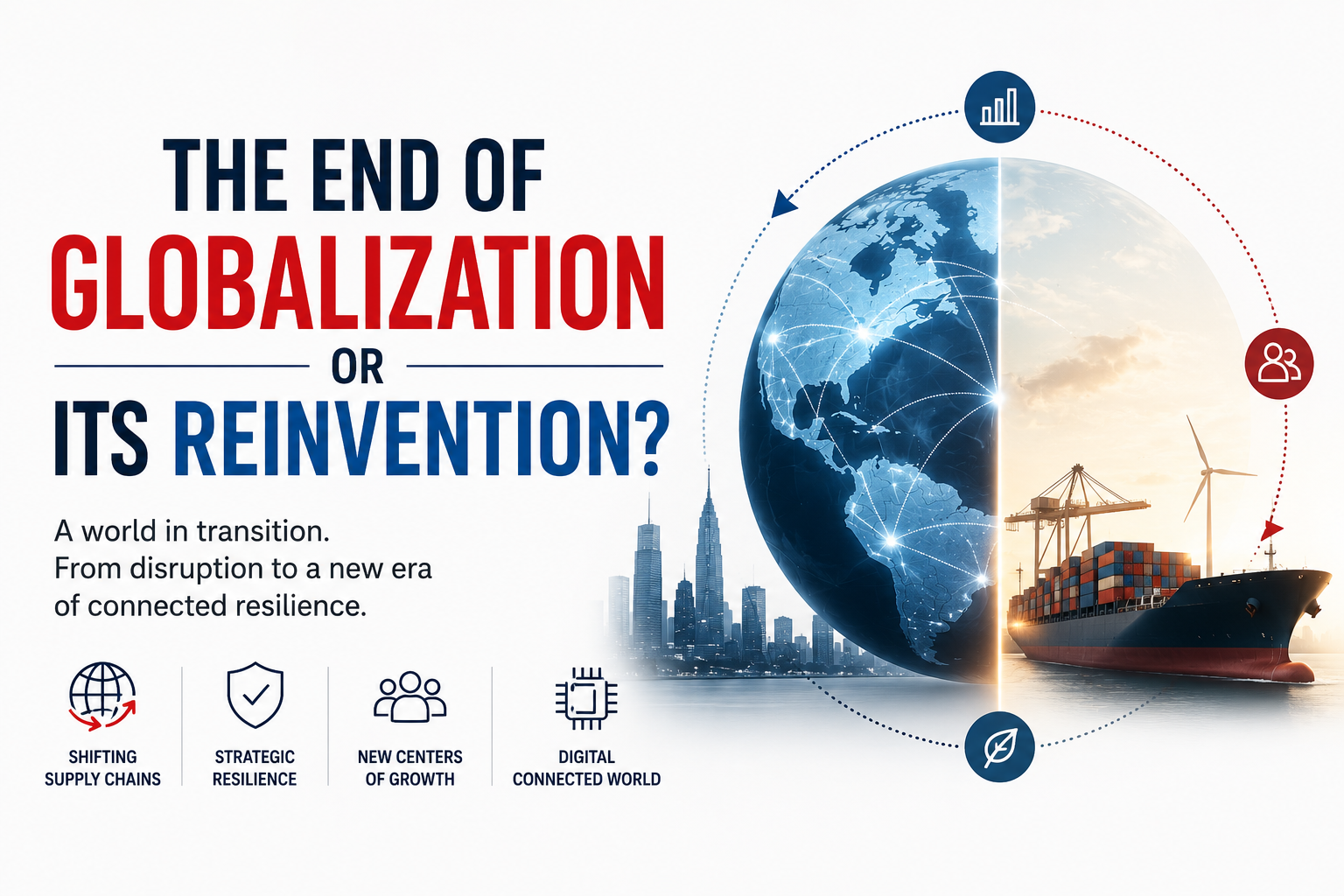
The Death of an Idea—or the Birth of a New One?
For much of the past three decades, globalization appeared unstoppable.
The collapse of the Soviet Union, the rise of free trade agreements, China’s integration into the global economy, and the digital revolution created an era of unprecedented economic interconnectedness. Companies built supply chains that spanned continents. Capital flowed across borders at remarkable speed. Goods became cheaper, markets became larger, and billions of people became part of a single global economic system.
The prevailing assumption was simple: the world would become increasingly interconnected, increasingly integrated, and increasingly dependent on globalization.
That assumption is now under challenge.
Trade wars, the COVID-19 pandemic, geopolitical conflicts, sanctions, technological restrictions, and the intensifying rivalry between the United States and China have exposed vulnerabilities in the hyper-globalized model.
Factories stopped.
Shipping routes were disrupted.
Semiconductor shortages crippled industries.
Energy prices surged.
Governments discovered that efficiency had created dependence.
The question confronting policymakers, businesses, and investors is profound.
Is globalization ending?
Or is it simply evolving into something entirely different?
The answer may shape the global economy for decades.
The Age of Hyper-Globalization
Between the early 1990s and the late 2010s, the world experienced one of the most integrated periods in economic history.
Trade expanded faster than global GDP.
Container shipping revolutionized logistics.
The internet connected consumers and businesses worldwide.
China emerged as the world’s manufacturing powerhouse.
Emerging markets became increasingly integrated into global supply chains.
This model produced enormous gains.
Hundreds of millions of people escaped poverty.
Consumers enjoyed cheaper products.
Companies achieved unprecedented efficiency.
Investors gained access to global markets.
Governments increasingly viewed economic interdependence as a force that reduced geopolitical tensions.
Globalization appeared to be a win-win system.
But hidden vulnerabilities were accumulating beneath its success.
The Pandemic That Changed Everything
The COVID-19 pandemic delivered the first major shock to the modern globalization model.
Factories across Asia shut down.
Ports became congested.
Container shortages disrupted international trade.
Hospitals struggled to secure medical equipment.
Automakers halted production because they lacked semiconductors.
The world discovered that efficiency and resilience were not the same thing.
Companies had optimized supply chains for cost.
They had not optimized them for disruption.
Governments realized that dependence on distant suppliers for essential goods represented a strategic vulnerability.
The pandemic fundamentally changed how nations think about economic security.
Supply chains were no longer viewed merely as commercial systems.
They became national security infrastructure.
The Return of Geopolitics
The second shock came from geopolitics.
The United States and China increasingly viewed economic interdependence not as a source of stability but as a source of leverage.
Trade restrictions expanded.
Export controls increased.
Technology sanctions intensified.
The conflict in Ukraine further accelerated this trend.
Europe’s dependence on Russian energy became an example of how economic integration could become strategic vulnerability.
Sanctions and countersanctions demonstrated that globalization could be weaponized.
Access to finance, technology, energy, and shipping routes became instruments of geopolitical power.
The assumptions of the post-Cold War era began to erode.
Economic integration no longer guaranteed security.
In some cases, it created new risks.
From Efficiency to Resilience
The central principle of globalization is changing.
For decades, companies asked one question:
How can we produce goods at the lowest possible cost?
Today, they increasingly ask a different question:
How can we maintain production during disruption?
This shift is producing a fundamental reorganization of global commerce.
Resilience is replacing efficiency as the defining objective of supply chain strategy.
Companies are diversifying suppliers.
Governments are encouraging domestic production of strategic industries.
Businesses are increasing inventories and building redundancy into operations.
The world economy is effectively purchasing insurance against future shocks.
This insurance is expensive.
But the cost of disruption has proven even greater.
The Rise of Strategic Globalization
Globalization is not disappearing.
It is becoming more strategic.
The emerging model prioritizes security alongside efficiency.
Governments increasingly distinguish between ordinary trade and strategically important sectors.
Food.
Energy.
Semiconductors.
Critical minerals.
Pharmaceuticals.
Telecommunications infrastructure.
Artificial intelligence.
These industries are increasingly viewed through the lens of national security.
The result is a new form of globalization that is more selective, more regionalized, and more politically influenced.
The age of purely market-driven globalization is ending.
The age of strategic globalization has begun.
Friend-Shoring and the New Geography of Trade
One of the clearest manifestations of this transformation is friend-shoring.
Rather than concentrating production solely in the lowest-cost locations, companies are increasingly moving manufacturing toward politically aligned countries.
India.
Vietnam.
Mexico.
Indonesia.
Eastern Europe.
These regions have become major beneficiaries of supply chain diversification.
Production is spreading across multiple jurisdictions to reduce geopolitical risk.
This process does not represent deglobalization.
It represents the redistribution of globalization.
Supply chains are becoming geographically broader and strategically more diversified.
Technology Is Creating New Forms of Globalization
While some forms of globalization are slowing, others are accelerating.
Digital services are expanding rapidly.
Cloud computing operates across borders.
Artificial intelligence relies on globally distributed talent.
Remote work enables companies to access expertise worldwide.
Cross-border digital payments continue to expand.
The movement of data increasingly matters as much as the movement of goods.
In many sectors, digital globalization is advancing faster than physical globalization.
This creates an important paradox.
The world may be becoming less integrated in manufacturing while becoming more interconnected digitally.
Globalization is not disappearing.
It is changing form.
The Rise of Regionalization
The future of globalization may be increasingly regional.
North America is deepening manufacturing integration through nearshoring.
Europe is attempting to strengthen industrial resilience and strategic autonomy.
Asia continues to develop highly interconnected regional supply chains.
The Middle East is positioning itself as a logistics and investment hub connecting East and West.
Africa’s population growth and industrial ambitions are creating new opportunities for regional trade integration.
The emerging world economy may become less dependent on one global system and more dependent on multiple interconnected regional ecosystems.
This could produce greater resilience.
But it may also create new forms of geopolitical competition.
The Cost of Reinvention
The reinvention of globalization carries significant costs.
Duplicating supply chains requires enormous investment.
Building domestic manufacturing capabilities is expensive.
Regionalization can reduce efficiency.
Fragmented technological ecosystems may slow innovation.
Consumers may face higher prices.
Economic growth may become less efficient than during the peak era of hyper-globalization.
Yet policymakers increasingly view these costs as necessary.
The objective is no longer maximizing efficiency at all costs.
The objective is balancing efficiency with security and resilience.
This represents one of the most important economic transitions of the twenty-first century.
Frequently Asked Questions
Is globalization ending?
No. Globalization is being reorganized rather than dismantled. The emerging system is becoming more regional, strategically driven, and focused on resilience.
Why are supply chains changing?
The pandemic, geopolitical tensions, technological competition, and national security concerns exposed vulnerabilities in highly concentrated global production networks.
What is strategic globalization?
Strategic globalization refers to an economic system where governments and companies prioritize resilience, security, and political reliability alongside efficiency and cost.
What is friend-shoring?
Friend-shoring involves relocating manufacturing and supply chains toward politically aligned countries to reduce geopolitical risks and dependencies.
Will the world become less interconnected?
Not necessarily. Manufacturing supply chains may become more regional, but digital services, data flows, and technological collaboration continue to increase global interdependence.
The Reinvention of Interdependence
Predictions about the death of globalization are probably premature.
Globalization has proven remarkably adaptable throughout history.
It survived world wars.
It survived financial crises.
It survived pandemics.
And it is adapting again.
The system emerging today is different from the one that existed twenty years ago.
It is more cautious.
More regional.
More strategic.
More politically influenced.
The era of hyper-globalization—where efficiency alone determined the organization of the global economy—is fading.
But globalization itself is not ending.
It is being reinvented.
The next chapter of globalization will not be defined by the absence of interdependence.
It will be defined by the management of interdependence.
The countries and companies that succeed will not be those that reject globalization entirely.
They will be the ones that learn how to navigate a world where economic integration and geopolitical competition increasingly coexist.
The World in 2035: Five Scenarios That Could Reshape Global Power


