


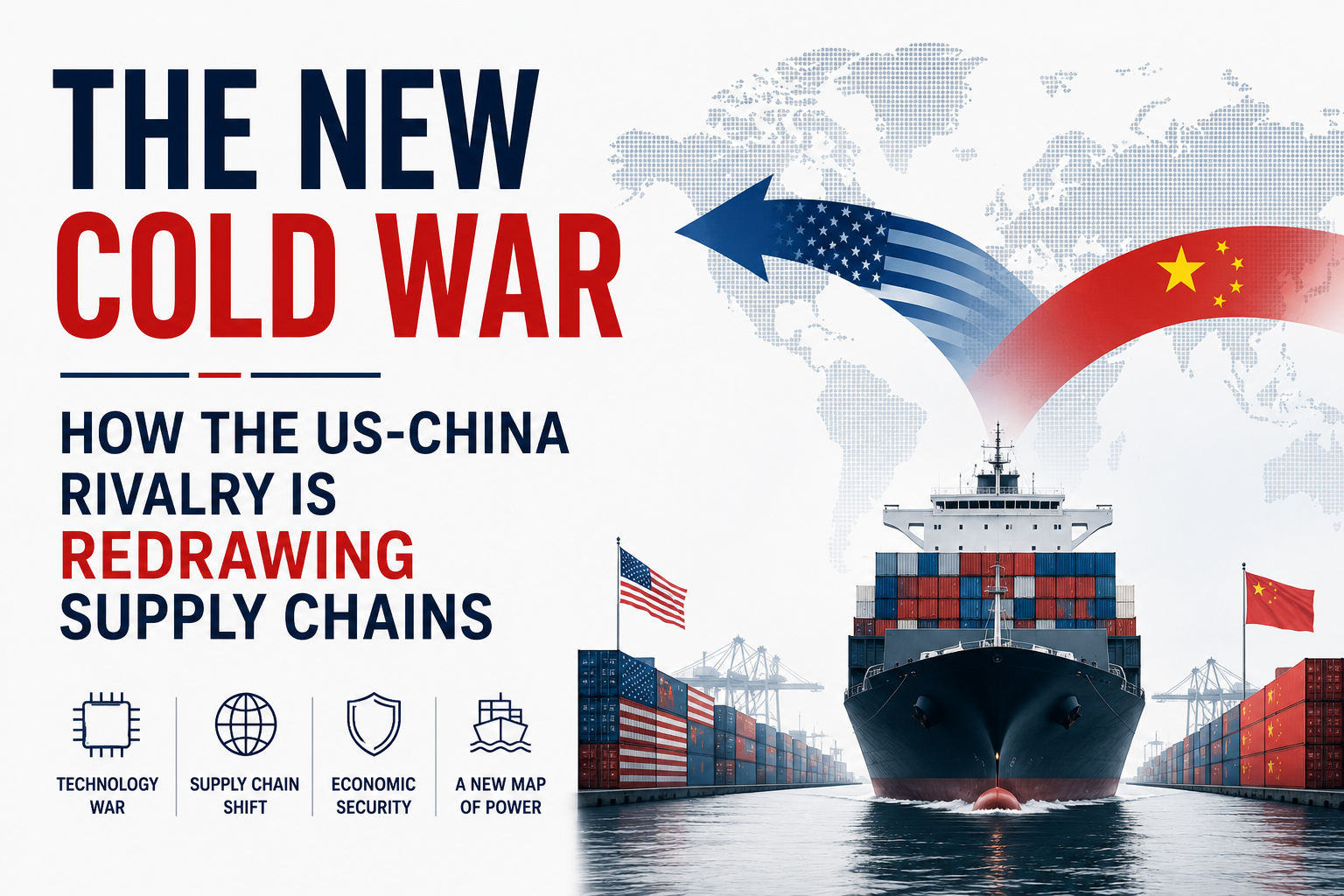
The End of the Global Factory
For nearly three decades, globalization operated on a simple premise: build products where it is cheapest, ship them where they are needed, and let efficiency dictate the organization of the world economy.
China became the workshop of the world.
The United States became the world’s largest consumer market and technological innovator.
Europe specialized in advanced manufacturing and industrial engineering.
Supply chains stretched across continents, optimized not for security or resilience, but for cost.
That era is ending.
The rivalry between the United States and China has fundamentally altered the assumptions on which globalization was built. Supply chains are no longer merely economic systems. They have become strategic assets. Factories, ports, semiconductors, rare earth minerals, and shipping routes are now viewed through the lens of national security.
The world is not witnessing the end of globalization.
It is witnessing its strategic reinvention.
Why the US-China Rivalry Became Economic Warfare
The deterioration in relations between Washington and Beijing did not occur overnight.
Trade tensions had existed for years, but the relationship fundamentally changed when both countries concluded that economic interdependence had become a source of vulnerability.
The United States increasingly viewed China’s technological rise as a challenge to its strategic dominance.
China increasingly viewed American export controls and alliance networks as efforts to contain its economic development.
The result was a gradual shift from economic competition to economic security.
Today, tariffs are no longer merely trade policy.
Technology restrictions are no longer merely commercial decisions.
Supply chains themselves have become instruments of geopolitical competition.
The Semiconductor War
No sector illustrates this transformation better than semiconductors.
Modern economies run on chips.
Smartphones, automobiles, cloud computing, artificial intelligence systems, military platforms, telecommunications networks, and industrial machinery all depend on advanced semiconductors.
The United States still dominates semiconductor design software, high-performance computing, and key technologies required to manufacture advanced chips.
China remains heavily dependent on foreign technology for its most sophisticated semiconductor requirements.
This dependence has turned chips into the strategic resource of the digital age.
Washington has imposed restrictions on advanced semiconductor exports and equipment access. Beijing has accelerated efforts to achieve technological self-sufficiency.
The result is an unprecedented global race to build semiconductor ecosystems.
Why Chips Matter
Economic Power: Semiconductors underpin nearly every modern industry.
National Security: Advanced weapons systems increasingly depend on sophisticated computing capabilities.
Artificial Intelligence: AI development requires enormous computing resources and advanced processors.
Technological Leadership: Nations that control semiconductor supply chains influence the pace of global innovation.
“The oil of the twentieth century powered economies. The semiconductors of the twenty-first century power intelligence itself.”
The Rise of Friend-Shoring
For decades, companies optimized supply chains around efficiency.
Today, resilience and political reliability are increasingly replacing cost as the dominant considerations.
This shift has produced what policymakers call “friend-shoring.”
Rather than manufacturing exclusively in the cheapest locations, companies are increasingly shifting production toward politically aligned countries.
Mexico, Vietnam, India, Indonesia, and parts of Eastern Europe have emerged as major beneficiaries of this trend.
Companies are diversifying manufacturing footprints to reduce dependence on any single country and to protect themselves from geopolitical shocks.
The logic is straightforward.
The cheapest supply chain may no longer be the safest supply chain.
The China Plus One Strategy
Multinational corporations are not necessarily abandoning China.
Many are pursuing what has become known as the “China Plus One” strategy.
China remains indispensable in many industries because of its industrial ecosystem, skilled workforce, logistics infrastructure, and supplier networks.
However, companies increasingly seek secondary production hubs elsewhere.
The objective is not decoupling.
The objective is redundancy.
Businesses now consider geopolitical disruption in the same way they consider natural disasters or financial crises.
Supply chain resilience has become a strategic necessity.
The New Geography of Manufacturing
The reorganization of global production is creating new winners.
India
India’s large domestic market, young workforce, and policy initiatives have positioned it as an increasingly attractive manufacturing destination.
Electronics manufacturing, pharmaceuticals, renewable energy components, and semiconductor ambitions are expanding rapidly.
Vietnam
Vietnam has become one of the largest beneficiaries of supply chain diversification.
Its export-oriented economy, strategic location, and trade agreements have attracted substantial manufacturing investment.
Mexico
Nearshoring to Mexico allows companies to maintain proximity to the United States market while reducing dependence on Asian supply chains.
Automotive manufacturing, electronics, and industrial production are experiencing renewed investment.
Indonesia
Indonesia’s vast reserves of critical minerals essential for electric vehicles and battery technologies have made it increasingly important in the emerging industrial landscape.
The redistribution of manufacturing is reshaping the economic geography of globalization.
Critical Minerals: The New Strategic Resources
The energy transition is creating a new form of resource competition.
Electric vehicles, renewable energy technologies, advanced batteries, and artificial intelligence infrastructure all require enormous quantities of critical minerals.
Lithium.
Cobalt.
Nickel.
Rare earth elements.
These resources are becoming the foundation of future industrial systems.
Control over their extraction, processing, and supply chains increasingly translates into geopolitical influence.
China currently plays an outsized role in refining and processing several critical minerals, creating strategic dependencies that concern Western governments.
In response, the United States and its allies are investing heavily in alternative supply chains.
The competition for minerals increasingly resembles the twentieth century competition for oil.
From Efficiency to Security
For decades, economic integration was viewed primarily through the lens of efficiency.
That logic is changing.
Governments increasingly ask different questions.
Can essential medicines be produced domestically?
Can advanced chips be secured during a crisis?
Can energy systems function if supply routes are disrupted?
Can critical infrastructure depend on potentially adversarial technology?
Economic policy and national security policy are becoming increasingly intertwined.
This shift represents one of the most profound changes in globalization since the end of the Cold War.
The Costs of Economic Fragmentation
The strategic restructuring of supply chains offers resilience, but it also carries costs.
Duplicating production capacity is expensive.
Building new industrial ecosystems requires enormous investment.
Fragmented technology systems reduce economies of scale.
Companies face increased compliance requirements and regulatory complexity.
Consumers may experience higher prices.
Global growth may become less efficient.
The world economy is effectively paying an insurance premium against geopolitical risk.
That premium is likely to rise.
Could the New Cold War Become Permanent?
Unlike the Cold War between the United States and the Soviet Union, the United States and China remain deeply economically interconnected.
Trade between the two economies remains extensive.
Financial markets remain linked.
Supply chains remain intertwined.
Complete decoupling would be extraordinarily costly.
The more likely outcome is selective decoupling.
Critical technologies and strategic industries may increasingly separate, while many other sectors remain globally integrated.
This would produce a world economy that is neither fully globalized nor fully divided.
It would be partially interconnected and partially fragmented.
Frequently Asked Questions
Is globalization ending?
No. Globalization is being reorganized around resilience, strategic considerations, and geopolitical alignment rather than purely around cost efficiency.
Why are supply chains becoming a security issue?
Modern economies depend on highly complex supply networks. Disruptions can affect economic growth, military readiness, healthcare systems, and technological development.
Which countries are benefiting from supply chain shifts?
India, Vietnam, Mexico, Indonesia, and several Eastern European economies have emerged as major beneficiaries of manufacturing diversification.
Will companies leave China completely?
Most companies are unlikely to abandon China entirely. Many are instead adopting “China Plus One” strategies that maintain operations in China while developing alternative manufacturing locations.
Why are semiconductors so important?
Semiconductors power nearly every advanced technology, including artificial intelligence, cloud computing, telecommunications systems, automobiles, and modern defense capabilities.
The Reinvention of Globalization
The new Cold War is not being fought primarily with tanks, missiles, or territorial conquest.
It is being fought through factories, supply chains, semiconductors, ports, minerals, and technology ecosystems.
The central question of globalization has changed.
The question is no longer where production can occur most cheaply.
The question is where production can occur most securely.
The winners of the next decade may not simply be the largest economies.
They may be the countries that position themselves as trusted manufacturing hubs, strategic resource providers, and indispensable links in the new architecture of global commerce.
The era of hyper-globalization is fading.
An era of strategic globalization has begun—and the map of global manufacturing is being redrawn in real time.
The World in 2035: Five Scenarios That Could Reshape Global Power


