


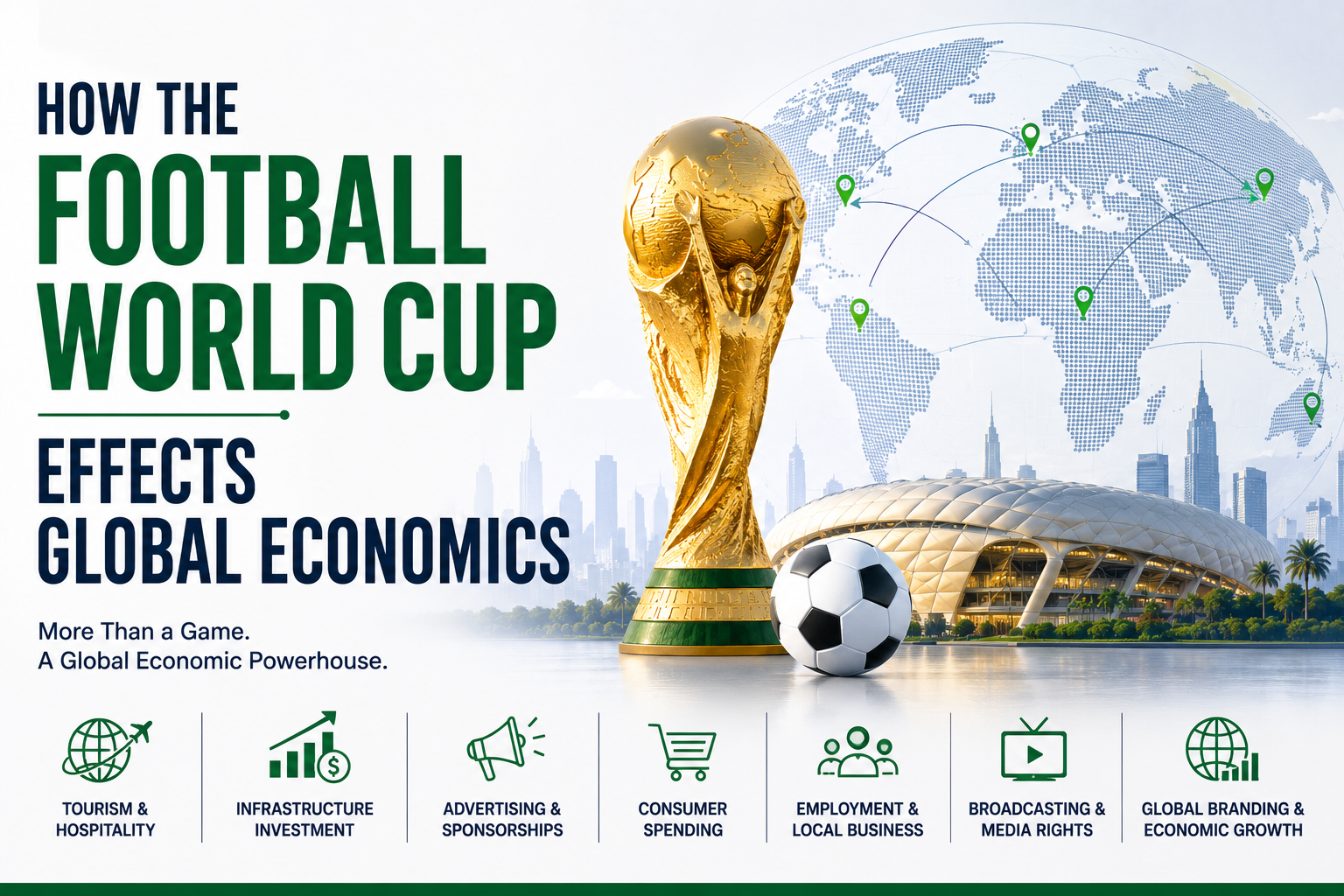
The Tournament That Stops the World
Every four years, billions of people pause their daily routines to watch the biggest sporting event on the planet.
The FIFA World Cup is more than a football tournament.
It is a global economic phenomenon.
From packed stadiums and surging tourism to advertising booms and infrastructure spending, the World Cup creates economic ripples that extend far beyond the ninety minutes played on the pitch.
Entire industries experience sudden bursts of activity.
Airlines add routes.
Hotels fill to capacity.
Restaurants experience record demand.
Brands spend billions on marketing campaigns.
Streaming platforms and broadcasters attract unprecedented audiences.
Financial markets even respond to match outcomes and consumer sentiment.
The World Cup is one of the few events capable of simultaneously influencing tourism, trade, employment, investment, and consumer behavior across multiple continents.
It is, in many ways, one of the world’s largest temporary economies.
The Trillion-Dollar Attention Economy
The modern economy increasingly runs on attention.
Few events command global attention like the FIFA World Cup.
Billions of viewers follow the tournament across television, streaming services, social media platforms, and digital channels.
This attention has enormous economic value.
Advertisers compete aggressively for sponsorship opportunities.
Global brands launch campaigns months before the tournament begins.
Companies invest heavily in promotional partnerships with teams, players, and broadcasters.
Consumer spending often increases during major tournaments.
Sales of televisions, smartphones, sports merchandise, beverages, and food products rise significantly.
The World Cup effectively creates one of the world’s largest temporary consumer markets.
Attention itself becomes an economic asset.
Tourism and the Host Nation Windfall
Hosting the World Cup can generate enormous economic activity.
Millions of international visitors travel to the host nation.
Tourists spend money on:
Hotels.
Restaurants.
Transportation.
Entertainment.
Retail shopping.
Local attractions.
For many countries, the World Cup becomes a global showcase.
It offers an opportunity to improve international branding, attract future tourists, and increase foreign investment interest.
Infrastructure investments often accelerate.
Airports expand.
Road networks improve.
Public transportation systems are upgraded.
Urban development projects receive additional funding.
The tournament can leave behind valuable physical assets that continue generating economic activity long after the final whistle.
The Infrastructure Debate
Yet hosting the World Cup is not automatically an economic success.
Staging the tournament requires enormous expenditure.
New stadiums.
Transportation networks.
Security systems.
Accommodation facilities.
Digital infrastructure.
Public services.
Costs can run into tens of billions of dollars.
The economic benefits often depend on whether investments create long-term value.
Some host nations successfully use the tournament to modernize infrastructure and stimulate tourism.
Others struggle with underutilized stadiums and large public debts after the event concludes.
The World Cup therefore presents both opportunity and risk.
Economic legacies depend heavily on planning and execution.
The Business of Broadcasting
The World Cup is also one of the world’s most valuable media properties.
Broadcasting rights generate billions of dollars.
Television networks compete intensely for access.
Streaming platforms increasingly seek partnerships and digital distribution opportunities.
Media companies view the tournament as one of the few remaining events capable of attracting massive live audiences.
Advertising rates often surge during the competition.
The tournament also accelerates innovation.
Streaming technologies improve.
Second-screen experiences expand.
Interactive sports content becomes more sophisticated.
The World Cup increasingly serves as a laboratory for the future of global media consumption.
Sponsorship and Global Brands
For multinational corporations, the World Cup represents a marketing opportunity unlike any other.
Global sponsors invest billions of dollars to associate themselves with the tournament.
Why?
Because football possesses something few events can offer.
Universal reach.
The World Cup connects consumers across developed and emerging markets simultaneously.
Brands gain visibility in Asia, Europe, Africa, Latin America, and the Middle East through a single event.
For many companies, the World Cup becomes one of the most effective platforms for global customer acquisition and brand building.
The economic value of this exposure often extends years beyond the tournament itself.
Employment and Local Economic Activity
Major sporting events create temporary employment opportunities.
Construction projects generate jobs.
Hotels increase staffing.
Restaurants hire additional workers.
Transportation services expand operations.
Security and event management industries experience increased demand.
Small businesses frequently benefit from higher visitor spending.
Street vendors.
Retail stores.
Local entertainment providers.
Tour operators.
The World Cup injects economic activity into local communities that participate in the tournament ecosystem.
While many of these jobs are temporary, they can provide meaningful short-term economic stimulus.
The Global Merchandise Economy
The football economy extends far beyond stadiums.
The World Cup fuels enormous demand for merchandise.
National team jerseys.
Sports equipment.
Flags.
Collectibles.
Digital products.
Consumer electronics.
Global sportswear companies experience major sales increases during tournament periods.
Manufacturing activity often rises in anticipation of increased demand.
Supply chains spanning multiple countries participate in this temporary surge in consumption.
The World Cup demonstrates how global sporting events can activate complex international production networks.
The Impact on Financial Markets
Sport and finance are more interconnected than they appear.
Investor sentiment can be influenced by major sporting events.
Consumer spending patterns shift.
Hospitality companies experience demand spikes.
Travel firms benefit from increased mobility.
Media and advertising companies often see higher revenues.
Some studies have even suggested that national mood following sporting outcomes can influence short-term market behavior and consumer confidence.
While these effects are usually temporary, they illustrate the remarkable ability of sport to influence economic psychology.
Soft Power and National Branding
Perhaps the most overlooked economic effect of the World Cup is soft power.
Countries increasingly recognize that global perception matters economically.
The tournament offers host nations and participating countries an opportunity to shape international narratives.
A successful World Cup can strengthen national branding.
Enhance tourism appeal.
Increase investor familiarity.
Improve global visibility.
Strengthen diplomatic relationships.
Reputation increasingly influences economics.
Countries compete not only for capital and trade, but also for attention, talent, and influence.
The World Cup provides one of the largest stages on Earth.
The Rise of Football as a Global Industry
Football itself has become a major industry.
Clubs operate as multinational businesses.
Players have become global brands.
Broadcasting rights generate billions.
Sponsorship revenues continue expanding.
Digital fan engagement creates entirely new business models.
The World Cup sits at the center of this ecosystem.
Its success reinforces the commercial value of football worldwide.
The tournament stimulates investment in sports infrastructure, youth development, broadcasting technology, and digital innovation.
It is increasingly both a sporting event and a global economic platform.
Frequently Asked Questions
How does the FIFA World Cup help the economy?
The World Cup stimulates tourism, increases consumer spending, generates employment opportunities, attracts advertising investment, and boosts media, hospitality, and retail sectors.
Do host countries always make money from the World Cup?
Not necessarily. Economic outcomes vary significantly. Long-term success depends on infrastructure planning, tourism strategies, and whether investments continue generating value after the tournament.
Why do companies spend billions on World Cup sponsorships?
The tournament offers unparalleled global reach, allowing brands to access billions of consumers across multiple markets simultaneously.
Which industries benefit the most?
Tourism, aviation, hospitality, broadcasting, advertising, retail, construction, transportation, and sports merchandise industries often experience significant gains.
Can sporting events influence financial markets?
Major sporting events can affect consumer sentiment, spending behavior, and investor psychology, although the financial impacts are usually temporary.
The Economics of a Shared Global Experience
The FIFA World Cup is ultimately more than a sporting competition.
It is one of the few events capable of synchronizing global attention.
That attention generates economic activity on an extraordinary scale.
Airlines fly millions of additional passengers.
Cities transform themselves into entertainment hubs.
Businesses launch worldwide campaigns.
Consumers spend billions.
Media companies compete for audiences.
Governments invest heavily in infrastructure and branding.
The tournament demonstrates a fundamental reality of the modern economy.
Economics is increasingly driven not only by resources and production but also by experiences, emotions, and shared moments of global attention.
Every four years, football creates one of the world’s largest temporary economies.
And for a few extraordinary weeks, the beautiful game becomes one of the most powerful economic forces on the planet.


