


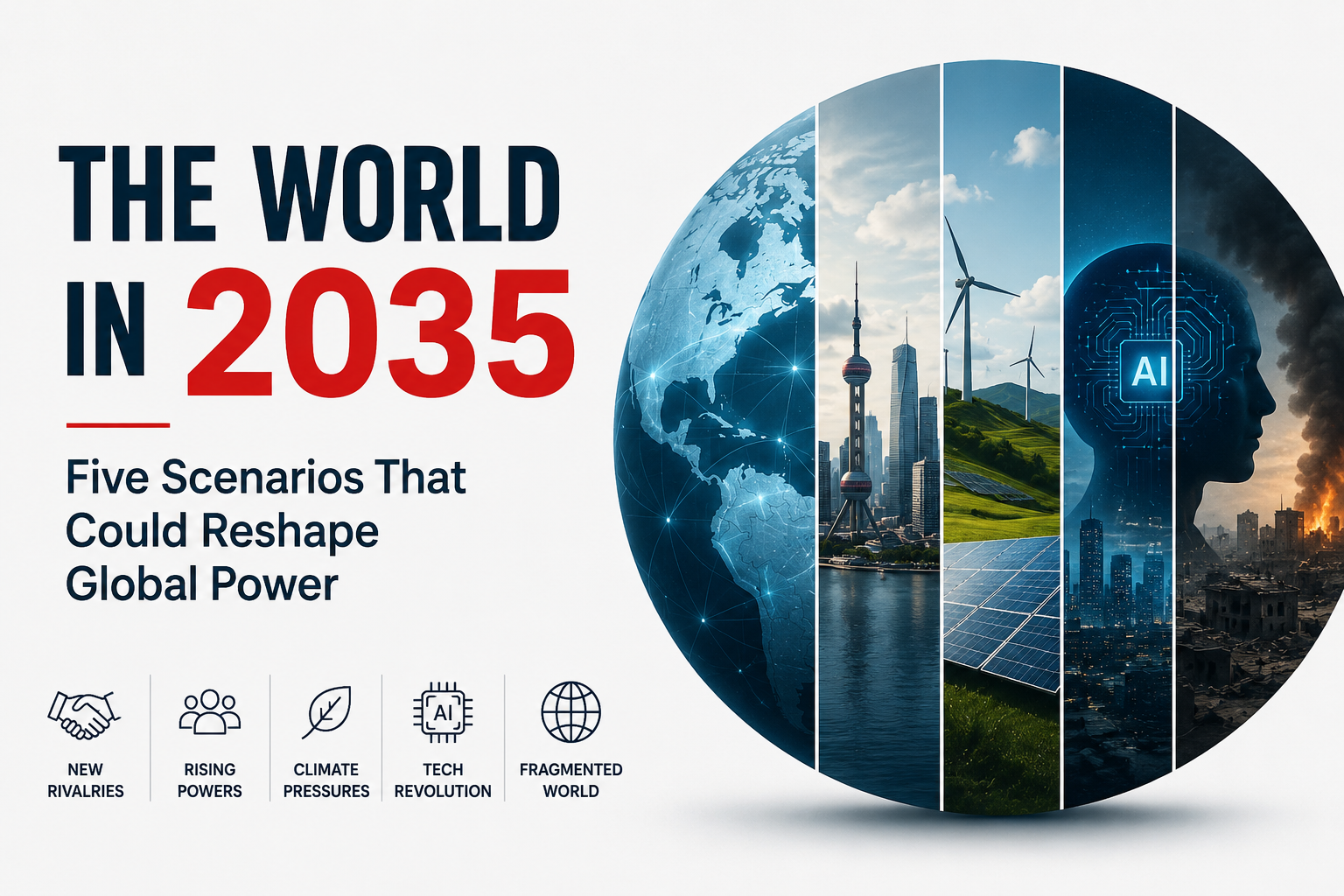
The End of the Familiar World Order
The international system is entering one of the most consequential periods of transformation since the end of the Cold War. The assumptions that defined the post-1991 order—American primacy, accelerating globalization, relatively stable alliances, and the steady expansion of liberal economic institutions—are under increasing strain.
The drivers of this transformation are not singular. They are simultaneous and interconnected. Technological disruption is redefining economic and military power. Climate change is altering the geography of prosperity and security. Demographic shifts are reshaping labour markets and political systems. The competition for critical minerals and digital infrastructure is producing new forms of geopolitical rivalry. And the diffusion of economic power beyond the West is challenging institutions designed for a different era.
The question is not whether the world order will change. The question is what replaces it.
Forecasting geopolitics is inherently uncertain, but scenario planning provides a framework for understanding the possible trajectories of global power. By 2035, the international system could look profoundly different from the one that exists today.
Five plausible scenarios stand out.
Scenario One: The New Bipolar World – America and China Divide the System
The first possibility is the consolidation of a new bipolar order dominated by the United States and China.
The rivalry between Washington and Beijing already extends beyond trade and tariffs. It encompasses semiconductors, artificial intelligence, telecommunications, military technology, supply chains, space capabilities, and influence across the developing world.
By 2035, this competition could evolve into a comprehensive geopolitical and economic division of the international system.
Technology ecosystems may become increasingly incompatible. Countries could be forced to choose between American-led and Chinese-led digital infrastructure. Financial systems might fragment into competing payment mechanisms. Strategic industries could reorganize around rival supply chains.
The result would resemble a twenty-first-century version of the Cold War—not an ideological confrontation between capitalism and communism, but a competition between competing models of technological governance and geopolitical influence.
Characteristics of a Bipolar World
Technology: Separate AI ecosystems, semiconductor supply chains, and digital standards.
Trade: Increased regionalisation and strategic decoupling.
Security: Expanded alliance systems in Asia and intensified military competition in the Indo-Pacific.
Diplomacy: Countries increasingly pressured to align with one of two competing spheres.
“The next Cold War will not be fought primarily over territory. It will be fought over technology, standards, data, and economic dependencies.”
The biggest risk in this scenario is that competition gradually overwhelms cooperation, making collective responses to climate change, pandemics, and financial crises increasingly difficult.
Scenario Two: The Multipolar Century – The Rise of Middle Powers
A second possibility is the emergence of a genuinely multipolar world.
In this scenario, neither the United States nor China achieves overwhelming dominance. Instead, several influential powers emerge simultaneously.
India’s economic expansion could make it one of the world’s largest economies. The Gulf states may transform themselves into investment and technological hubs. The European Union could consolidate strategic autonomy. Indonesia, Brazil, and parts of Africa may become increasingly important centres of economic and demographic growth.
Power would become more dispersed.
This system would be more complex than bipolarity because coalitions would be fluid rather than permanent. Countries would cooperate in some areas while competing in others.
A nation might rely on China for trade, partner with America on security, and invest alongside Gulf sovereign funds in technology projects.
Characteristics of a Multipolar World
Power Distribution: Several major centres of economic and political influence.
Diplomacy: Flexible issue-based coalitions rather than rigid blocs.
Trade: Greater regional integration and diversified supply chains.
Technology: Multiple innovation hubs across different regions.
Security: Reduced probability of a single hegemonic conflict but increased complexity in crisis management.
The challenge of multipolarity is coordination. More centres of power often mean slower collective decision-making and more fragmented governance.
Yet this system could also prove more resilient because it avoids excessive dependence on any single state.
Scenario Three: The Age of Climate Geopolitics
Climate change is no longer merely an environmental issue. By 2035, it may become one of the defining determinants of geopolitical power.
Extreme weather events, rising sea levels, water scarcity, agricultural disruption, and population displacement are already affecting economic and political systems.
As these pressures intensify, climate resilience may become a major source of strategic advantage.
Countries that control freshwater resources, food production, climate forecasting systems, energy transition technologies, and adaptation infrastructure could gain disproportionate influence.
Meanwhile, climate-vulnerable regions may experience increasing economic stress and political instability.
Climate as a Geopolitical Force
Water Security: Competition over transboundary river systems.
Food Systems: Agricultural productivity increasingly shaped by climate variability.
Migration: Large-scale displacement creating political pressures across borders.
Energy Transition: Control over critical minerals and green technologies becoming strategic assets.
Infrastructure: Climate adaptation emerging as a new form of national competitiveness.
“The winners of the climate century may not necessarily be the largest economies but the countries most capable of adapting to environmental change.”
Climate change could therefore produce a redistribution of geopolitical influence unlike anything seen in previous industrial eras.
Scenario Four: The AI Revolution and the Rise of Technological States
Artificial intelligence may become the most transformative force shaping global power by 2035.
Previous industrial revolutions changed economies over decades. Artificial intelligence may compress similar transformations into years.
Countries that successfully deploy AI across industry, defence, healthcare, education, logistics, and governance could experience extraordinary productivity gains.
The consequences would be enormous.
Military planning would increasingly rely on autonomous systems and predictive analytics. Economies would become more efficient. Governments capable of integrating AI effectively could gain significant advantages over less technologically advanced competitors.
However, technological inequality could also widen dramatically.
Characteristics of an AI-Driven World
Economic Power: Productivity gains creating enormous wealth disparities.
Military Competition: Autonomous systems and AI-enabled warfare.
Labour Markets: Significant workforce displacement and restructuring.
Governance: AI-enhanced administration and predictive policymaking.
Geopolitics: Technology leadership becoming the primary determinant of national influence.
The countries leading AI development may effectively become the new great powers of the twenty-first century.
Control over data, computational infrastructure, semiconductor manufacturing, and scientific talent could matter as much as traditional measures of power such as population size or military strength.
Scenario Five: The Fragmented World – Permanent Instability
The most pessimistic scenario is one of sustained fragmentation.
In this future, geopolitical competition intensifies while international cooperation steadily deteriorates.
Global institutions lose effectiveness. Supply chains become increasingly regionalised. Resource nationalism accelerates. Technological ecosystems fragment. Conflicts become more frequent and prolonged.
Economic growth slows.
Climate shocks, cyberattacks, disinformation campaigns, financial crises, and regional wars occur with greater frequency.
Trust between major powers erodes.
Characteristics of a Fragmented World
Economics: Persistent supply chain disruptions and reduced global growth.
Politics: Weakening multilateral institutions.
Security: Increased regional conflicts and hybrid warfare.
Technology: Competing standards and digital fragmentation.
Society: Rising inequality and political polarisation.
This scenario does not necessarily imply a single catastrophic event.
Rather, it describes a world of chronic instability in which governments become increasingly reactive and long-term planning becomes progressively more difficult.
Which Scenario Is Most Likely?
History rarely conforms perfectly to a single scenario.
The most probable future is likely to combine elements of all five.
The world of 2035 could simultaneously feature:
- Strategic rivalry between the United States and China;
- Increasing influence of middle powers;
- Climate-driven disruptions;
- Rapid advances in artificial intelligence;
- Persistent institutional fragmentation.
The interaction of these forces will determine the character of the international system.
The critical question is not which scenario occurs in isolation.
It is which force becomes dominant.
Frequently Asked Questions
Will China overtake the United States by 2035?
China is likely to remain one of the world’s largest economies and most influential powers, but overtaking the United States comprehensively across economic, technological, military, and alliance dimensions remains uncertain.
Could India become a superpower by 2035?
India’s demographic profile, digital economy, manufacturing ambitions, and geopolitical position provide substantial potential for major-power status, although infrastructure and institutional challenges remain significant.
Will climate change trigger conflicts?
Climate change is more likely to act as a threat multiplier by intensifying existing vulnerabilities such as water scarcity, food insecurity, migration pressures, and economic inequality.
Will artificial intelligence replace traditional sources of power?
Not entirely. Geography, resources, demographics, and military capabilities will remain important. However, AI could become one of the most significant force multipliers in modern history.
Is globalization ending?
Globalization is not disappearing. It is being reconfigured. The emerging system appears increasingly regionalised, security-conscious, and technologically fragmented.
The Architecture of Power in 2035
The world approaching 2035 is unlikely to resemble the world that emerged after the Cold War.
Power is becoming multidimensional.
Economic size alone will no longer guarantee influence. Military capabilities alone will no longer guarantee security. Technological leadership alone will not guarantee resilience.
The countries that shape the coming era will be those capable of combining all of these dimensions simultaneously—economic competitiveness, technological innovation, climate adaptation, demographic strength, and institutional agility.
The next decade will not simply determine who becomes richer or stronger.
It will determine which societies build the systems capable of governing an age defined by uncertainty.
The geopolitical order of 2035 is still being written.
And the decisions made today will decide who writes its rules.
The Startup Map of the Future: Which Industries Could Create the Next Trillion-Dollar Companies?


