


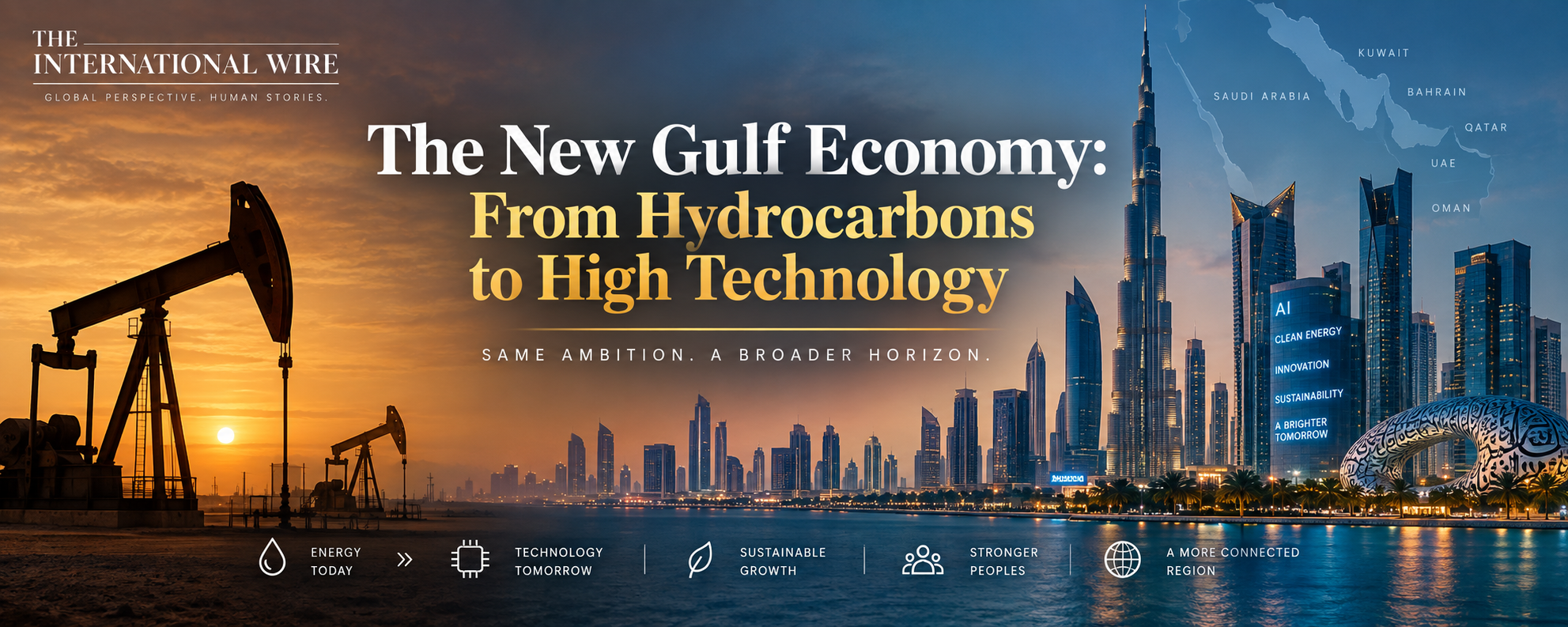
For decades, the Gulf’s economic power rested on one extraordinary resource: hydrocarbons. Oil and gas built cities, created sovereign wealth and transformed desert economies into some of the world’s richest states. But the next chapter of the Gulf economy is being written around something very different: technology, data, artificial intelligence, logistics, advanced manufacturing, tourism and human capital.
For much of the modern era, the economic model of the Gulf was relatively straightforward.
Oil generated revenue.
Revenue funded infrastructure.
Infrastructure attracted business.
And the state redistributed wealth through public spending, employment and investment.
That model created extraordinary economic transformation.
But it also created a structural vulnerability.
Oil prices rise and fall.
Global energy demand is changing.
Technology is transforming industries.
And governments across the world are accelerating the transition toward cleaner energy.
The Gulf therefore faces a historic question:
What happens when economic power can no longer depend primarily on selling hydrocarbons?
The answer emerging across the region is increasingly ambitious.
Saudi Arabia is pursuing Vision 2030.
The UAE is positioning itself as a global hub for finance, technology and artificial intelligence.
Qatar is expanding beyond gas into logistics, finance, tourism and technology.
Oman is developing logistics, manufacturing, tourism and renewable-energy opportunities.
Bahrain continues to build around financial services and digital industries.
Kuwait is attempting to accelerate diversification through investment and infrastructure.
The Gulf is not abandoning hydrocarbons.
Instead, it is attempting something more complicated:
Use the wealth generated by the old economy to build the foundations of the next one.
The World Bank describes diversification and digital transformation as increasingly essential for the GCC’s long-term stability and prosperity, while noting that hydrocarbons remain central to government finances.
The Gulf’s economic transformation is therefore not simply an oil-to-no-oil transition.
It is an attempt to move:
From resources → to capital → to infrastructure → to technology → to intellectual property and high-value services.
And that could fundamentally change the economic geography of the Middle East.
The Gulf Is Not Leaving Oil Behind
One of the biggest misunderstandings about Gulf diversification is the idea that Saudi Arabia, the UAE or Qatar are preparing for a world without oil and gas.
That is not what is happening.
Hydrocarbons remain enormously important.
They continue to generate export revenues, fiscal resources and strategic influence.
The transition is therefore not:
Oil → technology.
It is:
Oil + technology + services + manufacturing + logistics + finance + tourism.
This distinction matters.
Saudi Arabia’s economy, for example, has already become more diversified, with the IMF noting that Vision 2030 reforms have reduced dependence on oil and strengthened the non-oil economy.
The objective is not necessarily to eliminate hydrocarbons.
It is to ensure that hydrocarbons are no longer the only engine capable of powering growth.
1. Saudi Arabia Is Building a New Economic Model
Saudi Arabia sits at the center of the Gulf’s transformation.
Vision 2030, launched in 2016, was designed to reduce dependence on oil revenues while expanding private-sector activity, investment, tourism, manufacturing, technology and services.
Ten years into the program, the transformation has entered a different phase.
The IMF notes that Vision 2030 has strengthened the non-oil economy, expanded the role of the private sector and reduced dependence on oil.
The next challenge is even more difficult.
Saudi Arabia now needs to turn large-scale investment into sustainable private-sector productivity.
That means creating companies that can compete globally.
Not simply companies that build projects domestically.
This distinction could define the next decade.
2. The PIF Is Becoming an Economic Engine
Few institutions illustrate the Gulf’s transformation better than Saudi Arabia’s Public Investment Fund.
The traditional sovereign wealth fund model was relatively straightforward.
Collect oil revenues.
Invest internationally.
Preserve wealth for future generations.
The new model is more interventionist.
The PIF is increasingly being used to build domestic industries.
Tourism.
Entertainment.
Sports.
Technology.
Logistics.
Manufacturing.
Renewable energy.
Artificial intelligence.
Infrastructure.
The IMF’s 2026 assessment notes that the PIF’s recalibrated 2026–30 strategy places greater emphasis on selective capital allocation and crowding in private investment, with priority areas including AI, logistics, tourism, renewables and advanced manufacturing.
That represents an important evolution.
The sovereign wealth fund is no longer simply a financial institution.
It is becoming part of the country’s industrial strategy.
3. Artificial Intelligence Could Become the New Oil Narrative
The most ambitious part of the Gulf’s transformation may be artificial intelligence.
The region possesses several advantages.
Cheap and abundant energy.
Large pools of sovereign capital.
High rates of digital adoption.
Modern telecommunications infrastructure.
Centralized decision-making.
Large-scale government procurement.
And the ability to build infrastructure quickly.
The GCC has therefore emerged as an important destination for AI investment.
The World Bank notes that GCC countries have advanced telecom networks, with 5G coverage above 90%, while investments in data centers and high-performance computing are accelerating AI readiness.
The IMF has also highlighted the Gulf’s growing AI preparedness and the potential for AI to increase productivity and support diversification.
The economic ambition is enormous.
The Gulf does not merely want to consume AI.
It wants to:
Build AI infrastructure.
Deploy AI across government.
Develop AI companies.
Attract AI talent.
Host data centers.
Export AI-enabled services.
That would represent a fundamental change in the region’s economic position.
4. Data Centers Could Turn Energy Into Computing Power
For decades, the Gulf’s strategic advantage was simple:
Energy.
The emerging digital economy creates a new opportunity.
Turn energy into computing.
Artificial intelligence requires enormous quantities of electricity and data-center capacity.
The Gulf has access to both capital and energy.
That creates an unusual competitive advantage.
Instead of simply exporting energy to the world, Gulf countries could increasingly use energy domestically to power:
- Data centers
- AI infrastructure
- Cloud computing
- High-performance computing
- Digital services
- Advanced manufacturing
- Autonomous systems
The IMF has specifically highlighted the GCC’s access to energy as a comparative advantage for major data-center projects and cited partnerships involving Saudi Arabia, Qatar and the UAE.
This could create a new economic equation:
Oil → energy → computing → AI → high-value services.
That is a very different economic model from exporting crude.
5. The UAE Is Building a Digital Economy
If Saudi Arabia represents scale, the UAE represents connectivity.
Dubai and Abu Dhabi have spent decades positioning themselves as international hubs.
Finance.
Aviation.
Logistics.
Real estate.
Tourism.
Trade.
Media.
Technology.
The next stage is increasingly digital.
The UAE’s Digital Economy Strategy aims to increase the digital economy’s contribution to GDP from 9.7% in 2022 to 19.4% within ten years.
The objective is broader than simply creating technology companies.
It is about making the entire economy digital.
Banking becomes digital.
Government becomes digital.
Healthcare becomes digital.
Logistics becomes digital.
Real estate becomes digital.
Retail becomes digital.
Manufacturing becomes intelligent.
The distinction is important.
The future digital economy is not a sector.
It is the infrastructure underneath every sector.
6. Dubai’s Next Competitive Advantage May Be Data
Dubai’s original economic advantage was geography.
It sits between Europe, Asia and Africa.
That geography helped create one of the world’s great aviation and logistics hubs.
But digital infrastructure could create another advantage.
Data.
Capital.
Talent.
Cloud infrastructure.
AI companies.
Financial technology.
Cybersecurity.
Digital trade.
The city is attempting to become a place where global companies do not simply sell products.
They build regional operations.
They manage data.
They establish headquarters.
They conduct research.
They raise capital.
And they use the Gulf as a bridge between major emerging markets.
This is a fundamentally different role from being simply an oil-rich city.
7. Tourism Is Becoming an Economic Industry
The Gulf’s diversification story is not only about technology.
Tourism has become one of its largest economic bets.
Saudi Arabia is building an entirely new tourism industry.
The Red Sea.
AlUla.
Diriyah.
Qiddiya.
Riyadh.
Jeddah.
The country’s objective is to create a tourism ecosystem capable of attracting international visitors while increasing domestic spending.
The UAE has already demonstrated the potential of this model.
Dubai has transformed tourism into a major economic pillar through aviation, hospitality, retail, entertainment and events.
The next stage could be more integrated.
Tourism + entertainment + sports + culture + technology.
This creates jobs across an enormous ecosystem.
Hotels.
Restaurants.
Airlines.
Retail.
Construction.
Events.
Media.
Transportation.
Digital platforms.
Financial services.
Tourism therefore becomes more than hospitality.
It becomes economic diversification infrastructure.
8. Logistics Could Become the Gulf’s Second Great Natural Advantage
The Gulf sits at the intersection of some of the world’s most important trade routes.
Asia.
Europe.
Africa.
The Indian Ocean.
The Red Sea.
The Persian Gulf.
This geography has always mattered.
But supply-chain disruptions have made logistics even more strategically important.
Saudi Arabia is investing heavily in ports, airports, railways and logistics infrastructure.
The UAE has built globally competitive logistics and aviation ecosystems.
Oman has geographic advantages around ports and maritime routes.
The objective is increasingly clear:
Become the infrastructure through which global trade moves.
The Gulf’s future economic power may therefore come from controlling not only energy flows but also:
goods flows, capital flows, data flows and people flows.
9. Advanced Manufacturing Could Change the Gulf’s Industrial Base
For decades, the Gulf imported a large proportion of the manufactured products it consumed.
Diversification requires changing that equation.
The region is increasingly investing in:
- Industrial automation
- Aerospace
- Defense manufacturing
- Electric vehicles
- Pharmaceuticals
- Chemicals
- Advanced materials
- Electronics
- Machinery
- Food processing
- Renewable-energy equipment
Saudi Arabia’s Vision 2030 agenda explicitly emphasizes moving up global value chains and increasing economic complexity.
The challenge is not simply building factories.
It is building ecosystems.
Factories require suppliers.
Suppliers require engineers.
Engineers require universities.
Universities require research.
Research requires capital.
And global competitiveness requires intellectual property.
The real industrial transformation therefore happens when an ecosystem forms around manufacturing.
10. The Gulf Wants to Move From Consumer to Creator
This may be the most important transformation of all.
Historically, Gulf economies imported much of their technology.
Western companies built the software.
Asian manufacturers built the hardware.
International firms provided expertise.
The Gulf provided capital and demand.
The new ambition is different.
Build here.
Develop here.
Research here.
Own intellectual property here.
Export from here.
That is a much harder objective.
Money can build infrastructure.
It cannot automatically create innovation.
Innovation requires talent, research institutions, experimentation, risk-taking and competitive markets.
The Gulf is now attempting to develop those capabilities.
11. Human Capital Will Determine Whether the Transformation Works
Technology cannot transform an economy without people who can build and operate it.
This is one of the Gulf’s biggest challenges.
The region has enormous financial resources.
But advanced technology requires:
- AI researchers
- Software engineers
- Data scientists
- Semiconductor specialists
- Cybersecurity professionals
- Robotics engineers
- Product managers
- Entrepreneurs
- Scientists
- Researchers
- Skilled technicians
The Gulf therefore has to compete globally for talent.
It also needs to develop domestic talent.
Saudi Arabia has already seen major changes in labor-market participation and employment, while the IMF continues to identify human capital and skills alignment as priorities for the next stage of diversification.
The economic race is increasingly becoming a talent race.
12. The Gulf’s Young Population Is an Economic Asset
One of the region’s potential advantages is demographic.
A large young population creates demand for:
- Housing
- Education
- Technology
- Entertainment
- Travel
- Financial services
- Healthcare
- Digital products
But young populations also create expectations.
They need jobs.
They need career opportunities.
They need skills.
They need private-sector pathways.
This means diversification is not merely about GDP.
It is also about creating an economic system capable of absorbing a new generation of workers.
13. Women Are Becoming a Major Part of the New Gulf Economy
The transformation of women’s participation in Gulf labor markets is another major structural change.
Saudi Arabia, the UAE and other GCC states have introduced reforms aimed at increasing female participation in the workforce.
Saudi Arabia’s female labor-force participation rate has risen substantially during the Vision 2030 period, with the IMF noting significant progress in labor-market outcomes.
This has economic consequences.
More workers.
More households with additional income.
More entrepreneurs.
More consumers.
More professionals.
More human capital.
The Gulf’s economic transformation is therefore also a transformation in who participates in the economy.
14. Renewable Energy Will Not Eliminate Hydrocarbons
The energy transition creates a complicated situation for the Gulf.
The region is simultaneously:
A major producer of hydrocarbons.
And:
A major investor in renewable energy.
This may appear contradictory.
But from an economic perspective, it is understandable.
Gulf states are preparing for multiple possible futures.
They are investing in:
- Solar power
- Wind
- Hydrogen
- Carbon management
- Energy efficiency
- Nuclear power
- Battery technologies
- Grid infrastructure
The objective is not necessarily to predict exactly when oil demand will peak.
It is to remain economically competitive under multiple energy scenarios.
15. Green Hydrogen Could Create a New Export Industry
Hydrogen has attracted major attention across the Gulf.
Why?
Because the region has several potential advantages.
Large renewable-energy resources.
Available land.
Existing energy infrastructure.
Capital.
Ports.
Industrial experience.
Global energy relationships.
If green hydrogen becomes commercially competitive at scale, Gulf countries could potentially export a new form of energy.
The economic model would then evolve again.
From exporting oil and gas → to exporting molecules, electricity, industrial products and technology.
But hydrogen also faces technological, infrastructure and cost challenges.
The industry is still developing.
Its long-term contribution should therefore not be assumed.
16. Finance Is Becoming Part of the Diversification Strategy
The Gulf’s financial sector is also changing.
Historically, banks financed domestic growth while sovereign wealth funds invested globally.
Today, the region is increasingly attempting to become a global financial center.
Dubai.
Abu Dhabi.
Riyadh.
Doha.
Bahrain.
These centers are competing for:
- Asset management
- Private equity
- Venture capital
- Fintech
- Islamic finance
- Family offices
- Institutional investment
- Capital markets
The objective is significant.
If the Gulf can become a place where global capital is raised, managed and deployed, finance itself becomes an export industry.
17. Startups Could Become the New Small Businesses
The Gulf’s traditional private sector was dominated by trading companies, contractors, family businesses and service providers.
The emerging private sector looks different.
Startups.
Fintech.
SaaS.
AI.
Cybersecurity.
E-commerce.
Healthtech.
Edtech.
Mobility.
Climate technology.
The UAE and Saudi Arabia have developed increasingly active startup ecosystems, supported by government programs, sovereign investment and venture capital.
Saudi Arabia’s 2024 Vision 2030 report highlighted growing private investment in technology, advanced manufacturing and AI, alongside strong venture-capital activity.
The long-term question is whether these ecosystems can produce globally competitive companies rather than primarily domestically focused startups.
18. The Gulf Could Become a Global AI Bridge
There is another possibility.
The Gulf may not need to become Silicon Valley.
It could become something different.
A bridge.
Between:
East and West.
Between:
Capital and technology.
Between:
Energy and computing.
Between:
Asia, Africa and Europe.
The region can potentially combine American technology, Asian manufacturing, European expertise and Gulf capital.
That combination could create a distinctive economic model.
Not Silicon Valley.
Not Shenzhen.
Not Singapore.
Something uniquely Gulf.
19. Geopolitics Could Accelerate the Transformation
The Gulf’s economic strategy cannot be separated from geopolitics.
The region sits at the intersection of competing global powers.
The United States.
China.
India.
Europe.
Russia.
And emerging middle powers.
Gulf states increasingly seek relationships with multiple partners.
Technology partnerships with the United States.
Trade relationships with China.
Energy relationships with Asia.
Investment relationships with Europe.
Growing commercial ties with India.
This creates a strategy of economic connectivity.
The Gulf wants to become too economically important to be treated simply as an energy supplier.
20. The Gulf Is Becoming More Important to India
India is particularly important to the new Gulf economy.
The relationship is no longer limited to oil imports and expatriate workers.
It increasingly includes:
- Technology
- Infrastructure
- Finance
- Digital services
- Startups
- Manufacturing
- Logistics
- Food security
- Renewable energy
- AI
For India, the Gulf represents capital, energy and a major commercial market.
For the Gulf, India represents talent, technology, consumers and manufacturing capabilities.
This creates a potentially powerful economic corridor.
India + Gulf + global markets.
21. Africa Could Become the Next Frontier
The Gulf is also looking south.
Africa offers:
- Young populations
- Natural resources
- Growing cities
- Infrastructure needs
- Food demand
- Digital opportunities
- Consumer markets
Gulf investors are already active across African infrastructure, logistics, agriculture, mining and finance.
The relationship could become even more important as Gulf economies search for growth beyond their domestic markets.
The geography is compelling.
The Gulf sits close to East Africa.
Shipping routes connect the two regions.
Capital can move rapidly.
And Gulf companies can potentially use their logistics and financial infrastructure to connect African markets to global trade.
22. The Biggest Challenge Is Turning Capital Into Productivity
This may ultimately determine whether the Gulf’s economic transformation succeeds.
The region has money.
It can build infrastructure.
It can attract global companies.
It can fund startups.
It can construct smart cities.
But economic transformation requires something more difficult:
Productivity.
A new airport is infrastructure.
A new factory is infrastructure.
A new data center is infrastructure.
But sustainable economic growth requires those assets to generate competitive businesses.
That means:
More exports.
More private-sector investment.
More innovation.
More intellectual property.
More skilled employment.
More globally competitive companies.
The next phase therefore cannot simply be measured by how much the Gulf builds.
It must be measured by what the Gulf produces and exports.
23. Mega-Projects Are Entering a New Test
The Gulf’s transformation has produced some of the world’s most ambitious development projects.
NEOM.
The Red Sea.
Qiddiya.
Diriyah.
Dubai’s technology districts.
Abu Dhabi’s industrial and financial hubs.
These projects have attracted enormous global attention.
But the next question is different.
Can these projects generate durable economic ecosystems?
A successful project eventually needs:
Companies.
Workers.
Consumers.
Tourists.
Investment.
Exports.
Intellectual property.
Tax and commercial revenues.
If that happens, mega-projects can become economic platforms.
If not, they remain primarily construction and infrastructure projects.
The distinction will become increasingly important as governments become more selective with capital allocation.
24. The Gulf’s Economic Model Is Becoming More Private
One of the clearest long-term shifts is the growing role of private enterprise.
The state remains extremely important.
But governments increasingly want private companies to create jobs, invest capital and develop industries.
Saudi Arabia’s Vision 2030 framework has increasingly emphasized private-sector participation, while the IMF has identified greater private-sector involvement as important for sustaining diversification.
This represents a major structural change.
The old model was:
Government spends → private sector follows.
The emerging model aims to become:
Government enables → private sector invests → companies compete → exports grow.
That is a much more sustainable economic structure if it succeeds.
25. The Gulf’s Next Commodity Could Be Intelligence
Oil transformed the Gulf because it was a valuable resource that the world needed.
AI creates a different opportunity.
Intelligence itself is becoming an economic resource.
Data.
Algorithms.
Computing power.
Models.
Talent.
Research.
Intellectual property.
The Gulf is attempting to position itself at the intersection of all six.
The World Bank has described the GCC’s rapid digital transformation and AI adoption as central to its diversification efforts.
The IMF estimates that AI could increase non-oil GDP in Gulf economies, although the eventual gains will depend on investment quality, skills, adoption and productivity outcomes.
The economic prize could therefore be substantial.
But it is not guaranteed.
26. The Next Gulf Competition Will Be Between Gulf Cities
For decades, the Gulf’s economic competition was largely between countries.
Saudi Arabia.
UAE.
Qatar.
Bahrain.
Oman.
Kuwait.
Increasingly, it could become a competition between cities.
Dubai.
Abu Dhabi.
Riyadh.
Jeddah.
Doha.
Muscat.
Manama.
Each city is attempting to attract:
Capital.
Talent.
Companies.
Tourists.
Technology.
Events.
Headquarters.
The winning cities will not necessarily be those with the biggest buildings.
They will be those that create the strongest economic ecosystems.
27. The Gulf’s Biggest Asset May Eventually Be Connectivity
The Gulf has always been geographically connected.
But connectivity is becoming multidimensional.
Physical connectivity:
Ports.
Airports.
Railways.
Roads.
Digital connectivity:
5G.
Cloud.
Data centers.
AI.
Financial connectivity:
Banks.
Capital markets.
Sovereign wealth funds.
Venture capital.
Human connectivity:
Expatriates.
Professionals.
Tourists.
Students.
Entrepreneurs.
This could make the Gulf one of the world’s most important economic bridges.
28. The New Gulf Economy Will Still Need Oil
There is an important irony.
The Gulf’s future diversification is being financed partly by the very hydrocarbons it is trying to become less dependent on.
Oil revenues fund infrastructure.
Gas revenues fund investment.
Sovereign wealth funds provide capital.
Energy provides competitive advantages for data centers and industry.
Hydrocarbons therefore remain part of the transformation.
The objective is not necessarily to escape the old economy overnight.
It is to use the old economy to build the new one.
29. The Gulf Is Moving From Rentier State to Investment State
For decades, economists often described Gulf economies through the concept of the rentier state.
Large external revenues.
Limited taxation.
Strong government spending.
Public-sector employment.
The emerging model looks increasingly different.
The state is becoming:
Investor.
Developer.
Regulator.
Technology buyer.
Infrastructure builder.
Industrial strategist.
The question is whether this investment-state model can eventually produce enough private-sector productivity to reduce the dependence on public spending.
That will be one of the defining economic questions of the next decade.
30. The New Gulf Economy Will Be Built Around Five Pillars
The emerging economic model can broadly be understood through five pillars.
1. Energy
Oil, gas, renewables, nuclear, hydrogen and energy infrastructure.
2. Technology
AI, cloud computing, cybersecurity, digital services and advanced telecommunications.
3. Capital
Sovereign wealth funds, banking, private equity, venture capital and financial markets.
4. Connectivity
Ports, airports, logistics corridors, digital infrastructure and global trade.
5. Human Capital
Engineers, entrepreneurs, researchers, skilled workers and globally competitive professionals.
The interaction between these five pillars could define the Gulf’s next economic era.
31. The Biggest Risk Is Not the End of Oil
The biggest risk may be failing to create a productive economy beyond oil.
A country can diversify its GDP statistics without fundamentally transforming its economic structure.
Government spending can create temporary growth.
Construction can create employment.
Mega-projects can create demand.
But sustainable diversification requires competitive businesses.
That means companies capable of surviving without permanent state support.
Companies capable of exporting.
Companies capable of innovating.
Companies capable of competing globally.
The transition therefore has to move from:
Government-led diversification
toward:
Private-sector-led productivity.
32. Geopolitical Stability Will Matter
The Gulf’s economic transformation is taking place in a region exposed to geopolitical shocks.
War.
Shipping disruptions.
Energy-market volatility.
Regional rivalries.
Global trade tensions.
The IMF’s 2026 assessments of Saudi Arabia and the UAE emphasize that geopolitical uncertainty can affect trade, investor confidence and diversification.
This creates another reason for diversification.
Economic diversification is not only about growth.
It is also about resilience.
A diversified economy can potentially absorb shocks better than one dependent overwhelmingly on a single commodity.
33. The Gulf Could Become the World’s Next Economic Laboratory
Few regions have the combination of:
Capital + energy + ambition + infrastructure + young populations + strategic geography + centralized policymaking.
That makes the Gulf unusual.
The region is effectively conducting a large-scale economic experiment.
Can a group of hydrocarbon-rich economies transform themselves into globally competitive technology, finance, logistics and industrial hubs?
The answer is not yet fully known.
But the experiment is already underway.
The Gulf’s Defining Decade
The next decade may be the most consequential period in the economic history of the Gulf since the discovery of oil.
The first Gulf transformation was built around hydrocarbons.
The second was built around infrastructure.
The third is increasingly being built around technology.
Oil created wealth.
Infrastructure created connectivity.
Technology could create productivity.
And AI could accelerate all three.
But the transition will not happen automatically.
The Gulf will have to solve difficult problems.
How do you create world-class research?
How do you retain talent?
How do you build globally competitive companies?
How do you reduce dependence on government spending?
How do you convert sovereign capital into productive private investment?
How do you create intellectual property?
How do you ensure that AI generates productivity rather than simply infrastructure spending?
These questions will determine whether the Gulf becomes merely a wealthy region with impressive technology projects — or a genuine global economic center.
The New Gulf Is Already Emerging
The transformation is visible.
Riyadh is becoming a major investment and technology center.
Dubai continues to expand its role as a global business and digital hub.
Abu Dhabi is combining sovereign capital, energy and technology.
Doha is leveraging gas wealth to build infrastructure, finance and global connectivity.
Oman is expanding logistics, manufacturing and tourism.
Bahrain is deepening its financial and digital ecosystem.
Kuwait is seeking to accelerate investment and diversification.
The common thread is clear.
The Gulf is no longer preparing only for the next oil cycle.
It is preparing for the next economic system.
Conclusion
For nearly a century, the Gulf’s economic story was written in barrels.
Oil barrels.
Gas barrels.
Export revenues.
Energy prices.
The next chapter may be written in something very different.
Data.
Algorithms.
Patents.
Cloud infrastructure.
Tourists.
Logistics.
Advanced manufacturing.
Financial capital.
And human talent.
The Gulf does not need to abandon its hydrocarbon wealth to become a technology economy.
It needs to convert that wealth into capabilities that survive beyond hydrocarbons.
That means building companies rather than only projects.
Talent rather than only infrastructure.
Innovation rather than only consumption.
Exports rather than only imports.
Productivity rather than only spending.
The transformation is already underway, but its final outcome remains uncertain.
The Gulf’s greatest economic achievement of the 20th century was turning oil into wealth.
Its defining challenge of the 21st century will be turning that wealth into knowledge, technology and sustainable economic power.
The question is no longer:
What will the Gulf do when the oil runs out?
The more important question is:
What will the Gulf become while the oil is still valuable?
That answer could determine the economic balance of the Middle East for decades to come.


