


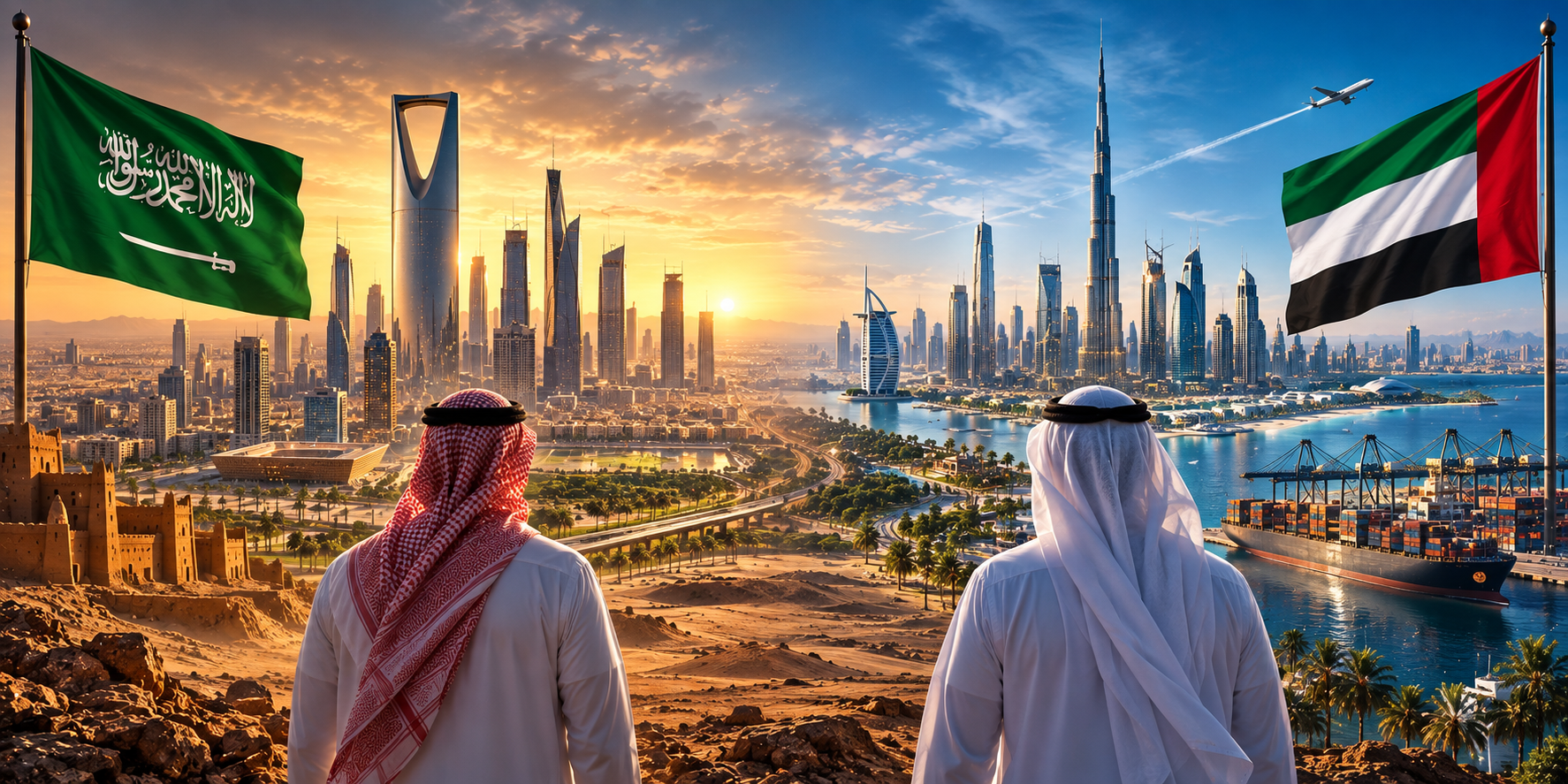
For decades, Dubai and Abu Dhabi built the Gulf’s most successful economic model while Saudi Arabia watched from the sidelines. Now Riyadh is no longer trying to join that model. It is trying to replace it.
For much of the past two decades, the economic hierarchy of the Gulf appeared relatively settled.
Dubai was the business hub. Abu Dhabi was the capital and energy powerhouse. Saudi Arabia was the region’s giant — rich, powerful and strategically important, but less internationally integrated.
That equation is changing.
Saudi Arabia’s Vision 2030 has transformed the Kingdom into a direct competitor for capital, companies, talent, tourism, logistics, finance, technology and global influence.
The UAE, meanwhile, is defending a model it spent decades building.
This is no longer simply competition between two neighboring economies.
It is becoming a contest over what the Middle East’s next economic center of gravity will look like.
And in 2026, the rivalry is becoming harder to hide.
Recent reporting indicates that Saudi authorities have subjected UAE-bound bank transfers to enhanced scrutiny, while disagreements over Yemen, Iran, oil policy and economic competition have widened the political gap between the two countries. At the same time, both governments continue to emphasize their deep economic ties. (Reuters)
The paradox is striking:
Saudi Arabia and the UAE need each other — while increasingly competing with each other.
From Partners to Competitors
The Saudi-UAE relationship was once one of the defining partnerships of the modern Gulf.
Riyadh and Abu Dhabi worked together on regional security, supported similar political forces during the Arab Spring, coordinated on Qatar and initially fought together in Yemen.
But the strategic environment has changed.
The UAE has built a highly globalized economic model around Dubai’s ports, aviation, finance, free zones, tourism and international business.
Saudi Arabia now wants many of those same functions — but at a dramatically larger scale.
The result is a structural collision.
The UAE wants to remain the Gulf’s global gateway.
Saudi Arabia wants to become the Gulf’s largest economic platform.
Those objectives can coexist.
But they increasingly overlap.
1. Riyadh vs. Dubai: The Battle for Global Companies
Perhaps nowhere is the competition clearer than in the race for multinational companies.
For years, Dubai was the default headquarters for international companies operating across the Middle East.
Its advantages were powerful:
- International connectivity
- English-speaking business environment
- Free zones
- Tax advantages
- Global banking infrastructure
- Large expatriate workforce
- Mature professional-services ecosystem
- Emirates airline
- Jebel Ali port
- A globally recognized business brand
Saudi Arabia is now attacking that advantage directly.
The Regional Headquarters program has attracted hundreds of multinational companies to Riyadh. Saudi government data showed more than 540 global companies had received regional-headquarters licenses by 2024, exceeding the original Vision 2030 target of 500. (Ministry of Finance)
The strategy is particularly powerful because Saudi Arabia has something Dubai cannot replicate:
the largest economy and government-spending market in the Arab world.
Saudi Arabia is effectively telling multinational companies:
If the biggest projects, government contracts and investment opportunities are in Saudi Arabia, your regional headquarters should be there too.
The Kingdom announced that from 2024, government entities would generally stop contracting with companies whose regional headquarters were outside Saudi Arabia. (Saudi Press Agency)
This changes the competitive equation.
Dubai offers companies access to the region.
Riyadh increasingly offers access to the region’s biggest individual market.
2. Saudi Arabia Has Scale. The UAE Has Ecosystems.
This is the fundamental difference between the two models.
Saudi Arabia has:
- More than 35 million people
- Vast energy resources
- Massive sovereign capital
- A huge domestic market
- Large government procurement
- Extensive infrastructure spending
- Significant industrial capacity
- A rapidly growing tourism market
The UAE has something different:
an extraordinarily mature ecosystem for international business.
Dubai’s success was built over decades by connecting ports, airports, free zones, finance, logistics, real estate and global talent.
Jebel Ali and its free zone became central to that model. Recent analysis highlights how deeply the port, free-trade zone and logistics infrastructure are embedded in Dubai’s economy. (Financial Times)
Saudi Arabia can build a bigger airport.
It can build a larger port.
It can construct a financial district.
It can create special economic zones.
But ecosystems are harder to reproduce.
This is why the competition will not be decided simply by who builds more infrastructure.
It will be decided by who creates the more productive network around that infrastructure.
3. The Battle for Capital
Money is perhaps the most important battlefield.
Both countries want to become the place where international investors allocate their Middle East capital.
The UAE has an enormous head start.
Dubai and Abu Dhabi have developed deep relationships with global banks, sovereign wealth funds, private-equity firms, asset managers, family offices and multinational corporations.
Saudi Arabia is using its own enormous financial power to close the gap.
The Public Investment Fund has become one of the world’s most influential sovereign investors, while Saudi Arabia’s domestic investment strategy is designed to attract more international capital into the Kingdom.
The objective is not merely to bring money into Saudi Arabia.
It is to make Riyadh a place where capital is created, managed and deployed.
That means competing with:
DIFC.
ADGM.
Dubai.
Abu Dhabi.
And increasingly, global financial centers outside the Gulf.
Saudi Arabia’s advantage is scale.
The UAE’s advantage is maturity.
4. Riyadh Wants to Become What Dubai Became
There is an uncomfortable reality behind the competition.
Saudi Arabia does not necessarily need to defeat Dubai.
It needs to capture enough of Dubai’s economic functions to fundamentally change the regional balance.
That means attracting:
- Regional headquarters
- Investment banks
- Consulting firms
- Technology companies
- Law firms
- Asset managers
- Private-equity funds
- International talent
- Entrepreneurs
- Luxury brands
- Global events
Every major company that chooses Riyadh instead of Dubai represents more than one office.
It brings executives.
Employees.
Suppliers.
Hotels.
Restaurants.
Housing demand.
Professional services.
Investment.
Tax revenue.
And, importantly, prestige.
That creates a network effect.
Once enough companies move, other companies follow.
This is precisely how Dubai built its advantage.
Saudi Arabia is now attempting to create the same gravitational pull.
5. Tourism Is Becoming a New Battlefield
Dubai has spent decades perfecting mass international tourism.
Saudi Arabia is starting much later — but with extraordinary capital.
The Kingdom has moved aggressively into:
AlUla.
Diriyah.
The Red Sea.
Qiddiya.
Riyadh.
Jeddah.
Sports, entertainment, concerts, luxury resorts and international events are becoming part of a deliberate tourism strategy.
Saudi Arabia recorded roughly 123 million domestic and inbound tourists in 2025 and has now raised its 2030 tourism ambition to 150 million visitors. (CSIS)
The objective is not to copy Dubai.
It is to create something different.
Dubai sells cosmopolitan urban tourism.
Saudi Arabia can combine:
- Religious tourism
- Cultural heritage
- Luxury tourism
- Desert experiences
- Sports
- Entertainment
- Business travel
- Coastal resorts
- Mega-events
This gives Saudi Arabia a potentially enormous tourism market.
But Dubai still possesses something that money cannot instantly buy:
brand recognition.
Millions of global travelers already know what a Dubai holiday looks like.
Saudi Arabia is still teaching the world what a Saudi holiday looks like.
6. Aviation: Emirates vs. Riyadh Air
Aviation illustrates the competitive dynamic perfectly.
Emirates helped turn Dubai into a global transit hub.
Its enormous network effectively connected the Middle East with Asia, Europe, Africa, Australia and the Americas.
Saudi Arabia is now building its own aviation ecosystem.
Riyadh Air is intended to become a major global carrier while Saudi airports are being expanded as part of the Kingdom’s broader logistics and tourism strategy.
This is not merely about airlines.
It is about controlling passenger flows.
If more travelers connect through Riyadh rather than Dubai, the effects extend into hotels, retail, business travel, conferences and investment.
The same logic applies to cargo.
Saudi Arabia wants its geography to become a competitive advantage connecting Asia, Europe and Africa.
7. The Ports Race
Another competition is taking place at sea.
Dubai’s Jebel Ali became one of the world’s most important logistics hubs.
Saudi Arabia has the geographic advantage of having coastlines on both the Red Sea and the Arabian Gulf.
The Kingdom is investing heavily in Jeddah Islamic Port, logistics zones, industrial cities and connections between its eastern and western coasts.
That creates a potentially powerful proposition:
Saudi Arabia can connect the Gulf with the Red Sea without relying entirely on the traditional Gulf-to-Hormuz trade route.
The strategic importance of this has become even clearer during the 2026 disruption to shipping through the Strait of Hormuz.
The IMF has highlighted Saudi Arabia’s diversified logistics infrastructure and the East-West pipeline’s role in helping the Kingdom maintain oil flows during the disruption. (IMF)
The UAE, meanwhile, is also developing alternatives around Fujairah and other routes as the vulnerability of Jebel Ali has become more apparent. (Financial Times)
The result is a new Gulf logistics competition.
8. Oil Is Now a Source of Competition — Not Just Cooperation
For years, Saudi Arabia and the UAE were two central players within OPEC+.
But their interests have increasingly diverged.
Saudi Arabia has traditionally prioritized market stability and collective production management.
The UAE has pushed for greater recognition of its expanding production capacity.
In 2026, the divergence became much more consequential after the UAE announced its departure from OPEC. Reuters reported that OPEC+ negotiations over future production baselines could become contentious as members seek quotas reflecting their capacity. (Reuters)
This is more than an oil dispute.
It reflects a broader reality:
The UAE increasingly wants greater strategic autonomy.
And Saudi Arabia increasingly expects to remain the Gulf’s leading power.
Those ambitions inevitably collide.
9. The New Competition Is About Economic Models
The deeper rivalry is not really about skyscrapers or ports.
It is about two different economic models.
The UAE model
Global openness + logistics + finance + trade + aviation + services
The UAE built an economy designed to attract the world.
The Saudi model
Scale + sovereign capital + domestic demand + industrialization + energy + technology
Saudi Arabia is building an economy designed to become powerful enough that the world has to come to it.
This distinction matters.
Dubai’s model works because Dubai is an intermediary.
Saudi Arabia’s model works if Saudi Arabia becomes a destination in its own right.
10. Technology Could Become the Next Major Battlefield
The competition is moving beyond traditional sectors.
Both countries increasingly want to become technology and AI hubs.
Saudi Arabia has enormous advantages:
- Cheap energy
- Land
- Capital
- Government support
- Large domestic market
- Growing digital infrastructure
The UAE has other advantages:
- International talent
- Mature technology ecosystem
- Global connectivity
- Existing AI institutions
- International financial networks
Both are investing heavily in artificial intelligence, cloud infrastructure and data centers.
The emerging competition could eventually become:
Who controls the Gulf’s computing infrastructure?
That matters because AI requires three things the Gulf possesses in abundance:
Energy.
Capital.
Land.
Saudi Arabia may have the advantage in scale.
The UAE may have the advantage in ecosystem maturity.
11. The Race for Talent
Capital follows talent.
Talent follows opportunity.
And opportunity follows companies.
This creates a feedback loop.
For decades, Dubai was exceptionally successful at attracting global professionals.
Riyadh is now trying to build a similar gravitational pull.
The difference is that Saudi Arabia is also trying to develop a much larger domestic workforce.
Vision 2030 has already dramatically increased female labor-force participation and expanded employment opportunities for Saudi citizens. CSIS notes that female labor-force participation has risen from around 20% to more than 34% since Vision 2030 began. (CSIS)
That could ultimately become one of Saudi Arabia’s greatest competitive advantages.
The UAE relies heavily on international talent.
Saudi Arabia wants to combine international talent with a much larger national talent base.
If it succeeds, the scale could be significant.
12. The Geopolitical Competition Is Getting More Complicated
The rivalry is not confined to economics.
Saudi Arabia and the UAE have increasingly pursued different foreign-policy priorities.
Yemen is perhaps the clearest example.
The two countries initially fought alongside each other against the Houthis.
But their preferred political outcomes inside Yemen increasingly diverged.
The UAE developed strong relationships with southern forces.
Saudi Arabia remained more focused on Yemen’s territorial integrity and its own border security.
Other differences have emerged over Iran, regional political movements, Israel and broader questions about how the Gulf should exercise influence.
A 2026 analysis by Israel’s Institute for National Security Studies describes the relationship as having shifted from close partnership toward open competition over leadership, prestige and regional influence. (InSS)
The important point is that the rivalry is becoming multidimensional.
Economic competition reinforces geopolitical competition.
And geopolitical competition reinforces economic competition.
13. But Neither Country Can Afford a Break
Despite the rivalry, a full Saudi-UAE economic rupture remains unlikely.
The economies are deeply intertwined.
The UAE remains an important commercial and investment partner for Saudi Arabia.
Saudi Arabia is also a major market for UAE companies.
Supply chains cross the border.
Banks, investors, families and businesses operate across both markets.
And both countries face the same major external challenges:
- Iran
- Regional conflict
- Global energy transition
- U.S.-China competition
- Oil-market volatility
- Shipping disruption
- Global economic uncertainty
Reuters reported in August that despite the growing tensions, analysts viewed a full economic rupture as unlikely because the commercial relationship is too deeply integrated and neither side would benefit from destroying it. (Reuters)
This is why the relationship is likely to resemble something increasingly familiar in global economics:
cooperate and compete simultaneously.
14. The Iran War Is Testing Both Models
The current regional crisis has exposed strengths and vulnerabilities on both sides.
Saudi Arabia’s huge geography, Red Sea access, East-West pipeline and domestic market provide resilience.
The UAE’s diversified global trade networks and financial system provide resilience.
But Dubai’s dependence on international aviation, tourism and Jebel Ali also creates vulnerabilities when regional shipping and air traffic are disrupted.
Recent reporting shows that the 2026 conflict has severely affected Gulf tourism, aviation, real estate and shipping, while Jebel Ali experienced extraordinary disruption. (The Wall Street Journal)
This could become an important turning point.
The Gulf’s next economic model will have to optimize not only for efficiency.
It will have to optimize for resilience.
15. The Real Question: Who Will Lead the Gulf Economy in 2035?
There may be no single winner.
Instead, the Gulf could develop a two-center economic system.
Dubai and Abu Dhabi
Could remain dominant in:
- International finance
- Global trade
- Aviation
- Free zones
- Private wealth
- International business
- Cross-border services
Riyadh and Saudi Arabia
Could become dominant in:
- Government spending
- Industrial investment
- Energy
- Mining
- Infrastructure
- Large-scale technology
- Domestic consumption
- Tourism
- Defense
- Regional corporate headquarters
That would create a powerful division of economic roles.
But there is another possibility.
Saudi Arabia could become sufficiently competitive that companies begin choosing between Riyadh and Dubai for functions that were previously concentrated almost entirely in the UAE.
If that happens, the Gulf’s economic geography changes permanently.
The Five Battlegrounds to Watch
The Saudi-UAE competition over the next decade will increasingly be decided in five areas.
1. Corporate Headquarters
Can Riyadh replace Dubai as the preferred regional headquarters for multinational companies?
2. Finance
Can Saudi Arabia build financial markets deep enough to challenge DIFC and ADGM?
3. Logistics
Can Saudi ports and land corridors challenge the UAE’s dominance in regional trade?
4. Technology
Can Riyadh combine Saudi capital and energy with world-class AI talent and technology?
5. Talent
Can Saudi Arabia attract enough international professionals while building a highly productive Saudi workforce?
The country that wins these five battles will possess enormous economic influence.
The Bigger Story: A Gulf Economic Renaissance
The Saudi-UAE rivalry could ultimately benefit the region.
Competition forces governments to improve.
Dubai’s success pushed Saudi Arabia to accelerate.
Saudi Arabia’s rise is now forcing the UAE to innovate again.
That means:
More infrastructure.
Better regulation.
More investment.
More technology.
More tourism.
More financial innovation.
More global connectivity.
In that sense, the competition may be less destructive than it appears.
The Gulf is entering an era in which Riyadh, Dubai and Abu Dhabi are competing not just with each other but with Singapore, London, Hong Kong, New York, Mumbai and other global hubs for capital and talent.
That is a much bigger race.
Conclusion
For decades, Dubai had something Saudi Arabia could not easily manufacture:
global relevance.
Now Saudi Arabia has something Dubai cannot easily manufacture:
scale.
The UAE built the Gulf’s most successful international business model.
Saudi Arabia is now using its enormous financial resources, domestic market and geopolitical weight to build a competing one.
The result is not necessarily a war between Riyadh and Abu Dhabi.
It is something more subtle — and potentially more consequential.
A race to determine who defines the Gulf economy of the next generation.
Dubai built the gateway.
Saudi Arabia is building the destination.
The next decade will determine whether the Gulf has room for both — or whether one becomes the region’s undisputed economic center.


