


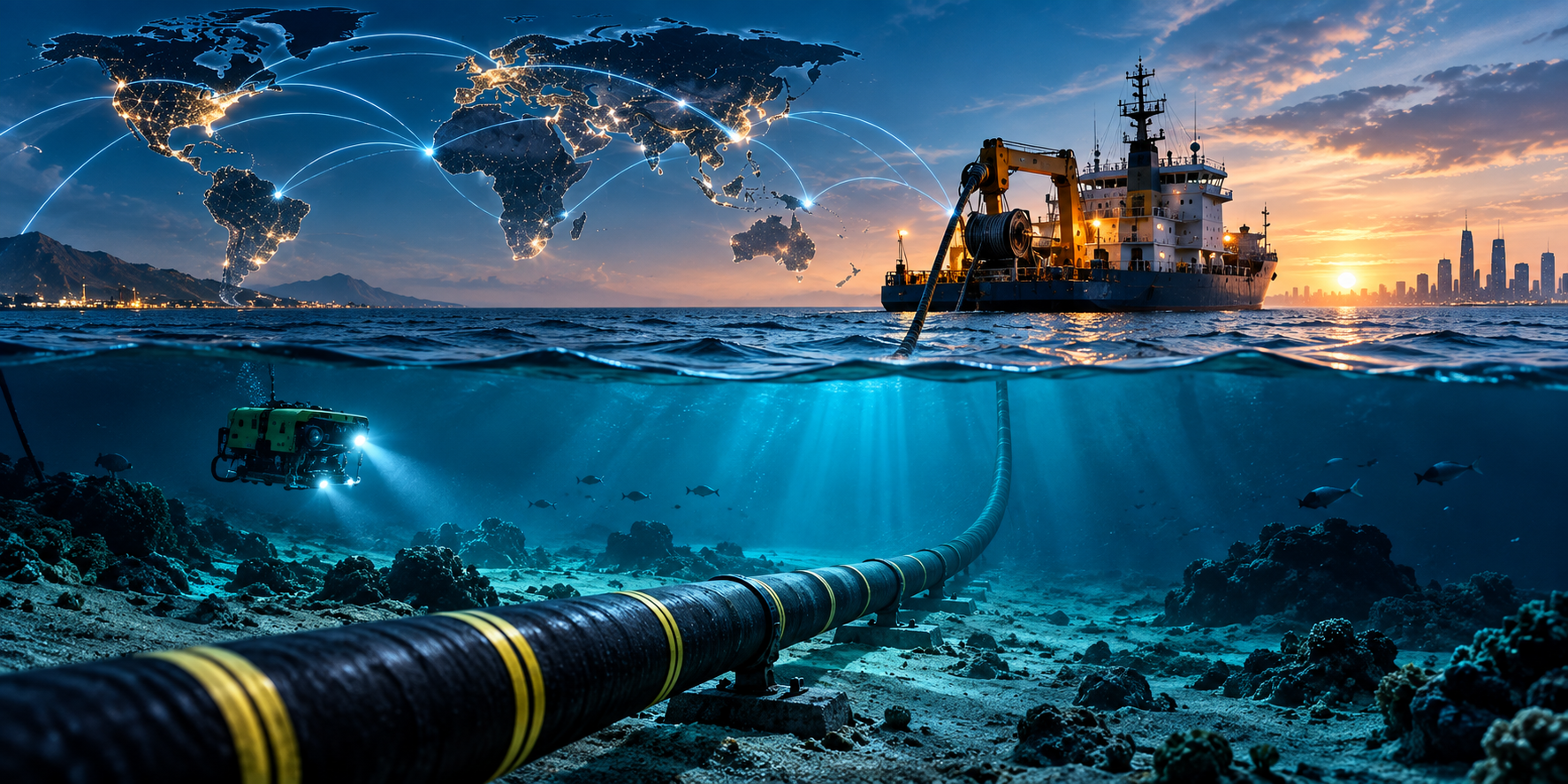
The world’s most important digital infrastructure is not in the cloud. It is sitting quietly on the ocean floor — and governments are beginning to treat it like strategic territory.
Every day, trillions of dollars move across borders.
A video call connects Mumbai to New York.
A bank in London communicates with a customer in Singapore.
A cloud application in India accesses servers in Europe.
An AI model processes data across continents.
A multinational company synchronizes its operations across dozens of countries.
We think of all of this as happening in “the cloud.”
It does not.
Much of it travels through a physical network of glass fibers lying beneath the world’s oceans.
Submarine communication cables carry more than 99% of international data traffic. The International Telecommunication Union says the global network includes more than 500 active and planned systems, while TeleGeography’s 2026 map tracks 694 systems and 1,893 landings that are active or under construction.
These cables connect continents, financial centers, data centers, military establishments, technology companies and entire national economies.
And increasingly, they are becoming part of the geopolitical competition between great powers.
The world’s digital infrastructure has become physical infrastructure.
And physical infrastructure has always been geopolitical.
The Internet Has an Ocean Floor
The internet feels weightless.
Messages appear instantly.
Cloud storage seems infinite.
AI systems feel almost entirely virtual.
But beneath that digital experience is an enormous physical network.
Thousands of kilometers of fiber-optic cable cross the Atlantic, Pacific, Indian Ocean, Mediterranean, Red Sea and other waterways.
The fibers carry information as pulses of light.
At landing stations, the cables connect into terrestrial networks that eventually reach data centers, telecom networks, cloud platforms, businesses and consumers.
The system is extraordinarily efficient.
It is also extraordinarily vulnerable.
The ITU estimates that submarine cables span more than 1.7 million kilometers globally. More than 200 faults are reported each year, with risks ranging from fishing and anchoring to natural hazards, aging infrastructure and deliberate interference.
The paradox is remarkable.
The infrastructure carrying the world’s most valuable information is largely invisible.
1. The Digital Economy Runs on Glass
The importance of submarine cables becomes clearer when we stop thinking about them as telecommunications infrastructure.
They are actually part of the infrastructure of the entire global economy.
Financial markets depend on them.
Cloud computing depends on them.
International trade depends on them.
Government communications depend on them.
Healthcare increasingly depends on them.
Manufacturing depends on them.
Airlines, logistics companies and digital platforms depend on them.
The ITU explicitly identifies financial transactions, cloud computing, government communications and other critical services among the functions enabled by submarine cables.
This means a cable failure is not simply an internet problem.
It can become an economic problem.
A sufficiently large disruption can affect latency, cloud access, communications and business operations across multiple countries.
That makes submarine cables comparable to other forms of strategic infrastructure such as pipelines, ports, electricity grids and shipping lanes.
The difference is that the cables are largely invisible.
2. The AI Revolution Is Making Cables Even More Important
The next phase of the internet may make submarine cables more strategically important than ever.
Artificial intelligence is creating an explosion in demand for computing power and data movement.
Large AI systems are increasingly distributed across:
- Data centers
- Cloud regions
- Semiconductor facilities
- Research institutions
- Enterprise systems
- Consumer applications
These systems are connected by high-capacity networks.
That means the AI economy needs not only chips and electricity.
It needs connectivity.
The ITU has noted that demand for submarine connectivity is being driven by heavy-data technologies including AI, the Internet of Things and expanding digital economies.
The relationship is becoming straightforward:
More AI → more data centers → more international data flows → more cable capacity.
This is why hyperscale technology companies are increasingly investing directly in submarine cables.
The traditional telecommunications model is changing.
Google, Microsoft, Meta and other major technology companies increasingly view subsea infrastructure as a strategic component of their cloud and AI networks.
The cable is becoming part of the computing platform.
3. The New Cable Race Is Already Underway
The world is entering a new submarine-cable construction cycle.
TeleGeography’s 2026 map identifies 694 cable systems and 1,893 landings that are active or under construction.
The expansion is being driven by several forces simultaneously:
Cloud computing.
AI.
5G and digital services.
Streaming.
Cross-border enterprise applications.
Growing internet adoption in emerging markets.
Geopolitical diversification.
This last factor is increasingly important.
For decades, cable routes were primarily optimized around cost and demand.
Now countries are asking another question:
What happens if the route becomes unavailable?
That changes the economics.
A slightly more expensive cable can become strategically valuable if it provides an alternative route around a vulnerable chokepoint.
4. Geography Matters More Than Most People Realize
A cable may cross an ocean, but it does not operate in isolation.
It has:
- A manufacturing origin
- A route
- Landing points
- Terrestrial connections
- Data-center connections
- Repair infrastructure
- Owners
- Operators
- Maintenance contracts
- Regulatory dependencies
That creates geographic chokepoints.
Egypt is a classic example.
A huge volume of Europe-Asia connectivity passes through routes associated with the Red Sea and Egypt.
TeleGeography’s 2025 map identified Egypt as a major hub with numerous cable systems and multiple landing stations and terrestrial crossings.
That gives Egypt something more valuable than a telecom business.
It gives the country digital geography.
The same principle applies elsewhere.
Singapore is strategically important because of its position between Asia’s major economies.
Marseille connects Europe to routes toward Africa and Asia.
The United States is connected to Europe and Asia through multiple transoceanic corridors.
India sits at the intersection of major Europe-Asia and Asia-Africa routes.
Geography determines where information flows.
And where information flows, economic power tends to follow.
5. The Red Sea Demonstrated the Risk
The vulnerability of these networks became impossible to ignore during disruptions in the Red Sea.
In September 2025, cuts to subsea cables in the Red Sea caused significant internet disruption across parts of Asia and the Middle East, including India, Pakistan and the UAE. Microsoft said users of Azure cloud services could experience increased latency as traffic was rerouted.
The incident was a reminder that one geographic corridor can affect countries thousands of kilometers away.
It also exposed an uncomfortable reality.
Digital globalization still depends on physical chokepoints.
The world may have spent decades trying to make information borderless.
But information still has to travel through particular places.
6. The Baltic Sea Turned Cables Into a Security Issue
The strategic debate became even more intense in Europe.
A series of incidents involving undersea infrastructure in the Baltic Sea pushed submarine cables into the center of European security discussions.
The European Union now explicitly describes submarine cables as critical infrastructure and has warned that some recent incidents appear consistent with deliberate hostile activity.
The EU’s response has been unusually comprehensive.
Its 2025 Cable Security Action Plan focuses on:
Prevention.
Detection.
Response and repair.
Deterrence.
In February 2026, the European Commission announced a €347 million allocation for strategic submarine-cable projects, including funding to improve repair capabilities.
The EU is also developing regional cable hubs using data aggregation and AI-based analysis to improve near-real-time detection of threats.
That is a significant change in thinking.
Europe is no longer treating cables as ordinary telecom assets.
It is treating them as critical national and collective security infrastructure.
7. Taiwan Is Showing What Cable Warfare Could Look Like
Taiwan provides another important example.
The island is highly dependent on submarine cables for international connectivity.
In 2025, Taiwan intensified monitoring of undersea cables amid concerns about possible Chinese “grey-zone” activity. Reuters reported that Taiwanese authorities increased patrols after incidents involving cable damage, including a case involving a Chinese-linked vessel.
The significance goes beyond Taiwan.
The Taiwan Strait and surrounding waters sit at the intersection of several critical economic systems:
- Global semiconductor supply chains
- Asian shipping
- International data networks
- Chinese military activity
- U.S. strategic interests
- Japan’s security
A major crisis in the Taiwan Strait would therefore not only threaten shipping and semiconductor production.
It could also threaten digital connectivity.
This is why undersea cables are increasingly being incorporated into strategic planning.
8. Cable Warfare Would Not Look Like Traditional Warfare
The most dangerous scenario is not necessarily a dramatic attack on dozens of cables.
It could be something much more ambiguous.
A vessel damages a cable.
An anchor drags across the seabed.
A repair ship is delayed.
A landing station experiences disruption.
A route becomes congested.
A second cable fails.
Then a third.
The problem is attribution.
Was it an accident?
Negligence?
Sabotage?
A state-directed operation?
A commercial dispute?
A cyberattack?
This ambiguity creates what military strategists increasingly call the grey zone.
The European Union has specifically warned that submarine infrastructure incidents can blur the boundary between civilian and military domains and make attribution difficult.
That makes undersea infrastructure particularly attractive in geopolitical competition.
An adversary may be able to impose economic costs without crossing the threshold of conventional war.
9. The Weakest Point May Not Be the Cable
A common misconception is that protecting submarine cables means protecting the cable itself.
But the cable is only one part of the system.
Consider the chain:
Cable → Landing Station → Terrestrial Network → Data Center → Cloud Platform → User
A cable could remain physically intact while a landing station or terrestrial connection becomes the bottleneck.
That makes cable landing stations strategically important.
TeleGeography’s 2025 research examined more than 1,500 cable landing stations and found that these facilities are critical connection points between subsea and terrestrial networks.
This is where geography becomes security.
A country with many cables but only a few concentrated landing points may have impressive connectivity on paper while still possessing significant vulnerability.
Redundancy therefore matters as much as capacity.
10. Redundancy Is the New Strategic Advantage
The question is no longer:
How many terabits can a country connect?
It is increasingly:
How many independent routes can it use if one fails?
This is a crucial distinction.
Imagine two countries.
Country A has one enormous cable with enormous capacity.
Country B has five smaller cables using different routes.
Country A may have more bandwidth.
Country B may have greater resilience.
The second model can be strategically superior.
This is why governments and companies are increasingly investing in:
- Multiple landing stations
- Diverse cable routes
- Terrestrial alternatives
- Satellite connectivity
- Regional interconnection
- Repair capacity
- Spare equipment
- Monitoring systems
The future of connectivity will therefore be defined by resilience, not just speed.
11. India Is Becoming a Major Cable Power
For India, the submarine cable story is particularly important.
India’s digital economy is expanding rapidly, while the country is also emerging as a major destination for data centers and AI infrastructure.
The government said in March 2026 that Indian data-center capacity had grown from 375 MW in 2020 to more than 1,500 MW by 2025. Four submarine cable systems were then being commissioned and three additional systems were under planning.
India’s connectivity architecture is also diversifying.
The 2Africa Pearls cable landed in India in 2025, adding more than 100 Tbps of international capacity and connecting India with Africa and Europe through the Middle East.
SEA-ME-WE-6 has also expanded India’s connectivity with Southeast Asia and Europe, with landings in Mumbai and Chennai and a designed capacity of 220 Tbps for India.
And in 2026, NEC announced the I-2SEA system linking India, Malaysia and Singapore, specifically connecting growing Indian AI and data-center hubs with Southeast Asia’s digital infrastructure.
This is not just a telecom story.
It is part of India’s emergence as a digital and AI infrastructure power.
12. Mumbai and Chennai Could Become Strategic Digital Gateways
India’s geography gives it a major opportunity.
Mumbai sits on the western side of the country, facing the Arabian Sea and routes toward the Middle East, Europe and Africa.
Chennai sits on the eastern coast, connecting India toward Southeast Asia and beyond.
That creates the possibility of a diversified east-west digital architecture.
The Indian government has identified submarine cable systems landing at Mumbai, Chennai and other coastal locations, while new systems are being developed to increase capacity and redundancy.
The strategic logic is straightforward:
More landing points + more routes + more data centers = greater digital resilience.
India could eventually become one of the world’s most important connectivity hubs between the Middle East, Europe, Africa and Asia.
13. The Cable Industry Is Becoming a National-Security Industry
Historically, submarine cables were largely the domain of telecommunications companies.
That is changing.
Governments are now becoming more involved.
Navies are paying attention.
Intelligence agencies are monitoring infrastructure.
Regulators are examining ownership.
Countries are assessing the nationality of cable manufacturers, operators and repair providers.
This creates a new strategic question:
Who owns the infrastructure through which a country communicates with the world?
Ownership matters because cables are long-lived infrastructure.
A cable can remain in service for decades.
Its landing stations can become part of a country’s critical communications architecture.
Its repair arrangements can determine how quickly connectivity can be restored.
And its ownership structure can become politically sensitive.
Digital infrastructure is therefore becoming part of economic sovereignty.
14. The Repair Ship May Become as Important as the Cable
One of the least discussed vulnerabilities is repair capacity.
When a cable breaks, someone has to find it.
Then a specialized vessel has to reach the location.
The damaged section must be recovered.
The cable must be repaired or replaced.
The system must be tested.
Only then can normal service resume.
The ITU’s 2026 resilience report specifically identifies increasing repair times as a major challenge, alongside geographic concentration and dependence on a small number of cable systems.
This creates another strategic bottleneck.
A country may own multiple cables but still face vulnerability if repair vessels, spare cable and specialized equipment are concentrated elsewhere.
That is why Europe is now investing in dedicated repair capacity.
The EU’s 2026 package includes funding for adaptable repair modules to be stationed at ports or shipyards so damaged cables can be restored more quickly.
The lesson is important:
Resilience means being able to recover, not simply being able to connect.
15. Satellites Are Not Going to Replace Submarine Cables
The rise of Starlink and other satellite networks has led some observers to ask whether satellites could make undersea cables obsolete.
Not at global scale.
Satellites are extraordinarily valuable for:
- Remote regions
- Disaster response
- Military communications
- Emergency connectivity
- Ships and aircraft
- Backup communications
But submarine fiber remains vastly more efficient for moving enormous quantities of data between continents.
The future is therefore unlikely to be:
Cables versus satellites.
It will be:
Cables + satellites + terrestrial networks.
The strongest countries will have multiple layers.
If one layer fails, another keeps essential systems operating.
That is the architecture of digital resilience.
16. The Next Cable Race Will Follow the AI Map
The geography of submarine cables has historically followed population and trade.
The next generation will increasingly follow:
AI and cloud geography.
Where are the largest data centers?
Where is electricity cheap?
Where are semiconductor clusters?
Where are major cloud regions?
Where is renewable energy abundant?
Where are the lowest-latency routes?
Where can companies obtain secure international connectivity?
These questions will increasingly determine where new cables are built.
That means countries may begin competing to become digital landing hubs.
A coastal city with:
- Multiple cables
- Reliable electricity
- Data centers
- Cloud regions
- Renewable energy
- Strong regulatory systems
- International connectivity
could become a major digital economic center.
The cable becomes the foundation.
The data center becomes the building.
The cloud becomes the service.
AI becomes the economic output.
17. The Global South Has the Most to Gain
The cable race is particularly important for developing economies.
Historically, international connectivity was concentrated around wealthy markets.
But new cable systems are increasingly connecting Africa, South Asia, Southeast Asia and the Middle East.
This can reduce latency, increase bandwidth and make local data centers more economically viable.
For Africa in particular, subsea connectivity can help expand:
- Cloud services
- Financial technology
- Digital payments
- E-commerce
- AI
- Outsourcing
- Education
- Healthcare
But connectivity alone is not enough.
Countries also need:
Reliable power.
Data centers.
Domestic fiber networks.
Affordable internet access.
Digital skills.
The cable is the highway.
The rest of the economy determines what travels on it.
18. China Is Building Digital Infrastructure as Geopolitical Infrastructure
China’s role in global digital infrastructure has become another major strategic issue.
Beijing has invested heavily in telecommunications networks, cloud computing, data centers and digital infrastructure.
At the same time, Western governments have become increasingly concerned about the strategic implications of Chinese technology and infrastructure ownership.
This does not mean every Chinese-linked cable is inherently a security threat.
But it does mean infrastructure is increasingly being evaluated through a geopolitical lens.
The broader competition resembles the infrastructure competition of earlier eras.
During the 20th century, countries competed over:
Oil pipelines.
Railways.
Ports.
Electricity grids.
In the 21st century, they are increasingly competing over:
Data routes.
19. The Ocean Floor Is Becoming a New Geopolitical Domain
For centuries, great-power competition focused on land.
Then it expanded into the sea.
Then air.
Then space.
Now another domain is receiving strategic attention:
the seabed.
The ocean floor contains cables, pipelines, energy infrastructure and other assets that are increasingly important to national economies.
Yet the seabed is difficult to monitor.
It is enormous.
It is dark.
It is difficult to patrol continuously.
And it crosses jurisdictions.
That creates a strategic environment in which ambiguity can be powerful.
A damaged cable may take hours or days to locate.
Determining what caused the damage can take much longer.
And proving responsibility may be even harder.
This makes the seabed one of the emerging frontiers of 21st-century security.
20. The New Measure of Digital Power
For years, countries measured digital power through:
- Number of internet users
- Smartphone penetration
- Cloud adoption
- 5G coverage
- Data-center capacity
- AI models
A new metric needs to be added:
Connectivity resilience.
How many international cables connect a country?
How geographically diverse are they?
Where do they land?
Who owns them?
How quickly can they be repaired?
Are there terrestrial alternatives?
Can satellites provide emergency connectivity?
Can data centers continue operating during a major disruption?
These questions will increasingly become part of national security planning.
The strongest digital economies will not simply be the ones with the fastest networks.
They will be the ones that are hardest to disconnect.
What Happens If the Cables Go Dark?
The most frightening scenario is not necessarily a global internet blackout.
The world has enough redundancy to make that unlikely.
The greater risk is localized or regional fragmentation.
A country loses several routes.
Latency rises.
Cloud services slow down.
Financial transactions become more difficult.
Businesses switch to backup systems.
Traffic is rerouted.
Repair vessels are mobilized.
Governments investigate.
Markets react.
If multiple cables fail simultaneously in a strategically important region, the economic impact could become significant.
And if the disruption occurs during a military crisis, the consequences could be much greater.
The digital economy has been designed around connectivity.
It has not always been designed around contested connectivity.
That is the next challenge.
The Cable Race Is Really a Race for Sovereignty
The deeper story is not about fiber optics.
It is about control.
Countries increasingly want to know:
Who connects us to the world?
Who owns the infrastructure?
Who can repair it?
Who can monitor it?
What happens if it fails?
These are sovereignty questions.
And as economies become more digital, connectivity becomes as strategically important as energy.
A country can survive without the newest smartphone.
It cannot easily function without communications.
Banks need networks.
Hospitals need networks.
Governments need networks.
Factories need networks.
Ports need networks.
AI systems need networks.
Modern economies are becoming dependent on digital connectivity in the same way industrial economies became dependent on electricity and oil.
That is why undersea cables are moving from the background of global infrastructure into the center of geopolitical strategy.
The Future: A More Resilient Digital Ocean
The response is already beginning.
Governments are investing in additional cable routes.
Companies are building new systems.
Countries are diversifying landing points.
The EU is developing regional cable-security hubs.
India is expanding its international connectivity.
The ITU is building international cooperation around resilience.
And technology companies are investing directly in infrastructure.
The objective is not to make cables invulnerable.
That is impossible.
The objective is to make the system redundant enough, monitored enough and repairable enough that individual failures do not become systemic crises.
That will require international cooperation.
No country can protect every kilometer of seabed.
No company can maintain every route.
No navy can patrol every cable.
The infrastructure is global.
Its protection will have to be global too.
Frequently Asked Questions
How much of global internet traffic travels through undersea cables?
More than 99% of international data traffic travels through submarine telecommunications cables, according to the ITU.
How many submarine cables exist?
The number depends on how cable systems are counted and whether planned systems are included. TeleGeography’s 2026 map identifies 694 active and planned systems and 1,893 landings.
Are submarine cables vulnerable?
Yes. Fishing, anchoring, natural hazards, aging infrastructure and deliberate interference can all damage cables. The ITU says 86% of cable faults are caused by human activities such as fishing and anchoring.
Could submarine cables be used in geopolitical conflict?
Yes. Their vulnerability and importance make them part of growing concerns about hybrid warfare and grey-zone activity. Recent incidents in the Baltic, Red Sea and waters around Taiwan have increased government attention.
Can satellites replace submarine cables?
Not at the scale required by the global digital economy. Satellites provide valuable redundancy and connectivity in remote or disrupted areas, but fiber-optic submarine cables remain the principal infrastructure for intercontinental data flows.
Why are submarine cables important for AI?
AI requires enormous amounts of computing power and data. As AI data centers and cloud regions become increasingly distributed across countries, high-capacity international connectivity becomes an essential part of the AI infrastructure stack.
Why is India important in the submarine-cable race?
India is expanding its cable infrastructure alongside rapid growth in data centers and digital services. New systems such as 2Africa Pearls, SEA-ME-WE-6 and I-2SEA are strengthening India’s connections to Europe, Africa and Southeast Asia.
Conclusion
The most important infrastructure of the digital age is largely invisible.
It lies hundreds or thousands of meters beneath the ocean.
It is made of glass.
And it carries the information that keeps the global economy functioning.
For years, submarine cables were treated as telecom infrastructure.
That era is ending.
They are now becoming economic infrastructure, national-security infrastructure and geopolitical infrastructure.
The countries that control energy once had enormous power.
The countries that control semiconductor technology have enormous power today.
Increasingly, the countries that control compute, connectivity and the routes between them will possess another form of strategic power.
The next great competition may not be over who builds the biggest data center.
It may be over who controls the networks that connect all of them.
The cloud may be virtual.
The power behind it is sitting on the ocean floor.


