


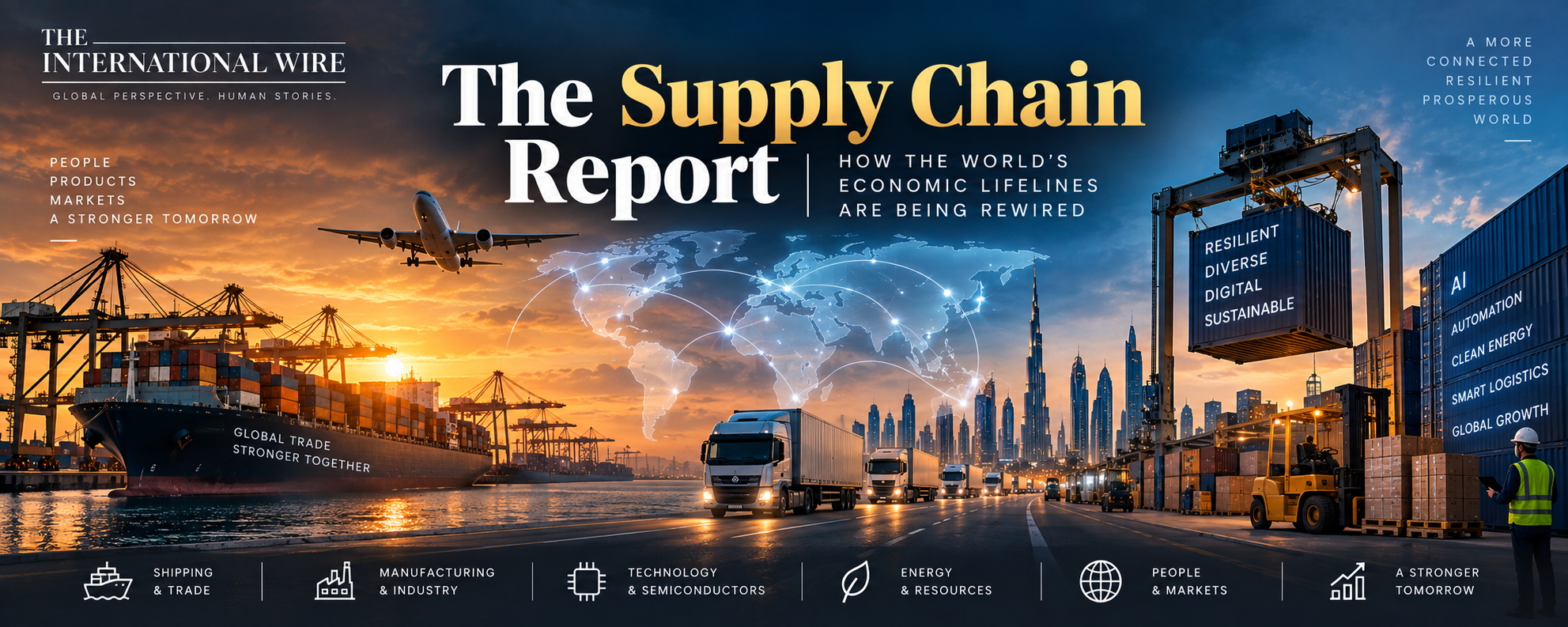
The global supply chain was once treated as an invisible machine. Goods were manufactured wherever costs were lowest, transported across oceans, assembled across multiple countries and delivered to consumers with remarkable efficiency. That model created decades of globalization. Today, it is being fundamentally rewired.
For much of the past three decades, the central question for companies was relatively simple:
How can we make this product cheaper and deliver it faster?
The answer produced the modern global supply chain.
Factories moved toward lower-cost manufacturing centers.
Ships became larger.
Ports became more automated.
Warehouses became increasingly sophisticated.
Companies reduced inventories.
Suppliers became specialized.
And production networks stretched across continents.
A smartphone could contain components from dozens of countries.
A car could cross several borders before reaching a customer.
A pharmaceutical ingredient could be manufactured on one continent, processed on another and packaged somewhere else.
The system was extraordinarily efficient.
It was also extraordinarily interconnected.
Then came a series of shocks.
The COVID-19 pandemic.
The Suez Canal disruption.
The Red Sea crisis.
The war in Ukraine.
Trade restrictions.
US-China strategic competition.
Tariff uncertainty.
Semiconductor shortages.
Extreme weather.
Energy disruptions.
And, in 2026, renewed instability around some of the world’s most important energy and shipping corridors.
The result is a fundamental change in the philosophy of global commerce.
The old question was:
How do we make supply chains more efficient?
The new question is:
How do we make supply chains survive disruption?
That distinction could define the global economy for the next decade.
The WTO’s 2026 trade assessment describes a world in which geopolitical tensions, digitalization, artificial intelligence, environmental pressures and increasingly complex trade policies are testing the global trading system.
Global merchandise trade is projected to slow in 2026 after exceptionally strong growth in 2025, with the WTO identifying AI-related products as an important source of recent trade expansion while warning that geopolitical and energy shocks could weaken the outlook.
The supply chain is therefore no longer simply a business function.
It is becoming an economic-security system.
The End of the “Just in Time” Era
For years, businesses optimized around one principle:
Just in time.
Keep inventories low.
Reduce warehouse costs.
Minimize working capital.
Depend on reliable suppliers.
Move goods quickly.
The model worked remarkably well when global transportation was predictable.
But a supply chain with very little inventory has one major weakness.
It has very little room for error.
If a factory closes, there is no buffer.
If a port becomes congested, there is no buffer.
If a shipping route is disrupted, there is no buffer.
If a semiconductor supplier stops production, there may be no alternative.
The pandemic exposed this vulnerability.
Companies discovered that the cheapest supply chain was not necessarily the most resilient supply chain.
The philosophy began shifting toward:
Just in time → just in case.
Companies began carrying more inventory.
Adding suppliers.
Building regional warehouses.
Diversifying manufacturing.
Signing alternative logistics agreements.
And mapping deeper layers of their supplier networks.
The result is a more expensive but potentially more resilient global economy.
1. Supply Chains Have Become Geopolitical
A supply chain used to be primarily an operational issue.
Today, it can be a geopolitical issue.
Consider a semiconductor.
Its design may originate in the United States.
Its fabrication may involve Taiwan or South Korea.
Equipment may come from the Netherlands and Japan.
Critical minerals may come from Africa, Australia or Latin America.
Assembly may occur elsewhere in Asia.
The final product may be sold worldwide.
One political decision can therefore affect an entire industrial ecosystem.
Export controls can restrict technology.
Tariffs can change sourcing economics.
Sanctions can eliminate suppliers.
Wars can close shipping routes.
Investment restrictions can prevent companies from building factories in certain countries.
This is why governments are increasingly asking questions that once belonged almost entirely to corporate procurement departments:
Where are our critical components made?
Who controls them?
What happens if that country becomes inaccessible?
How quickly can we replace the supplier?
Supply-chain strategy has become national strategy.
2. The World Is Moving From Globalization to “Selective Globalization”
The world is not necessarily deglobalizing.
Trade remains enormous.
Global production networks remain essential.
Companies continue to manufacture across borders.
But globalization is changing.
Instead of asking:
Where is the cheapest place to produce this?
companies are increasingly asking:
Where is the safest economically viable place to produce this?
That creates a new model.
Not complete localization.
Not complete globalization.
But:
Selective globalization.
Companies may maintain global suppliers for non-critical components while creating regional alternatives for strategic products.
This produces a more complicated map of global production.
3. China Remains Central — But Companies Are Diversifying
China remains one of the world’s most important manufacturing economies.
Its industrial ecosystem is difficult to replicate.
It has:
- Massive manufacturing capacity
- Deep supplier networks
- Skilled industrial labor
- Ports
- Infrastructure
- Machinery ecosystems
- Electronics clusters
- Chemical industries
- Logistics networks
That makes complete decoupling extremely difficult.
Instead, many companies are pursuing diversification.
The strategy is often described as:
China + 1.
Maintain Chinese production.
Add another manufacturing location.
Vietnam.
India.
Mexico.
Thailand.
Indonesia.
Malaysia.
Or elsewhere.
The objective is not necessarily to replace China.
It is to avoid depending entirely on one country.
4. India Is Becoming a Major Supply Chain Alternative
India is increasingly important in the reshaping of global manufacturing.
The country offers:
A huge domestic market + large workforce + growing infrastructure + expanding digital capabilities.
India has become increasingly important in electronics, pharmaceuticals, automobiles, engineering, chemicals and services.
Its role could grow further as companies diversify manufacturing across Asia.
But India faces challenges.
Infrastructure quality varies.
Logistics costs remain important.
Regulatory processes can be complex.
Supplier ecosystems are not equally deep across industries.
And manufacturing competitiveness depends heavily on execution.
The opportunity is nevertheless enormous.
India does not need to replace China’s entire manufacturing ecosystem.
It only needs to capture a larger share of the next wave of global production.
5. Southeast Asia Is Becoming a Manufacturing Powerhouse
Vietnam, Malaysia, Thailand and Indonesia are increasingly important to global supply chains.
Their appeal comes from a combination of:
- Competitive labor costs
- Proximity to Asian suppliers
- Growing industrial infrastructure
- Trade agreements
- Large domestic markets
- Geographic proximity to China
Southeast Asia is particularly important in electronics, semiconductors, automotive components, consumer goods and industrial production.
The region is therefore becoming one of the biggest beneficiaries of supply-chain diversification.
Recent analysis of global trade also points to Southeast Asia’s deepening manufacturing role as companies reconfigure production networks.
6. Mexico Has Become Strategically Important
Mexico has another major advantage:
Geography.
Its proximity to the United States makes it particularly attractive for North American manufacturing.
Automobiles.
Electronics.
Machinery.
Medical devices.
Industrial equipment.
Consumer goods.
The rise of nearshoring has therefore transformed Mexico’s strategic importance.
A factory in Mexico can potentially serve the US market with shorter transport distances and reduced exposure to trans-Pacific shipping.
This is the supply-chain equivalent of moving production closer to the customer.
7. The New Supply Chain Has Three Geographies
The future may increasingly be organized around three interconnected geographic models.
Global
Production remains international for cost and specialization advantages.
Regional
Companies build production ecosystems closer to major markets.
Local
Critical industries maintain domestic capacity for strategic resilience.
This creates a hybrid system.
A company might source globally.
Manufacture regionally.
And maintain emergency domestic capacity.
That is more expensive.
But it is also more resilient.
8. Shipping Is Still the Backbone of Global Trade
Despite the rise of air freight, rail and road networks, maritime shipping remains fundamental to global commerce.
UN Trade and Development estimates that shipping carries more than 80% of world trade.
That means a disruption at sea can become a global economic problem.
The Red Sea crisis demonstrated this.
When ships avoid the Suez Canal and travel around the Cape of Good Hope, journeys become longer.
Ships spend more time at sea.
Fuel consumption increases.
Capacity becomes less efficient.
Schedules become less predictable.
Insurance costs can rise.
And freight rates can increase.
UNCTAD reported that Red Sea rerouting significantly increased voyage distances and global shipping ton-miles, while container freight rates surged during 2024.
The lesson is simple:
Geography still matters.
9. The Suez Canal Is More Than a Canal
The Suez Canal is often viewed as a shipping shortcut.
It is much more than that.
It is an economic artery connecting:
Asia → Europe.
Its disruption affects:
- Container shipping
- Energy
- Food
- Automobiles
- Consumer products
- Industrial equipment
- Raw materials
When ships avoid the route, the economic impact spreads far beyond shipping companies.
Manufacturers wait longer.
Retailers receive inventory later.
Working capital increases.
Consumers may pay more.
And companies need larger safety stocks.
A maritime disruption therefore becomes a supply-chain disruption.
10. The Strait of Hormuz Represents a Different Kind of Risk
The Strait of Hormuz is particularly important because of its role in global energy trade.
It connects the Persian Gulf with the Gulf of Oman and is a major route for oil, LNG and other trade flows.
The WTO describes it as one of the world’s critical maritime chokepoints and notes that disruption can have consequences for global energy, food and fertilizer trade.
The 2026 disruption has reinforced a broader lesson:
A supply chain is only as resilient as its critical chokepoints.
Companies can have ten suppliers.
But if all ten depend on the same shipping route, diversification may be largely illusory.
11. The Hidden Supply Chain Is Often More Important Than the Visible One
A company may know its direct supplier.
But what about the supplier’s supplier?
And the supplier behind them?
Modern supply chains often contain multiple layers.
A car manufacturer may have thousands of suppliers.
A semiconductor company may depend on specialized chemicals, machinery and components.
A pharmaceutical company may depend on active ingredients produced by a handful of global manufacturers.
This creates a major challenge:
Supply-chain visibility.
Companies increasingly need to map not only their first-tier suppliers but also critical second- and third-tier dependencies.
The question is no longer:
Who supplies us?
It is:
What does our entire ecosystem depend upon?
12. Semiconductors Have Become the New Strategic Commodity
Oil once represented the foundation of modern industrial power.
Today, semiconductors occupy a comparable strategic position in many industries.
They power:
- Smartphones
- Cars
- Servers
- AI systems
- Aircraft
- Medical equipment
- Industrial machinery
- Defense systems
- Telecommunications
The semiconductor supply chain is highly concentrated.
Advanced manufacturing capabilities are distributed across a small number of locations.
This creates strategic vulnerability.
Governments are therefore investing heavily in domestic and allied semiconductor capabilities.
The objective is not merely economic.
It is technological security.
13. AI Is Creating a New Supply Chain
Artificial intelligence itself is generating an entirely new supply chain.
AI requires:
Chips.
Data centers.
Electricity.
Cooling systems.
Fiber networks.
Servers.
Memory.
Advanced packaging.
Cloud infrastructure.
Data.
This is why AI is no longer simply a software story.
It is an industrial story.
The WTO reported that trade in AI-enabling goods increased 21.9% year-on-year in 2025 to $4.18 trillion, and that such products accounted for 42% of total global trade growth that year.
AI is therefore becoming a significant driver of physical trade.
The future of artificial intelligence depends partly on the physical movement of materials, components and energy.
14. Data Centers Are Becoming Industrial Infrastructure
The traditional supply chain moved physical products.
The AI economy increasingly moves something else:
Computing capacity.
Data centers are becoming strategic infrastructure.
They require:
- Electricity
- Land
- Water or cooling systems
- Fiber connectivity
- Chips
- Servers
- Construction materials
- Backup power
- Grid infrastructure
This creates a new competition.
Countries are not only competing for factories.
They are competing for compute.
The locations that can provide reliable energy, connectivity, capital and regulatory certainty may attract enormous AI infrastructure investment.
15. Energy Is Back at the Center of Supply Chains
The energy transition was expected to reduce the importance of fossil fuels in global economics.
Instead, the transition has created new dependencies.
Lithium.
Copper.
Nickel.
Cobalt.
Graphite.
Rare earth elements.
These materials are critical to batteries, electric vehicles, electronics, renewable-energy systems and advanced technologies.
The result is a new resource competition.
The world is not eliminating resource dependency.
It is changing which resources matter.
16. Critical Minerals Could Become the New Oil Politics
Oil once shaped geopolitics because industrial economies depended on a relatively concentrated resource.
Critical minerals could create a similar dynamic.
The difference is that the supply chains are more complex.
Mining may occur in one country.
Processing in another.
Manufacturing in another.
Final assembly somewhere else.
This means the strategic question is not simply:
Who has the mineral?
It is:
Who controls the entire processing and manufacturing chain?
That distinction will become increasingly important.
17. Food Supply Chains Are Becoming Strategic
Food is another supply chain where geography matters enormously.
Grain.
Fertilizer.
Cooking oil.
Sugar.
Meat.
Dairy.
Rice.
Food systems depend on:
- Climate
- Water
- Energy
- Fertilizer
- Shipping
- Storage
- Transport
- Political stability
A disruption in one part of the chain can affect food prices thousands of kilometers away.
For import-dependent countries, supply-chain resilience is therefore a national-security issue.
This is particularly important across the Gulf, North Africa and parts of Asia.
18. The Gulf Is Becoming a Supply Chain Power
The Gulf’s geographic position gives it a unique role.
It sits between:
Asia.
Europe.
Africa.
Its ports, airports, free zones and logistics infrastructure have already made the region a major trade hub.
Saudi Arabia, the UAE, Oman and Qatar are investing heavily in logistics and connectivity.
The strategic objective is becoming broader:
Energy hub → logistics hub → trade hub → investment hub → digital hub.
The Gulf could become one of the world’s most important intersections between physical and digital supply chains.
19. Dubai’s Advantage Is Connectivity
Dubai’s economic model provides an important example.
Its strength is not primarily natural resources.
It is connectivity.
Airports.
Ports.
Warehouses.
Free zones.
Financial services.
Technology.
Trade.
Hospitality.
Business services.
Dubai has effectively turned geography into an economic asset.
The next phase could involve combining physical connectivity with digital supply-chain platforms.
That means companies may increasingly manage regional procurement, inventory, logistics and distribution from Gulf-based hubs.
20. Saudi Arabia Wants to Become a Logistics Superpower
Saudi Arabia’s geography is equally significant.
The country connects the Red Sea with the Gulf and sits between major Asian, African and European markets.
Its logistics ambitions are therefore closely connected to its broader economic diversification strategy.
Ports.
Rail.
Roads.
Air cargo.
Warehousing.
Industrial zones.
Digital logistics.
The objective is not simply to move Saudi products.
It is to move other countries’ products through Saudi Arabia.
That is a much larger economic opportunity.
21. The New Supply Chain Will Be Digital
Physical infrastructure is only one half of the future supply chain.
The other half is information.
Companies increasingly need real-time visibility into:
- Inventory
- Shipments
- Suppliers
- Demand
- Weather
- Port congestion
- Commodity prices
- Geopolitical risk
- Production capacity
This creates enormous opportunities for digital supply-chain platforms.
The World Bank’s 2025 Logistics Performance Indicators 2.0 increasingly measure logistics using shipment-level operational data rather than traditional perception surveys, highlighting the growing importance of actual connectivity, speed and reliability.
The future supply chain will therefore be increasingly data-driven.
22. AI Could Transform Procurement
Procurement has traditionally depended heavily on human judgment.
Negotiating with suppliers.
Comparing prices.
Monitoring contracts.
Managing purchase orders.
Forecasting demand.
AI can potentially automate much of this.
An AI system could analyze:
Supplier performance + pricing + geopolitical risk + inventory + demand forecasts + shipping conditions.
It could then identify vulnerabilities before they become crises.
This changes procurement from a transactional function into a strategic intelligence function.
23. Predictive Supply Chains Could Become the New Standard
The traditional supply chain reacts.
A shipment is delayed.
The company discovers the problem.
Then it searches for an alternative.
The predictive supply chain works differently.
It identifies risk before disruption.
For example:
A storm threatens a major port.
An AI system identifies the affected suppliers.
It calculates inventory exposure.
It models alternative routes.
It estimates financial impact.
It recommends another supplier.
The procurement team acts before the disruption becomes a crisis.
That is the future of supply-chain management.
24. Warehouses Are Becoming Technology Centers
The warehouse of the future will look very different from the warehouse of the past.
Robotics.
Computer vision.
Automated picking.
Autonomous vehicles.
AI forecasting.
Real-time inventory.
Digital twins.
Automated packaging.
Predictive maintenance.
The objective is not simply to store products.
It is to turn inventory into an intelligent system.
A modern warehouse increasingly knows:
What is here?
Where is it?
How quickly will it move?
Where should it go next?
25. The Last Mile Remains the Hardest Mile
Global supply chains have become extraordinarily sophisticated.
But the final stage remains difficult.
The last mile.
Getting a product from the distribution center to the consumer.
Urban congestion.
Fuel costs.
Driver shortages.
Customer expectations.
Returns.
Delivery windows.
Security.
The growth of e-commerce has made this even more important.
Consumers increasingly expect:
Fast.
Cheap.
Trackable.
Flexible.
The final kilometer can therefore determine the economics of the entire supply chain.
26. Climate Change Is Rewriting Supply Chains
Supply chains were traditionally designed around historical weather patterns.
That assumption is becoming less reliable.
Floods can close factories.
Heat can reduce worker productivity.
Drought can reduce agricultural output.
Storms can close ports.
Wildfires can disrupt transportation.
Water shortages can affect industrial production.
Companies therefore increasingly need to ask:
Where will climate risk affect our suppliers?
The World Bank’s logistics research highlights that connectivity and reliability can be weakened by infrastructure and border bottlenecks, while broader climate pressures add another layer of vulnerability.
Climate resilience is becoming supply-chain resilience.
27. Insurance Is Becoming a Supply Chain Variable
When risk increases, insurance costs can increase.
That affects shipping.
Warehousing.
Manufacturing.
Energy.
Agriculture.
Infrastructure.
In extreme cases, some routes or facilities can become economically difficult to insure.
This creates a new business calculation.
A location may be cheap to manufacture in.
But if transportation, insurance and disruption costs are high, the total economic advantage may disappear.
Companies are therefore moving from:
Lowest production cost
toward:
Lowest total risk-adjusted cost.
28. Inventory Is Becoming Strategic Capital
For decades, inventory was treated as an inefficiency.
Too much inventory meant capital was trapped.
That logic is changing.
Inventory can also be insurance.
A company holding extra semiconductor inventory may survive a disruption.
A retailer with additional stock may avoid empty shelves.
A manufacturer with alternative raw materials may keep production running.
The challenge is finding the balance.
Too little inventory creates vulnerability.
Too much inventory destroys capital efficiency.
The future belongs to companies that can optimize that trade-off dynamically.
29. Supply Chain Resilience Has a Price
There is no free resilience.
More suppliers cost more.
More inventory costs more.
More warehouses cost more.
Regional manufacturing can cost more.
Domestic production can cost more.
Redundant logistics routes cost more.
The result may be a world in which some products become structurally more expensive.
This is an important economic consequence.
The globalization era optimized for low prices.
The resilience era may optimize for continuity.
Consumers may ultimately pay part of that premium.
30. The World May Be Entering an Era of “Redundant Globalization”
The next supply chain may contain deliberate redundancy.
Two suppliers instead of one.
Three shipping routes instead of one.
Factories in multiple countries.
Regional distribution centers.
Backup data centers.
Alternative energy sources.
Strategic inventories.
The system will contain more duplication.
From an efficiency perspective, that may look wasteful.
From a resilience perspective, it may be essential.
31. The Most Valuable Companies May Be the Ones That Connect the Supply Chain
The future supply chain will create enormous opportunities for companies that can connect fragmented systems.
Procurement.
Logistics.
Inventory.
Payments.
Warehousing.
Forecasting.
Risk management.
Compliance.
Data.
AI.
The most powerful platforms may eventually become the operating systems of global commerce.
They will not necessarily own factories.
They may own the information layer connecting factories, suppliers, logistics companies and customers.
32. Cybersecurity Is Now Supply Chain Security
A modern supply chain can be disrupted without a physical attack.
A cyberattack can shut down:
- Ports
- Factories
- Warehouses
- Banks
- Logistics platforms
- Customs systems
- Rail networks
- Energy infrastructure
This creates a new concept:
Cyber supply-chain risk.
A company may have secure internal systems but remain vulnerable through a third-party supplier.
Supply-chain cybersecurity will therefore become increasingly important.
33. The Human Factor Has Not Disappeared
Technology may automate large parts of supply-chain management.
But people remain critical.
Engineers.
Drivers.
Warehouse workers.
Port operators.
Procurement managers.
Customs officials.
Shipping professionals.
Data scientists.
AI engineers.
Risk managers.
The supply chain of the future will therefore be neither completely human nor completely automated.
It will be:
Human decision-making augmented by machines.
34. Supply Chain Jobs Are Changing
The industry once focused heavily on logistics execution.
The future will demand more analytical capabilities.
Demand forecasting.
Data science.
AI.
Risk modeling.
Digital procurement.
Cybersecurity.
Automation.
Sustainability.
Strategic sourcing.
This means supply-chain professionals will increasingly need both operational and technological skills.
The supply-chain manager of 2035 may look more like a data strategist than a traditional logistics manager.
35. Governments Are Becoming Supply Chain Managers
Governments increasingly intervene when supply chains become strategically important.
They provide subsidies.
Build infrastructure.
Create industrial policies.
Support domestic manufacturing.
Stockpile critical goods.
Restrict exports.
Control strategic technologies.
Negotiate trade agreements.
This creates a major shift.
Supply chains were once optimized primarily by companies.
Now they are increasingly co-designed by:
Companies + governments + geopolitical alliances.
36. Friend-Shoring Is Creating New Trade Blocs
Another emerging concept is friend-shoring.
Instead of sourcing entirely based on cost, countries and companies may prioritize politically aligned partners.
This is particularly visible in strategic sectors such as:
- Semiconductors
- Batteries
- Critical minerals
- Defense
- Telecommunications
- AI infrastructure
- Energy
The result could be a world where supply chains increasingly follow political relationships.
That creates both resilience and fragmentation.
37. The World Could Become More Regional
Three major manufacturing regions could become increasingly important.
North America
United States, Mexico and Canada.
Europe
European Union and neighboring industrial economies.
Asia
China, India, Japan, South Korea and Southeast Asia.
These regions will remain connected.
But each may increasingly seek greater internal resilience.
That could create a world of:
Regional supply chains connected by global trade.
38. Africa Could Become the Next Supply Chain Frontier
Africa possesses enormous potential.
Natural resources.
Young populations.
Growing cities.
Large consumer markets.
Agricultural capacity.
Renewable-energy potential.
Strategic geography.
But infrastructure remains uneven.
Ports.
Rail.
Roads.
Power.
Warehousing.
Digital connectivity.
If these constraints improve, Africa could capture a greater share of global manufacturing and processing.
The Gulf’s proximity and capital could make it an important partner in that transformation.
39. Latin America Is Gaining Strategic Importance
Latin America also possesses major supply-chain advantages.
Critical minerals.
Agriculture.
Energy.
Proximity to North America.
Growing manufacturing capabilities.
Mexico is already central to North American supply-chain restructuring.
Brazil has major roles in food, commodities and industrial production.
Chile and Peru are strategically important in minerals.
The region could therefore become increasingly important as companies seek geographically diversified sources of raw materials and manufacturing.
40. The New Supply Chain Is Also a Financial System
Every supply chain involves money.
Supplier financing.
Trade finance.
Letters of credit.
Insurance.
Working capital.
Currency exposure.
Payment systems.
A disruption can therefore become a financial shock.
A shipment delay means inventory is trapped.
A factory closure means revenue disappears.
A supplier failure can trigger cascading payment problems.
Fintech and supply-chain finance may therefore become increasingly important.
41. Trade Data Could Become as Valuable as Trade Goods
Every shipment generates data.
Where it came from.
Where it is going.
How long it took.
What it cost.
Who handled it.
What delays occurred.
What route it followed.
That data can reveal patterns.
It can improve forecasting.
Reduce fraud.
Optimize routes.
Predict congestion.
Improve inventory.
And identify systemic risk.
In the future, the most valuable supply-chain asset may not always be physical infrastructure.
It may be trusted data about physical infrastructure.
42. The New Supply Chain Will Need Digital Twins
A digital twin creates a virtual representation of a physical system.
Imagine a company having a digital model of its entire supply chain.
It could simulate:
What happens if this port closes?
What happens if oil prices rise 30%?
What happens if this supplier fails?
What happens if demand doubles?
What happens if a tariff changes?
What happens if a major shipping route becomes unavailable?
Companies could test thousands of scenarios before making decisions.
This could transform supply-chain risk management.
43. Resilience Will Become a Board-Level Issue
Supply chain management used to sit largely within operations.
That is changing.
Supply-chain disruption can affect:
Revenue.
Margins.
Customer satisfaction.
Share prices.
Brand reputation.
Working capital.
Compliance.
National-security exposure.
Boards are therefore increasingly forced to treat supply-chain resilience as a strategic issue.
The question is no longer:
Who manages procurement?
It is:
Who is responsible when the supply chain fails?
44. The Supply Chain of the Future Will Be More Expensive — But Smarter
The world is unlikely to return to the hyper-efficient supply chains of the early globalization era.
The future will probably contain:
More inventory.
More suppliers.
More regional production.
More automation.
More AI.
More data.
More government involvement.
More strategic stockpiles.
More redundancy.
More monitoring.
This will increase complexity.
But it could also make the system more resilient.
45. The New Supply Chain Equation
The old equation was:
Cost + Speed = Competitive Advantage
The new equation is closer to:
Cost + Speed + Resilience + Visibility + Geopolitical Risk = Competitive Advantage
And increasingly:
AI + Data + Automation = Supply Chain Intelligence
That is the fundamental transformation.
46. What Companies Need to Do Now
Companies entering the next decade should increasingly focus on several priorities.
Map the Entire Supply Chain
Know first-, second- and third-tier dependencies.
Identify Critical Components
Not everything requires redundancy.
Critical inputs do.
Build Alternative Suppliers
Especially for strategically important components.
Regionalize Where Necessary
Move selected production closer to key markets.
Invest in Visibility
Real-time supply-chain data is becoming essential.
Use AI
Forecast demand, identify risk and optimize inventory.
Protect Digital Infrastructure
Cybersecurity is now supply-chain security.
Stress-Test the Network
Model wars, tariffs, disasters, port closures and supplier failures.
Treat Inventory Strategically
Balance working-capital efficiency against resilience.
47. What Governments Need to Do
Governments also have a role.
Invest in:
- Ports
- Railways
- Roads
- Airports
- Digital infrastructure
- Power grids
- Customs systems
- Industrial zones
Governments also need to improve:
- Trade facilitation
- Cross-border coordination
- Data standards
- Emergency planning
- Strategic stockpiles
- Critical-mineral policies
The World Bank’s LPI 2.0 emphasizes that supply-chain performance depends on the combined quality of infrastructure, trade facilitation and logistics services, with major reliability gaps still concentrated around ports, borders and inland checkpoints.
Supply-chain resilience therefore cannot be created by companies alone.
48. The Supply Chain Is Becoming an Economic Weapon
This is perhaps the most uncomfortable development.
Countries increasingly understand that controlling a critical supply chain can create strategic leverage.
Control the technology.
Control the mineral.
Control the shipping route.
Control the processing capacity.
Control the manufacturing equipment.
Control the market.
And you may possess influence far beyond the economic value of the product itself.
Supply chains are therefore becoming instruments of geopolitical power.
49. The Next Crisis May Begin Somewhere Nobody Is Watching
The biggest supply-chain vulnerabilities are not always obvious.
A tiny component.
A specialized chemical.
A rare industrial machine.
A particular port.
A single processing facility.
A specialized software system.
A small group of suppliers.
The global economy is full of invisible dependencies.
A disruption in a seemingly insignificant component can stop an enormous production system.
That is why supply-chain mapping is becoming so important.
50. The Future Will Belong to Resilient Networks
The most successful companies will not necessarily have the cheapest supply chains.
They may have the most adaptable ones.
They will know where their vulnerabilities are.
They will have alternatives.
They will use AI to anticipate problems.
They will maintain strategic inventory.
They will diversify geography.
They will build supplier relationships.
They will integrate logistics and technology.
They will continuously simulate possible disruptions.
In other words:
The competitive advantage will move from efficiency alone to adaptability.
The New Geography of Global Trade
The global supply chain of the 21st century will not disappear.
It will evolve.
China will remain important.
India will become more important.
Southeast Asia will continue expanding.
Mexico will gain strategic importance.
The Gulf will strengthen its logistics role.
Africa will become increasingly important to resources, manufacturing and consumption.
Europe will continue building strategic resilience.
The United States will seek greater domestic and allied capacity.
Latin America will become increasingly important in food, energy and minerals.
The world will remain connected.
But the connections will become more deliberate.
The Supply Chain Is the New Map of Power
For centuries, geopolitical power was measured through territory.
Then it was measured through armies.
Then through industrial capacity.
Then through energy.
Today, another form of power is emerging.
Control of networks.
Who produces the chips?
Who controls the minerals?
Who owns the shipping capacity?
Who operates the ports?
Who controls the data?
Who produces the AI infrastructure?
Who has access to energy?
Who controls the logistics corridors?
Who can switch suppliers fastest?
These questions increasingly determine economic power.
Conclusion
The global supply chain was built around a simple promise:
Anything could be produced anywhere, and delivered almost anywhere, at the lowest possible cost.
That promise transformed the world.
It lifted manufacturing.
Expanded trade.
Lowered consumer prices.
Connected economies.
Created enormous global interdependence.
But the system also created vulnerabilities.
A pandemic could shut factories.
A canal could become blocked.
A conflict could close a shipping corridor.
A semiconductor shortage could halt automobile production.
A cyberattack could disable a port.
A drought could disrupt food supplies.
A geopolitical dispute could cut off critical technology.
The lesson of the past several years is therefore profound.
Efficiency alone is no longer enough.
The future supply chain must be resilient.
It must be visible.
It must be digital.
It must be diversified.
It must be intelligent.
And increasingly, it must be geopolitical.
The world is not moving from globalization to isolation.
It is moving toward a new form of globalization — one in which companies, countries and regions think much more carefully about where things come from, how they move and what happens when the system breaks.
The supply chain is no longer the invisible machinery behind the global economy.
It is becoming the architecture of the global economy itself.
And in the next decade, the countries and companies that understand that architecture — and can adapt it faster than everyone else — may shape the next era of global trade.
The future of economic power may not belong to whoever produces the most.
It may belong to whoever can keep producing when the world is disrupted.


